Skip to content

Are there good hackers?

Hello and welcome back to our “Mystery Jet Ski.” Much better than those programs about supernatural stuff and alien suppositions. Today we will continue with our exhaustive investigation on the hacker world, and we will delve a little more into the concept of “ethical hacker.” Is it true that there are good hackers? Who are the so-called “White hats”? Who will win this year’s Super Bowl?

Do you already know who the so-called “White Hats” are?

In this blog we never stop saying it: “No one is free from EVIL, because EVIL never rests”, and if in previous articles we saw that a bad hacker, broadly speaking, is a person who knows a lot about computers and uses their knowledge to detect security flaws in company or organization systems and take control of them, today we will see who is the archenemy of the bad hacker or cracker, the superhero of security, networks and programming… “The White Hat Hacker.”

White Hats are “evangelized” hackers who believe in good practice and good ethics, and who use their hacking superpowers to find security vulnerabilities and help correct or shield them, whether in networks, software, or hardware. “Black Hats” would be the rogue hackers we all know for their evilness, and the “White Hats” would be their honest and do-gooder counterpart. Both hack systems, but White Hat hackers do it with the goal of favoring/helping the organization they are working for.

White Hats, ethical hackers

If you thought that piracy and honesty were antonyms, you should know that, within IT, they are not necessarily so. As we pointed out, White Hats do their thing but in an ethical and supervised way, all with the aim of improving cybersecurity, not damaging it. And, dear friend, there is lots of demand for this. White Hats are not short of work, they are in high demand as security researchers and freelancers. They are the candy of organizations to strengthen their cybersecurity. Companies, in fact, take white hat hackers and make them try to hack their systems over and over again. They find and expose vulnerabilities so that the company is prepared for future attacks. They show the ease with which a Black Hat could infiltrate, and even get to the kitchen, in a system, or look for “back doors” within the encryption determined to safeguard the network. We could almost consider the White Hats as another IT security engineer or an insightful network security analyst within the company.

Some known white hat hackers:

  • Greg Hoglund, “The Machine.” Mostly known for his achievements in detecting malware, rootkits, and hacking online games. He has worked for the United States government and its intelligence service.
  • Jeff Moss, “Obama’s Right Hand (on the Mouse)”. He came to work on the US National Security Advisory Council during the Obama term. Today he serves as a commissioner in the World Commission on the Stability of Cyberspace.
  • Dan Kaminsky, “The Competent.” Known for his great feat of finding a major bug in the DNS protocol. This could have led to a complex cache spoofing attack.
  • Charlie Miller, “The Messi of hackers.” He became famous for highlighting vulnerabilities in the products of famous companies like Apple. He won the Pwn2Own edition in 2008, the most important hacking contest in the world. 
  • Richard M. Stallman, “The Hacktivist.” Founder of the GNU project, an essential free software initiative to understand computing without restrictions. Champion of the free software movement since 1980.

Are there more “Hats”? 

We have already talked about the exploits of these White Hats, but what about the previously mentioned “Black Hats”? Are there more “Hats”?  Let’s have a look:

  • Black hats: Well, these are the bad guys, the computer criminals, the ones we know and take for granted. The villains of this story. They start out, perhaps, as inexperienced Script Kiddies and end up as crackers. Pure jargon to designate how bad they are. Some do it alone, selling malicious tools, others work for criminal organizations as sophisticated as the ones in movies.
  • Gray hats: Right in the middle of computer morality, we find these hats, combining the qualities of black and white. They are usually devoted, for example, to looking for vulnerabilities without the consent of the owners of the system, but when they find them they let them know. 
  • Blue hats: These are characterized by focusing all their malicious efforts on a specific subject or group. Motivated perhaps by revenge, they dominate it just enough to execute it. They may also be hired to test specific software for bugs before it is released. They say that their name comes from the blue emblem of the Microsoft employees.
  • Red Hats: The Red Hats do not like the Black Hats at all and act ruthlessly against them. Their life goal? Destroy all evil plans that bad hackers have in their hands. A good Red Hat will always be aware of the initiatives of the Black Hat, their mission is to intercept it and hack the pirate. 
  • Green hats: These are the “newbies” of the hacking world. They want to go further, for their hat to mature into an authentic and genuine Black Hat. They will put effort, curiosity and boldness in said company. They are often seen grazing in packs within hidden hacker communities asking their elders for everything.

Conclusions

Sorry for the Manichaeism, but we have the White Hat that is good, the Black Hat that is bad, and a few other colorful types of hats that fall between these two poles. I know that now you will imagine hackers classified by colors like Pokemon or Power Rangers. If only achieved that with this article, everything was worth it.

About Version 2 Limited
Version 2 Digital is one of the most dynamic IT companies in Asia. The company distributes a wide range of IT products across various areas including cyber security, cloud, data protection, end points, infrastructures, system monitoring, storage, networking, business productivity and communication products.

Through an extensive network of channels, point of sales, resellers, and partnership companies, Version 2 offers quality products and services which are highly acclaimed in the market. Its customers cover a wide spectrum which include Global 1000 enterprises, regional listed companies, different vertical industries, public utilities, Government, a vast number of successful SMEs, and consumers in various Asian cities.

About PandoraFMS
Pandora FMS is a flexible monitoring system, capable of monitoring devices, infrastructures, applications, services and business processes.
Of course, one of the things that Pandora FMS can control is the hard disks of your computers.

5 Reasons Why Scale Computing HC3 is the Perfect Edge Computing Infrastructure

The key drivers for edge computing.

Edge computing allows applications to run outside of the data center or cloud, close to where they are used and data is generated. Though edge environments are supported by some form of centralized processing, running applications locally, on-premises solves many of the intrinsic challenges of data center and cloud computing.

Data Explosion: More devices generating vast amounts of data.

IoT devices, video systems and environmental sensors are just some of the many technologies saturating our physical spaces. These devices generate massive amounts of data, much of which has value when it can be properly collected and analyzed. But bandwidth isn’t free and transferring all that data to the cloud for processing is both impractical and cost-prohibitive. Edge computing allows all this rich data to be collected and processed locally.

Resiliency: Having applications available when they are needed.

Reliable connectivity is key when applications are running from a centralized location. Whether it’s a complete outage, occasional drop or simply high error rates, any interruption is bound to affect the availability and performance of applications relying on that connection. Running applications locally means they can continue to operate as expected, even without a connection to the cloud or data center.

Latency: The impact of network distance and congestion on application response time.

Information takes time to travel across a network. The longer it takes, the more it impacts end-to-end processing times. Expectations for application response times vary from one application, and organization, to the next. However, the more an application experience benefits from a real-time response, the more important it is to remove distance as a factor. Edge computing brings applications closer to where they are used, reducing lag time and improving efficiency.

Regulation: Protecting privacy and maintaining data sovereignty.

Complying with data security and privacy regulations is both serious and non-trivial. The risk of interception and potential for regulatory non-compliance increases every time data is moved. By definition, the cloud is a fuzzy place, making it difficult to know exactly where data is and where it has been. The more data can be collected and processed on-site, the simpler maintaining compliance becomes.

How Scale Computing HC3 Edge is answering your needs.

1. HC3 Edge is right sized and edge ready.

Scale Computing HC3 Edge meets the definition of edge-ready, right-sized computing. Unlike competitive alternatives, it is not adapted from infrastructure solutions built for another purpose. It has been optimized for non-stop computing in uncontrolled, non-IT environments. Everything that can operate autonomously, does. Everything that can be fixed automatically, is. The architecture makes the platform so lightweight it utilizes a fraction of the resources of other solutions. Simply put, HC3 Edge lets you run the most applications on the smallest hardware with the most reliability and least amount of effort.

2. We remove the barriers to edge computing.

Large-scale, on-premises, distributed infrastructure deployments are the definition of an IT nightmare. Siloed, point solutions each supporting a unique application. Complex virtual environments modeled after those found in the data center. Systems that require skilled onsite support personnel. Architectures that inflate costs and underutilize resources. HC3 Edge replaces all of that with a powerful, cost-effective platform that makes edge computing easier than ever and is unmatched for reliability and availability.

3. We bring a cloud-like experience to on-premises computing.

Most of the infrastructure available for edge computing was not designed for the unique needs of the edge. Edge infrastructure should extend the best elements of both the cloud and data center to local, on-premises computing. Centralized management and monitoring with cloud-like orchestration brings the simplicity of the cloud to the world of edge computing.

4. We deliver the lowest TCO and highest ROI.

With Scale Computing HC3 Edge you eliminate cots from your application infrastructure every step of the way—purchase, deployment, management and maintenance. At the same time you maximize application uptime, use compute resources more efficiently and drastically improve IT team productivity. Add it up and you will see why Scale Computing is the only solution you can bank on.

5. We are recognized as a leader in the industry.

Scale Computing is recognized across the industry by experts such as Gartner, Forbes and IDC. We appeared in the Gartner Magic Quadrant for Hyperconverged Infrastructure Software the year it was first introduced and every year since. Our edge capabilities set us apart from our competitors in this market and year after year our award-winning solution is recognized for product excellence.

About Version 2 Limited
Version 2 Digital is one of the most dynamic IT companies in Asia. The company distributes a wide range of IT products across various areas including cyber security, cloud, data protection, end points, infrastructures, system monitoring, storage, networking, business productivity and communication products.

Through an extensive network of channels, point of sales, resellers, and partnership companies, Version 2 offers quality products and services which are highly acclaimed in the market. Its customers cover a wide spectrum which include Global 1000 enterprises, regional listed companies, different vertical industries, public utilities, Government, a vast number of successful SMEs, and consumers in various Asian cities.

About Scale Computing
Scale Computing is a leader in edge computing, virtualization, and hyperconverged solutions. Scale Computing HC3 software eliminates the need for traditional virtualization software, disaster recovery software, servers, and shared storage, replacing these with a fully integrated, highly available system for running applications. Using patented HyperCore™ technology, the HC3 self-healing platform automatically identifies, mitigates, and corrects infrastructure problems in real-time, enabling applications to achieve maximum uptime. When ease-of-use, high availability, and TCO matter, Scale Computing HC3 is the ideal infrastructure platform. Read what our customers have to say on Gartner Peer Insights, Spiceworks, TechValidate and TrustRadius.

Integrating IPEVO Document Cameras into Hybrid Teaching Solution

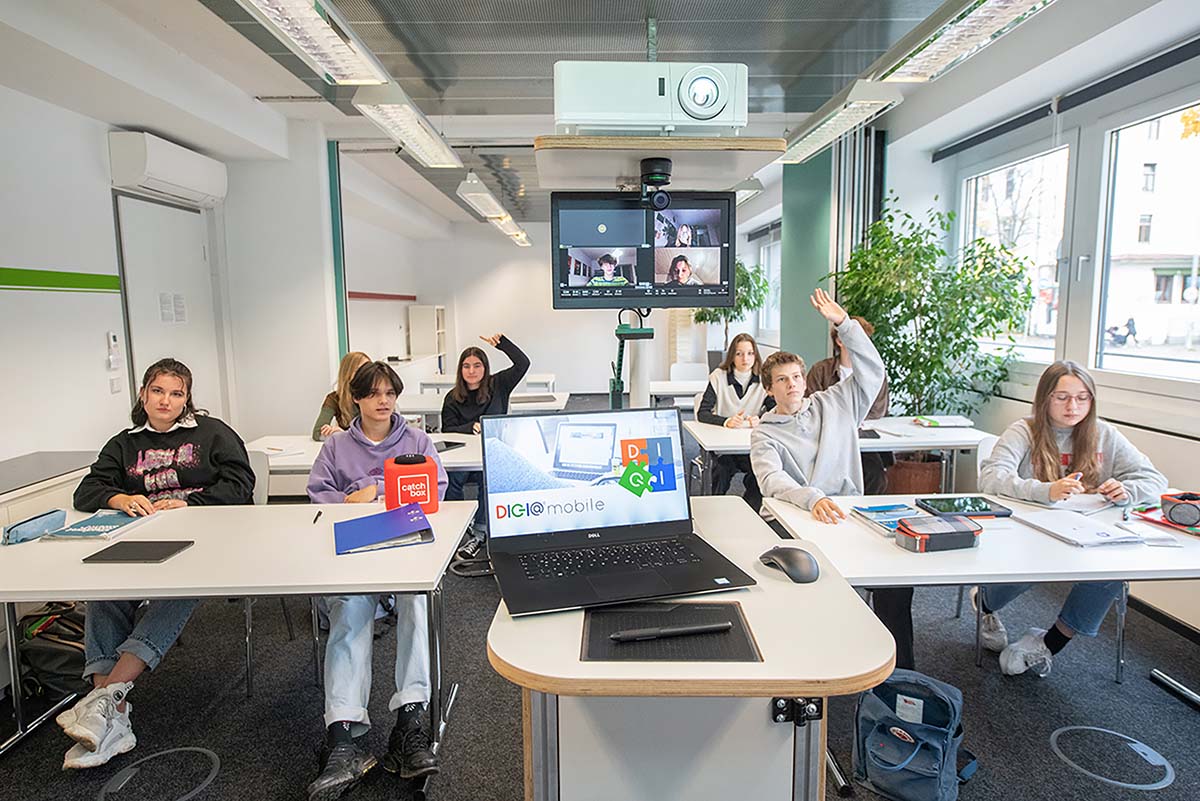
The pandemic has altered many aspects of our lives, and that includes how and where we work. Work from home became the normalized way of living, and teachers were forced to transition to online teaching overnight. Founded in the wake of Germany’s first COVID-19 lockdown, DIGI@Education is a German company that trains teachers on how to effectively do so as schools close their doors.

Having worked closely with teachers, they came to know the pain points, needs, and issues of online, and later, hybrid teaching that teachers faced in the changing education landscape. So, by utilizing their know-how experience accumulated during their previous career as healthcare system consultants, they developed an “All-in-one-Studio” solution — DIGI@mobile — that enables teachers to turn physical lessons into hybrid lessons with just a push of a button.

As visualization forms the core of a hybrid lesson, the ability to present oneself and any content interactively and clearly is highly sought after by many teachers. And this is where DIGI@Education found a real need to integrate a document camera into their solution:

“Document cameras are very important tools for hybrid teaching.”

In view of this, they gave IPEVO document cameras a try. Performing beyond their expectations, they found the integration process extremely easy and the image quality extraordinary:

“IPEVO document cameras can be directly mounted to our DIGI@mobile solution and provide perfect quality images directly from the classroom.”

Before deciding on IPEVO, they experimented with a few other brands of document cameras, but the results were not satisfactory:

“During early testing of our solution, we had problems with connectivity and mounting the document cameras.”

However, with the multi-jointed stand, swiveling head, and plug-and-play design of IPEVO document cameras, everything falls perfectly into place:

“With IPEVO’s product, especially with the swiveling head, we could solve these problems easily. They just work and integrate perfectly with our product (DIGI@mobile).”

When asked what makes IPEVO document cameras stand out, they said:

“High image and product quality, plus the swiveling head.”

In fact, many users of DiGI@mobile are very pleased with the integration:

“Our customers are very happy with the quality, and we get the feedback that it (IPEVO document camera) is a very user-friendly application.”

Summarizing the role of IPEVO document cameras in DIGI@Education’s hybrid teaching solution:

“Hybrid teaching and hybrid meetings are hard enough as it is. Making the hardware work easily, simply, and dependably is our effort to your (schools’ and teachers’) success. IPEVO products help us make it happen.”

About Version 2 Limited
Version 2 Digital is one of the most dynamic IT companies in Asia. The company distributes a wide range of IT products across various areas including cyber security, cloud, data protection, end points, infrastructures, system monitoring, storage, networking, business productivity and communication products.

Through an extensive network of channels, point of sales, resellers, and partnership companies, Version 2 offers quality products and services which are highly acclaimed in the market. Its customers cover a wide spectrum which include Global 1000 enterprises, regional listed companies, different vertical industries, public utilities, Government, a vast number of successful SMEs, and consumers in various Asian cities.

About IPEVO
IPEVO makes versatile teaching tools instead of specialized “classroom equipment”.
We go beyond the usual conventions of classroom technology—large, expensive, specialized and complex—to rethink simple and flexible solutions for interactive teaching in today’s classrooms.
IPEVO’s interactive teaching tools empower educators and teachers with radically affordable and compact technology that is simple, intuitive and flexible, so that precious time and resources can be wholly dedicated to teaching. We intend to make educational technology accessible and available to all.

CyberLink to Showcase Smart Retail Solutions at NRF 2022

Taipei, Taiwan — January 14, 2021 — CyberLink Corp. (5203.TW), a pioneer of AI and facial recognition technologies, will showcase new, contactless smart retail solutions. This solution is powered by its market-leading FaceMe® engine running on the Qualcomm® QCS6125 multimedia processor at NRF 2022 in New York. FaceMe® will be featured at Qualcomm Technologies booth #1411, in the Javits Convention Center, January 16-18, 2022.

FaceMe® is one of the world’s top facial recognition engines, with edge-based, optimized architecture delivering precise biometric data in a few milliseconds with up to 99.82% accuracy, and is top-ranked in NIST FRVT (Facial Recognition Vendor Test).

Qualcomm® QCS6125 multimedia processor delivers integrated heterogenous compute capabilities to provide optimized Edge AI performance in addition to robust security core for secure biometrics processing.

FaceMe® offers cross-platform capabilities on Windows, Linux, Android and iOS, for a variety of edge devices and different hardware configurations, which makes it an ideal solution for smart retail, from kiosks and POS, to personalized shopping, digital signage and statistics.

FaceMe® offers a broad and growing set of features and tools that redefine accuracy, performance, security, and flexibility standards for a wide range of industries. Since the launch of FaceMe® in 2018, CyberLink has collaborated with over a hundred global partners, including hardware makers, solution providers, and system integrators, deploying its technology across multiple scenarios.

“Working hand in hand with Qualcomm Technologies, CyberLink is leveraging both companies’ technologies to enable a wide range of new user experiences, as demonstrated for retail at NRF,” said Dr. Jau Huang, Chairman and CEO of CyberLink. “Our continued collaboration with Qualcomm Technologies has been integral in making CyberLink’s FaceMe® solution the most advanced biometric access technology in the market. We look forward to having NRF attendees visit the Qualcomm Technologies booth to see FaceMe in action.”

“Qualcomm Technologies is pleased to work closely with Cyberlink to drive next-generation biometric solutions and we look forward to showcasing the FaceMe® demonstration at NRF,” said Ketal Gandhi, Director, Business Development, Qualcomm Technologies, Inc. “We have worked collaboratively with CyberLink to support pre-integration capabilities to enable customers and our ecosystem to save time on their development and accelerate the go-to-market timeline for their applications in Retail such as Biometrics Payment, Access Control, Loyalty and more.”

CyberLink is inviting NRF visitors to stop by Qualcomm Technologies’ booth to see some exciting results of this collaboration, including its application into POS solutions from Ordyx. Ordyx will introduce a complete POS system accessed by facial recognition for both cashiers and opted-in customers who desire to pay using their face. This new system leverages FaceMe® facial recognition and the Qualcomm QCS6125 solution to create a secure, fast and convenient new experience for customers.

Come meet the FaceMe® team and find out about the latest developments in AI and facial recognition.

NRF 2022 Information

  • Time: Jan 16 – 18, 2022
  • Venue: Javits Convention Center
  • Booth Info: #1411 (Qualcomm Technologies’ Booth)

About Version 2 Limited
Version 2 Digital is one of the most dynamic IT companies in Asia. The company distributes a wide range of IT products across various areas including cyber security, cloud, data protection, end points, infrastructures, system monitoring, storage, networking, business productivity and communication products.

Through an extensive network of channels, point of sales, resellers, and partnership companies, Version 2 offers quality products and services which are highly acclaimed in the market. Its customers cover a wide spectrum which include Global 1000 enterprises, regional listed companies, different vertical industries, public utilities, Government, a vast number of successful SMEs, and consumers in various Asian cities.

About CyberLink
Founded in 1996, CyberLink Corp. (5203.TW) is the world leader in multimedia software and AI facial recognition technology. CyberLink addresses the demands of consumer, commercial and education markets through a wide range of solutions, covering digital content creation, multimedia playback, video conferencing, live casting, mobile applications and AI facial recognition.  CyberLink has shipped several hundred million copies of its multimedia software and apps, including the award-winning PowerDirector, PhotoDirector, and PowerDVD.  With years of research in the fields of artificial intelligence and facial recognition, CyberLink has developed the FaceMe® Facial Recognition Engine. Powered by deep learning algorithms, FaceMe® delivers the reliable, high-precision, and real-time facial recognition that is critical to AIoT applications such as smart retail, smart security, and surveillance, smart city and smart home. For more information about CyberLink, please visit the official website at www.cyberlink.com

Multifactor Authentication: How to benefit from this security strategy

Multi-factor authentication is a technological solution that aims to inhibit cyberattacks. In practice, this security strategy uses at least two types of mechanisms to identify an individual trying to access a certain system online.

The methods can involve knowledge factors, such as passwords; possession factors, such as totems; or inheritance factors, including fingerprint and facial recognition.

Do you want to learn more about it? Keep reading the article we have prepared.

Multi-factor authentication is an intelligent solution that protects from cyberattacks to individuals and businesses. 

This strategy is especially important these days, considering the significant increase in hacking attempts.

A survey done by Kaspersky, an organization specializing in security, and published on CNN Brasil‘s website, points to alarming numbers. According to the survey, in 2020, there was a 330% increase in cyberattack attempts. Altogether, more than 370 million corporate systems were hacked.

With the adoption of remote work by most companies during the covid-19 pandemic, their systems became more vulnerable to hacking. 

This has increased the need for technologies such as multi-factor authentication, as discussed in one of the topics below.

In this article, we explain what this feature is, its importance, and how to implement it, among other information. To make it easier for you to understand, it is divided into the following topics:

  • What is Multi-factor Authentication?
  • How Important is Multi-factor Authentication?
  • Are Companies Required to Use This Feature?
  • Two-factor Authentication and Multi-factor Authentication: What is the Difference?
  • Are Complex Passwords as Effective as MFA?
  • Digital Authentication Types
  • Methods Used in Attempts to Break MFA Security
  • Multi-factor Authentication and Remote Work

Keep reading and enjoy it!

  • What is Multi-factor Authentication?

Multi-factor Authentication (MFA) is a feature that inhibits attackers by putting together different mechanisms for user authentication. In this way, it guarantees the required security for data that could be accessed by the computing device, avoiding countless inconveniences and losses.

In practice, there must be a unique User ID that complies with PCI DSS Requirement 8.1.1, in addition to at least two of the three criteria outlined in PCI DSS Requirement 8.2. These are:

  • Knowledge factor: something the user knows, such as a password;
  • Possession factor: something they own, such as a token; and
  • Inheritance factor: something that relates to who they are, as in the case of biometrics.

For multi-factor authentication to work as it should, the mechanisms must be independent of each other. That is, if one of the factors grants access to the other, the desired security will be compromised.

  • How Important is Multi-factor Authentication?

Multi-factor authentication is a mechanism to combat data theft and cybercrime in general. For organizations, this protection is extremely important for several reasons.

It helps to avoid financial losses through theft and impact on productivity, as this type of occurrence can halt business operations.

In addition, it prevents the company from being exposed to legal proceedings arising from data leaks. 

This can occur, for example, by not complying with the General Data Protection Law (LGPD), which came into force on September 18th. This law requires companies to adopt a series of procedures in order to protect individual data. 

Failure to comply with the law can lead to administrative sanctions with eight different types of punishment, which include fines of up to R$50 million.

  • Are Companies Required to Use This Feature?

Multi-factor authentication is not a mandatory solution for all companies. However, its use is strongly advised for companies of any size or segment, after all, it combats a series of risks.

Also, individuals can benefit from this feature as they are also targeted by malicious actions such as cyberattacks.

For some audits, however, it is already a must, and it may no longer be optional in different contexts soon.

  • Two-factor Authentication and Multi-factor Authentication: What is the Difference?

Like multi-factor authentication, two-factor authentication (2FA) is intended to make it more difficult to hack an individual or legal entity’s accounts. Both require the user to use more than just a traditional password to log in.

The difference is that in two-factor authentication, the same method can be used more than once, such as a password and a security code, two factors of knowledge.

Multi-factor authentication is a more complex system, which requires at least two methods to allow access to a certain account. In practice, this means the individual will have to combine elements such as a password and the fingerprint scan. Note that we are talking, respectively, of a knowledge factor and an inheritance factor.

  • Are Complex Passwords as Effective as MFA?

Experts recommend using multi-factor authentication whenever a service provider offers this mechanism. 

That is because the MFA makes it possible to block 99.9% of automated bot attacks, and studies show its effectiveness in stopping malicious actions. 

According to Google, simply linking a phone number to the Google account as a way to recover passwords makes it possible to block up to 100% of automated bots, 99% of mass phishing attacks, and 66% of targeted attacks.

Using only a password as a security mechanism is already an inefficient action, however complex it can be, as hackers have access to increasingly sophisticated cyber tools and the number of breached accounts is shocking.

In contrast, using multi-factor authentication inhibits these intrusions because, in addition to the password, it is necessary to use an additional authentication method.

Furthermore, compromising MFA tokens is so expensive that it only generates interest in hackers who wish to gain access to exorbitant amounts.

  • Digital Authentication Types

There are numerous efficient ways to stop malicious online actions through digital authentication with different levels of complexity. In this topic, we cover the best known. Check them out:

  • Passwords: Passwords are the most common authentication mode. In order to fulfill their function and provide security, some services require compliance with criteria such as the minimum number of characters and the use of numbers or special characters.


  • Personal Information: Certain systems may request information from the user, such as the mother’s name, date or city of birth, and full name.


  • PIN: this is a code generated to identify the user of a website, for example. As mentioned earlier, this information is sent to a specific smartphone.


  • Token:  As a possession factor, the token is an item widely used by banks to generate passwords and prevent fraud. This method has the disadvantage of allowing shared access, which can reduce security, especially if not combined with another authentication mode.


  • Face Recognition: This highly advanced form of authentication can identify a person’s face through algorithms and software. First, the features are detected by a camera. Then, sizes, formats, proportions, and distances are analyzed. 

All this information is stored in a database and used for identification.

You might be asking yourself: what about when we get older or present ourselves with a different angle and lighting? In reality, this technology, which was limited before, has evolved more and more, and recognition in three dimensions is now possible.

In addition, the camera captures the shape of the user’s head, precisely to identify their features, regardless of the angle they are at.


  • Voice Recognition: There are certain applications to identify users’ voices. Audios are split into bits, converted into digital format, and transformed into text.

Voice recognition fulfills its purpose by analyzing intonation, pronunciation, and vocabulary, among other characteristics of the user’s speech. Its weakness lies in contemplating accents and changes in voice tone, for example.


  • Fingerprint: This form of authentication is very common among inheritance factors. It consists of the unique pattern each person has at their fingertips and can differentiate them from others.


No type of digital authentication is 100% secure if applied alone. For this reason, multi-factor authentication is strongly recommended.

  • Methods Used in Attempts to Break MFA Security

Multi-factor authentication is widely used by companies to prevent attacks. However, not even this mechanism, with all its complexity and effectiveness, guarantees 100% protection. Here are some methods used by hackers to breach your security:

  • Disabling the MFA

Malicious users can change settings in order to disable the multi-factor authentication application. That way, they do not need to go through a second authentication step when connecting.

  • Bypassing Multi-factor Authentication

In this case, the hacker applies techniques that allow access without MFA. They can do this in two ways: by controlling a maliciously downloaded, user-authenticated application, or by taking advantage of some multi-factor authentication vulnerability.

The possibility of intercepting an SMS message with the authentication code is an example.

  • Taking Advantage of Authorized MFA Exceptions

This happens when the malicious agent finds accounts operating without the MFA’s criteria. They take advantage of legacy applications that do not provide this protection mechanism. This is the case with POP/SMTP email servers.

  • Stealing SAML Signing Certificate

This technique is well known and very difficult to detect. It consists of stealing the private key or having a forged key for signing certificates and shows how important it is to have constant monitoring. 

  • Reusing a Session

It is possible to compromise a system with an authenticated session because most MFA features default to a 30-day timeframe to require re-authentication of a user, system, or application. This leaves enough time to access an account.

  • Multi-factor Authentication and Remote Work

The use of multi-factor authentication has become more urgent with the covid-19 pandemic. This is because most organizations had to adapt to a home office mode, with employees accessing the systems from any environment and device.

According to this publication, 90% of companies operating in Brazil have adopted remote work due to covid-19. Also, many will maintain this working mode even after the end of the pandemic.

This new condition brought vulnerability to companies, as it facilitated the actions of malicious individuals.

In this article, you have seen what multi-factor authentication is and its importance to individuals and corporations. If our content has answered your questions, please share it with others who are also interested in the subject.

About Version 2 Limited
Version 2 Digital is one of the most dynamic IT companies in Asia. The company distributes a wide range of IT products across various areas including cyber security, cloud, data protection, end points, infrastructures, system monitoring, storage, networking, business productivity and communication products.

Through an extensive network of channels, point of sales, resellers, and partnership companies, Version 2 offers quality products and services which are highly acclaimed in the market. Its customers cover a wide spectrum which include Global 1000 enterprises, regional listed companies, different vertical industries, public utilities, Government, a vast number of successful SMEs, and consumers in various Asian cities.

About Segura®
Segura® strive to ensure the sovereignty of companies over actions and privileged information. To this end, we work against data theft through traceability of administrator actions on networks, servers, databases and a multitude of devices. In addition, we pursue compliance with auditing requirements and the most demanding standards, including PCI DSS, Sarbanes-Oxley, ISO 27001 and HIPAA.

Did you know that there are several USB types? Do you know them all?

USB types: the final list to know them all

“Pen drive”, “memory stick”, for those less attentive: “VHS”… We have given many names to what we actually meant by USB. But you have to know that the term goes a little beyond that gadget of four or eight gigabytes that we use for so many things. In fact, there are several USB types, and today we will delve into getting to know them.

USB Types: What is a USB?

First we should make clear that, as many suspected but few dared to inquire, the acronym USB is derived from the corresponding words: Universal Serial Bus. USB is a connection protocol that allows us to connect several peripheral devices to an electronic device to achieve an exchange of data. It can also be useful to carry out some operations or charge the battery of our devices. It is, then, like a port that works as a connection socket between different devices.

The range of devices that we can interconnect to a computer thanks to USB is quite wide. We just have to think a bit so that they all come to our heads immediately. Mouses, keyboards, video and photo cameras, smartphones, USB memories, music players, webcams, speakers, printers, recorders, external hard drives, PDA… There are countless examples.

We owe this protocol to the fruitful 1990s, a wonderful decade for Britpop and for technology. It was seven large technology corporations (Intel, IBM, Northern Telecom, Compaq, Microsoft, NEC and Digital Equipment Corporation) who joined hands to reach an agreement on the peripheral connection standard for a computer. The idea was good for everyone, and although they started with a first model, USB 1.0, different from the current ones, everything was just a matter of evolution.

USB Types: Standards

USB devices are classified into four types based on their data transfer speed: Low Speed (1.0), Full Speed (1.1), High Speed (2.0) and Super High Speed (3.0).

  • USB 1.0. It was the one that appeared in the mid-nineties. The maximum speed at which information could be transferred was 1.5 Mbps. Well, it could be used for connecting devices like the mouse and keyboard for example.
  • USB 1.1. The transfer rate increased to 12 Mbps.
  • USB 2.0. It is undoubtedly the most widespread standard and sends data at a speed of 480 Mbps, although its actual rate is 280 Mbps. In the cable you may find four lines: two for data transfer and two for power.
  • USB 3.0. We can consider it about ten times faster than 2.0. It reaches speeds of 4.8 Gbps. The best thing is that it is still compatible with the previous ones and on top of that, it includes five additional contacts. At present, it coexists with 2.0. in perfect harmony.
  • USB 3.1 It is the last of the standards. In fact it emerged just a few years ago. It reaches a data transfer speed of 10 Gbps. As an incentive, it comes with a new type of connector, connector C.

USB Types: Types of connectors

Now we go to the shapes of USB, which is why we are more familiar with them.

Type A. It is the one that most users will recognize. That flattened rectangle in which we can see internal connections. The male connector is at the end of the cables, while the female is the port itself.

Type B. The ports and connectors belonging to this type are just as recognizable by users, but somewhat smaller and wider than those of type A. As a general rule, we can find them in devices such as printers.

Type C. The Type-C connector has appeared the same as USB 3.1 and the distinguishing feature is that it is reversible. That’s right, no matter which side you insert, it works both ways.

MiniUSB. You may find two different versions of this one, made by 5 or 8 pins. We can see them in cameras, external hard drives, music players and a few other trinkets.

MicroUSB. The microUSB is the smallest and thinnest of all. It is quite flat and was conceived to connect to our smartphones. With them we can transfer information and charge batteries, so we also know it very well.

USB Types: Mistaking them with USB Memory

As we have seen, the concept of USB refers to the connection port. However, the term “USB” has also been extended to refer to pen drives. Pen drives are enabled with a memory that works as a place for storing and transporting data. It’s the rightful replacement for floppy disks and CDs (who doesn’t have one, for God’s sake?!), with different capacities ranging from 1GB to 1TB. Simply because the pen drive connects through USB, they have ended up calling it that. To shorten it. We are that practical and love saving that much.

Once you just got into the technological ins and outs, are you hungry for more? Would you like to go even further in the world of technology? What about spending a couple of minutes to find out what computing system monitoring is and why it is also very important?

Monitoring systems are responsible for supervising technology (hardware, networks and communications, operating systems or applications, for example) in order to analyze its performance, and to detect and alert about possible errors. And this leads us to Pandora FMS, that wonderful tool thanks to which this blog is possible.

Pandora FMS is a flexible monitoring system, capable of monitoring devices, infrastructures, applications, services and business processes.

About Version 2 Limited
Version 2 Digital is one of the most dynamic IT companies in Asia. The company distributes a wide range of IT products across various areas including cyber security, cloud, data protection, end points, infrastructures, system monitoring, storage, networking, business productivity and communication products.

Through an extensive network of channels, point of sales, resellers, and partnership companies, Version 2 offers quality products and services which are highly acclaimed in the market. Its customers cover a wide spectrum which include Global 1000 enterprises, regional listed companies, different vertical industries, public utilities, Government, a vast number of successful SMEs, and consumers in various Asian cities.

About PandoraFMS
Pandora FMS is a flexible monitoring system, capable of monitoring devices, infrastructures, applications, services and business processes.
Of course, one of the things that Pandora FMS can control is the hard disks of your computers.

VEGAS Creative Software Embraces New 12th Gen Intel® Core™ Processor as CPU-of-Choice for Optimal Workflow Performance for VEGAS Pro

12th Gen Intel Core Processor Performance Gains, Enhanced CPU+GPU Integration Significantly Boosts VEGAS Pro Workflow Speed and Efficiency


01/05/22

VEGAS Creative Software (www.vegascreativesoftware.com) announced today it has embraced the new 12th Gen Intel® Core™ processor to optimize the workflow and performance of its lineup of video/audio editing, color grading, effects and live streaming software, including VEGAS Pro.

By embracing this new architecture, VEGAS Pro will now benefit from significant single- and multicore performance gains for content creators. All AI/ML-based features in VEGAS Pro are now optimized for the new 12th Gen processor through OpenVINO. Capabilities such as AI-based Upscale, Style Transfer and Colorization will be faster and more efficient.

For additional performance enhancements, VEGAS Pro also takes advantage of the improved GPU + CPU integration with Intel® Deep Link technology, as well as hardware accelerated encoding and decoding of video, offering a smoother workflow and a faster delivery for content creators.

The hybrid processor architecture of 12th Gen Intel® Core™ processors combines larger highperformance cores with smaller high-efficiency cores. The intelligent selection of cores for different levels of tasks is handled automatically by the Intel® Thread Director, supported by Windows 11. These capabilities are at the heart of many of the stunning, AI-powered effects built into VEGAS Pro.

Hagen Hirche, chief technology officer for MAGIX and VEGAS Creative Software commented: “The combination of VEGAS Pro, the 12th Gen Intel Core processor and Win 11 is something for our users to celebrate. With the launch of this new processor, Intel has provided a great leap forward in multicore performance and gives mobile devices desktop-like performance which in turn means our users can get more done in less time.”

Jerry Tsao, GM and VP of Client Computing Group MCP Enthusiast Segment at Intel: “This close collaboration by our engineers utilizing Intel® OpenVINO toolkit and Intel® Deep Link technology, enables an AI-rich and performance-optimized video editing experience when running VEGAS Pro on 12thth Gen Intel® Core™ H- Series processors, which will make creators more productive and help unlock their creativity.”

About Version 2 Limited
Version 2 Digital is one of the most dynamic IT companies in Asia. The company distributes a wide range of IT products across various areas including cyber security, cloud, data protection, end points, infrastructures, system monitoring, storage, networking, business productivity and communication products.

Through an extensive network of channels, point of sales, resellers, and partnership companies, Version 2 offers quality products and services which are highly acclaimed in the market. Its customers cover a wide spectrum which include Global 1000 enterprises, regional listed companies, different vertical industries, public utilities, Government, a vast number of successful SMEs, and consumers in various Asian cities.

About VEGAS
Today, millions of VEGAS Pro and VEGAS Movie Studio users benefit from global industry-leading video editing technologies. Now, VEGAS launches into a new era. In May, 2016, MAGIX acquired the multiple award-winning VEGAS Pro and VEGAS Movie Studio product lines, along with other video and audio products. VEGAS Creative Software stands poised to take video editing to a new level. Our development teams in the US and Germany are working on innovative solutions to old problems, and building tools that push the boundaries of what’s currently possible. The VEGAS Creative Software mission: to make VEGAS software faster, more efficient, and even more intuitive. Our goal: to provide users at all levels–from video editing amateurs to creative professionals–tools that are perfectly suited to their needs and demands.

The Log4j Vulnerability Spells Crisis for Network Security, With Some Exceptions

In early December 2021, a significant vulnerability in a common piece of Java-based code by Apache set the world on fire…at least for IT security professionals. Within 24 hours of disclosure, leading software companies like IBM, Oracle, Amazon, and Cisco went into damage control, seeking to assess the level of potential damage they had and could expect to sustain, and frantically working on patches to prevent their customers’ data from being siphoned off and sold to the highest bidder. The event was fitting for 2021, a year marked by disinformation, confusion and fear.

“The log4j vulnerability is the most serious vulnerability I have seen in my decades-long career,” Jen Easterly, U.S. Cybersecurity and Infrastructure Security Agency director, said in a interview on CNBC.

As December 2021 dragged on, related flaws continued to surface, sending those same software companies back to the drawing board to repackage and test yet another series of patches for customer distribution. This after communicating initial patches to customers that often took a whole weekend or more to implement. It didn’t bode well for a happy holiday season for already resource-strapped IT teams who had been dealing with a plethora of network security issues for two years brought on by the COVID-19 pandemic and the overnight surge of remote workforces.

Depending on the version and the type of application, the log4j vulnerability’s scope and severity ranged from focused and moderate to widespread and critical. Some vendors were hit harder than others, such as Cisco, whose Identity Services Engine system saw more than 120 configurations affected. Others, like Microsoft, capitalized on the opportunity, rolling out solutions to proactively seek out and manage affected files, software, and devices impacted by log4j.

Widespread & Hard to Pin Down

The extent of the impact of the log4j vulnerability was in many ways foreseeable. The root cause: human “ingenuity” that could otherwise be called laziness. Rather than reinventing the wheel by creating a new set of code for each application that is developed, software engineers now often patch together existing libraries and packages for shared functions to generate much of the codebase that runs critical applications.

Like many noteworthy cyber incidents before it, the Log4j vulnerability helped us open our eyes to just how many software dependencies exist across enterprise systems — no matter if they are designed for security, operations, or sales. It also highlighted to us just how hard it is to mitigate and develop stopgaps for these vulnerabilities when they are so far-reaching and barely understood, especially in the early days of disclosure.

While the ability to utilize the same code across many systems does offer value in terms of time to market, the problem is that many prefabricated libraries and open-source projects are interdependent, resulting in a web of dependencies that drill down many layers. Inevitably, this creates a scenario where indirect dependencies that can be nearly impossible to identify and troubleshoot when a vulnerability is unearthed.

For the average Joe IT manager, this just means that the software you licensed was likely built using common third-party code you’re not even aware of that likely contains some vulnerabilities. Multiply this shared code across other enterprise systems in your stack – and queue the headaches.

Avoiding Issues Like Log4j as an End-User

Java is a programming language that’s been around for a while and is commonly found in older on-premises software. As such, it should not come as a surprise that the classic tech giants of the world wasted no time prioritizing the log4j vulnerability – they had billions of dollars in revenue at stake across their suites of legacy software. And to make matters worse, the issue didn’t just impact Java-based systems, but also Java components and development frameworks that rely on it including Apache Struts2, Apache Solr, Apache Druid, Apache Flink, ElasticSearch, Apache Kafka and many others. We’re talking about tens of millions of impacted systems in use at any given moment today.

How to avoid such widespread vulnerabilities is more than a question of choosing which apps are programmed with which language(s) – software engineers can debate the efficacy of each until they are blue in the face. Rather, it’s a question of how to consume enterprise software. For organizations more reliant on cloud native software-as-a service applications, IT employees almost certainly experienced fewer lost weekends dealing with the log4j problem.

This is because SaaS has a shared responsibility model, whereby both the vendor and the customer are responsible for the security of the application in use. The onus is on the SaaS vendor to deliver secure products and services, while the responsibility for configuring, managing, and using the product lies with the customer. In the case of Log4j, most of the heavy lifting falls on the SaaS vendor. They must ensure that their products are not affected. If they are, it is up to them to provide transparency into how the system is being patched and how the vulnerability is being mitigated.

While this differentiation seems simple, implementing a cloud-first IT strategy – no matter if universal or by function – can mean retaining IT talent by avoiding burnout, optimizing your IT budget by eliminating the need for third-party professional services, and so much more.

About Version 2 Limited
Version 2 Digital is one of the most dynamic IT companies in Asia. The company distributes a wide range of IT products across various areas including cyber security, cloud, data protection, end points, infrastructures, system monitoring, storage, networking, business productivity and communication products.

Through an extensive network of channels, point of sales, resellers, and partnership companies, Version 2 offers quality products and services which are highly acclaimed in the market. Its customers cover a wide spectrum which include Global 1000 enterprises, regional listed companies, different vertical industries, public utilities, Government, a vast number of successful SMEs, and consumers in various Asian cities.

About Portnox
Portnox provides simple-to-deploy, operate and maintain network access control, security and visibility solutions. Portnox software can be deployed on-premises, as a cloud-delivered service, or in hybrid mode. It is agentless and vendor-agnostic, allowing organizations to maximize their existing network and cybersecurity investments. Hundreds of enterprises around the world rely on Portnox for network visibility, cybersecurity policy enforcement and regulatory compliance. The company has been recognized for its innovations by Info Security Products Guide, Cyber Security Excellence Awards, IoT Innovator Awards, Computing Security Awards, Best of Interop ITX and Cyber Defense Magazine. Portnox has offices in the U.S., Europe and Asia. For information visit http://www.portnox.com, and follow us on Twitter and LinkedIn.。

Actiphy Releases ActiveImage Protector 2022 Backup and Recovery Solution Featuring Direct-To-Cloud Backup and In-Cloud Recovery

Wildomar, CA — November 12, 2021, Actiphy Inc., a leading publisher of backup, disaster recovery, and virtualization software, announces the release of ActiveImage Protector 2022 featuring direct-to-cloud backup, in-cloud recovery, and a new agentless and agent-based hybrid licensing option.

This new version can now backup and restore directly to and from public cloud services and SFTP servers. With new In-Cloud Recovery, backup images can be restored as VMs in the cloud environment. New LTO Tape Support provides high speed backup of bulk data to high capacity tape storage solutions to ensure long-term archival stability. Point-in-time file and folder backup, a frequently requested feature, has been included in this release.

ActiveImage Protector 2022. On-Premise Strong, Cloud Stronger.

New Features


  • Direct-To-Cloud Backup
    Backup systems directly to cloud storage. Supported public cloud storage services include Amazon S3 and Azure as backup destinations. In addition, Direct-To-Cloud Backup also supports SFTP servers as backup destinations.


  • In-Cloud Recovery
    Any backup image can be restored directly to a virtual machine within the same cloud environment. In-Cloud Recovery offers an easy system migration of on-premise virtual or physical machines directly to cloud environments.


  • Actiphy Portal Service (APS)
    A powerful new on-line monitoring portal designed for Managed Service Providers (MSP), distributors and resellers. APS provides monitoring ActiveImage Protector (AIP) clients, collecting backup logs and generating reports of AIP clients’ task status.


  • LTO Tape Support
    Support for LTO as a backup destination. Backup data saved on tape can be physically isolated from ransomware attacks and ensures long-term archival stability.


  • File Backup
    A new file backup option providing granular point-in-time backup and restore of specific files and folders.


  • RescueBoot
    Adds an optional boot recovery environment to the system boot menu.


  • Disk-To-Disk Copy
    A new disk-to-disk copy option that supports virtual disks, physical disks, and volumes, for a complete sector by sector copy.


  • Offline Environment Activation Support
    With Actiphy Authentication Service (AAS) or a license file, ActiveImage Protector agents can be activated in an off-line environment.


  • iSCSI Target Server
    Utilize iSCSI targets and NFS exports to emulate backup images as virtual disk files for flexible and immediate recovery or migration.


  • Subscription License
    Annual, three-year, five-year subscription and perpetual licenses are now available.


  • Hybrid Licensing for Server Edition
    Selectable Agent-based or Agentless Backup licensing is now available for server edition.


  • Additional Linux Distributions Support
    ActiveImage Protector Linux edition now supports Ubuntu 18.04 LTS and 20.04 LTS, Debian 9/10/11, RedHat 8.4, Rocky Linux 8, Alma Linux 8 and Amazon Linux 2.


ActiveImage Protector 2022 is a backup and recovery solution that protects physical and virtual, Windows and Linux environments. The AIP solution includes all the tools necessary for enterprise level deployment and management of backup, recovery, standby switch-over, and migration.

Copyright © 2021 Actiphy, Inc. All rights reserved worldwide. All other brands and product names mentioned in this news release are trademarks or registered trademarks of their respective holders.

About Version 2 Limited
Version 2 Digital is one of the most dynamic IT companies in Asia. The company distributes a wide range of IT products across various areas including cyber security, cloud, data protection, end points, infrastructures, system monitoring, storage, networking, business productivity and communication products.

Through an extensive network of channels, point of sales, resellers, and partnership companies, Version 2 offers quality products and services which are highly acclaimed in the market. Its customers cover a wide spectrum which include Global 1000 enterprises, regional listed companies, different vertical industries, public utilities, Government, a vast number of successful SMEs, and consumers in various Asian cities.

About Actiphy
Actiphy founded in 2007, focuses on developing and offering innovative backup and disaster recovery solutions for complete protection of all your systems and data. ActiveImage Protector backs up Windows, Linux machines on physical and virtual environments and restore systems and data fast for you to be up and running with minimal downtime and data loss. Today Actiphy hold 20% of the image backup market in Japan and are expanding our services in the Asia/Pacific and North American regions, as well as in Europe, the Middle East and Africa.

Privileged Access Management

Implementing privileged access management in a company is critical to ensuring that there are no information theft and other security issues.

The so-called cyberattacks are responsible, for example, for the theft and hijacking of information in exchange for money, causing several damages to the continuity of an organization’s business. They have become very common and their actions can cause not only financial losses but also image and reputation losses.

Unfortunately, the trend is that over the years, these cyberattacks will become more and more severe and that their number of occurrences will grow.

With this scenario, the importance of privileged access management also grows. Cyberattacks happen through classic malware and phishing methods or the exploitation of zero-day software vulnerabilities, in addition to advanced social engineering techniques.

With all that, privileged access management comes to help ensure that organizations function. Thus, it covers the need to protect data, networks, and devices from malicious actions.

Gartner, in its document Gartner Top 10 Security Projects, named Privileged Access Management (PAM) as the number one priority in security projects. So, what does Privileged Access Management mean and why is it considered so important? That is what we are going to talk about today.

What is Privileged Access?

Before explaining what Privileged Access Management is, we need to understand what privileged access or credential is.

All the time, malicious people appear looking for flaws within the companies’ systems to gain access to confidential data. This threat can be both external and internal. Therefore, organizations are increasingly looking for solutions that are truly capable of protecting this information.

Privileged accounts are created to control access to this data. This access is usually restricted only to people who hold leadership positions (high-level management) and administrators in the IT area. Other employees can obtain this information with the authorization of the company.

Through privileged credentials, significant changes can be made to devices and applications installed on an infrastructure, which in many cases can affect business continuity. The impact of using them maliciously can cause serious damage, from violations of compliance items, which can lead to heavy penalties, to security incidents – which result in reduced trust by the interested parties and lost revenue.

Although it is extremely important, proper control often ends up being flawed. Hence the need to have a tool really capable of directing, tracking, and filtering these accesses. Among the most efficient, we have PAM solutions.

What is a Privileged Access Management (PAM) solution?

Privileged Access Management, also called Privileged Identity Management, enables organizations to protect their privileged credentials. In addition, PAM also ensures the effectiveness of least privilege policies by reducing attack vectors and possible data leaks.

Gartner believes that a PAM solution helps organizations securely provide privileged access to critical assets and meet compliance requirements by managing and monitoring privileged access and accounts.

Basically, a PAM solution works as a secure credential repository for devices installed in the environment. Based on the management of user privileges, one can allow users to access only the data required for them to perform their activities. Thus, the information security team can configure user access profiles, avoiding improper access to systems and data.

What is the Principle of Least Privilege?

The principle of least privilege is one of the bases for information security. Its main goal is to grant users access to environments that are required for them to perform their tasks. In other words, with the principle of least privilege, users do not access environments they do not require, avoiding internal threats, data leaks, and hacker infiltration in critical environments of a company.

Through the senhasegura solution, you have several security locks that ensure users access only the environments required by them. Besides monitoring the way the user is performing privileged access, the senhasegura solution registers, records, and notifies those responsible for information security about any malicious activity within the privileged session.

Through this simple practice, they significantly minimize the chances of a cybercriminal accessing sensitive company data and extracting information.

How is Privileged Access Done?

Privileged access to devices can be performed in two ways: manually (least recommended); and through specific Privileged Access Management (PAM) solutions. In this second case, PAM controls administrative access to a company’s critical systems to help it achieve its cybersecurity goals.

Controlling privileged actions allows one to protect a company’s IT systems against any attempt to carry out malicious actions, such as improper changes in the environment and theft of information. These blocked actions can take place both inside and outside the company.

In this context, using privileged access management technology is essential to optimize the deployment of a cybersecurity infrastructure in companies.

Moreover, the need for effective use of privileged access management techniques has never been greater, as traditional defense mechanisms such as antivirus, VPNs, and firewalls are subject to many failures today.

Thus, a PAM solution should be able to:

  • Allow a company to set several flexible parameters for privileged access control, such as window access, access restrictions for specific users or systems, or access limitation to resources required to perform a task;
  • Be a single repository of administrative credentials across all systems and environments within an organization, resulting in reduced audit time and incident investigations;
  • Link role-based user control to critical systems, applications, and services, thus allowing the connection between a privileged user and an individual, which improves granularity of control and visibility;
  • Provide a scalable, searchable, and comprehensive audit and reporting solution for user activities on critical systems, with the ability to view commands and sessions on those systems.
  • Centralize privilege visibility and control across a single management, policy, and reporting platform for all devices and users, resulting in increased efficiency and unification of the management approach across the environment.
  • Integrate auditing activities for user tasks such as Syslog with other monitoring and reporting technologies such as SIEM (Security Information and Event Management).
  • Strengthen the policies of least privilege for granular control of administrative rights, while facilitating elevation of privileges without the need to assign administrator or root access.
  • Escalate management of all credentials across a range of operating systems and platforms.

Through an architecture that requires no agent installation, senhasegura offers a centralized access point for critical systems. Its features allow strengthening the access control, limiting the user access only to what was previously authorized, respecting the principle of least privilege.

Thus, senhasegura offers full visibility of who has access to these systems and what actions have been taken with the privileged credentials.

Some features of senhasegura include:

Credential Management

Allows secure password storage and centralized access management. From the definition of Access Groups for segregation of roles, one can configure pre-approved or emergency access, or start from workflows with single or multiple approvals, without the user having access to the credential password.

Session Recording

Allows tracking of any action taken during a privileged session to meet any audit or data privacy authority’s demand. In addition, the livestream feature allows real-time monitoring of ongoing sessions and the possibility of remotely ending a session;

Application Identity

senhasegura uses its own template for changing the password of application credentials and stores the new encrypted password in its database. The credential can be viewed directly by the solution’s connection API or inserted directly into the application server connection pool.

When used to manage privileged access on organizational systems and platforms that store or protect the integrity of sensitive data, senhasegura provides a centralized access point for critical systems. Its features allow strengthening the access control, limiting the user access only to what was previously authorized, respecting the principle of least privilege.

Thus, senhasegura offers full visibility of who has access to these systems and what actions have been taken with the privileged credentials. Finally, control and visibility on privileged actions are key factors for an organization to comply with a range of regulatory requirements for system protection. This ensures compliance and business continuity.

About Version 2 Limited
Version 2 Digital is one of the most dynamic IT companies in Asia. The company distributes a wide range of IT products across various areas including cyber security, cloud, data protection, end points, infrastructures, system monitoring, storage, networking, business productivity and communication products.

Through an extensive network of channels, point of sales, resellers, and partnership companies, Version 2 offers quality products and services which are highly acclaimed in the market. Its customers cover a wide spectrum which include Global 1000 enterprises, regional listed companies, different vertical industries, public utilities, Government, a vast number of successful SMEs, and consumers in various Asian cities.

About Segura®
Segura® strive to ensure the sovereignty of companies over actions and privileged information. To this end, we work against data theft through traceability of administrator actions on networks, servers, databases and a multitude of devices. In addition, we pursue compliance with auditing requirements and the most demanding standards, including PCI DSS, Sarbanes-Oxley, ISO 27001 and HIPAA.