Skip to content

DNS Filtering & DNS Firewall: Any Difference?

In the digital age, cybersecurity is a top concern for businesses and individuals alike. One of the most important aspects of online security is filtering unwanted content and preventing unauthorized access to networks. Two commonly used technologies for this purpose are firewalls and content filtering. However, there is often confusion around the terminology used to describe these technologies, particularly in relation to DNS filtering. In this article, we will explore the differences between firewalls, content filtering, and DNS filtering, and clarify the terminology used to describe each.

What is a Firewall?

A firewall is a security system designed to monitor and control incoming and outgoing network traffic based on predefined security rules. Firewalls can be implemented at different levels of the network, including the hardware level, operating system level, and application level. Firewalls can block unwanted traffic, detect and prevent unauthorized access, and protect against malware and other security threats.

What is Content Filtering?

Content filtering refers to the process of blocking or allowing access to certain types of content based on predefined criteria. Content filtering can be done at the network level or at the endpoint level, and can be based on a variety of factors, including keywords, categories, file types, and more. Content filtering is often used to block access to inappropriate or harmful websites, or to prevent employees from accessing non-work-related content during work hours.

What is DNS Filtering?

DNS filtering is a type of content filtering that is based on domain name system (DNS) queries. DNS filtering works by intercepting DNS queries and determining whether to allow or block the requested domain based on predefined criteria. DNS filtering can be used to block access to known malicious domains, prevent access to specific categories of content, and enforce company policies related to internet usage.

Why do DNS filters and DNS Firewalls get mixed up?

One reason for the confusion between DNS filtering and DNS firewall is that both technologies operate at the DNS level. However, while DNS filtering is a type of content filtering that focuses on blocking or allowing access to specific domains, DNS firewalling is a more comprehensive approach that involves blocking or allowing traffic based on a wide range of criteria, including IP addresses, ports, protocols, and more. In essence, DNS filtering is a subset of DNS firewalling, but the two terms are often used interchangeably, which can lead to confusion.

Are they the same or different, then?

While DNS filtering is often referred to as a DNS firewall, this is not entirely accurate. A DNS firewall is a security system that is designed to prevent attacks that exploit DNS vulnerabilities, such as DNS cache poisoning or DNS amplification attacks. DNS filtering, on the other hand, is a content filtering technology that is designed to block or allow access to specific domains based on predefined criteria. While both technologies operate at the DNS level, they have different purposes and should be referred to using the appropriate terminology.

It’s crucial for cybersecurity companies to have a clear understanding of what “DNS Firewall” really means and to ensure that they can deliver exactly what their clients expect from them, without any confusion or uncertainty. While this term is used in many definitions and contexts, it can sometimes be difficult to know exactly what you’re getting. That’s why it’s important to choose a cybersecurity provider that you can trust to provide the services they promise. At SafeDNS, we started out as a content filter, and we have built our reputation on being transparent and delivering exactly what we say we will. When you work with us, you can have confidence that you are getting the protection and security you need, without any guesswork or uncertainty. Choose SafeDNS and let us help you stay safe and secure online.

If you’re interested in protecting your network and employees from harmful content and malicious domains, sign up for a free trial of SafeDNS today.

About Version 2 Limited
Version 2 Digital is one of the most dynamic IT companies in Asia. The company distributes a wide range of IT products across various areas including cyber security, cloud, data protection, end points, infrastructures, system monitoring, storage, networking, business productivity and communication products.

Through an extensive network of channels, point of sales, resellers, and partnership companies, Version 2 offers quality products and services which are highly acclaimed in the market. Its customers cover a wide spectrum which include Global 1000 enterprises, regional listed companies, different vertical industries, public utilities, Government, a vast number of successful SMEs, and consumers in various Asian cities.

About SafeDNS
SafeDNS breathes to make the internet safer for people all over the world with solutions ranging from AI & ML-powered web filtering, cybersecurity to threat intelligence. Moreover, we strive to create the next generation of safer and more affordable web filtering products. Endlessly working to improve our users’ online protection, SafeDNS has also launched an innovative system powered by continuous machine learning and user behavior analytics to detect botnets and malicious websites.

HIPAA compliance for SaaS: a guide for healthcare providers

As healthcare providers increasingly rely on Software-as-a-Service (SaaS) applications to manage patient data, it is crucial for them to understand the importance of HIPAA compliance.

This article will discuss what healthcare organizations need to know about HIPAA compliance for SaaS and how to ensure that their SaaS applications follow industry-specific regulations.

What does HIPAA compliance mean for SaaS?

When it comes to HIPAA compliance, SaaS providers fall into two broad categories: developers and app providers and SaaS hosting services. The two groups have different compliance needs, so it’s helpful to discuss them separately.

SaaS developers and providers

SaaS developers and providers that serve the healthcare sector must ensure their products are HIPAA compliant.

HIPAA compliance means that SaaS developers and service providers adhere to HIPAA’s Security, Privacy, and Breach Notification rules. The most important section here is the HIPAA Security Rule, which has three sub-sections: technical, administrative, and physical.

Under the HIPAA Security Rule, Covered Entities (CEs) and Business Associates (BAs) must put in place protective measures to secure Protected Health Information (PHI). SaaS companies tend to fall under the Business Associate header.

SaaS providers must sign Business Associate Agreements (BAAs) with clients. These agreements set out areas of responsibility and liability. Both healthcare companies and cloud providers should be clear about sharing compliance duties and protecting patient data.

SaaS hosting services

The situation is less clear about SaaS hosting services. HIPAA security rule does not set clear guidelines for cloud computing companies hosting healthcare services. Yet, it has become increasingly important to brand cloud infrastructure as HIPAA-eligible.

HIPAA-eligible hosts offer products that clients can adapt to meet HIPAA standards. This reassures clients that shared cloud computing architecture is properly secured. The major cloud platforms offer HIPAA-eligible services, including Amazon Web Services, Microsoft Azure, and Google Cloud.

Important HIPAA compliance areas for companies and SaaS providers

Not all SaaS companies working in the healthcare sector need to worry about HIPAA compliance. For example, many health app developers won’t handle patient records if their involvement ends when the app is delivered to clients.

But this changes if DevOps teams maintain and update cloud apps for health companies. If you handle Protected Health Information or could access PHI during development tasks, you must be HIPAA compliant.

Generally speaking, HIPAA compliance is critical for providers of SaaS-based healthcare services such as monitoring apps, payment portals, or insurance management tools. And compliance is also a concern for services that host PHI on cloud infrastructure.

Specifically, healthcare organizations need to protect patient data:

  • When creating patient records

  • When information is received

  • When PHI is at rest on cloud resources

  • During transmission (if this involves SaaS infrastructure or apps).

HIPAA requirements for SaaS providers

What does the process of becoming HIPAA-compliant look like? Under the HIPAA Privacy rule, there are three main areas of focus.

Firstly, achieving SaaS data security involves creating robust technical controls. This could include encryption of data in transit and at rest. It also includes access controls to prevent unauthorized access to confidential data. Multi-factor authentication, firewall protection, and password management systems all contribute.

On the administrative side, SaaS companies must train workers to use SaaS tools safely. They must also have robust data handling policies and device usage rules to prevent the unsafe movement of patient data.

Finally, physical security measures include securing data centers via locks, authorization systems, and cameras. There should be measures to protect physical devices on and off-site and plans to guard data against natural disasters and sabotage.

Business Associate Agreements cover all three of these areas. The Covered Entity and Business Associate sign BAAs before commencing their business partnership.

The BAA describes the areas of responsibility of clients and SaaS providers. It includes details on how to achieve compliance. And it explains how partners will be liable when security breaches occur.

Sharing compliance responsibilities

Under the Privacy Rule. SaaS partners and Covered Entities have shared responsibility for protecting patient data.

Cloud Service Providers guard infrastructure and data at rest on their servers. Service users manage access control, data in transit, and how users interact with their apps. This situation applies in healthcare as well. But controls on data access are much tighter.

HIPAA-compliant SaaS hosts and providers must apply the strongest possible encryption to all confidential data. They are responsible for ensuring data is available when requested. Servers must also remain online when healthcare organizations need them.

SaaS hosts manage the physical safety of hosting infrastructure. SaaS providers handle the integrity of application code. They must guard against emerging threats like Zero Day Exploits and ensure healthcare apps are as secure as possible.

Healthcare organizations (Covered Entities) have different responsibilities. Healthcare organizations must train staff to use SaaS services safely. Every covered entity needs to educate users about safe remote access, using encryption, managing passwords, and avoiding phishing attacks.

Healthcare organizations also deal with access controls. They must ensure PHI is only available to authorized professionals or patients themselves.

Most cloud-based cyber attacks have their roots in unsafe user behavior or loose access controls. Provider-side security is critical. Yet, it’s also important for SaaS providers and hosts to tighten their HIPAA compliance.

Healthcare organizations and SaaS partners should know exactly how to share responsibility and take appropriate action to ensure watertight compliance.

Implementing HIPAA compliance measures

A robust HIPAA compliance plan ensures that SaaS companies follow HIPAA’s Security, Privacy, and Breach Notification rules. Dividing your compliance plan between the three HIPAA regulations is good practice.

Compliance plans cover many areas, and the exact make-up varies between organizations. But common elements include:

Risk management

Create risk management plans for all critical data protection risks. Risk assessment processes should include risk severity and actions required to mitigate each risk.

Project ownership

Appoint individuals with responsibility for HIPAA privacy and security management.

Security controls

This includes physical safeguards such as cameras and locks. Data protection controls are also crucial. Use encryption, access management, endpoint protection, and monitoring tools to track user activity,

Administrative safeguards

This could include training plans to educate workers and communicate HIPAA responsibilities.

Auditing

Regular compliance audits ensure controls function properly and that staff training achieves the desired results.

Systems to receive and act on HIPAA complaints

Create a secure email or phone line to report PHI violations. Organizations must make data available to patients and have streamlined processes to report data breaches to regulators.

Documentation

Create and store clear documentation outlining HIPAA compliance policies. Make documents available to staff members and regulators if needed.

Handling third parties and associates

HIPAA-compliant organizations must have solid procedures to onboard business associates. SaaS partners should be able to provide clear evidence of compliance and HIPAA eligibility (if needed).

Clients should immediately know that the SaaS provider is a dependable and secure partner. If you have not done so, plan to achieve recognized security standards such as NIST 800-53, ISO 27001, or ISO 20000-1.

How can NordLayer help?

Becoming HIPAA compliant can be challenging for SaaS developers and service providers. But if you want to thrive in the healthcare sector, a strong compliance plan is essential. Nordlayer’s HIPAA-compliant solution can help you make the changes needed when building a reputation in SaaS health provision.

Our network security solutions include the following:

  • Streamlined network access controls to ensure only authorized users can access PHI.

  • Secure Remote Access from all endpoints ensures equally secure and protected network access for remote and hybrid work environments without putting health data at risk.

  • 256-bit AES encrypts data that is being sent between networks and reduces data breach risks.

  • Compatibility with major cloud platforms such as Azure and AWS. Integrate Secure Remote Access with cloud-native controls to create a solid HIPAA security setup.

All SaaS companies operating in the health sector need rock-solid data protection that complies with HIPAA regulations. Explore your options and ensure safe access to PHI with Nordlayer’s assistance.

About Version 2 Limited
Version 2 Digital is one of the most dynamic IT companies in Asia. The company distributes a wide range of IT products across various areas including cyber security, cloud, data protection, end points, infrastructures, system monitoring, storage, networking, business productivity and communication products.

Through an extensive network of channels, point of sales, resellers, and partnership companies, Version 2 offers quality products and services which are highly acclaimed in the market. Its customers cover a wide spectrum which include Global 1000 enterprises, regional listed companies, different vertical industries, public utilities, Government, a vast number of successful SMEs, and consumers in various Asian cities.

About Nord Security
The web has become a chaotic space where safety and trust have been compromised by cybercrime and data protection issues. Therefore, our team has a global mission to shape a more trusted and peaceful online future for people everywhere.

About NordLayer
NordLayer is an adaptive network access security solution for modern businesses – from the world’s most trusted cybersecurity brand, Nord Security.

The web has become a chaotic space where safety and trust have been compromised by cybercrime and data protection issues. Therefore, our team has a global mission to shape a more trusted and peaceful online future for people everywhere.

Why security mindset for small-medium companies is critical to business success: talk with Cutec

A discussion with Mark Rowland, Co-Founder & Managing Director at Cutec, about how they solved client problems using NordLayer and what to expect for next cybersecurity’s major challenges and possibilities.

Cutec is a Managed Service Provider (MSP) and IT support company from England. Operating in the industry for 25 years, a 20-employee expert team supports a range of small and medium clients across the UK. Whether an organization has a staff of just a few or hundreds of people, Cutec’s role is to consult companies with technical focus and accuracy to fill in the vacancy of an internal IT person for the client.

The consultancy firm fills in the IT management and knowledge gap, which is a recurring issue for many businesses, especially smaller organizations Cutec gets to consult. However, conversing with different clients revealed another concern — there’s no cybersecurity mindset. Mark Rowland, a Co-founder and Managing Director at Cutec, shares his insight on how crucial security awareness is for business continuity. 

Business case: decentralizing single-site infrastructure

The client has been with Cutec for about 6 years — during this time, the company of 30 people expanded to an almost 300-employee organization. And as this financial services provider grew into a country-wide company, it started facing security challenges.

“As for a managed IT service provider, it is important to be there for your client when they need you. It’s our responsibility to support branches dotted around different parts of the UK — online presence becomes a necessity over physical.”

Click to tweet

Being contained in one place and managing 20 people is relatively easy. However, the client business model involved advisors spread all over the country. Combine it with rapid growth during a short time and data sensitivity due to the nature of financial services — the need to protect databases, CRM, and phone systems was critical.

The foundational elements for security were there: the client had two-factor authentication, password management, and fixed IP in place. It’s secure enough for 20 people sitting in one office, but not if numbers jump to hundred users in dozen cities — circumstances urged for an extra layer of security.

An increasing number of VPN connections to internal applications started causing connectivity issues and quickly bogged the network. This was the turning point for Cutec to find a better solution for a VPN route that would ensure security.

Close-up on the solution

One of the available options for the client was to get much more powerful broadband for the HQ office, install hardware firewalls, and achieve the wanted level of security for an outrageous expense bill.

Moreover, the solution would bind everything to one location. From a disaster management perspective, it’s not sustainable for business continuity — if the power is cut off, the internet goes down, and all employees get disconnected despite their location.

The alternative was getting a NordLayer subscription. Although it meant paying per user license, it offered what the company needed — a fixed IP address that provided much-needed flexibility and stability.

Choosing NordLayer allowed upgrading and downgrading the number of member accounts as the staff comes and leaves and, most importantly, eliminating the dependence on the HQ office — if the power got cut off, server design allowed carry-on working.

Sorting out the inconvenience of in-house security

Deployment and maintenance of the on-premise solution meant a lot of man-hours. It included a remote connection to a client’s PC and setting up their VPN connection. 

NordLayer, on the other hand, provided a simple solution. The MSP had to connect to the Partner Portal and add the user, so they could complete the setup themselves — click the welcome link to install the VPN.

“The solution setup was fantastic as we looked at a massive project and a big headache. Rolling out NordLayer VPN connection to 300 people was achieved in four days. And out of 300 members, we had only five people calling for help, but that’s because they were cautious, not because they didn’t know what to do.”

Click to tweet

It’s worth mentioning that the client has no one in-house with the knowledge and expertise on cybersecurity. In this case, Cutec is an advisor and a guide for organizations’ cybersecurity strategy, closely collaborating with a single point of contact on-premise, the Technology Director, to help steer the business away from cyber threats.

Expert insights: take on SMBs security

The client scope Cutec works with is usually small-medium sized businesses without internally dedicated IT staff. Better to say SMBs have little understanding of cybersecurity. There’s a persistent tendency for a slow but inevitable change in the business mindset:

  • A now-outdated perspective of ‘antivirus solves all our security problems’ was effective 10–20 years ago — today you have to think outside the box.

  • Small-medium enterprises tend to give on-premise servers and migrate to the cloud more often. Core IT support is going to change. It will be more about picking the right cloud solution for people driving the migration to the cloud. Over the next three years, people will drop on-premise stuff and go to the cloud completely, and we’ll be there to help them with that.

  • Cloud-edge solutions like NordLayer are going to get more popular over time. Teams work from coffee shops and McDonald’s — they connect to public Wi-Fi and hot spots and must protect their traffic with tools that work well.

A future notion on SMBs from sensitive industries

The cybersecurity landscape changed— now it’s about protecting yourself online. At our company, we notice clients are transitioning to online cloud services. The number of adopted vendors and service providers can be three, five, or a dozen online solutions and tools.

Previously, having a server in the office under lock and key with a firewall allowed us to assume that that was enough to keep the company secure. However, small businesses struggle to comprehend the gravity of cybersecurity.

“Using Office365, therefore, thinking my data is secure is a mistaken approach. Company data might be secure in the Microsoft Data Center, but is it safe where you are accessing it from?”

Click to tweet

After Covid, once people started connecting from their home PCs and smartphones, companies without proper security measures risked having their business data on employees’ personal devices.

Larger enterprises and governmental institutions already have an awareness – sometimes forced by insurance companies and bank regulations – of owning some security accreditations to filter down the risks. Meanwhile, small-medium enterprises don’t have this perception, and MSPs like Cutec help them drive in the right direction.

Our biggest challenge is overcoming the big issue of clients thinking that security is finite. Threats are layered and complex — getting an antivirus or a firewall might solve only a small part of the potential risks and gaps for threat actors to exploit. Instead, business owners and their teams must keep up-to-date with a cybersecurity mindset to guarantee business continuity.

Pro cybersecurity tips

Education on cybersecurity is increasing, and it is becoming a common topic of conversation. More and more employees and decision-makers now acknowledge a serious lack of digital security knowledge. To make the learning process easier, it’s better to ask questions and have some starting points. Here’re some pro tips you can begin with:

Explore cybersecurity to broaden your knowledge about threats and solutions for managing them. NordLayer offers layered-by-design network access solutions for all kinds of businesses and their team setups to rise to the challenges of a modern company. And at NordLayer, we care about guidance. Thus, explore our Cybersecurity Learning Center and Decision Maker’s Kit for in-depth support for building your own cybersecurity strategy.

Want to join forces to build a more resilient and aware cybersecurity landscape for businesses and organizations? NordLayer invites Managed Service Providers to seize the opportunity to join our Partner Program — reach out to learn more about it.

About Version 2 Limited
Version 2 Digital is one of the most dynamic IT companies in Asia. The company distributes a wide range of IT products across various areas including cyber security, cloud, data protection, end points, infrastructures, system monitoring, storage, networking, business productivity and communication products.

Through an extensive network of channels, point of sales, resellers, and partnership companies, Version 2 offers quality products and services which are highly acclaimed in the market. Its customers cover a wide spectrum which include Global 1000 enterprises, regional listed companies, different vertical industries, public utilities, Government, a vast number of successful SMEs, and consumers in various Asian cities.

About Nord Security
The web has become a chaotic space where safety and trust have been compromised by cybercrime and data protection issues. Therefore, our team has a global mission to shape a more trusted and peaceful online future for people everywhere.

About NordLayer
NordLayer is an adaptive network access security solution for modern businesses – from the world’s most trusted cybersecurity brand, Nord Security.

The web has become a chaotic space where safety and trust have been compromised by cybercrime and data protection issues. Therefore, our team has a global mission to shape a more trusted and peaceful online future for people everywhere.

ESET Research: Chinese-speaking Evasive Panda group spreads malware via updates of legitimate apps and targets NGO in China

  • Users in mainland China at an international NGO were targeted with malware delivered through updates for software developed by Chinese companies.
  • With high confidence, we attribute this activity to the Chinese-speaking Evasive Panda APT group.
  • The backdoor MgBot is used for cyberespionage.

BRATISLAVA, MONTREAL — April 26, 2023 — ESET researchers have discovered a campaign conducted by the APT group known as Evasive Panda, in which update channels of legitimate Chinese applications were hijacked to also deliver the installer for the MgBot malware, Evasive Panda’s flagship cyberespionage backdoor. Chinese users were the focus of this malicious activity, which ESET telemetry shows started in 2020. The targeted users were located in the Gansu, Guangdong, and Jiangsu provinces. The majority of the Chinese victims are members of an international non-governmental organizations (NGO).

In January 2022, ESET Research discovered that while performing updates, a legitimate Chinese application had received an installer for the Evasive Panda MgBot backdoor and that the same malicious actions had already taken place as far back as 2020 with several other legitimate applications developed by Chinese companies. “Evasive Panda uses a custom backdoor known as MgBot that has seen little evolution since its discovery in 2014. To the best of our knowledge, the backdoor has not been used by any other group. Therefore, we attribute this activity to Evasive Panda with high confidence,” says ESET researcher Facundo Muñoz, who discovered this latest campaign. “During our investigation, we discovered that when performing automated updates, several legitimate application software components also downloaded MgBot backdoor installers from legitimate URLs and IP addresses,” explains Muñoz.

When ESET researchers analyzed the likelihood of several methods that could explain how the attackers managed to deliver malware through legitimate updates, two scenarios stood out: supply-chain compromises, and adversary-in-the-middle (AitM) attacks.

“Given the targeted nature of the attacks, we speculate that attackers would have needed to compromise the QQ update servers to introduce a mechanism to identify the targeted users in order to deliver the malware, and filtering out non-targeted users and delivering them legitimate updates. This is because we registered cases where legitimate updates were downloaded through the same abused protocols,” says Muñoz. “On the other hand, AitM approaches to interception would be possible if the attackers were able to compromise vulnerable devices such as routers or gateways and the attackers could have gained access to ISP infrastructure”. MgBot’s modular architecture allows it to extend its functionality by receiving and deploying modules on the compromised machine. The functionalities of the backdoor include recording keystrokes; stealing files, credentials, and content from the Tencent messaging apps QQ and WeChat; and capturing both audio streams and text copied to the clipboard. Evasive Panda (also known as BRONZE HIGHLAND and Daggerfly) is a Chinese-speaking APT group, active since at least 2012. ESET Research has observed the group conducting cyberespionage against individuals in mainland China, Hong Kong, Macao, and Nigeria. One victim of this campaign was verified to be located in Nigeria and was compromised through the Chinese software Mail Master by NetEase. For more technical information about the latest Evasive Panda campaign, check out the blogpost “Evasive Panda APT group delivers malware via updates for popular Chinese software” on WeLiveSecurity. Make sure to follow ESET Research on Twitter for the latest news from ESET Research.

Map of China showing where users were targeted

About Version 2 Limited
Version 2 Digital is one of the most dynamic IT companies in Asia. The company distributes a wide range of IT products across various areas including cyber security, cloud, data protection, end points, infrastructures, system monitoring, storage, networking, business productivity and communication products.

Through an extensive network of channels, point of sales, resellers, and partnership companies, Version 2 offers quality products and services which are highly acclaimed in the market. Its customers cover a wide spectrum which include Global 1000 enterprises, regional listed companies, different vertical industries, public utilities, Government, a vast number of successful SMEs, and consumers in various Asian cities.

About ESET
For 30 years, ESET® has been developing industry-leading IT security software and services for businesses and consumers worldwide. With solutions ranging from endpoint security to encryption and two-factor authentication, ESET’s high-performing, easy-to-use products give individuals and businesses the peace of mind to enjoy the full potential of their technology. ESET unobtrusively protects and monitors 24/7, updating defenses in real time to keep users safe and businesses running without interruption. Evolving threats require an evolving IT security company. Backed by R&D facilities worldwide, ESET became the first IT security company to earn 100 Virus Bulletin VB100 awards, identifying every single “in-the-wild” malware without interruption since 2003.

Complete Guide to SafeDNS AppBlocker for Granular Web Filtering Control

SafeDNS AppBlocker is a web filtering tool that enables precise control over your filtering settings, making it an excellent option to consider. SafeDNS AppBlocker has a list of 100+ apps divided into 14 groups for easier management, making it easier to block specific apps or ecosystems.

With SafeDNS AppBlocker, you can block individual apps or entire ecosystems or groups of apps/ecosystems. This gives you complete control over what apps are accessible, ensuring that you and your users are protected from harmful content and potential security threats.

AppBlocker VS. Categories

AppBlocker settings have a higher priority than Category settings in SafeDNS, which means that if an app is blocked by AppBlocker, that setting will override any Category settings that apply to the same app.

For instance, let’s say you have allowed access to social media apps by Categories settings, but you have also blocked access to Instagram by AppBlocker. In this scenario, Instagram will be blocked, even though it belongs to a category that is allowed.

It’s crucial to note that AppBlocker works one way only. If an app is blocked by Category settings, AppBlocker won’t allow access to that app. In such cases, it’s better to use the Allowlists to explicitly allow access to specific apps, regardless of their category.

AppBlocker VS. Allow/Denylists

AppBlocker functionality works alongside the Allow/Denylists to provide granular control over app and website access. While AppBlocker offers a more flexible approach to web filtering by allowing you to block individual apps or entire ecosystems/groups of apps, the Allow/Denylists enable you to explicitly allow or block specific websites or apps, irrespective of their category.

One crucial thing to note is that the Allow/Denylists have a higher priority than AppBlocker settings. This means that if a group of apps is blocked by AppBlocker, but an app from this group is in the Allowlist, the user will have access to the app because the Allowlist settings take precedence.

Whether you want to block social media apps during work hours, prevent access to gambling or adult content, or simply manage app usage, SafeDNS AppBlocker is the perfect solution. Its easy-to-use interface and customizable features make web filtering a breeze, helping you stay safe and secure online.

About Version 2 Limited
Version 2 Digital is one of the most dynamic IT companies in Asia. The company distributes a wide range of IT products across various areas including cyber security, cloud, data protection, end points, infrastructures, system monitoring, storage, networking, business productivity and communication products.

Through an extensive network of channels, point of sales, resellers, and partnership companies, Version 2 offers quality products and services which are highly acclaimed in the market. Its customers cover a wide spectrum which include Global 1000 enterprises, regional listed companies, different vertical industries, public utilities, Government, a vast number of successful SMEs, and consumers in various Asian cities.

About SafeDNS
SafeDNS breathes to make the internet safer for people all over the world with solutions ranging from AI & ML-powered web filtering, cybersecurity to threat intelligence. Moreover, we strive to create the next generation of safer and more affordable web filtering products. Endlessly working to improve our users’ online protection, SafeDNS has also launched an innovative system powered by continuous machine learning and user behavior analytics to detect botnets and malicious websites.

Everything You Need to Know About SafeDNS Categories

One of the key features of SafeDNS is its ability to categorize websites into different categories based on their content and purpose. In this blog post, we’ll take a closer look at SafeDNS Categories and explore how they work, both alone and in combination with other SafeDNS features.

So, how exactly do SafeDNS Categories work? Basically, when you try to access a website, SafeDNS checks its URL against its database of categorized websites. If the website falls into a blocked category, access is denied. If it’s in an allowed category, access is granted. Simple, right? SafeDNS Categories are super handy, especially when it comes to controlling internet access in a safe and secure way.

SafeDNS Categories and the Allow/Denylist:

Another great feature of SafeDNS is the Allow/Denylist. This is a list of websites that are either explicitly allowed or blocked, regardless of their category. SafeDNS Categories and the  Allow/Denylist work together to provide granular control over website access. SafeDNS Categories do not override the Allow/Denylist.

How the Allowlist Only Feature Works:

The Allowlist only feature is a setting in SafeDNS that allows you to block all websites except for those that are explicitly listed on the Allowlist. This is perfect for organizations that want to restrict website access to only a select few sites. You can be sure that your employees or students are only accessing the websites that you’ve deemed appropriate.

How Force Safe Search and Force Restricted Mode for Youtube Work:

SafeDNS offers a Safe Search feature that filters out any explicit content from search results on popular search engines such as Google, Bing, and Yandex. This ensures that your employees or students are not exposed to inappropriate content while browsing the web. In addition, SafeDNS offers a Restricted Mode feature for YouTube, which filters out any age-inappropriate videos on the platform. With these powerful features, you can ensure a safe and secure browsing experience for your users, and have peace of mind knowing that your organization’s web filtering policies are being enforced.

SafeDNS Categories are a powerful tool for controlling internet access and enforcing company policies. With SafeDNS Categories, the  Allow/Denylist, Allowlist only setting, Safe Search, and Restricted Mode for Youtube, you can customize your web filtering settings to meet your organization’s specific needs. SafeDNS is a great way to ensure a safe and secure internet environment for your employees or students.

About Version 2 Limited
Version 2 Digital is one of the most dynamic IT companies in Asia. The company distributes a wide range of IT products across various areas including cyber security, cloud, data protection, end points, infrastructures, system monitoring, storage, networking, business productivity and communication products.

Through an extensive network of channels, point of sales, resellers, and partnership companies, Version 2 offers quality products and services which are highly acclaimed in the market. Its customers cover a wide spectrum which include Global 1000 enterprises, regional listed companies, different vertical industries, public utilities, Government, a vast number of successful SMEs, and consumers in various Asian cities.

About SafeDNS
SafeDNS breathes to make the internet safer for people all over the world with solutions ranging from AI & ML-powered web filtering, cybersecurity to threat intelligence. Moreover, we strive to create the next generation of safer and more affordable web filtering products. Endlessly working to improve our users’ online protection, SafeDNS has also launched an innovative system powered by continuous machine learning and user behavior analytics to detect botnets and malicious websites.

Finding PaperCut MF and NG servers

PaperCut recently revealed that two products in its popular line of print server software contain severe vulnerabilities currently being exploited in the wild. Reported via the Trend Micro Zero Day Initiative, these vulnerabilities can be exploited by unauthenticated attackers to achieve remote code execution as the SYSTEM user (CVE-2023-27350/ZDI-CAN-18987) or information disclosure, including user information and password hashes (CVE-2023-27351/ZDI-CAN-19226).

What is the impact?

With a CVSS score of 9.8 (“critical”), CVE-2023-27350/ZDI-CAN-18987 exists in the SetupCompleted class and can be leveraged for unauthenticated remote code execution due to improper access control. The Application Server and Site Server components of PaperCut MF and NG product versions 8.0 and later contain this flaw.

CVE-2023-27351/ZDI-CAN-19226 has been assigned a CVSS score of 8.2 (“high”) and exists in the SecurityRequestFilter class as a flaw in the authentication algorithm, allowing for unauthenticated information disclosure. The Application Server component of PaperCut MF and NG product versions 15.0 and later contain this flaw.

PaperCut’s website claims over 130 million users of their products across almost 90,000 organizations in almost 200 countries, including government, commercial, and educational users. Coupled with the substantial list of affected product versions and exploitation of these vulnerabilities already observed happening in the wild, the impact could be quite broad. Trend Micro will defer disclosing more details on these vulnerabilities until next month in order to give PaperCut customers time to patch.

While a definitive indicator of compromise doesn’t exist in detecting exploitation of these vulnerabilities on a target, PaperCut does offer some clues one can look for.

Are updates available?

Last month, PaperCut released patched versions 20.1.7, 21.2.11, and 22.0.9 which fix these vulnerabilities. Older unsupported/end-of-life versions will not be receiving a patched update.

For admins who cannot patch immediately, PaperCut does provide a mitigation for CVE-2023-27351/ZDI-CAN-19226, but none is available currently for CVE-2023-27350/ZDI-CAN-18987.

How do I find potentially vulnerable PaperCut services with runZero?

From the Services inventory, use the following prebuilt query to locate all PaperCut MF and NG servers in your network:

_asset.protocol:http and protocol:http and (http.body:"PaperCut MF is a print management system" OR last.http.body:"PaperCut MF is a print management system" OR http.body:"PaperCut NG is a print management system" OR last.http.body:"PaperCut NG is a print management system")

As always, any prebuilt queries are available from your runZero console. Check out the documentation for other useful inventory queries.

About Version 2 Limited
Version 2 Digital is one of the most dynamic IT companies in Asia. The company distributes a wide range of IT products across various areas including cyber security, cloud, data protection, end points, infrastructures, system monitoring, storage, networking, business productivity and communication products.

Through an extensive network of channels, point of sales, resellers, and partnership companies, Version 2 offers quality products and services which are highly acclaimed in the market. Its customers cover a wide spectrum which include Global 1000 enterprises, regional listed companies, different vertical industries, public utilities, Government, a vast number of successful SMEs, and consumers in various Asian cities.

About runZero
runZero, a network discovery and asset inventory solution, was founded in 2018 by HD Moore, the creator of Metasploit. HD envisioned a modern active discovery solution that could find and identify everything on a network–without credentials. As a security researcher and penetration tester, he often employed benign ways to get information leaks and piece them together to build device profiles. Eventually, this work led him to leverage applied research and the discovery techniques developed for security and penetration testing to create runZero.

Don’t Delay Zero Trust! There’s Too Much at Stake.

In today’s fast-paced and ever-changing digital landscape, cybersecurity has become a critical concern for businesses of all sizes. With cyber threats becoming increasingly sophisticated and frequent, companies cannot afford to take a passive approach to security. The threat landscape and attack surface of organizations has immensely increased over the past few years.

In recent years, the concept of “Zero Trust” has gained significant traction as an effective security strategy for businesses looking to protect their assets and data. But despite its benefits, many companies still delay its implementation, putting themselves at risk. We’ll explore why companies shouldn’t delay Zero Trust and the potential consequences of doing so.

The State of Cybersecurity Today

Before we dive into zero trust and its challenges, let’s have a look at the state of cybersecurity to have an idea of what are we dealing with in terms of cybersecurity threats and data breaches.

According to ESENTIRE’s official Cybercrime report the average cost of cybercrime is predicted to hit $8 trillion in 2023 and exponentially rise to $10.5 Trillion by the year 2025.

As per IBM Security X-Force Threat Intelligence Report 2022, the most attacked region is the Asia Pacific accounting for approximately 31% of the incidents recorded by Incident Response.

Incidents by regions - zero trust

Figure 1. Incident By Regions 2020-2022. Source IBM X-Force

Further investigations by IBM revealed that Data extortion was the most common attack impact on organizations with phishing being the top initial access vector of compromise identified in 41% of cybersecurity incidents.

Further statistics by Verizon data breach report states that Ransomware attacks have increased by 13% as compared to the last 5 years.

It is quite evident from the above stats that cybersecurity incidents and data breaches won’t stop and will continue to rise at the same frequency as they were previously. To battle against high volume and complex cybersecurity attacks organizations must adopt a proactive approach and utilize security architectures and models like zero trust to mitigate and contain the previously mentioned attacks.

What is Zero Trust?

Zero Trust is a security framework that emphasizes the principle of “never trust, always verify.” It is designed to provide a comprehensive security approach that protects assets and data by ensuring that no user, device, or application is automatically trusted, regardless of whether they are inside or outside the corporate network. Zero Trust operates under the assumption that every access request is potentially malicious and should be thoroughly verified before granting access.

In a nutshell “The Zero Trust” model is built around three core principles:

  1. Identify
  2. Verify
  3. Enforce

The first principle, identify, involves identifying all users, devices, and applications that require access to resources. This involves creating a comprehensive inventory of all assets, including data, applications, and services, and mapping out their relationships with each other.

The second principle, verify, involves thoroughly verifying the identity and security posture of all users, devices, and applications before granting access. This involves implementing strong authentication mechanisms, such as multi-factor authentication (MFA) and continuously monitoring all access requests for signs of suspicious activity.

The third principle, enforce, involves enforcing strict access control policies that limit access to resources based on the user’s role, location, and device posture. This involves implementing granular access control policies and micro-segmentation to ensure that each user only has access to the resources they need to perform their job, and nothing more.

Zero Trust is not a single product or solution, but rather a comprehensive security framework that incorporates a range of security measures, such as encryption, network segmentation, and continuous monitoring. It also involves a cultural shift towards a security-centric mindset, where security is seen as a fundamental component of business operations, rather than an afterthought. Zero Trust Architectures are well-suitable and effective for environments that come under the hood of critical infrastructures due to their IT/OT integrations.

Challenges faced by organizations to adopt Zero Trust Model

For more than a decade, the idea of a Zero Trust security architecture has been around but the pace of adopting it has not seen an exponential increase over the past few years. Many organizations lack basic cybersecurity hygiene due to which sooner or later they suffer from an inevitable loss in terms of monetary and reputation.

Let’s demystify and uncover the challenges and the reasons why organizations are still hesitant and delaying adopting the zero trust model despite increasing cybersecurity attacks.

Why do companies delay Zero Trust?

Despite the clear benefits of Zero Trust, many companies delay its implementation for various reasons. One of the primary reasons is the perception that Zero Trust is too complex and time-consuming to implement. Companies may also be hesitant to implement Zero Trust due to the potential disruption to business operations and the need for significant changes to existing security policies and procedures. Additionally, some companies may feel that their existing security measures are adequate, or they may underestimate the severity of cyber threats.

Some of the pertinent challenges faced by organizations to implement zero-trust architectures are discussed below:

  • Complexity: One of the primary challenges of implementing Zero Trust architecture is its complexity. Zero Trust requires an extensive and integrated system of security controls, which is time-consuming and resource intensive. The architecture must be customized to fit each organization’s unique infrastructure, which can add a layer of complexity. The complexity part is typically decreased if the organization has clearly defined trust boundaries for traffic inflows and outflows, their critical assets are identified and a holistic approach towards security is being adopted by intensive information security programs.
  • Cost: Another significant challenge is the cost of implementing Zero Trust architecture. The architecture requires the integration of several security solutions such as firewalls, intrusion detection systems, and multifactor authentication tools, which can be expensive. On the other hand, the cost also increases if an organization has to replace legacy systems with new ones. Organizations must also allocate sufficient resources to maintain and upgrade the architecture.
  • Lack of skilled personnel: Zero Trust architecture requires skilled IT personnel who are experienced in cybersecurity practices. Unfortunately, there is a shortage of cybersecurity professionals, making it challenging for organizations to find the right people to implement and maintain the architecture. Often sometimes the internal controls, processes, and policies are too vague or hard to understand and the relevant teams lose their actual objective to protect and implement the desired security controls.
  • Culture: Zero Trust architecture requires a significant shift in an organization’s security culture. The architecture requires all users to adopt new security practices and mindsets, which can be challenging to achieve. Organizations must provide extensive training and awareness programs to ensure that employees are equipped with the necessary skills to implement and maintain Zero Trust.
  • Perception of low risk: Many organizations perceive themselves as low-risk targets for cyber-attacks, leading to a lack of urgency in implementing Zero Trust architecture. This perception often results from a lack of understanding of the potential risks and impacts of a cyber-attack, leading to inadequate investments in cybersecurity solutions.

The risks of delaying Zero Trust

Delaying the implementation of Zero Trust can have severe consequences for companies. With cyber threats becoming increasingly sophisticated and frequent, companies that rely on traditional security measures are at greater risk of security breaches. Hackers can exploit vulnerabilities in the network and gain unauthorized access to sensitive data, resulting in significant financial losses, reputational damage, and legal liabilities.

The consequences of a security breach can be devastating for companies, both in the short and long term. In addition to financial losses, companies may face legal action, regulatory fines, and damage to their reputation, which can have long-lasting effects on their business operations.

Implementing Zero Trust can be a challenging process, but the benefits far outweigh the challenges. Zero Trust provides a comprehensive security approach that ensures the protection of assets and data, regardless of the location or user. By implementing Zero Trust, companies can reduce the risk of security breaches and improve their overall security posture. Zero Trust can also help companies meet compliance requirements and improve their ability to respond to security incidents.

Conclusion

Organizations must take cybersecurity seriously and adopt advanced security solutions such as Zero Trust architecture to protect their data and resources from cyber-attacks. While the implementation of Zero Trust architecture is complex and comes with its own set of challenges and problems, the benefits of implementing it far outweigh the costs. Organizations must carefully consider the risks and rewards of Zero Trust architecture and implement it in a way that ensures the protection of critical resources and data. By doing so, organizations can build a robust and secure cybersecurity posture that protects them from ever-evolving cyber threats.

About Version 2 Limited
Version 2 Digital is one of the most dynamic IT companies in Asia. The company distributes a wide range of IT products across various areas including cyber security, cloud, data protection, end points, infrastructures, system monitoring, storage, networking, business productivity and communication products.

Through an extensive network of channels, point of sales, resellers, and partnership companies, Version 2 offers quality products and services which are highly acclaimed in the market. Its customers cover a wide spectrum which include Global 1000 enterprises, regional listed companies, different vertical industries, public utilities, Government, a vast number of successful SMEs, and consumers in various Asian cities.

About Portnox
Portnox provides simple-to-deploy, operate and maintain network access control, security and visibility solutions. Portnox software can be deployed on-premises, as a cloud-delivered service, or in hybrid mode. It is agentless and vendor-agnostic, allowing organizations to maximize their existing network and cybersecurity investments. Hundreds of enterprises around the world rely on Portnox for network visibility, cybersecurity policy enforcement and regulatory compliance. The company has been recognized for its innovations by Info Security Products Guide, Cyber Security Excellence Awards, IoT Innovator Awards, Computing Security Awards, Best of Interop ITX and Cyber Defense Magazine. Portnox has offices in the U.S., Europe and Asia. For information visit http://www.portnox.com, and follow us on Twitter and LinkedIn.。

FDA Bans Sale of IoMT Devices That Fail Cybersecurity Requirements

Picture this. You’re at the hospital, hooked up to a medical device meant to help you. Or you’re walking around with this device planted inside you as you go about your day. But little do you know that hackers could potentially access your personal health information stored in that device or maybe even take control of that device altogether. Scary, right?

Sadly, it’s not just a hypothetical situation. Major MedTech companies like BD, Insulet, and Zoll Medical have already reported cybersecurity vulnerabilities in their devices that could compromise sensitive data or patient outcomes.

This is primarily a case of security needing to catch up with technology. Internet-connected medical devices, often called Internet of Medical Things (IoMT), have become a common feature of the healthcare landscape over recent years and provided many benefits. For example, these devices enable proactive healthcare, leading to better patient outcomes and cost savings while empowering patients to receive care at home.

Still, while the capabilities of these devices are rapidly advancing, their security continues to lag. The situation presents new challenges for MedTech companies and Internet of Things (IoT) security professionals.

Now, the Food and Drug Administration (FDA) is stepping in to ensure that medical devices meet specific cybersecurity guidelines. But what exactly are these new rules? And just how dangerous of a situation is medical device hacking? Let’s get into it.

Strengthening Medical Device Cybersecurity: FDA’s New Guidelines

The FDA has issued new cybersecurity guidelines for medical devices in response to growing concerns about cyber threats to internet-connected products used in healthcare settings. These guidelines are part of the $1.7 trillion federal omnibus spending bill signed by President Joe Biden in December.

Under the new requirements, all new medical device applicants must submit a plan on how they will monitor, identify, and address cybersecurity issues and provide “reasonable assurance” that their devices are protected. They must also make security updates and patches available on a regular schedule, including for critical situations. Additionally, applicants need to provide a “software bill of materials” that lists all the software components used in their devices, including open-source software.

These requirements are aimed at preventing breaches by ensuring that medical device makers have plans in place to address cybersecurity vulnerabilities and quickly roll out updates to mitigate risks. The FDA will begin enforcing these requirements on October 1, 2023, to allow device makers sufficient time to comply.

The new law also mandates that the FDA work with the US Cybersecurity and Infrastructure Security Agency (CISA) to update its existing guidance on cybersecurity in medical devices within two years and periodically update it after that. The FDA must also update its online resources within six months of the bill’s enactment to provide up-to-date information on how healthcare providers and device makers can identify and address vulnerabilities and work with federal agencies to strengthen device security.

Additionally, the US Comptroller General has one year to develop a report identifying challenges in cybersecurity for devices and providing suggestions for how government agencies can help minimize these challenges for manufacturers, healthcare providers, and patients.

What IoMT Devices Are Vulnerable to Cyber-Attacks?

One example that highlights the vulnerability of medical devices to cyber attacks is the case of former Vice President Dick Cheney’s heart defibrillator. In 2007, cautious doctors replaced Cheney’s defibrillator and modified it to disable the wireless feature to prevent potential terrorists from sending a signal to the device and causing harm. This incident highlighted the serious risks associated with internet-connected medical devices, as hackers could potentially gain unauthorized access and manipulate the device’s settings, leading to life-threatening consequences.

Other IoMT devices, such as insulin pumps and infusion pumps, are also vulnerable to cyber-attacks. These devices often have wireless connectivity to allow for remote monitoring and adjustments, but this can also create potential entry points for hackers to exploit. For example, a cyber attacker could potentially hack into an insulin pump and administer an incorrect dosage, leading to dangerous fluctuations in blood sugar levels.

The reasons why IoMT devices are vulnerable to cyber-attacks are multifaceted. Many medical devices use outdated or legacy software systems that may not have the latest security patches or updates, making them susceptible to known vulnerabilities. Additionally, manufacturers may prioritize functionality and ease of use over security measures, resulting in inadequate protection against cyber threats.

Moreover, the rapid pace of technological advancements in the healthcare industry can outpace the development of robust cybersecurity measures, leaving IoMT devices vulnerable to emerging threats.

Embracing a Security Mindset

These new FDA rules will give MedTech companies the push to adopt a security-centric mindset. However, that’s not to say that MedTech companies have been burying their head in the sand when it comes to IoT security. In a Deloitte study into the top priorities of medical technology companies, cyber readiness ranked joint-top, beating research and development and global markets.

MedTech companies will likely start implementing robust authentication protocols and stringent access controls across all IoMT devices to ensure patient data can’t fall into the wrong hands. Similarly, strong data encryption is crucial for protecting patient information and preventing unauthorized access. All data transmitted between IoMT devices, as well as data stored on the devices or in the cloud, should be encrypted using robust encryption algorithms.

Regular security audits to identify and address any potential vulnerabilities in IoMT devices will also become far more common. This can include penetration testing, vulnerability scanning, and code reviews to identify and fix potential security flaws.

Lastly, regular updates and patches (as outlined by the FDA) will become the new norm. Essentially, MedTech companies will regularly update medical devices with the latest security patches and firmware updates. This helps to address known vulnerabilities and protect against known exploits.

About Version 2 Limited
Version 2 Digital is one of the most dynamic IT companies in Asia. The company distributes a wide range of IT products across various areas including cyber security, cloud, data protection, end points, infrastructures, system monitoring, storage, networking, business productivity and communication products.

Through an extensive network of channels, point of sales, resellers, and partnership companies, Version 2 offers quality products and services which are highly acclaimed in the market. Its customers cover a wide spectrum which include Global 1000 enterprises, regional listed companies, different vertical industries, public utilities, Government, a vast number of successful SMEs, and consumers in various Asian cities.

About Portnox
Portnox provides simple-to-deploy, operate and maintain network access control, security and visibility solutions. Portnox software can be deployed on-premises, as a cloud-delivered service, or in hybrid mode. It is agentless and vendor-agnostic, allowing organizations to maximize their existing network and cybersecurity investments. Hundreds of enterprises around the world rely on Portnox for network visibility, cybersecurity policy enforcement and regulatory compliance. The company has been recognized for its innovations by Info Security Products Guide, Cyber Security Excellence Awards, IoT Innovator Awards, Computing Security Awards, Best of Interop ITX and Cyber Defense Magazine. Portnox has offices in the U.S., Europe and Asia. For information visit http://www.portnox.com, and follow us on Twitter and LinkedIn.。

Healthcare cybersecurity: how to protect patient data

Cybersecurity for healthcare organizations involves protecting sensitive patient data from unauthorized access, use, and disclosure. It’s a strategic imperative for every healthcare business, but with the digitization of medical records, sharing sensitive information has become simple and, at the same time, much more exposed to cyber threats.

Cyberattacks often cause serious disruptions to patient care and lead to misdiagnosis and medical errors. Many studies have shown that ransomware attacks affected hospital mortality rates due to the lack of access to patient information. Also, as HIPAA Breach Notification Rule states, sensitive information violations can have serious financial consequences.

What other cybersecurity risks are healthcare organizations facing? And how can you mitigate them? Read on to discover the best practices for healthcare cybersecurity.

Over 93% of covered entities and business associates faced a breach in the last two years. According to IBM Data Breach Report, in 2022, the healthcare sector suffered the highest costs of data breaches. And although the number of breached records fell from 54.09 million in 2021 to 51 million in 2022, healthcare still remains one of the industries most affected by hackers. The commercial and public health sector is clearly under fire.

A new trend is a growing number of attacks through third-party vendors. Nearly 26 million records were exposed from business associates, and almost 25 million were on healthcare organizations.

Cyber attacks will continue to plague the US health sector, the Healthcare Cybersecurity Report for 2022 states. The criminal ecosystem keeps evolving and adjusting to new security measures. Threat actors will increasingly look for and exploit vulnerabilities in the systems. Also, third-party vendors are more at risk now.

Other long-term trends are seemingly unrelated geopolitical events directly impacting the healthcare industry. Since the beginning of the war, the Russian government has regularly leveraged wipers and DDoS attacks. And the same applies to Russia’s allies, such as China, North Korea, and Iran. 

Cybersecurity challenges for healthcare organizations

Let us examine why the healthcare industry is an attractive target for threat actors. There are 3 main reasons for that trend: 

  • Poor risk management

Healthcare organizations deal with connected medical devices (Internet of Medical Things), employees’ devices that don’t have adequate security measures, and several third parties that access Protected Health Information (PHI) and other critical assets. Ensuring adequate cybersecurity solutions that mitigate risk and address vulnerabilities in a legacy system is critical.

  • A huge value of PHI on the Dark Web

Stolen patient data can be used for malicious activities like identity theft or healthcare insurance fraud. A single medical record is valued at up to $250 on the black market, and this information is worth about 50 times more than credit card details on the Dark Web.  All this means that patient privacy is at risk of being violated.

  • Financial reasons 

It’s a major security risk for the industry. Suffering a ransomware attack, for example, means paying a large amount to the attackers. 

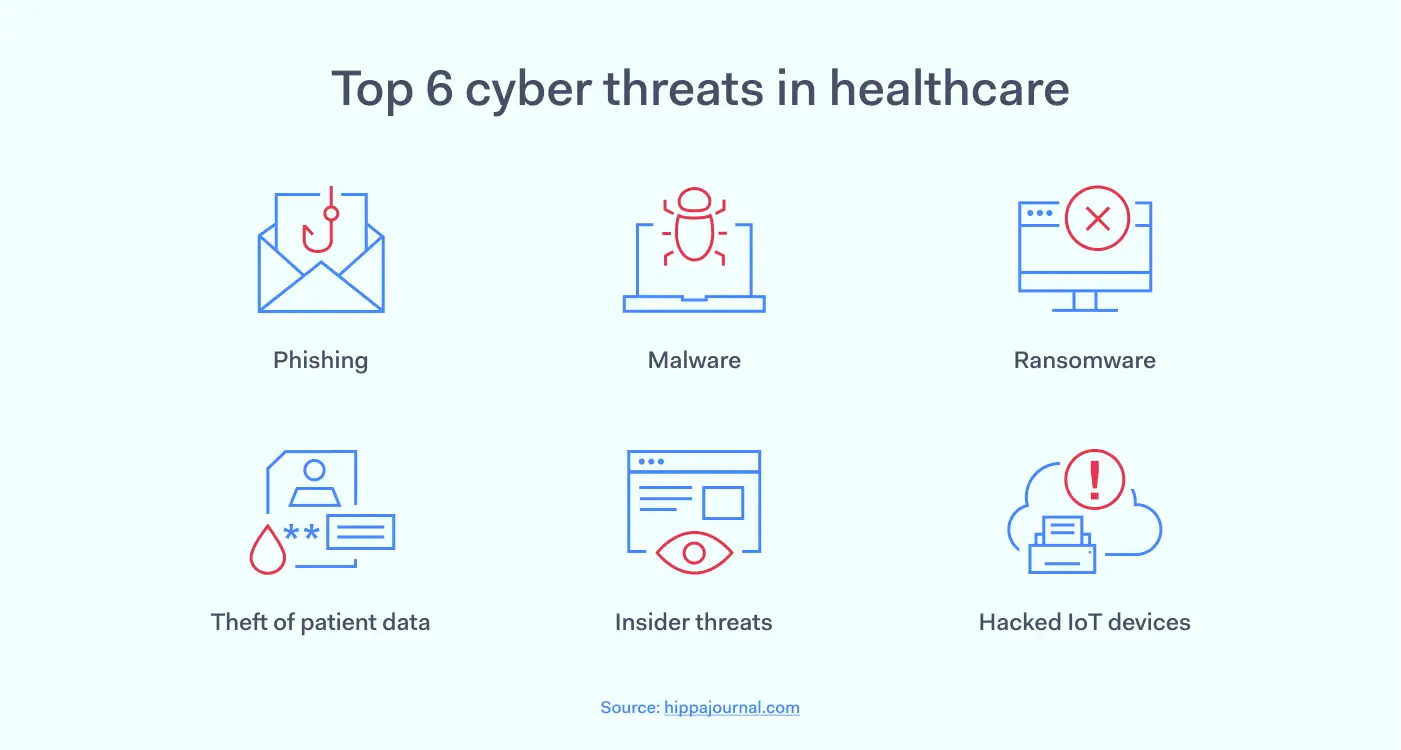
Top 6 cyber threats for healthcare organizations

Threats for the healthcare industry come in many forms, from ransomware to theft of personal information. In 2022, the biggest security breaches in healthcare came from phishing and malware attacks.

  • Phishing

Phishing targets individuals by tricking them into disclosing sensitive information, clicking a malicious link, or opening a malicious attachment. The most common telltale sign of a phishing email is that it conveys a sense of urgency or preys on fear or greed. Scammers can also use social media, text messages, and voice calls for phishing. 

  • Malware

It’s malicious software installed on a computer without a user’s consent. It can steal passwords or money or perform other malicious actions. Examples of malware include a Trojan horse, spyware, adware, or a virus.

  • Ransomware

Ransomware is a form of malware that encrypts files on a user’s device and locks them out until they pay the hacker money to release them. 

  • Theft of patient data

Stolen patient medical records may be sold on the dark web and used for insurance fraud or identity theft. Often, data recovery is not possible.

  • Insider threats

These risks can come from current or former staff members or contractors and happen intentionally or by negligence. For example, an employee may accidentally click a malicious link in a phishing email or skip security protocols to make their job easier. 

  • Hacked IoT devices

Hackers take advantage of vulnerabilities in devices connected by IoT, such as handheld devices, camera sensors, or CT scanners.

Top 6 cyber risks in healthcare

All the facts and statistics mentioned earlier mean one thing: cybersecurity in healthcare is a burning issue. Criminals can disrupt health businesses with malware, ransomware, or phishing. And damage the organization’s reputation and endanger patients’ lives. But apart from that, healthcare organizations are exposed to various cyber risks, such as unprotected access to PHI, human error, vulnerabilities of legacy systems, third-party vendors, and a lack of regular cyber risk audits. 

Risk 1: Unsecured access to PHI

According to new HIPAA encryption requirements, ensuring all sensitive patient data is unreadable, undecipherable, and unusable to any person or software program without access rights is mandatory. For your organization, it means implementing robust security controls that help store Protected Health Information (PHI) safely and protect it from unauthorized access.

Risk 2: Human error

82% of data breaches involved a human element, including social attacks, errors, and misuse.  according to Verizon’s 2022 Data Breach Investigations Report. Understanding how human error affects your organization can help you mitigate risks for the future. Almost one-third of such incidents involved a person abusing their use of internal resources. For example, a doctor shares access to their work-issued device with children, who click on a malicious link and download malware. 

Risk 3: Vulnerabilities of legacy systems 

Outdated technology opens doors for cybercriminals. Legacy devices and operating systems are vulnerable because they can’t update properly. This means inadequate security control and weaknesses in the system can’t be patched. 

However, some healthcare organizations delay transitioning to up-to-date security solutions because of tight budgets or complacency. They choose to fix a problem only after a system failure or a cyber attack. Deploying technology that encrypts data, monitors authorized users, and blocks unauthorized user access can help minimize cyber risks. 

Risk 4: Third-party vendors

The number of business associates that handle sensitive data has grown with the volume of electronic medical records. According to an analysis by Fortified Health Security, third-party vendors accounted for 16% of data breaches in the first half of 2022. 

In 2022, the largest third-party vendor data breach, which affected almost 4 million individuals, happened through a ransomware attack at Eye Care Leaders. The breach impacted at least 39 covered entities, as well. 

Risk 5: Compliance 

Healthcare organizations also face regulatory challenges. Protecting patient privacy according to the latest HIPAA and GDPR rules can be complex. Besides following compliance guidelines, your organization should implement the best cyber security practices. Failure to keep patient records private may result in substantial penalties and harm your reputation. 

Risk 6: The absence of risk assessments

Every healthcare organization should conduct a regular risk assessment to identify vulnerabilities and risks to the confidentiality and integrity of PHI.  The evaluation should determine your organization’s capabilities for detecting, preventing, and responding to cyberattacks. It’s also crucial to know where your sensitive information is, what threats your organization faces, and your system’s vulnerabilities and security holes. And what your action plan in case of an attack is. 

Best practices for healthcare cybersecurity challenges 

This year’s IBM Data Breach Report demonstrates no system is impenetrable. But healthcare cybersecurity is all about basic security measures that stop criminals and make them look for an easier target. What are the best practices for minimizing cyber risks? Here is a list of the strategies worth adopting: 

  • Deploy verified cybersecurity software

Install cybersecurity software on every connected device and secure your network. 

  • Update your software regularly

Prompt, regular updates will address patches and vulnerabilities.

  • Train your staff on cybersecurity

Your employees should be aware of cyber threats and how to detect them. 

  • Strengthen your system access controls 

Restrict access to your most sensitive data and monitor who accesses it.

  • Conduct regular risk assessments 

Identify weaknesses in your system and mitigate risks. Determine where your sensitive information is and protect access to it.

  • Ensure your business associates have strict security policies 

Some business associates have lax policies that can create problems for the healthcare organization they cooperate with. Don’t let stolen vendor credentials or data will compromise your organization. 

Cybersecurity solutions for healthcare organizations

Securing your organization from cyber threats can be overwhelming. Protecting your valuable data and critical equipment is complicated but doesn’t have to be complex. That’s why we have prepared a guide on security solutions tailored to the health industry.  

  • Network security

The key to combating any external threats is network visibility and responsive protection. A solution that quickly isolates risks will prevent your network from being exposed. Setting permissions and policies for secure users and apps across multiple devices is also good. This way, you will ensure that only authorized staff will access your confidential data. 

  • Application security 

The best way to secure access to your applications is to verify and authenticate every user, device, and connection. This Zero-trust approach enforces mandatory checks at every step and minimizes security gaps. It also enables your staff to work remotely and on multiple devices. 

  • Endpoint security

If your devices are left unsecured, they can be a gateway for breaches, and an infected endpoint will affect your organization’s functioning ability. A comprehensive solution for endpoint protection uses data encryption and enforces unified security policies on all servers, networks, and endpoints. It also monitors 24/7 access to your resources, alerting you if there is suspicious activity. 

  • Data security

Encrypting sensitive healthcare data can help conceal it from outsiders. MFA will add strength to authentication processes. Permission sets enable managing data access, meaning only authorized users can access it.  Everyone else will be blocked by default until granted the necessary privileges. Before you apply access controls, you need to classify your data accordion to its value and vulnerability. 

  • Cloud data security

As healthcare organizations move their assets and data to the cloud, cloud services need robust protection. Cloud providers and businesses should share responsibilities to ensure data security, but this doesn’t mean you will always have a full view of your infrastructure. The provider may move data without you even knowing it. That’s why having a clear division of responsibilities is crucial. Also, you should encrypt everything in the cloud and set strict access permissions. You add IP allowlists to only connect specific IP ranges to your network. 

How NordLayer can help 

You can protect access to your sensitive data and transition your organization towards the SSE framework by implementing our solutions for Zero Trust Network Access.

NordLayer also provides an adaptive network security solution that easily integrates with your existing infrastructure and provides secure access to sensitive resources.

Contact our sales team and discover how to protect your patient data from cyber threats.

Disclaimer: This article has been prepared for general informational purposes and is not legal advice. We hope that you will find the information informative and helpful. However, you should use the information in this article at your own risk and consider seeking advice from a professional counsel licensed in your state or country. The materials presented on this site may not reflect the most current legal developments or the law of the jurisdiction in which you reside. This article may be changed, improved, or updated without notice.

About Version 2 Limited
Version 2 Digital is one of the most dynamic IT companies in Asia. The company distributes a wide range of IT products across various areas including cyber security, cloud, data protection, end points, infrastructures, system monitoring, storage, networking, business productivity and communication products.

Through an extensive network of channels, point of sales, resellers, and partnership companies, Version 2 offers quality products and services which are highly acclaimed in the market. Its customers cover a wide spectrum which include Global 1000 enterprises, regional listed companies, different vertical industries, public utilities, Government, a vast number of successful SMEs, and consumers in various Asian cities.

About Nord Security
The web has become a chaotic space where safety and trust have been compromised by cybercrime and data protection issues. Therefore, our team has a global mission to shape a more trusted and peaceful online future for people everywhere.

About NordLayer
NordLayer is an adaptive network access security solution for modern businesses – from the world’s most trusted cybersecurity brand, Nord Security.

The web has become a chaotic space where safety and trust have been compromised by cybercrime and data protection issues. Therefore, our team has a global mission to shape a more trusted and peaceful online future for people everywhere.