Skip to content

Savour ITSM’s perfect burger: People, processes and technology

In this bleak world where technology has become a vital necessity, IT Service Management (ITSM) has become a key tool for many businesses.” It sounds like the introduction to a dystopian novel, doesn’t it? Easy, it’s not like that, today I didn’t get up very like Aldous Huxley.

We will rather answer the question: What is ITSM exactly? 

Don’t you worry, I will not get too involved with the technicalities, you already know what we’re like, I will explain it to you in an easy way and worth prizes such as the Nobel Prize for scientific dissemination.

Advantages of ITSM: Improve IT service management

What exactly is ITSM?

*Warning: Allegory for children.

Imagine that ITSM is the detective of a company. It’s the tough guy who helps the organization understand how technology works in the business and how it can become more efficient. But to be a good detective, ITSM needs three elements: people, processes, and technology.

People are important in ITSM because they are the ones who use the company’s IT services. End users, employees, customers, and external vendors are all people who need the company’s IT services to do their jobs. 

The implementation of ITSM helps define the roles and responsibilities of each user group, and ensures that everyone understands how they can contribute to improving the management of IT services.

Processes are also important in ITSM. And we’ll go crazy inserting an analogy into another analogy. Inception! 

If ITSM were a hamburger, the processes would be like hamburger mince. 

Processes are the different stages that the company’s IT services go through, such as incident management, IT asset management, and change management. A good ITSM implementation will help the company define these processes and ensure that they are followed correctly.

If we continue with the hamburger simile, technology is like ITSM’s hamburger cheese. It is the ingredient that holds everything together with its caloric value. 

Technology allows the company to automate its processes and improve access to service providers and end users. Automation reduces errors, brings consistency and service metrics based on critical success factors.

Although if you got lost in the middle of my great allegory of detectives and hamburgers I leave you here a more academic and cheeseless definition:

ITSM is the acronym for Information Technology Service Management, which refers to a set of practices, policies, procedures and tools used to plan, design, deliver, operate and control the information technology (IT) services that a company offers to its internal or external customers. 

ITSM is based on the service management approach and focuses on customer satisfaction, continuous improvement of services and efficient management of IT costs and resources. 

ITSM includes processes and areas such as incident management, problem management, change management, asset and configuration management, service level management, and capacity management. 

Implementing ITSM enables companies to improve the quality of their IT services, increase the efficiency and effectiveness of their processes, and reduce the risks and costs associated with information technology management.

Now that we know what ITSM is, what are the keys to its implementation?

Well, there are some key requirements that need to be met.

  • First, the roles and responsibilities of end-users must be defined.
  • Secondly, the processes to be followed must be defined, such as incident management, IT asset management and change management.
  • And finally, the right technology must be implemented to automate these processes and improve access to IT services.

When implementing new ITSM processes, the key is to adapt to the specific needs of your business. 

If your IT support team is always working on the same problems, finding the root cause and solving it is undoubtedly the best option. 

For example, if storage space is a recurring problem, deleting files every time the hard drive reaches its maximum capacity is not a long-term solution. 

Instead, installing a hard drive with greater capacity would be a more effective solution over time.

In ITSM, the incident management process becomes problem management. 

In this example, the lack of storage space is the incidence, while the storage capacity of the hard drive is the underlying problem.

But the implementation of ITSM processes depends not only on the tool used, but also on a culture change. 

It’s important for end users to see the IT team as a service provider, rather than just another department of the company.

Key points to consider when implementing ITSM processes are team maturity and size, identifying specific issues, and selecting the right framework. 

Each framework has its own structure and processes, so the choice will depend largely on the problems to be solved.

Once ITSM has been implemented, what are the advantages and why is it important?

There are many benefits to implementing ITSM. 

ITSM processes are key for companies looking to optimize the management of their IT services and improve customer satisfaction. 

Clearly defining service delivery goals, publishing an IT Service Catalog, and creating well-trained and enthusiastic support teams are just a few of the ways ITSM can benefit a company.

In addition, a good ITSM implementation can ensure quick troubleshooting, saving end users time and reducing help desk workload. 

This, in turn, can reduce IT service provision costs and increase service availability and trust.

Last but not least, ITSM ensures compatibility with different regulations or legal regulations, which is crucial for companies looking to comply with security and privacy standards. 

In short, implementing ITSM processes can provide a number of benefits to businesses, from better management of IT services to greater customer satisfaction and greater compliance with legal regulations.

But what about ITIL?

ITIL is a very popular ITSM framework, but it’s not the only option. 

There are other frameworks and standards, such as COBIT, ISO 20000, MOF and USMBOK, that can also be used to manage IT services. 

The main difference between ITIL and other frameworks is that ITIL is very prescriptive and specific about how IT services should be managed, while other frameworks are more flexible and allow companies to customize their processes according to their specific needs.

Despite the differences between ITSM and ITIL, both are important for IT service management. 

ITIL is a good choice for companies looking for a more detailed and structured solution, while other frameworks may be better suited for companies that need a more flexible and customized solution.

Conclusions

What else can we say, the implementation of ITSM is fundamental for the efficient management of IT services in companies. 

Like a seasoned detective, ITSM helps the organization understand how technology works in the business and how it can be more efficient. 

With the right definition of roles and responsibilities, well-defined processes, and implementation of the right technology, ITSM can improve the quality of IT services and increase end-user satisfaction. 

Whether using ITIL or any other framework, ITSM is a key tool for any company that wants to stay competitive in the increasingly technological world in which we live.

And remember, if you ever have problems with your company’s IT services, don’t worry, because ITSM is here to help you solve the mystery and make everything run smoothly!

As the famous detective Sherlock Holmes once said, “when the impossible has been removed, what remains, however improbable it may seem, is the truth”. And the truth is that ITSM is a powerful tool to improve the management of IT services in your company.

Dimas P.L., de la lejana y exótica Vega Baja, CasiMurcia, periodista, redactor, taumaturgo del contenido y campeón de espantar palomas en los parques. Actualmente resido en Madrid donde trabajo como paladín de la comunicación en Pandora FMS y periodista freelance cultural en cualquier medio que se ofrezca. También me vuelvo loco escribiendo y recitando por los círculos poéticos más profundos y oscuros de la ciudad.

Dimas P.L., from the distant and exotic Vega Baja, CasiMurcia, journalist, editor, thaumaturgist of content and champion of scaring pigeons in parks. I currently live in Madrid where I work as a communication champion in Pandora FMS and as a freelance cultural journalist in any media offered. I also go crazy writing and reciting in the deepest and darkest poetic circles of the city.

About Version 2 Limited
Version 2 Digital is one of the most dynamic IT companies in Asia. The company distributes a wide range of IT products across various areas including cyber security, cloud, data protection, end points, infrastructures, system monitoring, storage, networking, business productivity and communication products.

Through an extensive network of channels, point of sales, resellers, and partnership companies, Version 2 offers quality products and services which are highly acclaimed in the market. Its customers cover a wide spectrum which include Global 1000 enterprises, regional listed companies, different vertical industries, public utilities, Government, a vast number of successful SMEs, and consumers in various Asian cities.

About PandoraFMS
Pandora FMS is a flexible monitoring system, capable of monitoring devices, infrastructures, applications, services and business processes.
Of course, one of the things that Pandora FMS can control is the hard disks of your computers.

No more mistakes! Learn how to create strong, flawless software deployments with the help of automation

Friends, welcome to the world of software development! There have been more changes here in recent years than in Lady Gaga’s wardrobe during her Super Bowl halftime performance! You know, Agile, DevOps, the Cloud… These innovations have enabled organizations to develop and deploy software faster and more efficiently than ever before. One of the key DevOps practices is automated deployments.

In this article, we will discuss the importance of creating and monitoring strong automated implementations.

Automated deployments: achieve error-free software

Why do you need strong automated deployments?

Traditionally, software deployment was a manual process that implied manifold steps and was prone to human error. 

Automated implantations, on the other hand, allow organizations to implement software automatically without human intervention, reducing the chances of errors.

Automated implementations also offer the following advantages:

  1. Faster deployment: Manual implementation is a slow process that implies manifold steps. Automated implementation reduces the implementation time and allows companies to implement software more frequently.
  2. Coherence: Automated deployments guarantee that the deployment process is documented and can be repeated, which reduces the chances of errors caused by human errors.
  3. Downgrade: Automated deployments allow organizations to return to the previous software version quickly and simply if some problem arises.
  4. Profitability: Automated implementations reduce the need for manual intervention, which can be expensive and time-consuming.
  5. Improved tests: Automated deployments can be tested in a test or pre-production environment before going into production, reducing the likelihood of problems arising.

Steps to create strong automated implementations

Creating strong automated deployments involves the following steps:

  • Defining the deployment process: Define the steps needed to deploy the software, including dependencies, configuration settings, and environment requirements.
  • Automating the deployment process: It uses tools like Terraform, Ansible, Jenkins, and YAML to write the deployment process as code, store it in source control, and test it.
  • Add doors and approvals: It adds doors and approvals to require external approvals, perform quality validations, and collect status signals from external services before the implementation can be completed.
  • Develop a rollback strategy: Develop a rollback strategy that includes feature indicators and bluish-green deployments to roll back to the previous version of the software easier should any issues arise.
  • Implement automated monitoring: Implement automated monitoring of system metrics such as memory usage, disk usage, logged errors, database performance, average database response time, long-duration queries, simultaneous database connections, and SQL query performance.
  • Test and refine: Test and refine the automated deployment process, making the necessary adjustments.

Monitoring of strong automated deployments

Automated implementations must be accompanied by automated monitoring.

Organizations must monitor system metrics such as memory usage, disk usage, logged errors, database performance, average database response time, long-duration queries, simultaneous database connections, and SQL query performance.

Mature monitoring systems make obtaining a baseline prior to implementation easier as well as spotting deviations after the implementation.

Holistic hybrid cloud monitoring tools that alert organizations to errors or abnormal patterns are an important part of feature flags and bluish-green deployments.

They are the indicators that allow organizations to find out whether they need to deactivate a feature or return to the previous production environment.

Tools and processes

Although implementation and monitoring tools alone do not guarantee the success of the implementation, they certainly help.

It is also important to create a DevOps culture of good communication, design reviews throughout development, and thorough testing.

Automated deployments are just part of the DevOps lifecycle, and organizations can decide at what point in the cycle automation it adds value and create it in small chunks over time.

Automated deployments reduce the risk and effort required. Their high return on investment often makes them a great place to start automating considering DevOps best practices.

Conclusion

Automated deployments are an essential part of the DevOps culture. They reduce the likelihood of human error, allowing faster deployment.

Closing the circle with a reference to Lady Gaga:

Automated deployments are like having Lady Gaga’s costume assistant as your personal assistant – there’s no room for error!

Dimas P.L., de la lejana y exótica Vega Baja, CasiMurcia, periodista, redactor, taumaturgo del contenido y campeón de espantar palomas en los parques. Actualmente resido en Madrid donde trabajo como paladín de la comunicación en Pandora FMS y periodista freelance cultural en cualquier medio que se ofrezca. También me vuelvo loco escribiendo y recitando por los círculos poéticos más profundos y oscuros de la ciudad.

Dimas P.L., from the distant and exotic Vega Baja, CasiMurcia, journalist, editor, thaumaturgist of content and champion of scaring pigeons in parks. I currently live in Madrid where I work as a communication champion in Pandora FMS and as a freelance cultural journalist in any media offered. I also go crazy writing and reciting in the deepest and darkest poetic circles of the city.

About Version 2 Limited
Version 2 Digital is one of the most dynamic IT companies in Asia. The company distributes a wide range of IT products across various areas including cyber security, cloud, data protection, end points, infrastructures, system monitoring, storage, networking, business productivity and communication products.

Through an extensive network of channels, point of sales, resellers, and partnership companies, Version 2 offers quality products and services which are highly acclaimed in the market. Its customers cover a wide spectrum which include Global 1000 enterprises, regional listed companies, different vertical industries, public utilities, Government, a vast number of successful SMEs, and consumers in various Asian cities.

About PandoraFMS
Pandora FMS is a flexible monitoring system, capable of monitoring devices, infrastructures, applications, services and business processes.
Of course, one of the things that Pandora FMS can control is the hard disks of your computers.

Binary memory protection measures on Windows OS

Binary memory protection is a core part of cybersecurity, but there are many different options for implementing it. In this article, we explore common mechanisms and protection measures for Windows OS.

Why is binary memory protection important?

You may remember when the Blaster worm struck the internet, or more recently when WannaCry caused global havoc using a leaked EternalBlue Windows OS exploit. Both are examples of malware that used buffer overflow memory corruption vulnerabilities, causing remote code execution and infecting millions of machines worldwide.

Most operating systems, written in C or C++, have limited memory protection, allowing these attacks to occur. Malware like Blaster and WannaCry manipulate the environment, instructions, and memory layout of a program or operating system to gain control over it.

Security professionals have implemented mechanisms to prevent software exploitation and minimize damage caused by memory corruption bugs. A “silver bullet” solution would be a mechanism that makes it challenging and unreliable for attackers to exploit vulnerabilities, allowing developers to leave buggy code in place while they work on fixing or rewriting it in memory-safe languages.

Common mechanisms and protection measures

Let’s review some of the most common mechanisms and protection measures provided inside Windows OS from Windows XP to Windows 11.

ASLR

Address space layout randomization (ASLR) is a computer security technique that prevents an attacker from reliably jumping to, for example, a particular exploited function in a program’s memory. ASLR randomly arranges the address space positions of a process’s key data areas, including the base of the executable and the positions of the stack, heap, and libraries. The effectiveness of ASLR depends on the entropy of the process’s address space (simply put, the probability of finding a random local variable).

Because of this protection, exploit payloads must be uniquely tailored to a specific process address space.

Vista and Windows Server 2008 were the first operating systems in the Windows family to provide ASLR natively, though this system was first developed back in 2001. Prior to these releases, there were several third-party solutions like WehnTrust available that provided ASLR functionality to varying degrees.

When Symantec conducted research on ASLR in Windows Vista, they found that ASLR had a significant effect when implemented in Windows 8 (or Windows 8.1). It provided higher entropy for address space layouts. The larger address space for 64-bit processes also increased the entropy of the ASLR for any given process.

  Exploit mitigation improvements in Windows 8

Windows 8 added randomization for all BottomUp and TopDown memory allocations, increasing the effectiveness of ASLR, which was not available in Windows 7.

Exploit mitigation improvements in Windows 8   Exploit mitigation improvements in Windows 8

In Windows 8, Microsoft introduced operating system support to force EXEs/DLLs to be rebased at runtime if they did not opt-in to ASLR. This mitigation can be enabled system-wide or on a per-process basis. You can modify the settings of mandatory ASLR through the Windows Security app.

ASLR, like any other security technique, has its weaknesses and attack vectors (heap spray, offset2libc, Jump Over ASLR, and others). Even one memory disclosure can completely defeat ASLR and provide an attacker with a significant opportunity. In addition to this, ASLR is only efficient when all executables and shared libraries loaded in the address space of a process are randomized. For example, research by Trend Micro researchers showed that Microsoft Edge browser exploit mitigations, including ASLR, could be bypassed. You can watch a video from the BlackHat conference to learn more.

DEP

Data Execution Prevention (DEP) is a protection mechanism that blocks the execution of code in memory pages marked non-executable. The NX (No-Execute) bit is a protection feature on CPUs used by DEP to prevent attackers from executing shellcode (instructions injected and executed by attackers) on the stack, heap, or in data sections. If DEP is enabled and a program attempts to execute code on a non-executable page, an access violation exception will be triggered.

Starting with Windows XP Service Pack 2 (2004) and Windows Server 2003 Service Pack 1 (2005), the DEP was implemented for the first time on x86 architecture.

An application can be compiled with the /NXCOMPAT flag to enable DEP for that application. You can also use editbin.exe /NXCOMPAT over a .exe file to enable it on a previously compiled file.

On 64-bit versions of Windows, DEP is always turned on for 64-bit processes and cannot be disabled. Windows also implemented software DEP (without the use of the NX bit) through Microsoft’s “Safe Structured Exception Handling” (SafeSEH), which I will talk about a bit later.

Despite being a useful protection measure, the NX bit can be bypassed. This leaves us unable to execute instructions placed on the stack, but still able to control the execution flow of the application. This is where the ROP (Return Oriented Programming) technique becomes relevant.

GS (Stack Canaries)

Stack canaries are a security feature that helps protect against binary exploits. They are random values that are generated every time a program is run. When placed in certain locations, they can be used to detect stack corruption. The /GS compiler option, when specified, causes the compiler to store a random value on the stack between the local variables and the return address of a function. According to Microsoft, these application elements will be protected:

  • Any array (regardless of length or element size)

  • Structs (regardless of their contents)

In a typical buffer overflow attack, the attacker’s data is used to try to overwrite the saved EIP (Extended Instruction Pointer) on the stack. However, before this can happen, the cookie is also overwritten, rendering the exploit ineffective (though it may still cause a denial of service). If the function epilogue detects the altered cookie and the application terminates.

Example of memory layout during the buffer overflow
 
Example of memory layout during the buffer overflow

The second important protection mechanism of /GS is variable reordering. To prevent attackers from overwriting local variables or arguments used by the function, the compiler will rearrange the layout of the stack frame and will put string buffers at a higher address than all other variables. So when a string buffer overflow occurs, it cannot overwrite any other local variables.

It was introduced with the release of Visual Studio 2003. Two years later, they enabled it by default with the release of Visual Studio 2005.

However, this protection measure is also not bullet-proof, since the attacker can either try to read the canary value from the memory or brute force the value. By using these two techniques, attackers can acquire the canary value, place it into the payload, and successfully redirect program flow or corrupt important program data.

CFG/XFG

Control Flow Guard (CFG) is a highly-optimized platform security feature that was created to combat memory corruption vulnerabilities. Placing tight restrictions on where an application can execute code makes it much harder for exploits to execute arbitrary code through vulnerabilities such as buffer overflows.

CFG creates a per-process bitmap, where a set bit indicates that the address is a valid destination. Before performing each indirect function call, the application checks if the destination address is in the bitmap. If the destination address is not in the bitmap, the program terminates.

How Windows CFG works
 
How Windows CFG works

Microsoft has enabled a new mechanism by default in Windows 10 and in Windows 8.1 Update 3. Developers can now add CFG to their programs by adding the /guard:cf linker flag before program linking in Visual Studio 2015 or newer. As of the Windows 10 Creators Update (Windows 10 version 1703), the Windows kernel is compiled with CFG.

To enhance CFG (Control Flow Guard), Microsoft introduced Xtended Control Flow Guard (XFG). By design, CFG only checks if functions are included in the CFG bitmap, which means that technically if a function pointer is overwritten with another function that exists in the bitmap, it would be considered a valid target.

XFG addresses this issue by creating a ~55-bit hash of the function prototype (consisting of the return value and function arguments) and placing it 8 bytes above the function itself when the dispatch function is called. This hash is used as an additional verification before transferring the control flow.

Getting back to the CFG, there are multiple techniques to bypass it. For example, you can set the destination to code located in a non-CFG module loaded in the same process, or find an indirect call that was not protected by CFG. A brief write-up about the CFG bypass by Zhang Yunhai can be found here.

SafeSEH

SafeSEH is an exception handler. An exception handler is a programming construct used to provide a structured way of handling both system and application-level error conditions. Commonly they will look something like the code sample below:

1
try {
2
}
3
catch (Exception e)
4
{
5
// Exception handling goes here
6
}

Windows supplies a default exception handler when an application has no exception handlers applicable to the associated error condition. When the Windows exception handler is called, the application will be terminated.

Exception handlers are stored in the format of a linked list with the final element being the Windows default exception handler. This is represented by a pointer with the value 0xFFFFFFFF. Elements in the SEH chain before the Windows default exception handler are the exception handlers defined by the application.

Exception handler layout on stack
 
Exception handler layout on stack

If an attacker can overwrite a pointer to a handler and then cause an exception, they might be able to get control of the program.

SafeSEH is a security mechanism introduced with Visual Studio 2003. It works by adding a static list of good exception handlers in the PE file at the timing of compiling. Before executing an exception handler, it is checked against the table. Execution is passed to the handler only if it matches an entry in the table. SafeSEH only exists in 32-bit applications because 64-bit exception handlers are not stored on the stack. By default, they build a list of valid exception handlers and store it in the file’s PE header.

Preventing SEH exploits in most applications can be achieved by specifying the /SAFESEH compiler switch. When /SAFESEH is specified, the linker will also produce a table of the image’s safe exception handlers. This table specifies for the operating system which exception handlers are valid for the image, removing the ability to overwrite them with arbitrary values. If you want to see how this mitigation technique can be bypassed in real-life, this blog post offers more useful information.

Conclusion

Memory corruption vulnerabilities have plagued software for decades. As mentioned in the beginning, there are multiple mitigation techniques to prevent software exploitation and minimize damage caused by memory corruption bugs. However, those protections are definitely not a “silver bullet” solution for all memory corruption vulnerabilities.

For the developer, this means that no one should not blindly rely on the OS-provided protections. Instead, try to propagate secure coding practices and integrate security toolings like fuzzers and static code analyzers.

Lastly, move to memory-safe languages like Rust, if possible. For the attackers, even if the target application has all available mitigation measures, there may still be ways to bypass those protections.

About Version 2 Limited
Version 2 Digital is one of the most dynamic IT companies in Asia. The company distributes a wide range of IT products across various areas including cyber security, cloud, data protection, end points, infrastructures, system monitoring, storage, networking, business productivity and communication products.

Through an extensive network of channels, point of sales, resellers, and partnership companies, Version 2 offers quality products and services which are highly acclaimed in the market. Its customers cover a wide spectrum which include Global 1000 enterprises, regional listed companies, different vertical industries, public utilities, Government, a vast number of successful SMEs, and consumers in various Asian cities.

About Nord Security
The web has become a chaotic space where safety and trust have been compromised by cybercrime and data protection issues. Therefore, our team has a global mission to shape a more trusted and peaceful online future for people everywhere.

About NordLayer
NordLayer is an adaptive network access security solution for modern businesses – from the world’s most trusted cybersecurity brand, Nord Security.

The web has become a chaotic space where safety and trust have been compromised by cybercrime and data protection issues. Therefore, our team has a global mission to shape a more trusted and peaceful online future for people everywhere.

Optimizing your business IT processes

In today’s fast-paced business environment, information technology shapes the way companies operate, compete, and grow. The pace of technological advancements adoption can play a deciding role in a company’s success or failure. However, how this can be achieved within an organization may not always be clear.

For this reason, we’ve invited co-founder and CPO at Kubernetes automation, optimization, security, and cost management platform CAST AI, Laurent Gil. Additionally, our Head of Platform Engineering at NordLayer, Carlos Salas, for his take on improving the current organization’s IT infrastructure.

Let’s take a deep dive into your current IT infrastructure assessment, automation areas identification, the right automation tools selection, its implementation, and the best practices.

Assessing your current IT infrastructure

Laurent Gil shared his valuable insights on how businesses can optimize their IT infrastructure to drive efficiency and productivity. According to him, one crucial step in this process is conducting a comprehensive assessment of your current infrastructure.

“A successful IT optimization strategy always starts with a gaining clarity around the current state of the infrastructure. A thorough assessment helps to identify issues and bottlenecks that are good candidates for automation – and where automation will make the biggest impact. Quick wins are just as important as long-term strategy and keeping your eye on the bigger picture, considering your company’s specific needs and direction.”

Click to tweet

Here’s how your current IT infrastructure could be evaluated in 8 steps:

  1. Define assessment objectives. Assessment objectives can be diverse, and they should focus on particular areas that could use improvements. For some businesses, it may be ironing out security vulnerabilities, while for others, it may be performance improvements. 

  2. Gather information. Regardless of assessment objectives, the next step will always be data collection. This will form a solid foundation for the evaluation process providing useful insights in later steps.

  3. Evaluate your used hardware and software. All used servers, storage devices, routers, switches, as well as operating systems, databases, applications, and security software should be reviewed. Check for potential bottlenecks and clunky setups that are slowing down your operations. 

  4. Perform network checks. Analyze your network topology, bandwidth, and latency. Evaluate your network security measures, such as firewalls, intrusion detection, and prevention systems.

  5. Look into data backups and disaster recovery. Verify that your data backup and recovery plans are up-to-date, reliable, and effective. Test your disaster recovery procedures to ensure that they meet your recovery time objectives.

  6. Analyze your security setup. Assess your security policies and procedures, including access controls, authentication, and authorization. Test your security controls to identify weaknesses or gaps.

  7. Consider the IT budget. Evaluate your IT budget and spending to identify areas for improvement or cost savings. Identify potential areas where technology investments can drive business value and growth.

  8. Document your findings. Document your findings and recommendations in a detailed report. This will serve as a reference document providing actionable recommendations for improving your IT infrastructure.

Identifying areas for automation

Findings from the IT infrastructure assessment should help you identify areas that could benefit the most from automation. As different companies have different IT struggles, going through this process should be a highly individualized approach. That said, here are some common areas that could be easily automated.

Data entry and data processing. Routine maintenance tasks like data entry, migration, and validation can be easily automated using macros, scripts, and other robotic processes.

Network and system administration. Tasks like server monitoring, backup, and patch management can be time-consuming and repetitive. Automations enable the creation of templates to perform the tasks identically, leaving less room for human error. In addition, this frees the staff from manual processes allowing them to focus on strategic activities.

Software deployment. Every software deployment instance involves a lot of repetitive tasks to ensure that it’s deployed correctly and without errors. Automating them can help reduce the time and effort required for deployment and improve the reliability of the process.

Customer support. Simple customer support tasks like answering frequently asked questions, providing account information, and processing routine requests can be solved without human involvement. Leveraging chatbots and virtual assistants can combine convenience and efficiency for businesses and their customers.

Choosing automation tools

When it comes to selecting automation tools, Laurent Gil highlights the significance of putting business needs at the forefront.

“I’ve seen the benefits automation can bring to organizations of all sizes firsthand. However, not all automation tools are created equal, and choosing the right one for your business can be a daunting task.

What you need to consider are first and foremost your specific business requirements. Understanding business needs and matching them to the right automation offering ensures that what you invest in represents the best fit for your company.”

Click to tweet

Here’s a brief overview of the approach that businesses can take when selecting automation tools:

Research what’s available on the market 

Clear business objectives and defined areas for improvement will allow you to fill in the gaps with automation tools. This can involve various routes like reviewing industry publications or consulting with vendors directly.

Evaluate select tool features 

Once a list of potential features has been compiled, it’s important to evaluate its features. Depending on needed functionalities, this can involve scalability, customizability or other ease of use adjustments.

Consider integrations

Industry expert and Head of Platform Engineering Carlos Salas highlighted the importance of considering the bigger picture when selecting automation tools, highlighting their interoperability.

“Whatever automation tools you select won’t exist in a vacuum, so thinking about potential integrations with existing systems and processes isn’t a bad idea.”

“Data security is paramount. Before implementing any automation tool, it’s imperative to thoroughly evaluate its capabilities in protecting sensitive information and adhering to established security protocols.”

Click to tweet

This paves the way for seamless automation implementation without hiccups and ensures optimal performance down the line.

Test and trial 

Before making a final decision, businesses should take chosen automation tools for a test drive. Various methods like setting up a proof of concept or pilot project to evaluate the effectiveness of the tool in real-world scenarios will help to realistically evaluate its usefulness.

Implementing automation

Implementing business IT automation can be a complex task that requires careful planning and execution. Here are some general steps that you can follow to implement business IT automation.

  1. Design the automation process. Start by creating a plan for automation, including a timeline and a list of tasks to be automated. It also helps to break the process into smaller tasks and identify the rules and conditions that must be followed.

  2. Deploy the automation. The exact route of automation deployment will depend on whether it’s an in-house built tool or a third-party provider was chosen. Still, it’s best to test in a production environment initially and, after testing, move on to full-scale implementation.

  3. Train employees. Expect that your workforce will only know how to use it after a while. Expect that there will be a transitionary period during which various training will help staff to familiarize themselves with the tool better.

  4. Evaluate the results. After the automation has been implemented and employees get used to it, it’s worth checking its impact on productivity, efficiency, and accuracy. This information can be highly useful when identifying shortcomings in your current setup as well as planning and identifying new areas for automation.

Best practices for automating IT

To maximize your chances that your automation process goes smoothly, it can be good advice to follow the best industry practices. These include:

Focusing on standardization 

Standardization is critical when it comes to automating IT processes. It also makes it easier to automate routine tasks, reduces the chances of errors, and helps ensure consistency across your IT infrastructure.

Make use of automation platforms

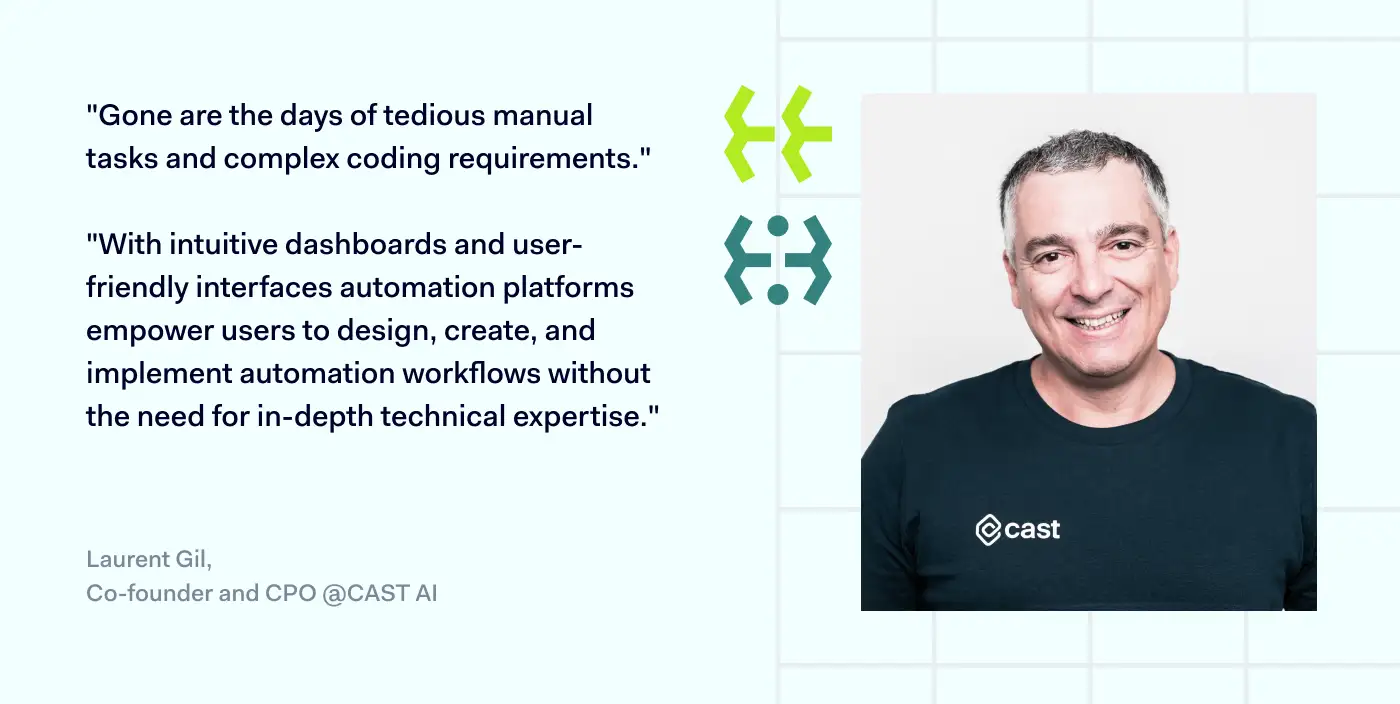
Laurent Gil quote

According to Laurent Gil, automation platforms have the power to enhance business efficiency and streamline operations.

“Automation platforms enable businesses to accelerate and streamline their workflows and processes. Gone are the days of tedious manual tasks and complex coding requirements. With intuitive dashboards and user-friendly interfaces, these platforms empower users to design, create, and implement automation workflows without the need for in-depth technical expertise. And that’s a very good thing.”

Click to tweet

Gil’s words highlight the significant shift brought about by automation platforms in the business landscape. With these powerful tools at their disposal, organizations of all sizes can leverage automation to optimize their workflows, freeing up valuable time and resources for more strategic endeavors.

Adopt a DevOps approach 

Adopting a DevOps approach to automation can help streamline the IT development and deployment processes. Integrating development and operations teams allows the entire software development lifecycle to be automated. This can help you deliver software faster and with fewer errors.

Involving stakeholders 

Stakeholders are the personnel that the automation process will directly impact. Therefore, their input can help to identify potential pain points in advance. This can lead to more effective automation that addresses real problems and is designed to meet the organization’s specific needs.

Bottom line

Optimizing your business IT requires a systematic approach based on evaluating your current setup. The thorough analysis of the current businesses’ IT environment allows them to identify potential automation areas.

The process is finalized by choosing appropriate automation tools and going through the implementation process. It’s important to consider specific needs, evaluate tool features, integration, and test and try the solutions before fully committing. Automation adoption has the potential to make businesses even better adjusted to the current digital landscape.

About Version 2 Limited
Version 2 Digital is one of the most dynamic IT companies in Asia. The company distributes a wide range of IT products across various areas including cyber security, cloud, data protection, end points, infrastructures, system monitoring, storage, networking, business productivity and communication products.

Through an extensive network of channels, point of sales, resellers, and partnership companies, Version 2 offers quality products and services which are highly acclaimed in the market. Its customers cover a wide spectrum which include Global 1000 enterprises, regional listed companies, different vertical industries, public utilities, Government, a vast number of successful SMEs, and consumers in various Asian cities.

About Nord Security
The web has become a chaotic space where safety and trust have been compromised by cybercrime and data protection issues. Therefore, our team has a global mission to shape a more trusted and peaceful online future for people everywhere.

About NordLayer
NordLayer is an adaptive network access security solution for modern businesses – from the world’s most trusted cybersecurity brand, Nord Security.

The web has become a chaotic space where safety and trust have been compromised by cybercrime and data protection issues. Therefore, our team has a global mission to shape a more trusted and peaceful online future for people everywhere.

Elevating healthcare: a definitive guide to robust cloud security in the industry

When compared to other industries, healthcare has remained quite reluctant to digitalization. However, as technology evolves, cloud computing has become vital in streamlining operations and enhancing data accessibility. On the flip side, this also introduces various security concerns that demand attention.

This comprehensive guide delves into the importance of robust cloud security in healthcare. It provides valuable insights to safeguard sensitive patient information, maintain regulatory compliance, and fortify the industry against evolving threats. Join us as we explore all the essential information regarding cloud security in healthcare.

The growing importance of cloud security in healthcare

After the COVID-19 pandemic, the healthcare industry experienced a heightened demand for improved and more modern services. Distributed care and telemedicine pushed healthcare organizations to move to cloud computing, meaning data security had to be considered. The problem is that the same techniques that were valid for data security on-premises don’t translate well into externally kept data.

Some of the challenges facing the healthcare industry transitioning to cloud infrastructure included:

  • Resource and budget strains. Most healthcare providers work with limited IT budgets, so major infrastructure overhauls are long and tedious.

  • Continuity of operations. Data migrations to the cloud shouldn’t disrupt everyday operations, which isn’t something that all healthcare providers can allow.

  • Regulatory compliance. Patient data is highly confidential information so various local regulations sanction its security.

Generally, healthcare organizations want to move to cloud computing to make their services more effective while avoiding unnecessary or unmanaged risks. As patient data is one of the most sensitive data types, ensuring robust security measures is a top priority.

Types of healthcare cloud security solutions

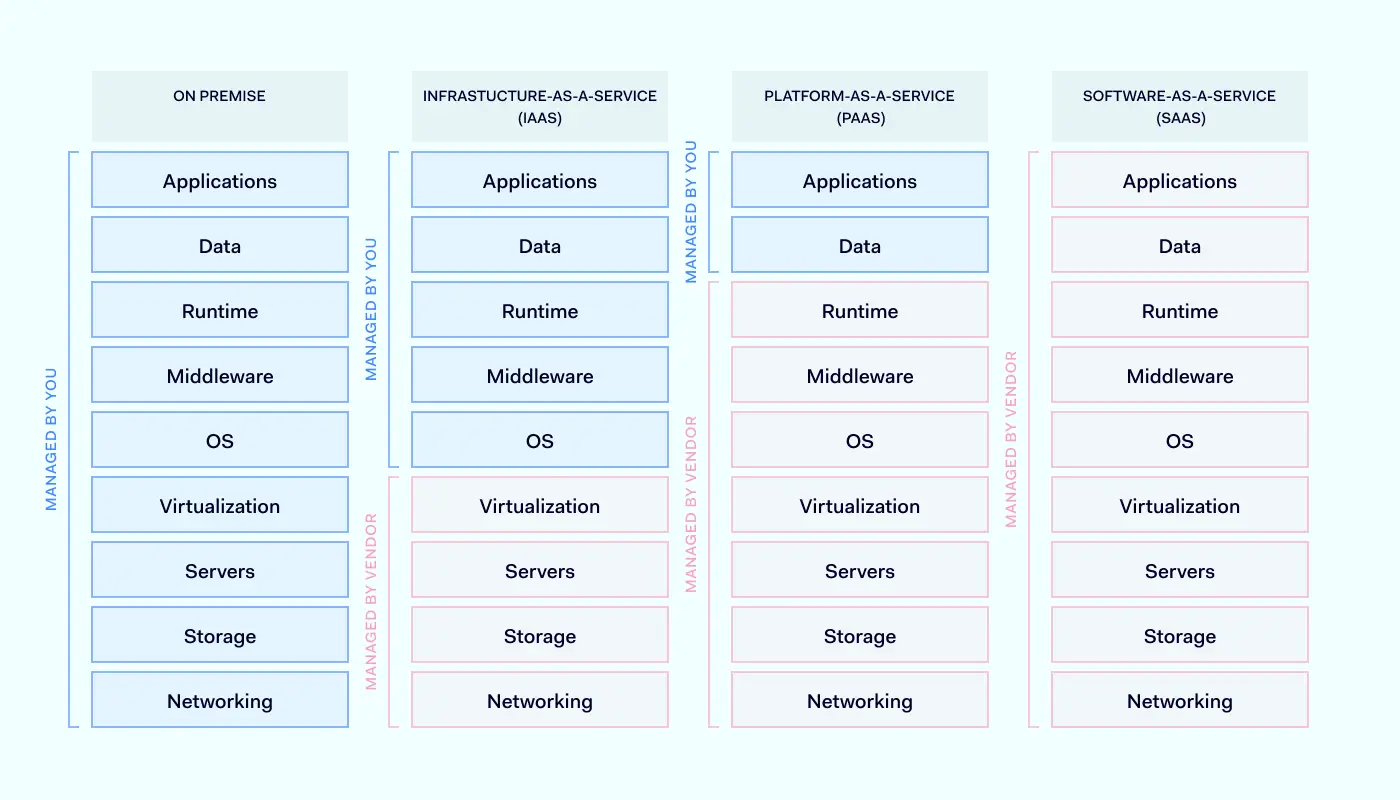
Healthcare providers (and, by extension, most industries) rely on three main types of cloud computing services. This includes Infrastructure-as-a-Service (IaaS), Platform-as-a-Service (PaaS), and Software-as-a-Service (SaaS).

Infrastructure-as-a-Service (IaaS)

Infrastructure-as-a-Service provides virtualized computing resources as services over the internet. In IaaS, the service provider manages and delivers all associated hardware and software components: servers, storage, networking, and virtualization resources. With IaaS, users can provision and control these resources on-demand, scaling them up or down as needed.

Benefits of IaaS in healthcare

Aside from the fact that cloud computing makes it easier to deploy workloads, IaaS has a range of benefits that could be useful for healthcare companies.

  • Scalability and flexibility. By leveraging IaaS, users can rapidly deploy and configure virtual machines, storage, and network components. This allows healthcare organizations to scale their infrastructure up or down based on their actual needs.

  • Disaster recovery. IaaS enables organizations to back up and recover their critical data and remote machines. As critical data and applications are kept in cloud storage, this ensures their availability and integrity.

  • Cost efficiency. IaaS service providers use a flexible pay-as-you-go pricing model allowing users to pay only for the resources they use. This enables cost optimization, eliminating the need for upfront hardware and infrastructure maintenance investments.

Security challenges and how to address them

IaaS security is shared between the service provider and the user. While the service provider is responsible for managing underlying networking, storage, servers, and virtualization, the user is responsible for managing the security of everything running on top of the infrastructure. This involves operating systems, middleware, data, and applications. This setup is not without cybersecurity challenges.

  • Data protection. Sensitive patient data must be protected using encryption and access controls. As the data is physically located in third-party data centers, unauthorized access or breaches are the primary concern.

  • Compliance. Patient data falls under government-protected information, so regulatory compliance applies to it. Organizations must ensure that their IaaS providers adhere to sensitive patient data from unauthorized access or breaches.

For these reasons, IaaS provider selection is crucial to avoid collateral damage. Implementing multi-factor authentication, regular vulnerability assessments, and proactive monitoring can enhance security.

Platform-as-a-Service (PaaS)

Platform-as-a-Service includes everything from IaaS with a dedicated environment for developing, deploying, and managing applications over the internet. It offers tools, frameworks, and services that enable developers to build, test, and run applications. Much like a physical data centre, PaaS providers handle hardware provisioning, operating system management, and network setup, allowing developers to focus solely on application development.

Benefits of PaaS in healthcare

With PaaS, healthcare providers get a platform for developing, testing and deploying applications in the cloud. Here are its main benefits:

  • Rapid application development. PaaS simplifies the application development process, allowing one to skip multiple setup steps and go directly to the deployment. This can accelerate innovation and provide new solutions quickly.

  • Scalability and performance. As with all cloud-based tools, they can automatically scale based on demand, ensuring high availability and optimal performance.

  • Collaboration and integration. PaaS is compatible with existing systems, meaning currently used tools can be integrated into a unified system.

Security challenges and how to address them

When adopting PaaS, organizations need to be wary of its security challenges. Here are some examples:

  • Application security. PaaS environments involve the deployment and running of custom applications. Therefore, businesses should conduct regular code reviews, implement secure coding practices, and perform vulnerability assessments.

  • Secure configuration. Businesses need to make sure that used PaaS platforms are properly configured. This includes firewalls, network access controls, and encryption protocols.

  • Incident response and monitoring. PaaS environments require ongoing monitoring and timely incident response capabilities. By establishing robust logging and monitoring systems and employing detection and prevention mechanisms, we can have a ready system in case of an intrusion.

Software-as-a-Service (SaaS)

Software-as-a-Service is a cloud computing model in which hosted software is delivered over the internet instead of installed on local premises. In this model, the software is centrally hosted by a provider who manages and maintains the underlying infrastructure, database, and updates. Users only pay a subscription fee to access and use the software on a pay-as-you-go basis.

Many healthcare-related applications are delivered via SaaS, including healthcare picture archiving and communication systems (PACs), electronic health records (EHR), telehealth services, and more.

Benefits of SaaS in healthcare

With SaaS, healthcare organizations are provided with the service directly without the need to handle setup and maintenance. Here are its main benefits:

  • Accessibility and mobility. SaaS applications can be accessed from everywhere, enabling healthcare professionals to securely access patient information on various devices, enhancing workflow efficiency.

  • Automatic updates. The responsibility to handle software updates and patches fall on the service provider, meaning that healthcare applications are always up to date and protected against emerging security threats.

  • Fast deployment. SaaS applications are provided instantly and with minimal setup compared to on-premises software. Software updates and maintenance are handled by the SaaS provider, ensuring smooth operation.

Security challenges and how to address them

The problem is that SaaS brings healthcare organizations not only benefits. It does have some security challenges that need to be addressed by IT personnel.

  • Access control. As SaaS applications are externally hosted, managing user access and authentication is critical. This is the only way to prevent unauthorized intrusions.

  • Third-party integrations. Some SaaS applications need to be integrated with third-party services or APIs. These integrations can introduce security risks if not properly managed or if they have exploitable vulnerabilities.

  • Multi-tenancy risks. The same SaaS application can serve multiple consumers, sharing the same underlying structure and resources. This is why logical separation and isolation between tenants are crucial to prevent data leakage or unauthorized access to customer data.

Compliance and regulatory landscape in cloud security

Regulatory landscape and compliance are critical considerations for organizations across various industries. Most countries have recently implemented various data protection and cybersecurity laws. The government regulates the privacy protection of medical data, and breaching the law ensues grave consequences.

Here are some prominent regulations, guidelines that could impact cloud security, and strategies for ensuring compliance.

HIPAA and HITECH

The Health Insurance Portability and Accountability Act (HIPAA) and the Health Information Technology for Economic and Clinical Health (HITECH) Act are crucial regulations in the healthcare industry. They both perform different functions:

HIPAA — sets standards for protecting sensitive patient health information

HITECH — promotes the adoption of electronic health records

Compliance with both is essential when leveraging cloud computing services in the healthcare sector. Organizations need to take care of security measures like data encryption, access controls, and regular audits to safeguard patient data and meet the requirements outlined in these regulations.

GDPR

The General Data Protection Regulation (GDPR) is a comprehensive data protection framework that affects organizations operating in European Union countries or handling EU citizen data. It emphasizes individual privacy rights, consent management, and data breach notification.

Cloud service providers and organizations utilizing cloud computing services must comply with GDPR by implementing appropriate security measures, conducting data protection impact assessments, and ensuring cross-border data transfers adhere to GDPR guidelines. Encryption, pseudonymization, and privacy-by-design principles are critical for achieving compliance with GDPR in cloud computing.

Other regional regulations and guidelines

In addition to HIPAA, HITECH, and GDPR, other regional regulations and guidelines impact cloud security in specific industries or geographic locations. Examples include the Payment Card Industry Data Security Standard (PCI DSS) for the payment card industry and the Federal Risk and Authorization Management Program (FedRAMP) for U.S. government agencies.

Compliance with these regulations requires organizations to align their cloud security practices with specific requirements. Depending on the regulation and area, this may include data encryption, access controls, vulnerability management, and incident response protocols. Staying informed about relevant regional regulations is crucial to ensure compliance and avoid potential penalties or reputational damage.

As it was mentioned previously, cloud services adoption would involve collaboration with third parties. Here are some key considerations of security responsibilities between the cloud service provider and the customer:

Vendor risk assessment

A thorough vendor risk assessment helps to make sure that a cloud provider will be a matching fit for a healthcare organization’s needs. The cloud service provider’s market is saturated, but not everyone has compliant security controls, certifications, incident response capabilities, and data protection practices. The same strict requirements for healthcare organizations also apply to their third-party partners.

By assessing vendor risks, organizations can make informed decisions and select providers aligning with their security requirements and compliance obligations. Provider’s failure to secure the underlying infrastructure can open the gap in the security set up by the healthcare provider.

Understanding the shared responsibility model

The shared responsibility model defines the division of security responsibilities between cloud service providers and customers. While providers are responsible for securing the underlying infrastructure, customers are accountable for securing their data and applications within the cloud.

Organizations must understand and fulfill their share of responsibilities, which may involve tasks such as configuring access controls, encrypting sensitive data, applying patches and updates, and regularly monitoring for security incidents.

Key cloud security strategies and solutions for healthcare

While cloud computing is appealing to make operations more modern and effective, the downside is the potential cybersecurity risks. Safeguarding sensitive patient data and navigating regulatory compliance requirements are the primary concerns for healthcare providers. There are three main cloud security strategies and solutions to consider.

Advanced threat prevention

Advanced threat prevention is one of the key cloud security strategies for healthcare. It involves deploying sophisticated security measures to identify and mitigate potential threats before they cause any damage. Relying on technologies like machine learning algorithms, behavior analysis, Deep Packet Inspection, and real-time monitoring, organizations aim to detect and respond to suspicious activities.

As a proactive approach to cybersecurity, advanced threat monitoring allows healthcare organizations to identify and effectively neutralize threats. This helps businesses to reduce the risk of data breaches and unauthorized access to patient information.

Cloud-based security operations and monitoring

Monitoring is critical in ensuring the integrity and confidentiality of healthcare data stored in the cloud. By providing continuous oversight and proactive detection of potential security breaches or unauthorized access attempts, monitoring enables organizations to secure against security incidents promptly.

In addition, by leveraging cloud-based security tools, healthcare organizations can centralize security operations, streamline incident response, and gain insights into potential vulnerabilities. The systems can be automated, helping organizations detect and mitigate security breaches on time and enhancing overall security posture without human involvement.

Secure remote work

During the COVID-19 pandemic, the adoption of remote work in the healthcare sector accelerated. Secure remote access became critical as healthcare professionals needed to access patient data and collaborate remotely.

Cloud security solutions enable secure sensitive data storage, ensuring healthcare providers can work efficiently while adhering to strict security protocols. Implementing secure virtual private networks (VPNs), multi-factor authentication, and encryption technologies safeguard data transmission and prevent unauthorized access, mitigating risks associated with remote work.

Cloud security in action: enabling new healthcare capabilities

Cloud security not only performs the function of safeguarding patient data, it also empowers healthcare organizations to embrace new capabilities and innovate. Here are some routes in which cloud security can facilitate advancements.

Redundancies to prevent ransomware attacks

Ransomware attacks use malware that encrypts data stored in the device’s hard drive rendering it inaccessible until a payment is made to the attacker. This is extremely disruptive to organizations relying on on-premises infrastructure as this can completely shut down all operations and compromise patient data.

The only solution to this issue is data replication in multiple dispersed locations. That way, there’s no centralized storage that could be tampered with. In an accident, data can be restored from unaffected backups, minimizing downtime and ensuring continuity of care. Cloud servers enable effective mirroring solutions allowing distributed backups.

Delegation of security responsibilities to third-party firms

Cloud security can catalyze operations outsourcing, allowing better work distribution in your organization. Managing and maintaining robust cloud security infrastructure requires specialized expertise. That’s one of the key reasons why many healthcare organizations delegate their security responsibilities to reputable third-party vendors.

Cloud computing partners already possess the knowledge and resources to implement industry best practices, conduct regular security assessments, and respond to emerging threats promptly. This allows organizations to enhance the cloud security posture and focus on quality patient care.

Automation to free up healthcare resources

Cloud security can be improved by adopting various innovations to improve the setup. By automating vulnerability scanning, log analysis, and security policy enforcement, healthcare providers can free up their workforce from manual and time-consuming tasks.

Automation improves efficiency, reduces the risk of human error, and ensures consistent application of security controls. As IT professionals aren’t burdened with recurring manual tasks. This leaves them more time to focus on advanced security measures and stay updated with evolving threats.

Expert insights and resources for healthcare cloud security

Several organizations provide expert insights and resources for healthcare cloud security. Cloud Security Alliance (CSA), the European Union Agency for Cybersecurity (ENISA), and the National Institute of Standards and Technology (NIST) are the main ones providing various recommendations for cloud security in healthcare companies.

CSA

CSA has established requirements for healthcare organizations to ensure secure cloud computing practices. These requirements mainly focus on several key areas:

  • Implement strong access controls and authentication mechanisms to protect sensitive data.

  • Regularly monitor and audit cloud services for security vulnerabilities and incidents.

  • Encrypt data both in transit and at rest to maintain confidentiality.

  • Conduct regular risk assessments and threat modelling to identify and mitigate potential risks.

  • Establish incident response and recovery plans to handle security breaches effectively.

  • Stay updated with the latest security best practices and standards.

By adhering to these CSA requirements, healthcare organizations can enhance the security of their cloud computing environments and protect patient information from unauthorized access or data breaches.

ENISA

ENISA lays out comprehensive requirements for healthcare organizations in the European Union to enhance their cybersecurity measures. These requirements encompass multiple aspects of cloud security:

  • Develop and enforce robust security policies and procedures for cloud adoption.

  • Perform thorough risk assessments to identify and address potential security threats.

  • Ensure the secure configuration and hardening of cloud computing environments.

  • Employ strong access controls and authentication mechanisms to protect sensitive data.

  • Regularly monitor and log cloud computing activities to detect any suspicious behaviour.

  • Establish incident response plans and conduct regular security audits.

Adherence to these ENISA requirements is vital to safeguarding patient data, protecting critical healthcare systems, and maintaining the resilience and trustworthiness of healthcare services within the EU.

NIST

NIST provides guidelines and requirements and guidelines for healthcare organizations to ensure the security and privacy of patient information. These requirements include:

  • Follow the NIST Cybersecurity Framework for risk management and cybersecurity best practices.

  • Employ strong identity and access management controls to protect data and resources.

  • Use encryption to safeguard data both in transit and at rest.

  • Regularly update and patch cloud infrastructure and applications to address security vulnerabilities.

  • Implement robust network security controls, such as firewalls and intrusion detection/prevention systems.

  • Conduct continuous monitoring and log analysis to promptly detect and respond to security incidents.

Healthcare companies must review and adapt these recommendations to their organizational needs and regulatory requirements.

How can NordLayer help?

Securing cloud infrastructure can be challenging for healthcare companies. Still, the benefits outweigh the risks, so it’s worth considering digitally transforming an organization and improving its services. It’s not a bad idea to turn to third-party partners that could help to take a leap.

NordLayer streamlines network access controls to ensure only authorized users can access confidential data. Access to cloud resources happens using encrypted tunnels using AES 256-bit and ChaCha20 cyphers. The service is also compatible with major cloud platforms like Azure and AWS, allowing seamless integration with other solutions and services.

With correct control mechanisms, NordLayer is a valuable ally to follow through with the best cloud environment security practices. With an extensive set of centrally implemented features and monitoring controls that are all managed via the Control Panel, NordLayer allows the implementation of security policies reducing various risks.

Contact NordLayer and discuss your security options today to ensure safe access to patient data and protect your cloud infrastructure.

FAQ

How can healthcare organizations ensure compliance in the cloud?

Healthcare organizations can ensure compliance in the cloud by understanding applicable regulations. Familiarizing with regulations like HIPAA and GDPR will allow organizations to identify specific compliance requirements. This will serve as a basis for cloud provider choice and guide what access controls and other cybersecurity functionalities must be implemented to align with requirements.

What are examples of cloud security?

Cloud security is an umbrella term encompassing various technologies to protect data and systems in the cloud. This includes encryption, access controls, firewalls, intrusion detection and prevention systems, security information and event management, and data loss prevention.

How does the shared responsibility model work in healthcare cloud security?

The shared responsibility model defines the division of security responsibilities between the cloud service provider (CSP) and the healthcare organization. While the specifics entirely depend on the cloud service model, the cloud service provider usually takes care of the underlying cloud infrastructure. At the same time, the healthcare organization is responsible for application data security and access control.

What steps can healthcare organizations take to mitigate third-party risks?

To mitigate third-party risks, healthcare organizations must establish clear contractual agreements outlining security expectations, data handling procedures, breach notification requirements, and liability provisions. Then, a good plan is to perform ongoing maintenance with regular risk assessments. This should help organizations minimize risks associated with third parties.

About Version 2 Limited
Version 2 Digital is one of the most dynamic IT companies in Asia. The company distributes a wide range of IT products across various areas including cyber security, cloud, data protection, end points, infrastructures, system monitoring, storage, networking, business productivity and communication products.

Through an extensive network of channels, point of sales, resellers, and partnership companies, Version 2 offers quality products and services which are highly acclaimed in the market. Its customers cover a wide spectrum which include Global 1000 enterprises, regional listed companies, different vertical industries, public utilities, Government, a vast number of successful SMEs, and consumers in various Asian cities.

About Nord Security
The web has become a chaotic space where safety and trust have been compromised by cybercrime and data protection issues. Therefore, our team has a global mission to shape a more trusted and peaceful online future for people everywhere.

About NordLayer
NordLayer is an adaptive network access security solution for modern businesses – from the world’s most trusted cybersecurity brand, Nord Security.

The web has become a chaotic space where safety and trust have been compromised by cybercrime and data protection issues. Therefore, our team has a global mission to shape a more trusted and peaceful online future for people everywhere.

Elevating healthcare: a definitive guide to robust cloud security in the industry

As new data breaches are making the headlines, cybersecurity is becoming one of the most critical elements of a long-term business strategy. To protect their sensitive data and mitigate potential risks, businesses are actively looking for ways to move into the 21st century in terms of their infrastructure. However, as many soon discover, cybersecurity integration within an existing business is rarely a one-click solution.

Even putting all the technical questions aside, cybersecurity raises many questions regarding return on investment. This article will provide a broad overview of how to approach cybersecurity spending. We’ll briefly cover what makes up cybersecurity costs, what factors could affect them, the financial impacts of cyberattacks, potential benefits, and some guidelines on approaching cybersecurity estimates in your company.

Costs of cybersecurity

Cybersecurity spending can mean several things. The exact route will depend on the actual business case and the risks that the company is trying to mitigate. Still, no matter which options your company is considering, this is something where budget constraints will have to become a consideration.

Let’s look at the costs from different cybersecurity ecosystem components: solutions, services, personnel, and training.

Solutions

One of the go-to routes for organizations looking to shield themselves against cyberattacks is purchasing cybersecurity hardware or software solutions. This allows companies to flexibly integrate them into the infrastructure, strengthening the areas needing attention.

As such, businesses have numerous options available. Cybersecurity hardware and software provide easy access to firewalls, antivirus, access control mechanisms, intrusion detection and prevention systems. When used collectively, these technologies work together to halt cyberattacks or mitigate their impact if they do occur.

While it’s also true that their costs depend on various factors (which we will address later on), let’s look at the average industry costs associated with various cybersecurity solutions. Please note that the distinction between solutions and services isn’t as set in stone as it used to be due to modern service delivery models (like SaaS) and the popularity of cloud computing.

Firewalls

If an organization relies on a network, a firewall is a must as it monitors and controls network traffic. Acting as a barrier between the internet and/or other untrusted networks and your private network, it’s the first defense against malicious connections based on predefined rules.

The tricky part for the comparison is that they can be implemented at different levels of the network stack, i.e., from the network layer (filtering packets) to the application layer (proxy servers). Finally, they can be hardware or software-based, or a combination of both, affecting the final price tag.

Therefore, an average firewall configuration can range between $450 and $2,500 (as a one-off investment not factoring in its maintenance which costs extra). That doesn’t take into account setup or maintenance costs, so the final cost can be higher.

Antivirus software

Antiviruses are still staples to protect computer systems from malware, viruses, and other security threats. As an essential component of comprehensive cybersecurity strategy, they can be used as the last line of defense. Usually, in business settings, they’re deployed across an organization’s network to protect all connected devices.

It’s often the case that antiviruses also include additional features like firewalls, intrusion prevention systems, and email filtering to provide further protection against cyber threats. This also makes our comparison more difficult.

Still, if we’re looking for rough estimates, which is what we’re doing here: basic antivirus usually costs between $3 and $5 per user and $5 to $8 per server monthly. While the final price tag will entirely depend on your organization’s size, the estimate could be at least $30 a month if you have around five users.

Spam filters

Business communication primarily still takes place over emails. This is something that hackers are exploiting in phishing attacks. For this reason, having spam filters is essential to identify and block harmful emails before they end up in employees’ inboxes. Spam filters rely on various technologies to analyze the content and metadata of incoming messages to determine whether they are legitimate.

Some email providers offer spam filters already integrated into their suite. Meanwhile, for other cases, it’s required to set up a spam filter on top of it. It’s estimated that the price for this ranges between $3 – $6 per user per month.

Services

What makes cybersecurity services different from cybersecurity solutions is that they’re typically provided by a third-party provider, who may offer the service on a subscription basis. While a cybersecurity service may include various cybersecurity solutions, the two concepts are not interchangeable. Cybersecurity service by definition encompasses ongoing protection against cybersecurity threats.

Frequently this also means that cybersecurity services can help against threats of greater sophistication. This makes them a good pick for organizations looking into securing their digital assets and preventing unauthorized access, theft, and exploitation of sensitive information.

VPN

With plenty of employees working remotely, businesses need a secure way for their employees to access company resources. VPN encryption seals the sensitive data in a secure tunnel, enabling secure exchanges to the company’s network. This additional protection layer also helps mitigate cyber threats by masking the user’s IP address.

Yet, as with most cybersecurity components, there are multiple routes to consider here. A VPN could be set up as a hardware stack with ongoing third-party maintenance fees or a software-only solution. This is something that can skew the price.

While the software-only is cheaper and can be up to $10 per user, the hardware setup can range up to $3,500 per device. That’s a significant gap between them, while both options provide similar functionality. The particular business case will be a deciding factor.

Consulting and testing

Cybersecurity consulting and testing service providers have a high level of expertise in identifying and mitigating security risks. This is something that few companies can manage to achieve out of their own resources. Specialized cybersecurity professionals perform various checks to properly evaluate the used cybersecurity measures’ effectiveness and outline the most critical areas.

Due to the nature of their services, this can be a pretty expensive endeavor. A vulnerability assessment for a network with up to three servers would cost $1,500 to $6,000. It goes without saying that if the scope of investigations needs to be broader, this will only add up to the final price tag.

Endpoint detection and response

Businesses turn to endpoint detection and response (EDR) services because they provide high protection against cyber threats by monitoring and detecting potential security breaches. This allows businesses to detect and respond to cyber threats quickly and before they cause significant damage to the organization’s assets, reputation, and financial standing. EDR solutions typically operate through a combination of software agents and cloud-based systems.

Endpoint detection and response solutions cost around $5 to $10 per month per device. Yet, as with most subscription-based services, there are discounts: with more devices, EDR usually becomes cheaper per single device. Still, EDR solutions come in different depths and feature sets, so the final cost can be higher.

Personnel

Personnel is one of the most important cybersecurity assets at any company’s disposal. These specialists will protect your data from various forms of cyberattacks and ensure the risks are minimal. Whatever cybersecurity solutions or services you’ve purchased, the IT personnel will set up and maintain those tools.

Cybersecurity doesn’t become an integral part of an organization’s DNA just by purchasing some subscriptions. It needs to be cultivated. One way to ensure this is sustainable is to develop security policies and protocols — exactly what cybersecurity personnel will do.

Network administrators

Network administrators are responsible for setting up and maintaining the organization’s network infrastructure. They must ensure the network is secure from unauthorized access and that all transmitted data is protected from interception and other potential threats. The administrators will be configuring and managing firewalls, blocking specific ports, managing user permissions, monitoring the network, and patching system components.

As for their cost, you can look at conflicting data sources: depending on the region, experience, market saturation, and other factors. Still, if we’re looking for a broad view based on data from Payscale, this should be within $63,244 per year.

Compliance officers

Compliance officers are specialists who ensure an organization’s cybersecurity by implementing policies and procedures to align compliance with regulations and industry standards. They identify risks, monitor security measures, and ensure employees follow security protocols. These key people outline how an organization should handle sensitive data, access controls, and incident response.

A compliance officer’s salary is $73,255 a year based on publicly available data. Mind you, compliance is one of the trickiest landscapes to navigate, so these specialists must periodically refresh their knowledge to stay updated with the latest policy changes.

Security analysts

Security analysts identify potential threats to an organization’s network, systems, and data. They’re using various tools and techniques to detect and prevent cyberattacks before they can cause damage. Security analysts identify vulnerabilities in an organization’s systems and infrastructure by conducting risk assessments.

Security analysts are crucial in protecting an organization’s assets and cyber threats. Based on Glassdoor data, their salaries, on average, are around $90,283 a year. Due to the increased frequency and complexity, professional cyber security analysts are in high demand, which can further increase their salaries.

Trainings

The cybersecurity landscape is constantly changing. Therefore employees’ skills and knowledge need to be periodically refreshed. This is where cybersecurity training and certifications ensure that employees know the best practices for protecting this information and can identify potential threats. These trainings can be expensive, and organizations must ensure they are effective.

Courses

Cybersecurity courses can be an invaluable resource in helping to understand the importance of protecting company data from cyberattacks. By teaching employees how to identify potential security threats and how to take preventative measures, companies can reduce the risk of data breaches and protect their sensitive information. Nowadays, there are plenty of resources, ranging from in-person training to online lectures.

For this reason, cybersecurity training costs vary significantly and can range from freely available online resources to $5,000 or more. Mind you that the price is affected by factors like depth and competencies. Courses intended for niche specializations will always cost more than a basic introduction.

Certifications

Cybersecurity certifications provide credibility to professionals working in the field, demonstrating that they have met rigorous standards and have the necessary knowledge and skills to protect against cyber threats. Using certification as a standardized measure allows aligning the team and ensuring that best practices are applied when making organization-level cybersecurity improvements.

There are several popular cybersecurity certifications widely recognized in the industry. For example, the Certified Information Systems Security Professional (CISSP) exam costs around $699. Certified Ethical Hacker (CEH), another important pick for cybersecurity professionals, costs around $1199. Along with GIAC Security Essentials (GSEC) certification and exam, it’s priced around $1699, which makes it one of the more expensive courses.

Factors that affect cybersecurity costs

It’s important to note that the cybersecurity costs provided in the previous section are only rough estimates. The final price will depend on numerous factors, which will be the key differentials from business to business when calculating cybersecurity costs. Let’s look at some of them to see how they factor into the final price tag.

Size

The size of an organization is one of the most important factors which can drastically alter cybersecurity costs. As larger companies have more complex IT infrastructures, more employees to train, and a higher risk of cyber attacks due to their visibility and financial resources — their security naturally costs more. When compared to smaller organizations, the difference might be night and day.

Keep in mind that, in some cases, some cybersecurity tools will need to be adjusted. They cannot operate that well when used in corporate settings, which are within a completely different pricing category. However, numerous reports confirm that small businesses are three times more likely to be targeted by cybercriminals than larger companies. So while the risks remain high, not all companies are as well equipped to tackle the potential risks.

Industry

The industry in which an organization operates and any regulatory requirements it must comply with can impact its cybersecurity costs. Organizations working in highly regulated industries like healthcare and finance will have higher cybersecurity costs because more regulations apply to the data they’re holding.

As a side note, the industry determines an organization’s risk tolerance. Different industries can have very different thresholds for acceptable risk levels. This means that security’s scope will have to be aligned, which will also, in turn, affect cybersecurity costs. In addition, businesses in certain industries seem to fall victim to more cyberattacks than others, which is also a factor.

Financial impact of cyber attacks

While up until this point, you got the impression that cybersecurity is expensive, let’s move on to an overview of the financial impact of cyber attacks. Depending on what business operations are targeted, the attack scope, and the kinds of data leaking to the public, all constitute significant financial losses. Let’s look at revenue losses, legal fees, and reputational damage.

Revenue

Cyberattacks can disrupt normal organizations’ day-to-day operations and compromise sensitive data. This can easily make an organization’s systems and networks inaccessible or unusable. The downtime when the IT team is trying to patch together a solution and get the operations back up and running costs time, which also translates into lost revenue.

2 financial impact of cyberattacks

The recovery costs can also be factored in as damaged equipment needs to be replaced, and systems need to be restored from the backups. It’s not a coincidence that a quarter of companies that have experienced a cyber attack have lost between $50,000 and $99,999 in revenue. These are steep numbers, and they don’t factor in the costs of getting the operations back up and running.

Legal fees

After data breach remediation and operations restoration, the trouble isn’t over. Especially in cases of a large data breach, companies need to hire legal counsel, forensic experts, and other professionals to help manage the aftermath. So there’s the precedent of estimation and cleaning up.

3 post-breach legal fees breakdown

Additionally, depending on the data breach’s severity, the company may also be held responsible for the damage suffered by affected customers or clients. If there are lawsuits, this can quickly mount legal fees, including settlement costs. For smaller companies, that’s an instant endgame as they often just aren’t equipped to handle such expenses. For instance, it’s estimated that legal costs range from $50,000-$148 million, with a median of $1.6 million and a mean of $13 million.

Reputational damage

A data breach leaves a permanent black mark on a company’s reputation. Companies will need to spend a lot of resources to repair their image and reassure the customers that they have learned from their mistakes and won’t happen again. This long process involves public statements and social media management and should be an aspect of long-term customer trust remediation.

4 cybersecurity reputational costs

According to various reports, the proportion of the total costs that can be attributed to reputational costs like abnormal customer turnover and loss of goodwill was around $1.57 million. Mind you that this is something that affects companies for a long time, provided that a company even makes a recovery from a data breach.

Benefits of cybersecurity spending

Cybersecurity spending can minimize various risks associated with revenue, reputation, or legal fees. While this is a solid argument advocating for cybersecurity solutions, this is far from the only benefit. Having a functioning infrastructure with a cybersecurity-focused mindset also generates a positive outcome for organizations. Let’s look at some of the indirect benefits of cybersecurity spending.

Better compliance alignment

Many compliance regulations, like General Data Protection Regulation (GDPR) and the Health Insurance Portability and Accountability Act (HIPAA), require organizations to implement specific security measures to protect sensitive data. Therefore, investments in cybersecurity help to achieve two goals simultaneously:

  • The risk profile is contained, and the organization is more resistant to cyberattacks.

  • The organization ensures that it has all the necessary technologies and policies in place to meet compliance requirements.

Reports confirm that achieving substantial compliance goals require holistic and integrated security solutions, ensuring that every aspect of an organization is covered. For this alone, cybersecurity investments should be at the top of the business manager’s list.

Increased productivity

Cybersecurity matters can often be a catalyst for workplace modernization. While this may not always be a seamless transition, the change often allows the work to be performed more efficiently and securely. A good example of this is the remote and hybrid work trend, which became very popular after the global pandemic.

In fact, securing identities and endpoint devices enables users to do their work quickly and securely from anywhere. Nowadays, there are many ways of working, and cybersecurity can be a good contributor to breaking the cycle of outdated tech and enabling all ways of working.

How to apply cost-benefit analysis for your organization

Our rough estimates demonstrate that data breach costs outweigh cybersecurity expenses. While this is a valid statement, this doesn’t provide clear guidelines on what actionable steps should be taken when considering cybersecurity spending. Businesses have finite resources, and cybersecurity is just one area that needs to be addressed. Thankfully, there are some models that we can use as a basis to evaluate cybersecurity costs and benefits.

Let’s start by looking at one of the most widely used schemes: the National Institute of Standards and Technology (NIST) Cybersecurity Framework. This is a helpful document consisting of standards, guidelines, and best practices to manage cybersecurity risks. It’s especially useful because it’s applicable to companies from all industries.

The problem with it is that while it recognizes that management of cybersecurity risks is always organization-specific, which will also shape how the final cost-benefit evaluation will look, it doesn’t outline how the cost-benefit analysis should be provided. For this reason, some researchers suggest integrating mathematical models Lawrence A. Gordon and Martin P. Loeb developed into the NIST Cybersecurity Framework. The model calculates an optimal investment in cybersecurity based on the cost of an attack, the expected probability, and the effectiveness of the security measures put in place.

The basic premise of the Gordon-Loeb model is that there is a tradeoff between the cost of an attack and the cost of investing in cybersecurity. Organizations want to minimize the total cost, including the cost of an attack and the security investment. The model assumes that the cost of an attack is proportional to the value of the information assets that could be compromised.

The model also considers the probability of an attack occurring, which is a function of the number of potential attackers, the likelihood that they will attempt an attack, and the effectiveness of the security measures. The effectiveness of security measures is assumed to be proportional to the level of investment in cybersecurity.

To calculate the optimal investment in cybersecurity, a balance needs to be found between the level of investment and the expected total cost. This relies on the relation between the expected cost of an attack and the cost of the security investment. This leaves us with a four-step approach:

  1. The value of protected information should be estimated as it represents the potential loss (L)

  2. The probability of the information being breached should be estimated (v)

  3. These first two values should be combined to derive the expected loss (vL)

  4. Cybersecurity investments should be allocated to the information based on the productivity and cost of the investments, so an optimal investment level (z)

Putting this data in the graph gives us some perspective on the diminishing returns. If the values of v and L are small, for instance, when v equals 0.1, and L equals $1M, extensive investments in cybersecurity aren’t optimal, as the expenses are higher than the benefits.

However, as the values of v and L increase, the optimal investment amount (z) and the expected loss resulting from a cybersecurity breach (vL) increase in this scenario.

5 graph showing optimal cybersecurity spending

In other words, the more valuable data an organization has, the more it has to lose. Once that threshold is met, not investing in cybersecurity is sitting on a powder keg. It’s a simple exercise to go through to better evaluate your organization’s standing in terms of cybersecurity. As a rule of thumb, the authors of the study suggest that organizations should generally invest less than 37% of the expected loss from a cybersecurity breach. The actual number will then need to be individually calculated based on your organization’s specifics.

How to improve your cybersecurity with NordLayer?

Cybersecurity is unavoidable in the current business environment because cyber threats aren’t going anywhere. This also has associated costs: solutions, services, personnel, and trainings. Organizations aren’t left alone without help, so for those willing to team up with cybersecurity providers — the market offers numerous opportunities that could make your company more resistant to cyber threats.

When it comes to the price, though, there are numerous factors that can also affect cybersecurity costs, like industry and size. As most cyberattacks are financially motivated, the companies with the most sensitive data are the prime targets. Although, it’s always fair to assume that no matter the industry or size, no one is immune to them.

That is why organizations need modern cybersecurity solutions that adapt to changing complexities of today’s working environments. All organizations have information that needs protecting, so all communication channels are interesting to hackers.

With NordLayer’s solutions, organizations can secure access to sensitive information and prevent reputational, legal, and financial damage. No matter what industry, NordLayer can be a reliable ally to help you stay secure. Contact us, and let’s discuss your cybersecurity journey together.

About Version 2 Limited
Version 2 Digital is one of the most dynamic IT companies in Asia. The company distributes a wide range of IT products across various areas including cyber security, cloud, data protection, end points, infrastructures, system monitoring, storage, networking, business productivity and communication products.

Through an extensive network of channels, point of sales, resellers, and partnership companies, Version 2 offers quality products and services which are highly acclaimed in the market. Its customers cover a wide spectrum which include Global 1000 enterprises, regional listed companies, different vertical industries, public utilities, Government, a vast number of successful SMEs, and consumers in various Asian cities.

About Nord Security
The web has become a chaotic space where safety and trust have been compromised by cybercrime and data protection issues. Therefore, our team has a global mission to shape a more trusted and peaceful online future for people everywhere.

About NordLayer
NordLayer is an adaptive network access security solution for modern businesses – from the world’s most trusted cybersecurity brand, Nord Security.

The web has become a chaotic space where safety and trust have been compromised by cybercrime and data protection issues. Therefore, our team has a global mission to shape a more trusted and peaceful online future for people everywhere.

Protecting Industrial Networks: Analyzing a Cyber Attack on a Factory

The integration of IT and OT networks has brought significant benefits to industrial processes, including increased efficiency, real-time data access, and improved decision-making. However, this integration also brings serious security challenges that could threaten equipment availability and the integrity of factory data. Manufacturers rely on data to make critical business decisions, which can cause production delays, equipment failures, and even safety hazards if the data is compromised.

This blog post reviews and analyzes a potential cyber attack on a production factory and demonstrates how it could be detected using GREYCORTEX Mendel. It serves as an example of how network detection and response solutions can effectively protect against massive cyber attacks.

Traditional security approaches, such as air-gapping or DMZ, are no longer effective in protecting OT networks. Although existing security solutions are attempting to close the gap between IT and OT infrastructures, unfortunately, it is highly problematic to achieve. Industrial equipment is more outdated as its lifecycle is much longer than that of IT devices (which, in some cases, can be 20 years or more). Furthermore, IT professionals are responsible for network security in both IT and OT, whereas OT professionals are more concerned with maintaining smooth operations and data integrity than cybersecurity. And the lastly, IT and OT professionals have difficulty communicating and understanding each other due to the use of different terminologies, technologies, and educational orientations.

About the Factory

For this scenario, we will imagine that GREYCORTEX Mendel has been installed in a bakery consisting of three separate locations: the main office building, the storage and production building, and the packaging and logistics building. Although separate, the IT and OT networks of these locations are interconnected.

Attack Description

The cyber attack took place over the weekend. The attackers, who may have been amateurs, cybercriminals, or hackers hired by a competitor, were able to connect to a device that had an outdated operating system on the private office network via public Wi-Fi. Using the infected device, they launched a network scan and discovered production machines in remote facilities. The attackers gained control over the oven and packing line and made changes to their configuration.

Detection in GREYCORTEX Mendel

The first thing that IT or OT specialists would see in GREYCORTEX Mendel is a representation of the industry standard MITRE ATT&CK® Security Framework. It is a dashboard designed to be a connection point for IT and OT specialists as it uses terminology that is understandable for both sides. Here, they can detect security alerts concerning industrial equipment.

By going to the event section in Mendel, the analysts can filter all events related to the OT network and this cyberattack. Here, they detect that the attacks were able to infiltrate the internal network and, upon scanning, discover both IT and OT infrastructures. The cybercriminals found devices that were open and could be used to initiate a connection.

Security Alert: Temperature Change in the Oven

The attackers tested their ability to make changes to the machine settings. They connected to a device controlling the oven and altered the temperature.

Continuing in the incident investigation, the analysts observe that Mendel detected the change in the oven temperature. Upon analyzing this event, they discover that there was a connection from the engineering workstation from the IT network to a machine in the Storage and Preparation network over the MODBUS protocol. In the application layer, they detect that the attackers set a high temperature, which could result in the cookies coming out burnt.

Security Alert: Change in Packaging Settings

Similar to the oven, the attackers in this example attempted to connect to the packaging line and change its configuration.

Mendel also detected that the cybercriminals changed the default number of pieces per package. They connected to a system within the Packaging and Logistics network via the MODBUS protocol, and upon analyzing the application layer, it was discovered that only eight pieces would be placed in one box instead of the usual ten.

Mendel alerted the analysts to these changes because the default values for the oven were set to 200 degrees Celsius and ten pieces for a single package. Thus, Mendel is capable of detecting any changes that occur in the OT network.

Empower Your IT and OT Security

Industrial networks need to operate continuously without unscheduled interruption, making security a secondary concern. However, failing to secure industrial networks can lead to devastating consequences, including production downtime, equipment damage, and even physical harm. The reason why cyber attacks can happen in the first place is that OT protocols are not designed with security in mind, making them vulnerable to cyberattacks.

We have described just two examples of what potential attackers could do, but they could take multiple actions, such as infiltrating the system and testing their abilities to make minor changes in the configuration. Such changes may be unnoticeable for analysts and OT professionals. The attackers could then wait until the right moment, such as the launch of a new product, to cause significant damage.

Thanks to the ICS module, the advanced industrial intrusion detection system (IDS), GREYCORTEX Mendel is able to detect such an attack. Mendel alerts manufacturers to potential security threats in the early stages, providing valuable time to prevent attacks. To narrow the gap between IT and OT worlds, the detection dashboard based on the MITRE ATT&CK® framework was created, which uses unified terminology understandable for both IT and OT professionals.

About Version 2 Limited
Version 2 Digital is one of the most dynamic IT companies in Asia. The company distributes a wide range of IT products across various areas including cyber security, cloud, data protection, end points, infrastructures, system monitoring, storage, networking, business productivity and communication products.

Through an extensive network of channels, point of sales, resellers, and partnership companies, Version 2 offers quality products and services which are highly acclaimed in the market. Its customers cover a wide spectrum which include Global 1000 enterprises, regional listed companies, different vertical industries, public utilities, Government, a vast number of successful SMEs, and consumers in various Asian cities.

About GREYCORTEX
GREYCORTEX uses advanced artificial intelligence, machine learning, and data mining methods to help organizations make their IT operations secure and reliable.

MENDEL, GREYCORTEX’s network traffic analysis solution, helps corporations, governments, and the critical infrastructure sector protect their futures by detecting cyber threats to sensitive data, networks, trade secrets, and reputations, which other network security products miss.

MENDEL is based on 10 years of extensive academic research and is designed using the same technology which was successful in four US-based NIST Challenges.

GREYCORTEX Mendel 4.1 Introduces a New User Interface

[May 31, 2023] — GREYCORTEX, a leading provider of network detection and response solutions, is pleased to announce the release of GREYCORTEX Mendel 4.1, featuring an all-new visually appealing interface that enhances the user experience. 
 
With a strong focus on usability, GREYCORTEX Mendel 4.1 introduces a cleaner and more modern look, offering users an intuitive environment. The new user interface has been meticulously designed to reduce visual complexity and provide seamless access to essential data, enabling users to effortlessly navigate through the system.

We understand the importance of simplicity in user interfaces,” said Radek Hloušek, Product Manager at GREYCORTEX. ​Our goal with GREYCORTEX Mendel 4.1 was to create an interface that not only looks great but also enhances the overall user experience. We wanted to make complex functionality accessible and intuitive for our users, allowing them to focus on what matters most – detecting and mitigating cyber threats.

One of the standout features of the new Mendel UI is the availability of light and dark themes, providing users with the flexibility to choose a visual style that suits their preference and working environment. Whether it’s a bright and vibrant theme or a sleek and sophisticated dark mode, GREYCORTEX Mendel 4.1 offers a personalized experience to cater to diverse user needs.

Additionally, the new version brings integration with endpoint detection and response platforms and software-defined networking solutions to enable extended detection and response capabilities. Moreover, advanced filtering helps power users extract the precise information they are looking for. For OT customers, BACnet protocol processing offers visibility into building management systems.

GREYCORTEX Mendel 4.1 represents the company’s commitment to continuously innovating and improving its offerings, ensuring customers have access to cutting-edge solutions that enhance their cybersecurity.

More about GREYCORTEX Mendel 4.1.
 

23.5.0 ‘Thebe’ released

Thebe is the latest entry in our quarterly rollup series. It branches off from our main rolling Voyager development into a fixed target for our partners to qualify and build upon. 

Like Comet’s previous recent quarterly software releases, ‘Thebe’ is named after a moon of Jupiter, which in turn takes its name from an ancient Greek mythological figure. It is a very small moon with only 0.004x earth’s gravity, meaning it is less likely to shape itself into a sphere – in fact a large impact crater covers around 40% of its surface area.

It was discovered by the Voyager 1 and 2 spacecraft in 1979, but owing to its small size and position, almost nothing more could be discovered until the next spacecraft Galileo visited two decades later. Scientists believe it contains water ice.

As for the software, Comet 23.5.0 ‘Thebe’ brings 10 features and 22 enhancements, including S3 Object Lock support for immutable protection against ransomware, a new design for the Comet Server web interface, an official Docker container, a C# SDK, support for Azure Key Vault codesigning, and more.

As always for a new quarterly release, there are two changelogs for 23.5.0 ‘Thebe’ depending on whether you are coming from the previous quarterly release or the previous Voyager release:

Changes compared to 23.2.2

Breaking Changes

This release makes some changes to how codesigning works in Comet Server, which includes bundling a PKCS#11 engine.

  • If you are using a hardware dongle for Authenticode EV codesigning, you may require an updated codesigning configuration
  • Performing Windows codesigning from an ARM64 Linux version of Comet Server now requires glibc

New Features

  • Cosmetic overhaul for the Comet Server web interface

  • An official Comet Server docker container, which offers MSPs another deployment option. For more details, visit this link
  • Support for Azure Key Vault as an option for Windows Authenticode codesigning

  • Ability to use S3 object locking
  • New option to permanently remove files marked for deletion in versioned S3 storage
  • New Comet Server home page widgets for Protected Items types, server storage, server self-backup, and server replication
  • When configuring an exclusion via Policy in the Comet Server web interface, default suggested exclusion paths have been added
  • Ability to search for items to restore within Storage Vault snapshots via the Comet Server web interface
  • A Test Connection button has been added to Storage Template configuration dialog
  • Authenticode codesigning has been applied to the Comet Backup client uninstaller on Windows

About Version 2 Limited
Version 2 Digital is one of the most dynamic IT companies in Asia. The company distributes a wide range of IT products across various areas including cyber security, cloud, data protection, end points, infrastructures, system monitoring, storage, networking, business productivity and communication products.

Through an extensive network of channels, point of sales, resellers, and partnership companies, Version 2 offers quality products and services which are highly acclaimed in the market. Its customers cover a wide spectrum which include Global 1000 enterprises, regional listed companies, different vertical industries, public utilities, Government, a vast number of successful SMEs, and consumers in various Asian cities.

About Comet
We are a team of dedicated professionals committed to developing reliable and secure backup solutions for MSP’s, Businesses and IT professionals. With over 10 years of experience in the industry, we understand the importance of having a reliable backup solution in place to protect your valuable data. That’s why we’ve developed a comprehensive suite of backup solutions that are easy to use, scalable and highly secure.

May 2023: What’s New?

“What’s New?” is a series of blog posts covering recent changes to Comet in more detail. This article covers the latest changes in Comet Voyager over May 2023.

There were four Comet software releases during May, all in the weekly 23.3.x Voyager release series. The work this month included a mix of core application development as well as projects in the surrounding ecosystem:

Learn about Chunking

Earlier in May, Mason gave a presentation of the history and overview of backup technologies, starting with simple file copies, through chain-based approaches, and culminating in the Content-Defined Chunking technology used by Comet.

Comet Server in Docker

The Self-Hosted Comet Server is now available as a Docker container:

Docker is a popular system for running applications in “containers”. In the same way that freight shipping containers have a consistent size and shape, in order to fit within a larger shipping ecosystem, Docker containers also have some consistent behaviors in order to fit within a larger application runtime ecosystem: a “containerized” application has a standard way to start, stop, and log messages; how their storage and configuration is managed, how ingress and TLS termination works, and how sandboxing and permission restrictions are applied.

By offering Comet Server as a Docker (OCI) container, it should be easy for existing Docker users to get started with the Self-Hosted app and to manage it going forward. It also enables new functionality such as running multiple self-hosted Comet Servers on the same PC or VM. This does not replace the existing Self-Hosted installers, which will continue to be available.

There has been a long-standing open feature request for an official Docker container. Thank you to everyone who voted and commented on this feature, and a special thanks to “Hobadee” for providing an unofficial solution to the community so far.

C# .NET SDK and expanded API documentation

When you visit the the Comet Server web interface, your web browser loads and runs a “Single Page App” (SPA) locally inside your browser. This webapp speaks to the Comet Server backend solely using our public API. This API broadly covers every action you take within the Comet Server web interface, which means if you can do an action in the web interface, then it can be automated by a developer.

The Comet Server API is comprehensively documented, and during May we added many more comments and explainer notes to the constants, endpoints, and type definitions. Developers using the existing PHP SDK, Javascript / Typescript SDK, Ruby SDK, and Go (Golang) SDK will see these new comments appear in their IDEs during autocomplete.

During May, we put the finishing touches on the latest addition to this group – a new public .NET SDK. It’s available as CometBackup.CometAPI.SDK on NuGet and is developed in C# for use with any compliant .NET Standard 2.0 runtime, including .NET Framework 4.6, .NET Core 2.0, .NET 5, or any later versions.

Getting started with the SDK should be straightforward:

using (var client = new CometAPI("http://127.0.0.1:8060", "admin-user", "admin-password")) {
    var users = client.AdminListUsers();
    foreach (var user in users) {
        Console.WriteLine(user);
    }
}

Every API method is also available as an Async() version to allow for concurrency.

Our SDK version numbers generally adhere to Semantic Versioning and any enthusiastic readers may have noticed this SDK uses a “version zero” version number at present. We don’t necessarily expect to make breaking changes, but we are actively requesting feedback about this new SDK from existing C# users to ensure we’ve created something idiomatic. We’d love to hear any feedback about the SDK design or any bug reports before we commit to v1 compatibility, so if you are a C# developer then please reach out by ticket or on GitHub.

Audit logging

To help our partners meet their compliance obligations, we’ve added advanced audit logging capabilities into Comet Server. Almost every action – including login events for administrators and users, restoring data, changes to user and server settings, and more – can now be logged server-side into a secure file.

This work was based on expanding Comet Server’s live event streaming features to cover a much more comprehensive set of data. If you are making use of the existing Webhook feature or the Websocket API feature, when upgrading to Comet Server 23.3.7 or later, you may start receiving a larger amount of data. You can control this by declaring a restriction on the streamable event types you want to receive.

In current versions of Comet, this feature must be configured by setting the AuditFileOptions property inside the cometd.cfg file. We expect to make it available via the Comet Server web interface soon!

Quality, performance, and memory enhancements

As we approached the quarterly release, we took a special focus on quality improvements to give us a solid foundation.

The fresh new design for the Comet Server web interface had its debut in 23.3.3, and since then throughout the 23.3.x Voyager release track, we have spent additional time and effort to ensure quality. In the latest versions of Comet Server you will see fewer cosmetic issues as this work has stabilised nicely.

We’ve also made significant performance improvements to key areas of the client application. Performing granular restore of single files from inside a Disk Image or Hyper-V backup may now be 3-8x faster while using 40% less memory. Comet also now uses less memory for loading files from S3-compatible Storage destinations like Wasabi, and when loading very large files from a Storage Vault.

The Office 365 Protected Item type in Comet has been a continued development focus this quarter, including a partial rewrite. Comet is now better able to handle incremental changes to mailboxes; the reported error messages are more detailed; and Office 365 backup jobs taken with the latest version of Comet should be more resilient against network errors and rate-limiting from the Microsoft Graph API. We would encourage all users to raise a support ticket if you experience any issues with Office 365 backups as we continue to improve the sync capabilities.

Comet 23.5 “Thebe”

On the 1st of June, we put the finishing touches on our latest quarterly release, Comet 23.5.0 “Thebe”.

Thebe is the latest entry in our quarterly rollup series. It branches off from our main rolling Voyager development into a fixed target for you to qualify and build your service offering upon.

Like Comet’s previous recent quarterly software releases, “Thebe” is named after a moon of Jupiter, which in turn takes its name from an ancient Greek mythological figure. It is a very small moon with only 0.004x Earth’s gravity, meaning it is less likely to shape itself into a sphere – in fact a large impact crater covers around 40% of its surface area:

It was discovered by the Voyager 1 and 2 spacecraft in 1979, but owing to its small size and position, almost nothing more could be discovered until the next spacecraft Galileo visited two decades later. Scientists believe it contains frozen water.

As always for a new quarterly release, there are two changelogs for 23.5.0 “Thebe” depending on whether you are coming from the previous quarterly release or the previous Voyager release. You can see the full details in the release notes.

That’s all for this month! Thanks for reading – there are some more great features currently under development that we’re excited to be able to share with you soon. As always, please follow @CometBackup on Twitter and you can always contact us if you have any questions.

About Version 2 Limited
Version 2 Digital is one of the most dynamic IT companies in Asia. The company distributes a wide range of IT products across various areas including cyber security, cloud, data protection, end points, infrastructures, system monitoring, storage, networking, business productivity and communication products.

Through an extensive network of channels, point of sales, resellers, and partnership companies, Version 2 offers quality products and services which are highly acclaimed in the market. Its customers cover a wide spectrum which include Global 1000 enterprises, regional listed companies, different vertical industries, public utilities, Government, a vast number of successful SMEs, and consumers in various Asian cities.

About Comet
We are a team of dedicated professionals committed to developing reliable and secure backup solutions for MSP’s, Businesses and IT professionals. With over 10 years of experience in the industry, we understand the importance of having a reliable backup solution in place to protect your valuable data. That’s why we’ve developed a comprehensive suite of backup solutions that are easy to use, scalable and highly secure.