Skip to content

Do you need to sacrifice privacy for security?

It is a commonly held belief of many people that using software that watches what happens on their devices means giving up their privacy. However, even though privacy and security are intertwined, they are not the same.

Security software usually works in either one of these four ways:

  • It scans all or chosen programs and files as they enter your device and compares them to the vendor’s malware database to determine whether they are harmless or pose a threat.
  • It analyzes programs and files already present on your device, looking for any suspicious activity. 
  • It uploads unknown files to the vendor’s cloud for a deeper analysis.
  • It does multiple or all of the above-mentioned options at once.

All four of these options could sound like an invasion of one’s privacy. Imagine your bodyguard always looking over your shoulder and standing next to you in every action you take and every conversation you have. It all sounds intrusive and you probably wouldn’t want that. This is how some may view security software.

But this is actually not the case. Imagine an army of bodyguards around you, making sure nothing harmful gets to you. They have their previous experiences and compare anything getting to you to the things they’ve come across before. In this sense, anything would be a cyber threat. Now, these bodyguards are also protecting other people, so they need to remember what they´ve encountered. But here is the trick. They do not share that data with anyone, except the bodyguard company they work for, aka your security vendor. And the only data that is collected and shared with the company is for the purpose of increased protection and making security solutions better for all users.

The company (security vendor) is interested in the types of threats so that it can learn and better protect you and others. It’s not really interested in personal files, such as photos, or birthdays. The sole and only purpose of any data collection is to strengthen security. And that is what ESET is doing as well.

We live in an age where people – quite rightly – are increasingly concerned about who has access to their personal information and how it is being used. The same goes for security software and its data sharing, which is required for the software to be able to properly protect the user. However, this does not mean users are surrendering all their personal information to the provider without consent.

The independent testing organization AV-Comparatives has recently put 20 consumer security vendors to the test, ESET being one of them. It conducted an analysis of data-sharing practices, policies, accessibility, and transparency. ESET emerged as one of the top-performing vendors, receiving 4.5 stars out of 5.

We have talked about data privacy many times before and it has been the concern of not only individuals but governments as well. The recent TikTok bans are one example. Privacy is a crucial part of our online presence, more than ever before. Therefore, it is very important to consider it when choosing your security vendor.

ESET at the heart of European Digital Security

Of course, as with any software company, security vendors need to comply with local and international regulations. ESET (as an EU-based company) was one of the first IT security companies to be awarded the label by the European Cyber Security Organization (ECSO). The label recognizes a company’s capabilities and commitment to protecting citizens, businesses, and government bodies from cyber threats. It also underscores the quality and values of the security vendors . ESET does not share data with third parties, and prefers to process its data in the European Union (EU). With a proportion of the company’s cybersecurity research and development taking place in the EU, the company also meets the requirements of the General Data Protection Regulation (GDPR), as well as local privacy regulations.

Data-sending practices are something to take seriously, and making sure to choose a provider that aligns with what you are looking for is very important. Users should be cautious with the data they provide companies of any kind, including how and what they collect and how it’s being used. User privacy is and always will be of the utmost importance for ESET. That is why personally identifiable files, such as pictures, documents, and databases, are by default excluded from automated uploads to ESET’s cloud analysis systems in case unknown and suspicious behavior were detected. Of course, this list can always be expanded or redacted by users and admins alike. ESET is also one of the very few vendors that allow the use of protection of the cloud without having to contribute their own data.

As the digital world expands and changes rapidly, our vigilance and caution need to evolve with it. It is vital to remember that not only companies, corporations, and governments can fall prey to cyber criminals. The need to protect oneself in the online world is just as important as in the offline. And just like you wouldn’t choose an inexperienced bodyguard, in the same way, you need to choose a security vendor that takes users’ privacy seriously.

About Version 2 Limited
Version 2 Digital is one of the most dynamic IT companies in Asia. The company distributes a wide range of IT products across various areas including cyber security, cloud, data protection, end points, infrastructures, system monitoring, storage, networking, business productivity and communication products.

Through an extensive network of channels, point of sales, resellers, and partnership companies, Version 2 offers quality products and services which are highly acclaimed in the market. Its customers cover a wide spectrum which include Global 1000 enterprises, regional listed companies, different vertical industries, public utilities, Government, a vast number of successful SMEs, and consumers in various Asian cities.

About ESET
For 30 years, ESET® has been developing industry-leading IT security software and services for businesses and consumers worldwide. With solutions ranging from endpoint security to encryption and two-factor authentication, ESET’s high-performing, easy-to-use products give individuals and businesses the peace of mind to enjoy the full potential of their technology. ESET unobtrusively protects and monitors 24/7, updating defenses in real time to keep users safe and businesses running without interruption. Evolving threats require an evolving IT security company. Backed by R&D facilities worldwide, ESET became the first IT security company to earn 100 Virus Bulletin VB100 awards, identifying every single “in-the-wild” malware without interruption since 2003.

August 2023: What’s New?

“What’s New?” is a series of blog posts covering recent changes to Comet in more detail. This article covers the latest changes in Comet Voyager over August 2023. 

There were six Comet software releases during August – five releases in the 23.6.x Voyager release series, plus one release for the launch of our new quarterly 23.8.x Adrastea release series.

New design for the Comet Backup desktop app

We’re very pleased to announce a visual refresh for the Comet Backup desktop app:

This work followed on from the new design for the Comet Server web interface that was released earlier this year for the previous 23.5 quarterly series. This is the first major layout change to the desktop app in Comet’s history; the current desktop app has had the same layout for the past six years.

Our goal for the new interface design was to make the product simpler for new users, while still keeping it familiar for existing users. The tabs, icons, buttons, fonts and colors have all been refreshed with a modern rounded style, but you are still greeted with your familiar Protected Items and charts on the home screen.

The most fundamental change was made to navigation within the app: the previous left-side navigation bar has been removed, meaning your Protected Items are always clearly visible, and we have refreshed the breadcrumb bar appearance to help orient you to this landmark interface element. The removed left-side navigation bar has been replaced with a top navigation bar which puts more emphasis on your branded company logo, and offers clearer, more distinctive focus on the calls-to-action for the key backup and restore functionality.

In the top-right corner, you will see a a dropdown overflow menu, using modern and intuitive UX iconography. Inside this menu, you can get quick access to detailed job history; creating recovery media for restoring Disk Image backups; and a new Settings dialog. The new Settings dialog contains Storage Vault management, account and login settings, email reporting settings, your devices, and the ability to import settings from other supported backup products.

If you had configured a custom Help webpage for embedded use, it will now appear as a button on the main screen.

VMware beta program

We’ve been hard at work developing the next Protected Item type for Comet, to add VMware support.

This has been a highly upvoted feature on our Feature Request page for some time. We’ve spent extra time and effort on making this Protected Item type as polished and performant as possible.

The details are subject to change before release, but we expect to be able to support major versions of VMware ESXi (6 / 7 / 8) and vCenter, using either free or paid licenses. Your backup jobs can be accelerated using changed block tracking (CBT) to produce synthetic full disk images that are deduplicated inside your Storage Vault. The new Protected Item type will work seamlessly with Comet’s scheduling, deduplication, compression, encryption, job reporting, tenants, and granular restore of single files from supported virtual disk filesystems.

We’re in the final stages of the beta program and are currently accepting new partners to help us ensure that this new Protected Item type is a good fit for your production VMware infrastructure. If you are interested in getting early access to this feature, please follow this link to register your interest – we would greatly appreciate any feedback you might be able to give us before the official launch later this year.

Price change notice for Backblaze B2

Comet has supported Backblaze B2 as a storage platform for over six years, since our 17.6.4 release back in July 2017. Over the years Backblaze B2 has proven to be a reliable, trustworthy, performant, and cost-effective solution. Together with Wasabi, these are the two most popular cloud storage providers amongst Comet users.

This month, Backblaze B2 have announced a price change. The base storage cost is increasing from $5 USD / TB to $6 USD / TB, but egress bandwidth costs are being reduced. For full details, please see their official announcement.

WebDAV

WebDAV is a storage protocol like FTP, SFTP, or the S3-compatible protocol, that can be used to store files in a remote location. It’s based on HTTP technology and supports password based authentication, as well as transport layer security over HTTPS. The protocol has been around since 1996 and was standardized by the IETF in RFC 4918.

Accessing a remote WebDAV server is a built-in feature of Windows Explorer, as well as macOS Finder and the KDE and GNOME file managers.

Because the capability for accessing remote storage is built into the operating system, WebDAV is simple to use with a very low barrier to entry, helping it maintain a broad user base amongst enterprises, universities, and commercial service providers including Hetzner Storage Box, DreamHost, Yandex Disk, pCloud, and many others.

You can easily host your own WebDAV storage server as the protocol is built into NextCloud, OwnCloud, and the Apache and Microsoft IIS web servers. In particular, users of Synology NAS devices can install the WebDAV Server app from the Synology Package Center for a more reliable alternative than configuring SMB credentials.

WebDAV is available as a storage type for Storage Vaults and for Comet Server Storage Role in 23.6.9 and later.

Quick feedback

The next time you visit the account.cometbackup.com dashboard, you might notice a new “Feedback” tab on the right-hand side of the screen:

Clicking the “Feedback” text will open a short survey asking for any short thoughts you have about your impressions of Comet and how easy our product is to use. Our Customer Success team would really appreciate any answer you give. After submitting feedback, the tab will disappear, but you can submit more feedback at any time by clicking the “Give us Feedback” link in the page footer area.

If you have long feedback or any questions, we would appreciate this via the existing communication channels, such as a support ticket or an email.

23.8.0 Adrastea

Earlier this week, we put the finishing touches on our latest quarterly release, Comet 23.8.0 Adrastea. This is the the latest entry in our quarterly rollup series, that branches off from our main rolling Voyager development into a fixed target for you to qualify and build your service offering upon.

As with all our recent quarterly release series, Adrastea is named after a moon of Jupiter, which in turn takes its name from an ancient Greek mythological figure. It is the second-closest moon to Jupiter and the smallest of the four inner moons, orbiting at the edge of Jupiter’s main ring. It is thought to be the main contributor of material to the rings of Jupiter.

For users coming from the previous 23.5 Thebe quarterly release series, Adrastea adds 7 features and 24 enhancements, including the new Comet Backup desktop app design and WebDAV support mentioned above; single sign-on support with OpenID Connect (OIDC); Protected Items that can stay linked with the user’s Policy; additional admin permission options; and many performance improvements.

The 23.8.0 series does remove support for some old versions of macOS. If you have users with old Mac machines that are not able to upgrade the OS, the previous 23.5.x Comet Backup client will remain capable and working when connected to a 23.8.x Comet Server.

The full set of changes can be found in the release notes.

Webinar announcement

If you’d prefer to watch rather than read, we’re hosting a webinar next week to discuss this new quarterly release and all the new changes. Please register for a notification before we go live on September 5th (5pm EDT / 2pm PDT) to catch up on all the latest Comet news with me – and as usual, there will be time for a live question-and-answer session at the end of the presentation.

As well as that, we have many more videos available on our YouTube channel, including guides on getting started with Comet, individual features, demonstrations with our technology partners, and webinars for previous quarterly software releases.

About Version 2 Limited
Version 2 Digital is one of the most dynamic IT companies in Asia. The company distributes a wide range of IT products across various areas including cyber security, cloud, data protection, end points, infrastructures, system monitoring, storage, networking, business productivity and communication products.

Through an extensive network of channels, point of sales, resellers, and partnership companies, Version 2 offers quality products and services which are highly acclaimed in the market. Its customers cover a wide spectrum which include Global 1000 enterprises, regional listed companies, different vertical industries, public utilities, Government, a vast number of successful SMEs, and consumers in various Asian cities.

About Comet
We are a team of dedicated professionals committed to developing reliable and secure backup solutions for MSP’s, Businesses and IT professionals. With over 10 years of experience in the industry, we understand the importance of having a reliable backup solution in place to protect your valuable data. That’s why we’ve developed a comprehensive suite of backup solutions that are easy to use, scalable and highly secure.

DNS Tunneling: An Overview of Cybersecurity Risks

Amidst the ever-changing landscape of cybersecurity, new threats continue to emerge, and among them lies the covert menace of DNS tunneling. This elusive technique enables cybercriminals to exploit the Domain Name System, covertly transferring data without detection. 

What is DNS Tunneling?

DNS tunneling is a sophisticated cybersecurity technique that enables attackers to establish covert communication channels by utilizing the DNS protocol, which was originally designed for translating domain names into IP addresses. In a typical DNS transaction, a user’s device sends a query to a DNS resolver, which then returns the corresponding IP address. However, malicious actors exploit this communication process to hide and transport unauthorized data within DNS queries and responses.

This method of data exfiltration and communication poses a significant threat to network security, as it allows attackers to bypass traditional security mechanisms, such as firewalls and proxies, that usually monitor and filter internet traffic based on standard protocols. As a result, DNS tunneling becomes a preferred choice for cybercriminals seeking to remain undetected while transferring sensitive information or controlling compromised systems.

How Does DNS Tunneling Work?

DNS tunneling works by infiltrating a malware command and control (C&C) server into the network, which then sends DNS requests to external malware-controlled servers. These servers resolve the DNS queries to reveal and communicate additional information, usually in the form of a hidden payload.

The malware can then hide its activities in these DNS requests and responses since they are often overlooked by firewalls. The hackers can then use the incoming DNS queries to extract data from the network and covertly transmit the payloads to a remote C&C server.


Note!

DNS tunneling takes place not in real-time, but rather from a
compromised machine.


DNS tunneling is a dangerous tactic that malicious actors can use to bypass standard security measures. In this attack, an attacker will infiltrate an internal DNS server and send DNS requests to an external target DNS server. The internal DNS server will then send the request to the target DNS server, which will resolve it and return additional information in the form.

Risks Associated with DNS Tunneling

DNS tunneling poses severe risks to organizations. One of the most significant dangers is that it can allow cybercriminals to bypass firewalls and other security protocols.

It can also lead to the theft of sensitive information, such as confidential business data and personal customer information, that might be encrypted or not secured correctly, opening up the possibility for it to be exfiltrated from the network.

Moreover, DNS tunneling can make it particularly challenging for IT teams to detect and prevent attacks from taking place because the attack traffic typically uses the same protocol that the organization uses for its everyday operations.


Real-Life Examples of DNS Tunneling Attacks and Their Impact

DNS tunneling attacks have been used to great effect by malicious actors in the real world, leading to significant damage to industries and organizations.

In 2019,

researchers discovered a DNS tunneling attack targeting a large international energy company. In this case, attackers managed to gain access to the company’s internal network via a compromised domain name system server. After gaining access, they used DNS tunneling techniques to send malicious payloads into the network that allowed them to exfiltrate sensitive data.

In 2020,

an attacker targeted an Australian logistics firm with a DNS tunneling attack, resulting in the theft of confidential business information and customer data. The attacker was able to bypass security protocols by sending out malicious requests hidden in standard DNS queries.


DNS tunneling attacks can also be used as part of more sophisticated campaigns. In one instance, attackers created a fake domain name system server that they then used to launch distributed denial-of-service (DDoS) attacks against multiple organizations simultaneously. By hiding their traffic in DNS queries, they were able to use their own fake server as the source of the attack without detection.

DNS tunneling is a particularly dangerous type of cyberattack that has caused significant damage to various industries and organizations around the world. It allows attackers to bypass standard security measures and exfiltrate sensitive data from networks undetected. As such, it is important for organizations and businesses alike to remain vigilant against this form of attack and take steps towards mitigating its risk whenever possible.

Recognizing DNS Tunneling

DNS tunneling can be difficult to spot due to the fact that it uses the same protocol as other network activities, making it hard to differentiate malicious traffic from legitimate traffic.

However, there are a few signs that IT professionals can look for when attempting to recognize DNS tunneling. For example, if an internal server is sending requests or receiving data from strange IP addresses, this could be a sign of DNS tunneling. Additionally, spikes in DNS query volume or unusually high amounts of traffic coming from a particular domain name could indicate malicious activity.

Other indicators of DNS tunneling include unusual port connections and unencrypted data being sent over the network. Monitoring services such as netflow and packet capture can help businesses detect these suspicious patterns and alert them of any potential threats.

Organizations should also look out for any anomalous behavior from trusted users; while most users will only use standard DNS protocol commands, any sudden changes or unfamiliar commands could signify malicious intent. In addition, Domain Name System Security Extensions (DNSSEC) should be enabled on all systems to prevent attackers from manipulating records and bypassing security protocols.

How to Protect Against DNS Tunneling

To avoid falling victim to DNS tunneling, it is crucial to have a multi-layered approach to cyber defense in your organization.


First,

it is essential to strengthen your gateway defenses. Install quality firewalls that can detect and block DNS tunneling attacks. Moreover, monitor incoming and outgoing network traffic by setting up an intrusion detection system (IDS) to analyze DNS traffic.

Secondly,

keep all your software updated and apply strict patch management practices. Ensure that DNS servers are patched and kept up-to-date with the latest security standards, which can help fix vulnerabilities.

Finally,

establish security protocols for your users, including access policies, credentials, and dynamic passwords across your network.


Conclusion

DNS tunneling poses significant threats to organizations. Preventing these attacks requires a multi-layered approach to network security to ensure all potential exploits and system vulnerabilities are detected and prevented. From protective firewalls to critical system processes implementation, there is much that companies can do to protect themselves against DNS tunneling attacks and other similar cybersecurity threats. Employing proper security measures, IT teams can shrug off network vulnerabilities.

About Version 2 Limited
Version 2 Digital is one of the most dynamic IT companies in Asia. The company distributes a wide range of IT products across various areas including cyber security, cloud, data protection, end points, infrastructures, system monitoring, storage, networking, business productivity and communication products.

Through an extensive network of channels, point of sales, resellers, and partnership companies, Version 2 offers quality products and services which are highly acclaimed in the market. Its customers cover a wide spectrum which include Global 1000 enterprises, regional listed companies, different vertical industries, public utilities, Government, a vast number of successful SMEs, and consumers in various Asian cities.

About SafeDNS
SafeDNS breathes to make the internet safer for people all over the world with solutions ranging from AI & ML-powered web filtering, cybersecurity to threat intelligence. Moreover, we strive to create the next generation of safer and more affordable web filtering products. Endlessly working to improve our users’ online protection, SafeDNS has also launched an innovative system powered by continuous machine learning and user behavior analytics to detect botnets and malicious websites.

Is Your CISO Championing Cybersecurity?

Navigating the Complex Landscape of Modern Business Threats Demands CISOs to Articulate and Advocate for Cybersecurity

In the ever-evolving landscape of modern business, where the intricate tapestry of digital interconnectivity weaves together opportunities and vulnerabilities, Chief Information Security Officers (CISOs) stand as sentinels guarding their organizations against a relentless tide of cyber threats. These security custodians face a daunting challenge: how to effectively defend the importance of cybersecurity within their organizations and, in a world of constrained resources, secure the budgets necessary to fortify their digital ramparts.

Today, cyber threats loom large, threatening not just financial loss, but also reputational damage and customer trust erosion. Cyberattacks have evolved from crude viruses to sophisticated, state-sponsored campaigns and ransomware attacks that can cripple entire industries. As organizations become more reliant on digital processes, data, and technology, the role of CISOs becomes pivotal in ensuring operational continuity and data integrity.

Articulating the Imperative: Translating Tech Speak into Business Speak

To garner support for increased cybersecurity budgets, CISOs must first bridge the communication gap between technical jargon and the boardroom’s language of risk and return on investment. Rather than bombarding executives with technical intricacies, successful CISOs have learned to articulate the cybersecurity imperative in terms of business impact. By translating potential security incidents into tangible financial losses, reputation damage, and regulatory fines, CISOs can present cybersecurity as a strategic investment rather than a mere IT expense.

Drawing analogies to physical security can also be a powerful communication tool. Just as a physical store would invest in locks, alarms, and security personnel, digital assets too require safeguards against unauthorized access, breaches, and data leaks. Analogies like these help bridge the comprehension gap and underline the urgency of bolstering cybersecurity defenses.

Cultivating a Culture of Security: Education as a Shield

Championing cybersecurity goes beyond presenting budget proposals; it necessitates nurturing a company-wide culture of security awareness. CISOs can engage employees through targeted education and training programs that empower them to become the first line of defense against cyber threats. Regular workshops, simulated phishing attacks, and informative newsletters can collectively foster a sense of shared responsibility towards cybersecurity.

When employees understand the implications of their actions on the organization’s security posture, they become more vigilant against potential threats like phishing emails, social engineering attempts, and data mishandling. This proactive engagement can significantly reduce the overall risk profile of the organization, ultimately reducing the potential financial impact of a successful cyberattack.

Elevating the CISO Role: From Technical Expert to Strategic Advisor

Traditionally seen as tech experts tucked away in the IT department, CISOs are gradually rising to a more prominent and strategic role within organizations. They now serve as vital advisors to executive leadership, providing insights on how cybersecurity intersects with strategic decision-making. To effectively advocate for larger budgets, CISOs must leverage this expanded role to demonstrate how robust cybersecurity aligns with the broader organizational goals.

For instance, CISOs can emphasize how a secure digital environment fosters innovation by enabling safe experimentation with new technologies. They can also showcase how regulatory compliance, a growing concern in a data-centric world, can be a competitive advantage when approached proactively. By positioning cybersecurity as an enabler of business growth and resilience, CISOs can transcend the perception of cybersecurity as a necessary evil and instead portray it as a strategic asset.

Quantifying the Unseen: Making a Business Case for Cybersecurity Investment

Measuring the return on investment (ROI) for cybersecurity initiatives can be a complex task due to the intangible nature of security itself. However, CISOs can harness metrics that spotlight the value of their efforts. These may include metrics like reduced incident response time, percentage decrease in successful phishing attempts, and time-to-remediation for vulnerabilities. Such metrics not only offer insights into the effectiveness of security measures but also provide a tangible basis for justifying budgetary allocations.

Moreover, aligning cybersecurity initiatives with industry benchmarks and compliance standards can substantiate the need for budget increases. Demonstrating that the organization is keeping pace with or surpassing industry peers in terms of security readiness can underline the seriousness of the cybersecurity agenda.

Leveraging Real-World Examples: The Power of Cautionary Tales

CISOs can draw upon the ever-growing pool of high-profile cyber incidents to drive home the consequences of inadequate cybersecurity investment. High-impact incidents like data breaches, ransomware attacks, and supply chain vulnerabilities underscore the gravity of the situation. By presenting these real-world examples, CISOs can illustrate how even the most seemingly invulnerable organizations can fall victim to cyber threats.

These cautionary tales not only serve as a wake-up call but also provide valuable insights into the potential financial and reputational losses that can result from insufficient cybersecurity measures. They paint a vivid picture of the stakes involved, compelling stakeholders to take action and allocate resources to bolster their defenses.

In the digital age, the role of CISOs extends beyond the confines of technology; they are stewards of trust, custodians of data integrity, and guardians of organizational resilience. To defend the importance of cybersecurity within their organizations and secure larger budgets, CISOs must step into the role of communicators, educators, strategists, and advocates. By articulating the business impact, fostering a culture of security, leveraging their strategic advisory role, quantifying their efforts, and weaving narratives from real-world incidents, CISOs can ensure that the digital ramparts remain fortified in the face of an ever-evolving cyber threat landscape. After all, in a world where information is power, safeguarding it is paramount.

About Version 2 Limited
Version 2 Digital is one of the most dynamic IT companies in Asia. The company distributes a wide range of IT products across various areas including cyber security, cloud, data protection, end points, infrastructures, system monitoring, storage, networking, business productivity and communication products.

Through an extensive network of channels, point of sales, resellers, and partnership companies, Version 2 offers quality products and services which are highly acclaimed in the market. Its customers cover a wide spectrum which include Global 1000 enterprises, regional listed companies, different vertical industries, public utilities, Government, a vast number of successful SMEs, and consumers in various Asian cities.

About Portnox
Portnox provides simple-to-deploy, operate and maintain network access control, security and visibility solutions. Portnox software can be deployed on-premises, as a cloud-delivered service, or in hybrid mode. It is agentless and vendor-agnostic, allowing organizations to maximize their existing network and cybersecurity investments. Hundreds of enterprises around the world rely on Portnox for network visibility, cybersecurity policy enforcement and regulatory compliance. The company has been recognized for its innovations by Info Security Products Guide, Cyber Security Excellence Awards, IoT Innovator Awards, Computing Security Awards, Best of Interop ITX and Cyber Defense Magazine. Portnox has offices in the U.S., Europe and Asia. For information visit http://www.portnox.com, and follow us on Twitter and LinkedIn.。

Simplify remote employee onboarding with a complete checklist

Remote working is now a standard feature of the work landscape. From IT support to DevOps, companies rely on armies of remote workers to keep things moving.

As remote work has expanded, companies have had to adapt their onboarding processes. Remote onboarding has become critical when ensuring a smooth transition for new hires. But how does remote employee onboarding work, and what challenges can HR teams expect?

This article presents a comprehensive remote employee onboarding checklist. Our step-by-step checklist simplifies the onboarding process, making challenges easy to overcome. The result will be a more positive experience for IT professionals and remote workers.

Challenges with remote employee onboarding

Remote onboarding integrates new hires into company culture and introduces IT systems that power the organization. But unlike standard hiring procedures, remote employee onboarding is a virtual experience.

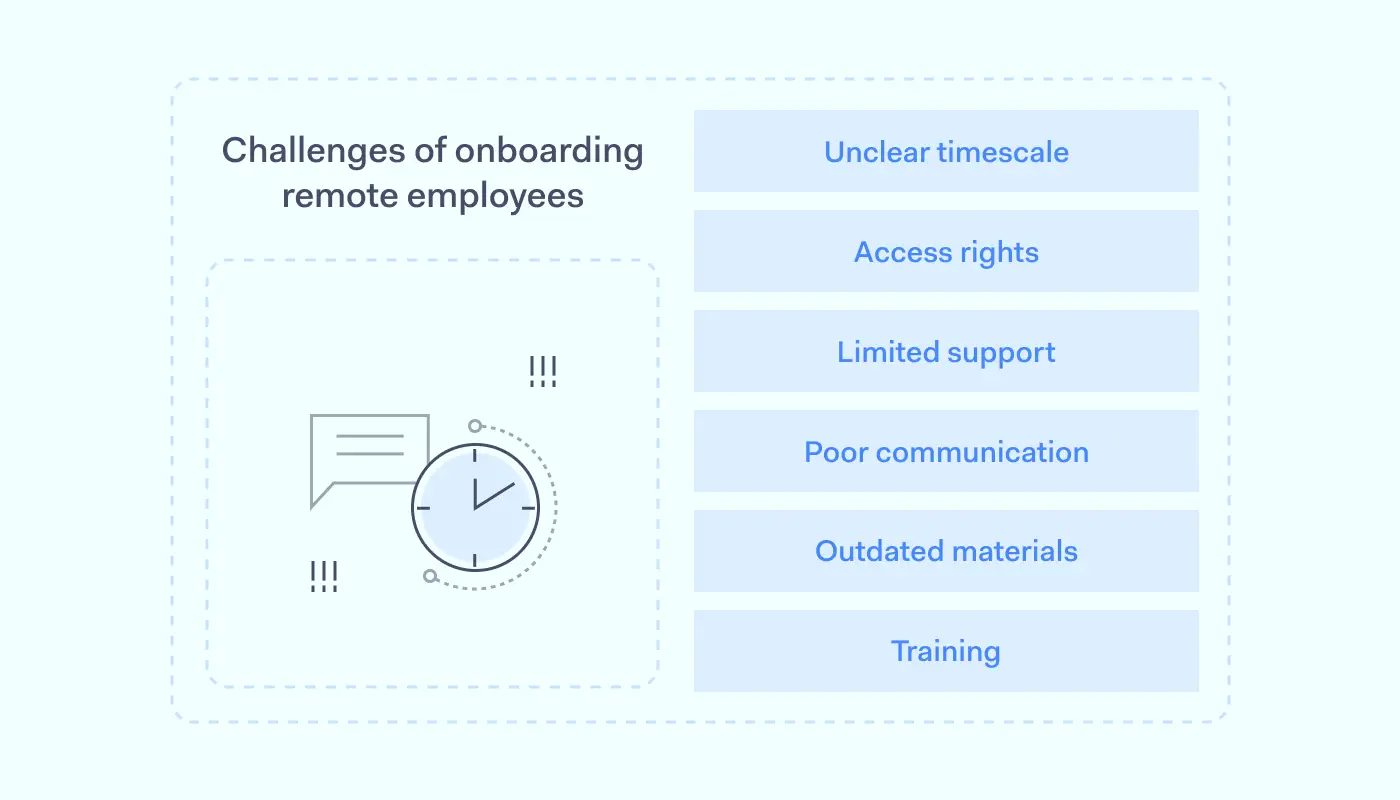
Challenges of onboarding remote employees 1400x800

HR teams do not have face-to-face contact with new hires during remote onboarding. Employees meet managers and colleagues virtually via emails, Teams meetings, and Slack discussions. This creates some unique challenges that companies need to think about.

1. Lack of a clear onboarding timescale

Onboarding tasks like creating access profiles, logging devices, and providing security training takes time. New hires may need to arrange calls with IT teams, HR professionals, and departmental colleagues.

Companies may provide employees with approved hardware like authentication tokens or access cards. And contracts and confidentiality agreements are often part of the process.

As a result, onboarding processes aren’t usually over in hours. They can even extend beyond the first week. New hires can wait over a week before accessing applications and databases. So HR teams must set itineraries for each stage of the remote onboarding process.

2. Managing access credentials and permissions

Each new hire must have an appropriate access control profile before accessing network assets. But establishing access controls for different resources can be challenging.

Security teams must create accurate profiles for new employees and connect permissions to their corporate role. They must also ensure that new hires have suitable credentials and train workers to use enterprise-wide 2FA or Multi-factor authentication systems.

3. Limited technical and administrative support

Remote onboarding can be highly technical. Employees sometimes need to update their hardware and security setups to meet company requirements. Companies often use unique platforms and apps that require orientation training. Collaboration tools can also lead to bottlenecks, making it harder to start work efficiently.

Every remote hire needs support to overcome these issues. But with many new employees entering an organization and limited IT resources, providing this support can be difficult.

4. Communication problems

Ideally, HR teams and managers would introduce new hires to the company via face-to-face meetings. But that’s not possible with remote onboarding. The distance between new hires and central offices can result in communication issues.

Without instant feedback, it’s also easy to lose critical information the new hire needs. And this is even more challenging when workers speak a different language.

New hires may also struggle to create personal connections with their colleagues. Integrating a new hire into the company culture becomes very difficult. Companies thrive when workers are connected and willing to share information. But disconnected remote workers rarely collaborate effectively.

5. Out-of-date onboarding materials

New remote employees require relevant information about technology, access, and cybersecurity. But company policies constantly change. HR teams may not maintain up-to-date onboarding databases. And they often provide the wrong information during remote onboarding processes.

For example, a company might install a data loss prevention (DLP) system to protect critical client data. But new hires may not receive guidance about classifying and handling data. This results in security risks and frustration when they begin work.

6. Delivering cybersecurity training

Cybersecurity in the workplace now extends to home offices. New remote employees need the knowledge required to use company assets securely, wherever they are. Whether you are hiring managers or freelance designers, delivering the correct cybersecurity training is challenging.

Video calls, emails, and downloadable presentations are a robust basis for security training. But they do not always add up to a productive learning environment. New hires may have questions about policies and processes. Technical problems could interfere with training events. And managers may lack assurance that employees retain critical information.

Remote employee onboarding checklist: what you need to know

When done well, remote onboarding allows workers to hit the ground running. It makes sure employees are cybersecurity aware. And it minimizes the workload on IT support teams as hires become familiar with corporate systems.

But a poorly executed remote onboarding program can be disastrous. Companies can lose the social connections that make teams effective. IT staff can become overwhelmed. Poor security practices creep into everyday work, raising the risk of phishing and malware attacks.

A well-structured remote onboarding policy streamlines the process. And creating effective systems relies on IT professionals. The following checklist provides a roadmap to design onboarding systems that integrate new hires without raising security risks or damaging productivity.

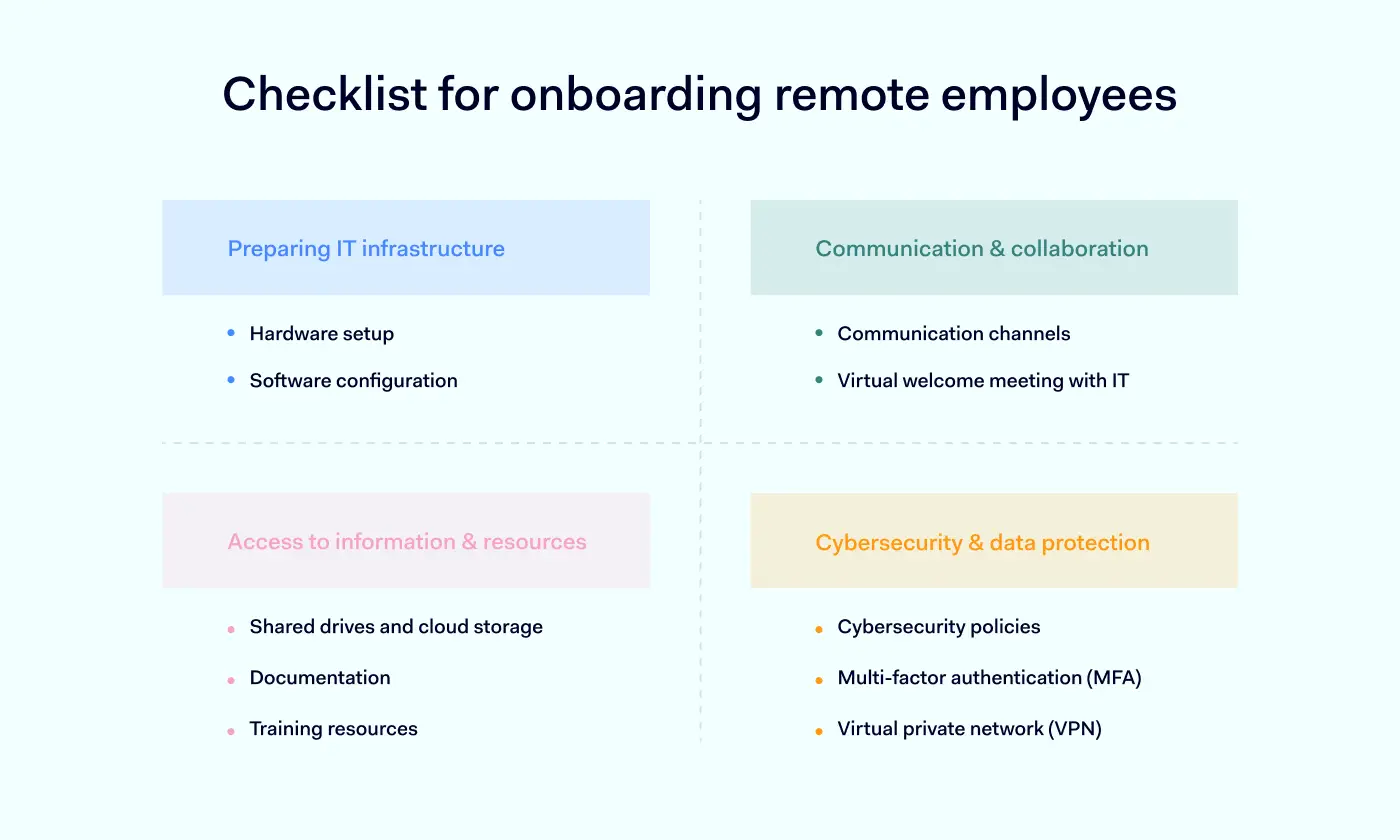
1. Preparing the IT infrastructure

New hires must usually make changes to their home IT setup. IT teams need to ensure staff have appropriate workstations and operating systems. They need to consider cybersecurity, as well as providing critical communication tools. And IT staff must provide proper support to make IT infrastructure operational.

Hardware setup

At the start of the onboarding process, prepare any necessary hardware. Match up new hires with required laptops or authentication peripherals. Prepare the hardware for shipment as quickly as possible.

OSHA can also fine companies that put the health and safety of remote workers at risk. In any case, protecting worker health is crucial. Verify that each workspace meets ergonomic requirements. And provide any necessary furniture to create safe, comfortable environments.

Software configuration

Remote employees need access to essential applications. IT teams should prioritize the configuration of video conference software and communication tools. Set up messaging apps and virtual meeting platforms. This will keep new hires informed and help to integrate them quickly.

IT must check that software supplied to remote devices has the correct licenses. And technicians should test every critical app. Ensure the worker can access central or cloud-hosted resources and that performance meets minimum benchmarks.

2. Cybersecurity and data protection

Remote workers can create cybersecurity risks to both network assets and sensitive data. IT teams need to prioritize security when introducing new employees.

Cybersecurity policies

Review your security policies before onboarding new workers. Security policies should cover all critical risks. For example, they should clearly explain password policies for remote workers. And they should include details about penalties for policy breaches.

Provide cybersecurity training for every hire. Remote workers should understand the main phishing risks and the importance of using updated threat detection tools. They should be aware of corporate data handling policies. Including a list of best practices in the employee handbook is advisable. This list should provide guidelines for critical security issues.

Multi-factor authentication (MFA)

Remote workers should connect via secure authentication systems. Implement multi-factor authentication for all access requests. MFA requires multiple authentication factors for each login request. It can apply to SSO portals or individual messenger apps.

Ensure every employee has correct credentials and that authentication tools connect seamlessly with privileges management systems.

Virtual Private Network (VPN)

Virtual private networks encrypt data passing between remote workers and central network resources. They provide an essential layer of protection for information and should be part of every remote onboarding process.

Inform new hires how to access the company VPN. Provide client software and any required hardware. And check connection speeds to ensure seamless connectivity.

3. Communication and collaboration

Create smooth communication channels between your new hire and the IT department. Onboarding remote workers involves a lot of technical information. And employees usually have queries or issues to resolve. Following these communication best practices will help.

Communication channels

Add remote employees to relevant team chats and email lists. Introduce them to colleagues in team chat rooms, and ensure staff can use communication tools effectively. If you need to provision specialist collaboration tools, go ahead and do so.

Introduce virtual meeting tools and check for bandwidth or configuration issues. Licensing problems can interfere with some video meeting tools. Double-check to ensure everything is up to date.

Virtual welcome meeting with IT

Schedule a virtual introduction meeting with relevant IT professionals. This is an opportunity to explain critical technology issues and reinforce cybersecurity training.

The meeting is a social event that introduces personalities and gives new hires the confidence to raise questions. Take onboard employee feedback and use it to make the onboarding process more efficient. The meeting also allows technicians to test video conferencing tools, allowing IT staff to fine-tune configurations.

4. Access to information and resources

Network resources should be available to remote employees when they complete security training. This should take place as quickly as possible. IT teams should plan so that access privileges slot into place automatically.

Shared drives and cloud storage

Link each new hire to a role-based access management profile. Access management tools document which resources are available to the user. Users should have easy access to data and apps that are relevant to their role, including company intranets and cloud environments. But IT teams should block access to all other resources on shared drives and cloud containers.

Be careful to provide the right privileges for each role. If you are hiring a large group of remote workers for a project, you can use generic RBAC profiles. But hiring managers requires a more tailored approach for each individual.

Documentation

Make security and IT policies available to every new hire. At the introductory meeting, explain how to access documentation and how policies are updated and maintained. If possible, create an employee handbook that includes everything remote workers need to know.

Training resources

Remote employees require virtual training. So prioritize access to digital training materials and resources. From the start, security training is a core part of the company culture. And make access to resources as flexible as possible, allowing workers to fit training into their onboarding routine.

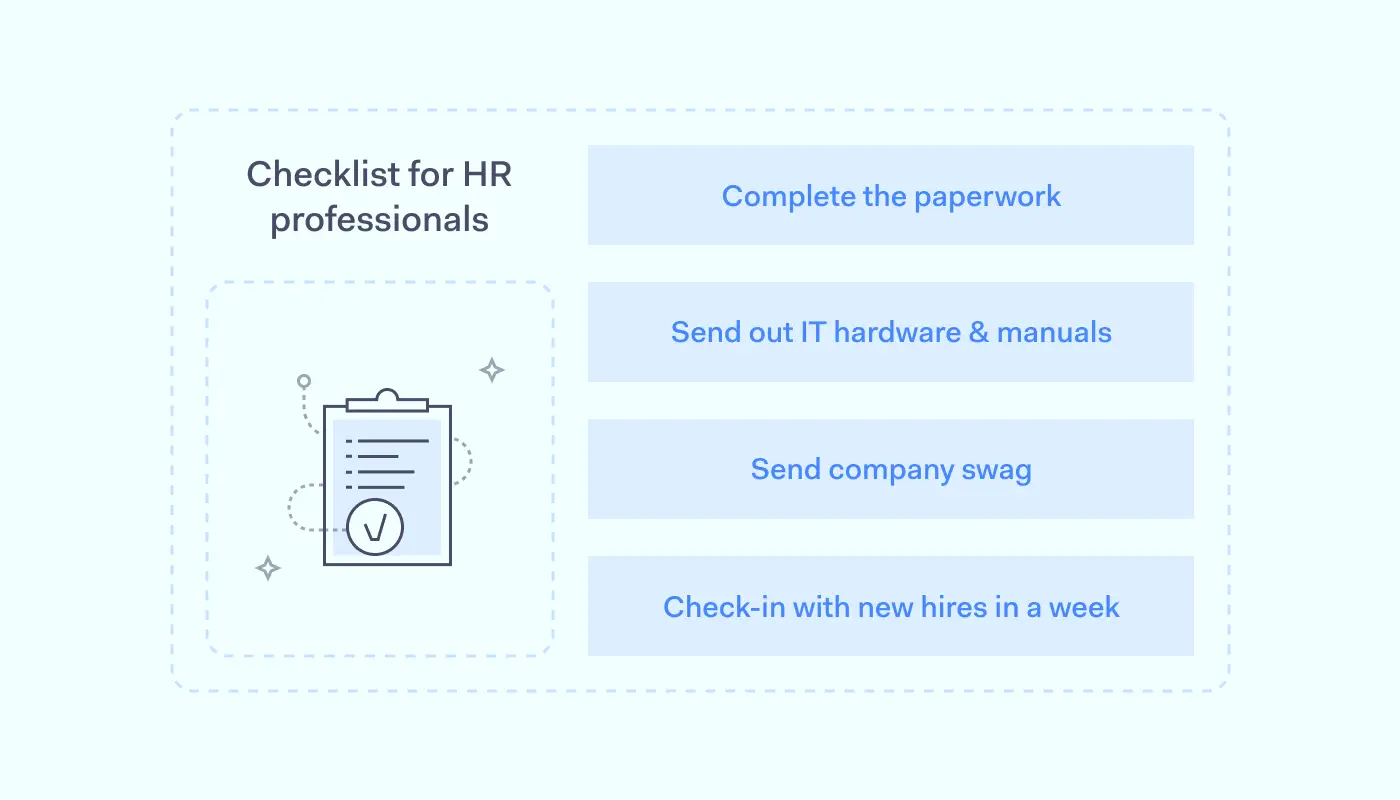
Checklist for HR professionals

The other side of the remote onboarding coin relates to Human Resources teams. HR professionals are critical in introducing new employees and making the onboarding experience more enjoyable.

Company orientation tasks complement the work of IT departments. Here are the key actions that HR officers need to consider:

Ensure paperwork is done

Nothing is more frustrating during onboarding than receiving an endless stream of documents to sign. Make this task pain-free by creating a single cache of necessary paperwork for each onboarding procedure.

Automate the provisioning of key documents. This reduces the number of times the new employee needs to provide digital signatures and makes human error less likely. Assign a team member to field queries about forms or policies. And apply encryption to secure any personal information transmitted during onboarding procedures.

Send pre-boarding IT hardware and manuals

Ensure employees are comfortable and safe by providing ergonomic furniture and peripherals like back supports and ergonomic mice. And field requests for specific hardware. Employees may need more powerful laptops or software upgrades. Provide whatever hires need to work safely and productively.

Manuals are an important part of the HR onboarding process. Produce an appealing employee manual that blends clarity and accessibility. Include information about cybersecurity and how to access critical workloads. But also add sections on company history and employee benefits the company provides.

Send company swag

One of the most important HR tasks during remote onboarding is creating a sense of belonging to the company culture. That isn’t easy to achieve without face-to-face contact. HR professionals need to think creatively about the onboarding experience and make every new employee feel welcome from the start.

Providing company swag in the first week is an easy win. Simple branded items like cups, mouse pads, pens, or diaries can add a human touch. But you can go as far as you like. Some companies like to send hoodies or T-shirts. Others send laptop cases, beach towels, or practical items like reusable water bottles.

Check up on new hires in the first week

HR is the first point of contact for each new employee during their first days on the job. Make HR professionals available to talk via video calls. And proactively check up on remote workers to keep them in the loop.

HR can also encourage staff to complete the onboarding schedule within the agreed timescale. Don’t force new hires to finish the onboarding process too quickly. Everyone adjusts at their own pace. But be clear about what employees must do, and let them know when everything is complete.

Simplify and secure remote onboarding with NordLayer

Remote onboarding is a challenge for businesses in every area of the economy. Workers need to receive training and information. They need the tech to carry out their duties. And they must have the right access privileges and authentication credentials to work securely.

NordLayer will help you create a secure and streamlined onboarding experience. Our solutions make the IT side of remote onboarding much easier.

Companies can use our secure remote access solutions to replace existing Virtual Private Networks. NordLayer’s business gateway encrypts traffic passing from remote workstations to the company intranet. And they scale easily. Organizations can easily add more workers as the need arises.

Our remote access systems facilitate network segmentation for assigning role-based privileges, offering network administrators precise controls over the network. They integrate with all major authentication providers. And they do so cost-effectively. Companies can onboard hires rapidly, safely, and affordably.

If you are struggling with remote employee onboarding, NordLayer can assist. Use our checklist to guide you and feel free to get in touch with our team today.

About Version 2 Limited
Version 2 Digital is one of the most dynamic IT companies in Asia. The company distributes a wide range of IT products across various areas including cyber security, cloud, data protection, end points, infrastructures, system monitoring, storage, networking, business productivity and communication products.

Through an extensive network of channels, point of sales, resellers, and partnership companies, Version 2 offers quality products and services which are highly acclaimed in the market. Its customers cover a wide spectrum which include Global 1000 enterprises, regional listed companies, different vertical industries, public utilities, Government, a vast number of successful SMEs, and consumers in various Asian cities.

About Nord Security
The web has become a chaotic space where safety and trust have been compromised by cybercrime and data protection issues. Therefore, our team has a global mission to shape a more trusted and peaceful online future for people everywhere.

About NordLayer
NordLayer is an adaptive network access security solution for modern businesses – from the world’s most trusted cybersecurity brand, Nord Security.

The web has become a chaotic space where safety and trust have been compromised by cybercrime and data protection issues. Therefore, our team has a global mission to shape a more trusted and peaceful online future for people everywhere.

ESET Research discovers MoustachedBouncer targeting European and other diplomats in Belarus via network tampering at the ISP level

  • MoustachedBouncer is a threat group, recently discovered by ESET researchers, which specializes in the espionage of foreign embassies, including European ones, in Belarus. It is very likely aligned with Belarus interests.
  • The group has been operating since at least 2014 and has used the adversary-in-the-middle (AitM) technique since 2020 to redirect captive portal checks to a Command and Control (C&C) server and deliver spyware.
  • ESET believes that MoustachedBouncer uses a “lawful interception system” to conduct its AitM operations.
  • Since 2014, the group has been operating a malware framework that we have named NightClub. It uses email protocols for C&C communications. Since 2020, the group has been using, in parallel, a second malware framework that we have named Disco.
  • NightClub and Disco support additional spying plugins, including a screenshotter, an audio recorder, and a file stealer.

BRATISLAVA, MONTREAL, LAS VEGAS — August 10, 2023 — ESET Research has discovered a new cyberespionage group, MoustachedBouncer. It is named after its presence in Belarus and is aligned with the interests of the local government. Active since at least 2014, the group targets only foreign embassies, including European ones, in Belarus. Since 2020, MoustachedBouncer has most likely been able to perform adversary-in-the-middle (AitM) attacks at the ISP level, within Belarus, in order to compromise its targets. The group uses two separate toolsets that ESET has named NightClub and Disco. The research was exclusively presented during the Black Hat USA 2023 conference on August 10, 2023, by ESET researcher Matthieu Faou.

According to ESET telemetry, the group targets foreign embassies in Belarus, and ESET has identified four countries whose embassy staff have been targeted: two from Europe, one from South Asia, and one from Africa. ESET assesses that MoustachedBouncer is very likely aligned with Belarus interests and specializes in espionage, specifically against foreign embassies in Belarus. MoustachedBouncer uses advanced techniques for Command and Control (C&C) communications, including network interception at the ISP level for the Disco implant, emails for the NightClub implant, and DNS in one of the NightClub plugins.

While ESET Research tracks MoustachedBouncer as a separate group, we have found elements that make ESET assess with low confidence that it is collaborating with another active espionage group, Winter Vivern, which has targeted government staff of several European countries, including Poland and Ukraine, in 2023.

To compromise their targets, MoustachedBouncer operators tamper with their victims’ internet access, probably at the ISP level, to make Windows believe it’s behind a captive portal. For IP ranges targeted by MoustachedBouncer, network traffic is redirected to a seemingly legitimate, but fake, Windows Update page,” says ESET researcher Matthieu Faou, who discovered the new threat group. “This adversary-in-the-middle technique occurs only against a few selected organizations, perhaps just embassies, not countrywide. The AitM scenario reminds us of the Turla and StrongPity threat actors, who have trojanized software installers on the fly at the ISP level.”

“While the compromise of routers in order to conduct AitM attacks on embassy networks cannot be fully discarded, the presence of lawful interception capabilities in Belarus suggests the traffic mangling is happening at the ISP level rather than on the targets’ routers,” explains the ESET researcher.

Since 2014, the malware families used by MoustachedBouncer have evolved, and a big change happened in 2020, when the group started to use adversary-in-the-middle attacks. MoustachedBouncer operates the two implant families in parallel, but on a given machine, only one is deployed at a time. ESET believes that Disco is used in conjunction with AitM attacks, while NightClub is used for victims where traffic interception at the ISP level isn’t possible because of a mitigation such as the use of an end-to-end encrypted VPN where internet traffic is routed outside of Belarus.

“The main takeaway is that organizations in foreign countries where the internet cannot be trusted should use an end-to-end encrypted VPN tunnel to a trusted location for all their internet traffic in order to circumvent any network inspection devices. They should also use top-quality, updated computer security software,” advises Faou.

The NightClub implant uses free email services, namely the Czech webmail service Seznam.cz and the Russian Mail.ru webmail provider, to exfiltrate data. ESET believes the attackers created their own email accounts, instead of compromising legitimate ones.

The threat group focuses on stealing files and monitoring drives, including external ones. The capabilities of NightClub also include audio recording, taking screenshots, and logging keystrokes.

For more technical information about MoustachedBouncer, check out the blog post “MoustachedBouncer: Espionage against foreign diplomats in Belarus” on WeLiveSecurity. Make sure to follow ESET Research on Twitter (X) for the latest news from ESET Research.

MoustachedBouncer compromise via AitM scenario

About Version 2 Limited
Version 2 Digital is one of the most dynamic IT companies in Asia. The company distributes a wide range of IT products across various areas including cyber security, cloud, data protection, end points, infrastructures, system monitoring, storage, networking, business productivity and communication products.

Through an extensive network of channels, point of sales, resellers, and partnership companies, Version 2 offers quality products and services which are highly acclaimed in the market. Its customers cover a wide spectrum which include Global 1000 enterprises, regional listed companies, different vertical industries, public utilities, Government, a vast number of successful SMEs, and consumers in various Asian cities.

About ESET
For 30 years, ESET® has been developing industry-leading IT security software and services for businesses and consumers worldwide. With solutions ranging from endpoint security to encryption and two-factor authentication, ESET’s high-performing, easy-to-use products give individuals and businesses the peace of mind to enjoy the full potential of their technology. ESET unobtrusively protects and monitors 24/7, updating defenses in real time to keep users safe and businesses running without interruption. Evolving threats require an evolving IT security company. Backed by R&D facilities worldwide, ESET became the first IT security company to earn 100 Virus Bulletin VB100 awards, identifying every single “in-the-wild” malware without interruption since 2003.

Synergizing WPA3 Security & NAC for Effective Wi-Fi Protection

Today, our reliance on wireless networks has soared to unprecedented heights and shows no signs of slowing. The convenience they offer comes hand in hand with a pressing need for security. As we move beyond the limitations of WPA2, the third iteration of Wi-Fi Protected Access (WPA3) has emerged as a stalwart guardian of wireless network security. Coupled with Network Access Control (NAC), these technologies form an impenetrable fortress, ensuring that our wireless communications remain private and shielded from malicious actors.

WPA3 Security: The Shield Against Attackers

WPA3 security represents a pivotal evolution in wireless protection, addressing vulnerabilities that were exposed in its predecessor, WPA2. One of the most notable improvements is the replacement of the outdated Pre-Shared Key (PSK) authentication with the Simultaneous Authentication of Equals (SAE) protocol. SAE significantly mitigates the risk of password cracking by using a secure key exchange process that resists offline attacks.

Moreover, WPA3 enhances security through its individualized data encryption. Unlike WPA2, where all devices on a network share the same encryption key, WPA3 security provides each device with a unique encryption key. This ‘forward secrecy’ prevents the compromise of one device’s key from affecting the security of others. Another crucial feature of WPA3 is the resistance to brute-force attacks. It enforces a rate-limiting mechanism that thwarts repeated login attempts, making it exceedingly difficult for attackers to exploit weak passwords.

NAC: Elevating Wireless Access Control

While WPA3 security marks a commendable leap forward, it is not a panacea. Network Access Control (NAC) steps in as a complementary layer of defense, fortifying wireless networks against a spectrum of threats. NAC’s fundamental premise revolves around controlling and managing device access based on various criteria before granting entry to the network. At its core, NAC verifies the identity and health status of devices seeking network access. It evaluates devices for compliance with security policies and checks for updated operating systems, security patches, and antivirus software. Any device failing these checks is either denied access or diverted to a remediation network where it can be updated and secured before accessing the main network.

One of the key advantages of NAC is its ability to enforce role-based access. Different users and devices can be granted varying levels of access based on their roles within the organization. This minimizes the attack surface by ensuring that only authorized personnel can access sensitive resources. Additionally, NAC excels in thwarting unauthorized device connections. Through its continuous monitoring and profiling capabilities, NAC can swiftly detect and block rogue devices attempting to gain entry. This feature is particularly critical in today’s world of IoT, where devices can be easily compromised and repurposed for malicious intent.

Synergizing WPA3 Security and NAC

The true strength of a security strategy lies in its layers. WPA3 and NAC, when combined, create a formidable barrier against cyber threats that individual solutions could hardly achieve. While WPA3 secures the communication channel itself, NAC extends its reach by ensuring that only authenticated and healthy devices gain entry. This synergy starts with a strong foundation: the impenetrable encryption offered by WPA3. Once devices pass through this first layer, NAC kicks in, scrutinizing them for compliance and identity verification. If a device fails any of these checks, NAC acts as a gatekeeper, preventing the device from accessing the network until the necessary security measures are taken.

Moreover, the integration of WPA3 and NAC facilitates robust user authentication. In combination with identity management systems, organizations can ensure that only authorized users can connect to the network, bolstering security against unauthorized access attempts.

As the world hurtles forward into an interconnected future, safeguarding our wireless networks is of paramount importance. The implementation of WPA3 addresses critical vulnerabilities and enhances encryption methods, but it is only part of the larger puzzle. Network Access Control, with its ability to enforce strict policies and monitor device health, provides the much-needed layer of protection that complements WPA3’s strengths.

The synergy between these technologies transforms wireless networks into resilient bastions against cyber threats. The days of relying solely on passwords and basic encryption are behind us; the age of WPA3 and NAC has dawned, promising a safer and more secure wireless landscape for organizations and individuals alike. As we continue to embrace innovation, let us not forget the vital role that security plays in ensuring a trustworthy and fortified digital world.

About Version 2 Limited
Version 2 Digital is one of the most dynamic IT companies in Asia. The company distributes a wide range of IT products across various areas including cyber security, cloud, data protection, end points, infrastructures, system monitoring, storage, networking, business productivity and communication products.

Through an extensive network of channels, point of sales, resellers, and partnership companies, Version 2 offers quality products and services which are highly acclaimed in the market. Its customers cover a wide spectrum which include Global 1000 enterprises, regional listed companies, different vertical industries, public utilities, Government, a vast number of successful SMEs, and consumers in various Asian cities.

About Portnox
Portnox provides simple-to-deploy, operate and maintain network access control, security and visibility solutions. Portnox software can be deployed on-premises, as a cloud-delivered service, or in hybrid mode. It is agentless and vendor-agnostic, allowing organizations to maximize their existing network and cybersecurity investments. Hundreds of enterprises around the world rely on Portnox for network visibility, cybersecurity policy enforcement and regulatory compliance. The company has been recognized for its innovations by Info Security Products Guide, Cyber Security Excellence Awards, IoT Innovator Awards, Computing Security Awards, Best of Interop ITX and Cyber Defense Magazine. Portnox has offices in the U.S., Europe and Asia. For information visit http://www.portnox.com, and follow us on Twitter and LinkedIn.。

It’s time to talk about cloud security

Reading about the cloud in 2023 has an almost nostalgic feeling to it, a bit like watching that HBO special for the 20th anniversary of the Harry Potter series. You suddenly realize how long it’s been since the whole conversation about cloud computing started.

The cloud has become such a common IT tool that today it is difficult to find an industry (or even a company) that does not use it to some extent. The chances are very high that you yourself are using it frequently.

So, we will not waste your time with generic information explaining the benefits and challenges of the cloud. Instead, we’ll get down to the nitty-gritty and discuss what’s really important — cloud data security.

First things first: What is cloud security?

Cloud data security could be explained as what organizations do to protect their cloud-based systems and applications — and the data they store in the cloud — against cyber threats.

You could also say that it is a set of strategies, procedures, and tools that, when properly applied, can help companies prevent unwanted data exposure or IT infrastructure damage caused by various internal or external factors.

Both explanations are correct. In fact, they complement each other and together provide more context — although they don’t give the whole picture.

Treating it more like a concept, we could say that cloud security is a complex and constantly evolving field in IT that requires attention from all organizations that have either fully or partially based their IT environment on the cloud. So, with that in mind, the question you may be asking yourself right now is…

Why is cloud security so important?

If we had to answer that in one sentence, it would probably be this: cloud security plays an essential role in ensuring the confidentiality, integrity, and availability of sensitive data stored in the cloud. But this only scratches the surface. So, allow us to elaborate a bit because there’s more to this matter than meets the eye.

Each year, more and more organizations start their digital transformation journeys and integrate cloud-based tools and services into their IT infrastructures. All of those companies — no matter if they are small businesses or large-scale enterprises — cannot afford to take any risks regarding the security of their digital assets.

This is why cloud security is one of the aspects that these companies must address if they decide to run even a tiny part of their activities in the cloud — or to keep their data inside one. If they don’t, they risk not only data loss or disruption of their business operations but also financial and reputational damage. They must be aware of the fact that keeping digital assets in the cloud doesn’t mean that they are unreachable to hackers.

This is to say that organizations should make every effort to ensure that their cloud cybersecurity is at the highest level at all times — after all, the success of their business endeavors depends on that.

Main risks associated with cloud security

Security issues in cloud computing often revolve around the potential for unauthorized access — but not only that. Below, you will find descriptions of some of the biggest threats that today’s companies must be aware of while developing their cloud security strategy. Whether a company will be able to address and manage these threats depends not only on the actions they take but also on its awareness of the emerging trends and disruptive forces shaping its industry.

  • Data breaches:

    Whenever an organization starts storing sensitive information in the cloud, it instantly becomes a target for cybercriminals — and they will try to find their way in. A successful breach could result in the exposure of the company’s confidential data including its financial records, customers’ personal information, or even intellectual property.

    In its “Cost of a data breach” report, IBM reveals that the global average cost of a data breach across all sectors in 2023 is almost $4.5 million — which is an amount that has increased by almost 15% over the last three years. This fact alone shows that companies cannot waste time, and they should introduce robust authentication mechanisms, encryption protocols, and access controls as soon as possible to protect themselves against this threat.

  • Insider threats and privilege abuse:

    It should be no surprise to anyone that employees with access to company data sometimes misuse their privileges or can be coerced into revealing sensitive information. This can lead to similar or even the same issues that arise due to data breaches.

    Hackers will use every vulnerability in security controls or protocols to gain unauthorized access to your systems and applications — and that is why companies must work on developing sound cybersecurity policies that, first, their employees will adhere to, and second, will help them mitigate the damage if one of their employees (whether intentionally or not) causes a potential cybersecurity threat.

  • Cloud service providers often operate on a global scale, helping customers from different parts of the world where different sets of data protection laws and regulations apply. It’s no rocket science to point out that complying with these diverse legal requirements can be a challenge for both cloud providers and their customers.

    Non-compliance with the standards may lead to serious financial or reputational losses. Thus, businesses must carefully navigate the regulatory landscape and choose cloud providers that meet the relevant criteria.

Best practices in cloud security

Before we discuss any cloud security best practices, we would like to point out that cloud security as a whole is a continuous process and, therefore, you should stay informed about the latest security trends and practices so that you can protect your cloud environment more effectively. In other words, do not think of the following examples as the only elements you should pay attention to when creating a cloud security strategy. Instead, treat them as a starting point.

  1. Encrypt your data: One of the foundational pillars of cloud security is encryption, which is the process of using combinations of sophisticated algorithms to make sure that no unauthorized party can access your data — whether at rest or in transit. Some cloud service providers offer built-in encryption features, which you can leverage to keep your data secure at all times. If they are not available to you from the get-go, consider using third-party encryption tools to protect your sensitive information.

  2. Implement and use identity and access management (IAM) tools: To manage user access and permissions effectively, you must implement a strong IAM strategy. For example, by following the principle of least privilege, you can ensure that only authorized users with specific roles can access your systems, applications, and data. In other words, you can use IAM tools to provide the right people with access to the right resources — and only them. This will help you protect sensitive information from being compromised.

  3. Carry out audits regularly and monitor all cloud activities: You can stay ahead of potential security risks if you conduct frequent security audits. That way, you will be able to identify cybersecurity areas that require improvement and take necessary measures to address them before any security breach occurs. If you pay close attention to what’s going on in your network, you’ll be able to detect and respond to any anomalies or potential threats before they cause damage.

  4. Find out what your provider does to ensure cloud security: When teaming up with a cloud service provider, you should take the time to understand their shared responsibility model and all the security features they offer. In other words, you should get familiar with your provider’s security practices and security to, first, double-check if their approach aligns with your organization’s specific security requirements, and second, to ensure that your sensitive data and applications are adequately protected in the cloud environment.

  5. Backup your data: You can enhance your organization’s cybersecurity by consistently backing up your business data in a highly secure location and rigorously testing the recovery process. If you take this proactive approach, you will be able to, in the unfortunate event of a security breach or data loss, quickly and seamlessly restore crucial data and applications. Not to mention that it will help you minimize downtime, safeguard your reputation, and ensure business continuity.

How does NordLocker fit into the context of cloud security?

To adequately answer this question, we need to start with a brief explanation of what NordLocker is, namely an end-to-end encrypted cloud storage platform that allows you to securely store, manage, and share your business data with company members and partners.

NordLocker was designed to help companies — no matter the size, location, and nature of their business — protect their digital assets in a highly secure, state-of-the-art cloud environment to which only they have access. Therefore, it is more than fair to say that NordLocker was created with cloud security in mind.

Thanks to its wide range of features — from end-to-end encryption, through multi-factor authentication (MFA), to zero-knowledge architecture (and everything in between) — NordLocker covers all the cybersecurity practices we discussed in this article to help its users create a much safer online business environment. It can help you do that as well.

That’s why we encourage you to go to NordLocker and learn more about the platform and get a 14-day free trial. That way, you will be able to see for yourself if NordLocker is the right fit for your business and if what we’re saying is true.

Enjoy the ride!

About Version 2 Limited
Version 2 Digital is one of the most dynamic IT companies in Asia. The company distributes a wide range of IT products across various areas including cyber security, cloud, data protection, end points, infrastructures, system monitoring, storage, networking, business productivity and communication products.

Through an extensive network of channels, point of sales, resellers, and partnership companies, Version 2 offers quality products and services which are highly acclaimed in the market. Its customers cover a wide spectrum which include Global 1000 enterprises, regional listed companies, different vertical industries, public utilities, Government, a vast number of successful SMEs, and consumers in various Asian cities.

About NordPass
NordPass is developed by Nord Security, a company leading the global market of cybersecurity products.

The web has become a chaotic space where safety and trust have been compromised by cybercrime and data protection issues. Therefore, our team has a global mission to shape a more trusted and peaceful online future for people everywhere.

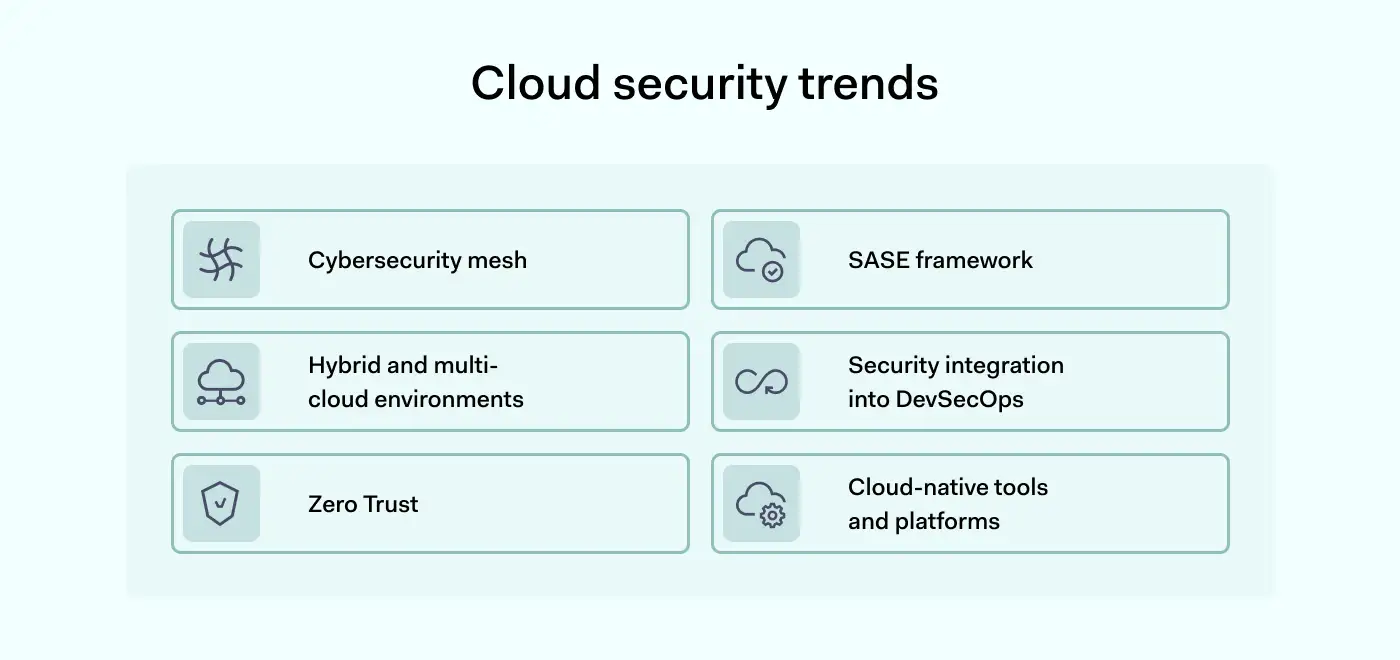
The ever-evolving landscape of cloud security trends

In today’s business environment, cloud computing is the most flexible and cost-efficient method to set up operations. Yet, as businesses increasingly rely on cloud-based services to store, manage, and exchange data, this attracts unwanted guests.

Consequently, there has been a significant increase in data breaches, disrupting business operations and jeopardizing companies’ security and compliance worldwide. These breaches often stem from attackers exploiting vulnerabilities and misconfigurations in cloud systems.

This blog will cover the most recent cloud security trends that are shaping the industry. By keeping up with these developments, businesses can enhance the protection of their digital assets and reinforce the security of their cloud computing infrastructure to mitigate potential breaches.

Key takeaways

  • Cloud computing offers businesses cost-efficiency, flexibility, and scalability, but it also introduces security vulnerabilities and risks

  • The shared responsibility model requires cloud providers to secure the infrastructure while customers secure their data and applications

  • The cloud security landscape is constantly evolving and businesses need to keep up with new trends

  • Cloud security has progressed significantly with improvements in data protection, network security, and connectivity

  • The future of cloud security will see more integration of AI and machine learning

  • To keep up with the trends, organizations can regularly update security policies, implement advanced threat detection, embrace automation, and foster a culture of security awareness

Understanding the concept of cloud security and why it matters today

Cloud computing solves many business problems like scalability, cost-efficiency, and flexibility. At the same time, for most businesses, it also means stepping into unfamiliar territory where it’s easy to leave gaps that hackers could exploit.

The shared responsibility model is also something that needs to be established. In it, the cloud provider is responsible for securing the underlying cloud infrastructure, while the customer is responsible for securing their data and applications. Though it sounds simple, it’s not always easy to crystallize a comprehensive cloud security approach.

As more organizations embrace cloud adoption and rely on cloud services, the need for effective cloud security measures has never been greater.

Evolutions in cloud security

Cloud security has come a long way since its inception. Initially, concerns regarding data protection and network security limited cloud adoption (as well as a requirement for stable online connectivity). Fortunately, as cloud technology has matured, so has its security.

The concept of cloud computing emerged in 1950 with the development of mainframe computers, which could be accessed through thin or static clients. Since then, cloud computing has undergone several iterations, progressing from static clients to dynamic ones, from software-based systems to service-oriented solutions.

Security problems started cropping up when businesses began entrusting their data to major companies like Amazon. Despite the numerous benefits and efficiency improvements, storing critical data on servers that customers couldn’t physically access challenged the conventional notion of security. As data storage expanded in type and volume, hosting companies implemented more extensive precautions to safeguard the data.

The current state of cloud security

Today’s cloud service providers go to great lengths to protect the data stored on their servers. This includes thorough employee background checks to minimize the risk of insider attacks and isolation procedures that prevent one company from accessing another’s data. Yet, it’s still the user’s responsibility to ensure secure passwords and connections like they would have if the data were stored locally.

Encryption of data at rest and in transit, network segmentation, and adopting cybersecurity mesh architectures have all enhanced cloud security. As cloud environments become increasingly complex and multi-cloud adoption rises, ensuring consistent security across different platforms and providers becomes challenging. This emphasizes the need for ongoing security training and proactive new technologies adoption.

Security teams must be aware of the latest cloud security trends to stay ahead of the ever-changing threat landscape. Here are the main ones you should be aware of:

1. Cybersecurity mesh

Companies are adopting the concept of cybersecurity mesh to ensure the security of data and assets in the cloud. This approach involves creating a distributed network and infrastructure that forms a security perimeter around the individuals and devices connected to the network. By implementing cybersecurity mesh, companies can centrally manage data access and enforce security policies, aligning with Zero Trust architecture principles.

2. Hybrid and multi-cloud environments

The trend in cloud security involves adopting a hybrid approach or leveraging multiple cloud services. Organizations can migrate their data entirely to the cloud or keep some data and services hosted privately. The hybrid approach combines local and cloud-hosted services, allowing for more secure deployments. Additionally, using multiple clouds has gained popularity, with companies adopting a multi-cloud strategy. This approach allows for better utilization of security tools across different environments, such as SIEM and threat intelligence.

3. Zero Trust

The principle of Zero Trust emphasizes verifying rather than blindly trusting anything within or outside an organization’s perimeters. With the increasing reliance on cloud services, Zero Trust should be a priority for all organizations. Traditional perimeter security measures and firewalls are insufficient to protect valuable resources such as user data and intellectual property. Zero Trust enhances security around every device, user, and connection, enabling proactive threat management and comprehensive defense strategies.

4. SASE framework

Gartner has stated that the future of network security lies in the cloud. The Secure Access Service Edge (SASE) framework offers a cloud-based cybersecurity solution that supports digital enterprises’ dynamic and secure access needs. It combines wide area networking (WAN) capabilities with multiple security features such as anti-malware and security brokers to establish a comprehensive security environment within a cloud infrastructure. SASE is an essential framework for securely connecting users, systems, and endpoint devices to a unified cloud environment.

5. Security integration into DevSecOps

DevSecOps is a methodology that integrates security protocols throughout the software development lifecycle (SDLC). Organizations can address threats proactively rather than reactively by incorporating security measures early in the development process. DevSecOps is particularly effective in fast-paced, fully automated software development lifecycles, enabling secure innovation. Collaboration between DevOps and security teams is essential to implement strong security measures throughout the entire supply chain and make security a continuous process within the continuous integration/continuous delivery pipeline.

6. Cloud-native tools and platforms

Cloud-native applications designed specifically for the cloud environment are becoming increasingly prevalent. These applications take advantage of the speed and efficiency offered by cloud platforms. Traditional security tools designed for on-premises applications may not be adequate to protect cloud-based resources. Companies recognize the need to invest in cloud-based security tools and platforms to safeguard their cloud resources against potential attacks.

While cloud security progresses along with cloud computing, it’s crucial to acknowledge the dark side of trends that security teams must address. Attackers are finding new ways to exploit vulnerabilities, and organizations must be cautious. Here are the emerging threats directed at cloud computing security:

Slow patching leaves web services vulnerable

Based on the Orca Security report, 36% of organizations have web services in their cloud environment that are accessible to the Internet but remain unpatched. Such services pose a significant risk as they contain known vulnerabilities and bugs, which can serve as primary entry points for attacks on cloud environments. The absolute majority of cyber-attacks on cloud infrastructure begin with the exploitation of these known vulnerabilities.

Unpatched vulnerabilities provide malicious actors with easy access to cause service downtime, enable remote code execution, or facilitate unauthorized remote access in certain cases. Users must promptly apply fixes through updates or patches to contain potential risks.

Git repositories containing sensitive data

Storing sensitive data in Git repositories should be avoided at all costs. It may include information like database passwords, API keys, encryption keys, hash salts, and secrets, which can be mistakenly pushed into a Git repository. While it deviates from security practices, the inclusion of this data into the source code of an application might inadvertently leak it to hackers. Therefore, repositories must be checked for sensitive information, which should be removed from the repository and its history.

AWS keys storage on file systems

At least 49% of organizations store sensitive AWS keys on file systems within virtual machines. AWS keys can function as backdoors to your system. They can grant access to all your resources and the ability to perform any operation, like launching EC2 instances or deleting S3 objects. Therefore, it’s crucial always to store your AWS keys separately and avoid sharing them with external parties.

Instead of AWS, it’s a good practice to use temporary credentials. They include an access key ID and secret access key that would also include a security token specifying the expiration date of the credentials.

Too many administrators for a single organization

Single sign-on providers suggest putting limits on the administrative privileges. For instance, only 50% of admins should have super admins privileges, if you have more, you’re risking your organization’s security. This is much more than it would be advisable, as administrators have many permissions that directly relate to your information security.

As a rule of thumb, it’s generally inadvisable, except in exceptional circumstances, not to define an IAM role with full administrative privileges. Such a role grants anyone who assumes it the ability to perform any action on any resource within the account. This violates the Principle of Least Privilege (PoLP), significantly expands the attack surface, and increases the risk of a full account takeover.

The road ahead: future of cloud security

Looking ahead, the future of cloud security is full of challenges and opportunities. One of the most obvious courses for development is the continued integration of artificial intelligence and machine learning into cloud security operations. These technologies will enable autonomous threat detection, automated incident response, and adaptive security measures.

The speed at which these developments will reach the end-users depend on the service providers’ initiatives to invest in advanced technologies. Yet, it’s likely that the shared responsibility model will continue to be relevant, and while the user will be provided with more tools, it will still be needed to make sense of the provided data and act on it.

Conclusion

Cloud security is an ever-evolving landscape with new trends and challenges emerging regularly. For this reason, organizations must stay alert and recognize the importance of cloud security and its recent developments.

By adopting advanced technologies, adopting proactive security measures, and fostering collaboration with cloud providers, organizations can navigate the complex cloud environment while safeguarding their data, applications, and infrastructure against evolving security threats.

FAQs

What is the role of AI in cloud security?

AI can be used to enhance threat detection and response capabilities by analyzing vast amounts of data and identifying patterns that may indicate security threats or anomalies. In addition, AI can assist in automating security tasks, such as security patching, vulnerability management, and incident response. This can help prevent various types of attacks like malware, phishing attempts, and data breaches, reduce the workload on security teams, and improve overall efficiency.

What is a cloud access security broker (CASB), and how does it contribute to cloud security?

CASB is an intermediary between an organization’s premises infrastructure or network and cloud service providers. It helps organizations extend their security policies and controls to the cloud environment. Offering a range of security functionalities, it also helps to expand visibility into cloud storage, data loss prevention (DLP), access control, threat detection, encryption, and compliance monitoring.

How does the Zero Trust model enhance cloud security?

The Zero Trust model enhances cloud security by shifting the traditional perimeter-based security approach to a more dynamic and granular model. Instead of blindly trusting users or devices within a network, Zero Trust assumes that all network traffic, whether from inside or outside the network, is potentially malicious and must be verified before granting access. That way, organizations can reduce the risk of lateral movement within their cloud environment, mitigate the impact of compromised credentials, and improve overall security posture.

What strategies can organizations adopt to stay ahead of future cloud security trends?

To stay ahead of future cloud security trends, organizations can:

  • Regularly assess and update security policies

  • Implement advanced threat detection and response capabilities

  • Embrace automation and orchestration

  • Foster a culture of security awareness

All of these actions improve overall business security posture and help stay one step ahead of unauthorized access attempts.

How can NordLayer help?

As cloud computing is at the center of modern business operations building, its security is at the forefront of business priorities. A robust cloud security strategy must include access controls, encryption, firewalls, and auditing. However, finding a reliable partner isn’t always easy.

NordLayer can be a helpful ally when securing public and private cloud infrastructure setups. Using our Virtual Private Gateways, SaaS applications, and other resources can be reached efficiently but securely. With features like IP allowlisting, overall business network security posture is improved, allowing only authorized personnel to access your cloud environments.

Identity checks can be enforced using 2FA and SSO to ensure secure authentication. A tandem of all of these features makes cloud security management safer and easier to manage.

Contact the NordLayer team to learn more about how your cloud infrastructure could be secured.

About Version 2 Limited
Version 2 Digital is one of the most dynamic IT companies in Asia. The company distributes a wide range of IT products across various areas including cyber security, cloud, data protection, end points, infrastructures, system monitoring, storage, networking, business productivity and communication products.

Through an extensive network of channels, point of sales, resellers, and partnership companies, Version 2 offers quality products and services which are highly acclaimed in the market. Its customers cover a wide spectrum which include Global 1000 enterprises, regional listed companies, different vertical industries, public utilities, Government, a vast number of successful SMEs, and consumers in various Asian cities.

About Nord Security
The web has become a chaotic space where safety and trust have been compromised by cybercrime and data protection issues. Therefore, our team has a global mission to shape a more trusted and peaceful online future for people everywhere.

About NordLayer
NordLayer is an adaptive network access security solution for modern businesses – from the world’s most trusted cybersecurity brand, Nord Security.

The web has become a chaotic space where safety and trust have been compromised by cybercrime and data protection issues. Therefore, our team has a global mission to shape a more trusted and peaceful online future for people everywhere.

23.6.9 ‘Voyager’ released

Changes compared to 23.6.8

New Features

  • Added support for performing backups to a WebDAV based Storage Vault

Enhancements

  • Added support for macOS client notarization using notarytool (Xcode 13 or later) with a fallback to altool if not installed. Note: Apple’s notary service will not accept uploads from altool or Xcode 13 or earlier starting November 1, 2023. See this link for details
  • Added the ability to verify if versioning is enabled on the bucket when setting up Object Lock on supported S3-backed Storage Templates
  • Improved performance for accessing Storj.io Storage Vaults
  • Improved the documented types in the PHP SDK

Bug Fixes

  • Fixed an issue with WebAuthn logins for non-OIDC admins failing in the Comet Server web interface
  • Fixed an issue with jobs not appearing when clicking on segments on the Recent Activity page of the Comet Server web interface
  • Fixed an issue with the Application Aware Writer live picker in the Comet Backup desktop app not accurately displaying what is selected
  • Fixed a cosmetic issue with certain characters showing incorrectly in the Microsoft 365 Protected Item dialog in the Comet Server web interface
  • Fixed an issue with the Storage Vault “Test Connection” button crashing the Comet Server web interface when Storage Role is disabled

About Version 2 Limited
Version 2 Digital is one of the most dynamic IT companies in Asia. The company distributes a wide range of IT products across various areas including cyber security, cloud, data protection, end points, infrastructures, system monitoring, storage, networking, business productivity and communication products.

Through an extensive network of channels, point of sales, resellers, and partnership companies, Version 2 offers quality products and services which are highly acclaimed in the market. Its customers cover a wide spectrum which include Global 1000 enterprises, regional listed companies, different vertical industries, public utilities, Government, a vast number of successful SMEs, and consumers in various Asian cities.

About Comet
We are a team of dedicated professionals committed to developing reliable and secure backup solutions for MSP’s, Businesses and IT professionals. With over 10 years of experience in the industry, we understand the importance of having a reliable backup solution in place to protect your valuable data. That’s why we’ve developed a comprehensive suite of backup solutions that are easy to use, scalable and highly secure.