Skip to content

Zero Day Bug Evolution and the Power of NAC

Zero-day bugs have proven to be a constant source of concern due to their potential to exploit vulnerabilities before they can be patched or even known. But worry not; solutions like Network Access Control (NAC) can effectively mitigate their impact on corporate networks. Today, we dive into the evolution of zero-day bugs, their impact on corporate networks, and the power of NAC in dealing with them.

Understanding the Zero-Day Bug Evolution

Zero-day bugs stand out in the realm of cybersecurity due to their unique nature. These elusive threats are essentially software vulnerabilities that cybercriminals leverage before they are detected or fixed by the software developers. As a result, there are literally ‘zero days’ left to address these vulnerabilities, hence the name. The evolution of zero-day bugs from simple nuisances to significant threats has been a multi-faceted process resulting in a rapid progression that is increasingly detrimental. The advancement and proliferation of internet usage have amplified the potential risks associated with these bugs.The advent of cloud computing has also played a significant role in their evolution. Cloud environments, with their vast, interconnected networks, have increased the number of potential entry points for hackers to exploit these bugs. Perhaps, the most significant contributor to the development of zero-day bugs has been the rise of the Internet of Things (IoT). IoT devices, ranging from smart thermostats to connected security systems, have exploded in popularity over recent years. However, these devices often lack robust security features and, therefore, present a fertile ground for zero-day exploits. The journey of zero-day bugs reflects the broader trend in the cybersecurity landscape: an increasing attack surface due to technological advancements even in the most secure environments. Recently, a ransomware gang used a new zero-day flaw to steal data on 1 million hospital patients. As such, it’s crucial for network administrators and engineers to comprehend this evolution and its implications. Understanding the trajectory of zero-day bugs is a significant first step towards developing robust strategies to combat them.

The Impact on Corporate Networks

When zero-day bugs successfully infiltrate corporate networks, the repercussions can be severe and far-reaching. Given that these vulnerabilities can be exploited before they are detected, organizations could suffer significant setbacks before even realizing there is a problem. These impacts often extend beyond the IT department, reverberating across an entire enterprise. The cybercriminals who exploit zero-day vulnerabilities have the potential to access, steal, or manipulate sensitive data, which could include proprietary business information or confidential customer data. This data breach could result in severe financial penalties, particularly if regulatory requirements are violated, and the fallout could damage customer trust, leading to loss of business. A single attak could be financially crippling for most companies as the global average cost per data breach was 4.45 million U.S. dollars in 2023.

Operational Headaches

In addition to data breaches, zero-day bugs can disrupt critical services. Operations may be halted or slowed as IT teams scramble to identify and address the vulnerability. This disruption can result in costly downtime, with businesses losing valuable time and money. Furthermore, zero-day exploits can enable cybercriminals to gain control of systems, which can lead to further compromise. With this level of access, attackers can potentially alter system configurations, install additional malicious software, or even lock out legitimate users. Such a situation could result in prolonged system outages or require extensive effort to remediate.

Covert Attacks

Perhaps the most alarming aspect of these bugs is their ability to bypass traditional security defenses. This is due to their unknown nature, which allows them to go undetected by typical antivirus software and firewalls. Consequently, network administrators may find themselves battling an invisible enemy, making the task of protecting corporate networks significantly more challenging. In the face of these potentially devastating impacts, it becomes evident that proactive measures are necessary to guard against the stealthy and unpredictable threat of zero-day bugs. As technology continues to evolve and create new vulnerabilities, organizations must continue to enhance their defense strategies to keep pace.

The Power of Network Access Control (NAC)

In the dynamic landscape of cybersecurity, Network Access Control (NAC) emerges as an efficient and proactive defense mechanism against zero-day bugs. This security solution is essentially a gatekeeper, governing access to a corporate network based on specific policies set by network administrators. By exerting control over who and what is accessing the network, NAC provides an additional layer of defense against cyber threats.

Network Visibility

The main strength of NAC lies in its ability to provide a comprehensive view of the network. It affords administrators a holistic perspective of network access, shedding light on every device, user, and connection. This visibility is crucial in detecting potential threats and irregularities that could indicate an exploited zero-day vulnerability. Moreover, NAC is not just about monitoring; it’s about action. It can enforce policies on devices and users, blocking or limiting access if they fail to meet certain criteria. This proactive approach can help prevent unauthorized access and reduce the risk of zero-day exploits. NAC also offers a degree of adaptability. It can be tailored to fit the specific needs and security posture of an organization, from defining policies to customizing alerts and responses. This flexibility allows it to evolve in tandem with an organization’s growth and changing security needs, thereby enhancing its value as a long-term investment.

Safe and Secure with NAC

With the right NAC solution, an organization can not only protect its network but also align with compliance requirements. By enforcing access policies, documenting all network connections, and providing comprehensive reports, NAC helps businesses demonstrate their commitment to secure practices and meet regulatory standards. In the battle against zero-day bugs, Network Access Control (NAC) serves as a potent ally. Its ability to offer visibility, enforce policies, and adapt to changing needs, positions it as a key player in the realm of network security. However, its true power lies in its capability to turn the tide in an organization’s favor, transforming potential vulnerabilities into fortified defenses. Looking for a NAC solution for your organization? Portnox’s cloud-native NAC solution delivers passwordless authentication, endpoint risk monitoring, and 24/7 compliance enforcement.

Implementing NAC for Enhanced Security

The first step in deploying NAC within your organization is to establish comprehensive network access policies that clearly define who or what can have access, when and where this access can occur, and under what conditions. These policies will serve as the foundation upon which your NAC solution operates. It is essential to involve all key stakeholders in this policy development process, ensuring that it reflects the unique needs and challenges of your organization. Once your policies are in place, it’s time to select and implement a NAC solution that aligns with these guidelines. Effective network controls are the foundational core of your enterprise security strategy. NAC solutions come in a variety of forms, including hardware and software solutions. They can be implemented as standalone products or integrated with existing network infrastructure. The choice between these options will largely depend on your organization’s specific needs and the complexity of your network environment.

NAC is the New Black

Cloud-based NAC solutions, in particular, have become increasingly popular, largely due to their inherent scalability and relative ease of deployment. These solutions are ideal for organizations with rapidly growing networks or those with a significant number of remote or mobile users. A cloud-based approach allows for the management of network access control from any location, providing a significant advantage in today’s increasingly mobile and decentralized work environments. Regardless of the form your NAC solution takes, its implementation should be carried out with a focus on ensuring seamless integration with existing systems and minimal disruption to network operations. During this phase, it’s critical to test the solution thoroughly, ensuring that it operates as expected and aligns with your defined policies. This process may involve several rounds of testing and adjustments as necessary. Additionally, consider the ongoing management and maintenance of your NAC solution. This includes regular updates and patches to keep it effective against new and emerging threats. Preventing attacks should always be tops of mind as bad actors are constantly finding innovative ways to target vulnerabilities. In fact, 2022 is the second-highest recorded year for zero-day vulnerabilities since 2014. Remember, a robust NAC implementation is not a one-time project but an ongoing commitment to network security.

Navigating Future Challenges with NAC

The cybersecurity landscape is not static; it continues to evolve at a rapid pace. The introduction of new technologies and the increasing complexity of cyber threats require equally advanced security measures. As we peer into the future, Network Access Control (NAC) undoubtedly retains its key role, but it must also evolve to meet the changing dynamics of network security. Emerging technologies like 5G expand the potential attack surface for zero-day bugs. However, an adaptable NAC solution can rise to this challenge, leveraging these new technologies to enhance its capabilities and provide more robust defenses.

IoT

Moreover, the Internet of Things (IoT) continues to grow and diversify, with each new device potentially a new entry point for an attack. But with its comprehensive visibility, NAC can keep track of every connected device, regardless of its nature or number, thereby strengthening its defense against the exploitation of IoT devices. The sophistication of zero-day threats also continues to increase, as cybercriminals employ increasingly innovative techniques to exploit unknown vulnerabilities. But the power of NAC is in its proactive approach and its ability to adapt. It can evolve in line with these threats, enforcing stricter policies and enhancing detection capabilities to identify and neutralize potential exploits.

Future Success with NAC

However, to navigate these future challenges, a continued commitment to NAC is required. The deployment of a NAC solution is not the end of the journey but rather the beginning. Constant updates, regular testing, and continual adaptation to new network realities are essential to maintaining an effective NAC solution. As the future unfolds with new technologies and advanced threats, NAC remains a vital tool in the cybersecurity arsenal. Its power lies not just in its current capabilities, but also in its capacity to adapt, evolve, and rise to the challenges of tomorrow. Invest in the secure future of your organization with the help of Portnox’s cloud-native NAC solution. With the Portnox Cloud, powerful and easy-to-use network access control functionality is available at your fingertips.

About Version 2 Limited
Version 2 Digital is one of the most dynamic IT companies in Asia. The company distributes a wide range of IT products across various areas including cyber security, cloud, data protection, end points, infrastructures, system monitoring, storage, networking, business productivity and communication products.

Through an extensive network of channels, point of sales, resellers, and partnership companies, Version 2 offers quality products and services which are highly acclaimed in the market. Its customers cover a wide spectrum which include Global 1000 enterprises, regional listed companies, different vertical industries, public utilities, Government, a vast number of successful SMEs, and consumers in various Asian cities.

About Portnox
Portnox provides simple-to-deploy, operate and maintain network access control, security and visibility solutions. Portnox software can be deployed on-premises, as a cloud-delivered service, or in hybrid mode. It is agentless and vendor-agnostic, allowing organizations to maximize their existing network and cybersecurity investments. Hundreds of enterprises around the world rely on Portnox for network visibility, cybersecurity policy enforcement and regulatory compliance. The company has been recognized for its innovations by Info Security Products Guide, Cyber Security Excellence Awards, IoT Innovator Awards, Computing Security Awards, Best of Interop ITX and Cyber Defense Magazine. Portnox has offices in the U.S., Europe and Asia. For information visit http://www.portnox.com, and follow us on Twitter and LinkedIn.。

23.12.6 Voyager released

Changes compared to 23.12.5

Enhancements

  • Improved the performance of S3-compatible Storage Vaults when Object Lock is enabled
  • Improved the performance of simulated restores for most Protected Item types
  • Added a Job History tab to the User details page which shows jobs for the selected user in the Comet Server web interface

Bug Fixes

  • Fixed an issue preventing one or more files from being selected for restore when a partition of a virtual disk is selected in the granular restore workflow
  • Fixed a crash caused by an out-of-bounds access when using granular restore from a Hyper-V Protected Item
  • Fixed an issue with the Comet Server web interface where schedule options would overlap in certain languages
  • Fixed an issue with extra fields appearing when editing a Storage Template created prior to 23.12.5 in the Comet Server web interface
  • Fixed an issue with missing validation for Storage Template settings using the Custom Remote Bucket type
  • Fixed a cosmetic issue with not resetting the Test Connections button state when switching Storage Template types in the Comet Server web interface
  • Fixed a cosmetic issue with showing an unusable Test Connections button for Storage Template settings using the Custom Remote Bucket type
  • Fixed an issue with unexpected “incomplete data” log messages when restoring large files to certain locations

About Version 2 Limited
Version 2 Digital is one of the most dynamic IT companies in Asia. The company distributes a wide range of IT products across various areas including cyber security, cloud, data protection, end points, infrastructures, system monitoring, storage, networking, business productivity and communication products.

Through an extensive network of channels, point of sales, resellers, and partnership companies, Version 2 offers quality products and services which are highly acclaimed in the market. Its customers cover a wide spectrum which include Global 1000 enterprises, regional listed companies, different vertical industries, public utilities, Government, a vast number of successful SMEs, and consumers in various Asian cities.

About Comet
We are a team of dedicated professionals committed to developing reliable and secure backup solutions for MSP’s, Businesses and IT professionals. With over 10 years of experience in the industry, we understand the importance of having a reliable backup solution in place to protect your valuable data. That’s why we’ve developed a comprehensive suite of backup solutions that are easy to use, scalable and highly secure.

Finding AnyDesk Installations with runZero

On February 2, 2024, AnyDesk disclosed that they have been the victim of a cyber attack that has compromised production systems. 

This compromise led AnyDesk to revoke its current code signing certificate, as well as reset all passwords for various cloud services.

The company indicates in their statement that they do not have any evidence that end-user systems have been compromised. They do, however, recommend users change passwords if they are used for both AnyDesk and other services. The company also recommends that users update to the latest version of AnyDesk with the new code signing certificate.

What is the impact?

According to the company they do not have any evidence that end-user systems have been compromised. However, they state that their production systems have been impacted and have revoked their existing code signing certificate.

Are updates or workarounds available?

As part of its statement, AnyDesk urged users to change their passwords if the same password is used for AnyDesk and other services. Additionally, they recommend that users update to the latest version of AnyDesk, which uses the new code signing certificate.

How do I find AnyDesk installations with runZero?

From the Services Inventory, use the following query to locate AnyDesk clients:

product:AnyDesk

Additional fingerprinting research is ongoing, and additional queries will be published as soon as possible.

About Version 2 Limited
Version 2 Digital is one of the most dynamic IT companies in Asia. The company distributes a wide range of IT products across various areas including cyber security, cloud, data protection, end points, infrastructures, system monitoring, storage, networking, business productivity and communication products.

Through an extensive network of channels, point of sales, resellers, and partnership companies, Version 2 offers quality products and services which are highly acclaimed in the market. Its customers cover a wide spectrum which include Global 1000 enterprises, regional listed companies, different vertical industries, public utilities, Government, a vast number of successful SMEs, and consumers in various Asian cities.

About runZero
runZero, a network discovery and asset inventory solution, was founded in 2018 by HD Moore, the creator of Metasploit. HD envisioned a modern active discovery solution that could find and identify everything on a network–without credentials. As a security researcher and penetration tester, he often employed benign ways to get information leaks and piece them together to build device profiles. Eventually, this work led him to leverage applied research and the discovery techniques developed for security and penetration testing to create runZero.

Virtual vs. physical firewalls: why going virtual wins

Introduction: understanding virtual firewalls 

As businesses adapt to hybrid work models, traditional hardware firewalls are reaching their limits. Designed for on-premises security, they excel within office perimeters but may struggle in remote work culture.

Gartner® highlighted this gap, predicting a significant shift toward Firewall-as-a-Service (FWaaS) by 2025. This transition reflects a growing need for security that goes beyond physical boundaries.

Cloud firewalls, such as NordLayer Cloud Firewall, step in to fill this gap. It extends protection to every endpoint, anywhere, bridging the gap left by traditional firewalls. Moreover, it simplifies security management and adapts to various environments, from the office to the cloud.

Key takeaways

  • Cloud firewalls deploy faster and cheaper than physical ones, needing no physical setup and integrating online quickly.

  • They’re cost-effective, with automatic updates, free patches, and lower operational costs due to no physical maintenance.

  • Cloud firewalls allow easy, fast updates and policy changes via the web, perfect for changing businesses.

  • They scale easily, adjusting resources as needed without hardware delays and offering flexible payment options.

  • Ideal for hybrid work, cloud firewalls provide consistent access and security for both remote and office workers, unlike office-restricted physical firewalls.

Easier, faster and cheaper deployment

In the past, we purchased a physical firewall akin to a router and placed it in the office server room. This box was then connected to the modem.

Setting up a physical firewall meant engaging in physical setup, network configuration, and rigorous testing—a process demanding both time and technical know-how.

A Cloud Firewall offers a modern and straightforward approach to network security. Its setup includes a few steps: choosing a provider, setting up a gateway, and adding rules. This method fits smoothly into your existing network, eliminating the need for extra hardware and saving time and resources. Plus, testing is faster than with traditional methods.

The ease and speed of installing a Cloud Firewall benefit IT teams greatly. For example, setting it up with NordLayer can take just 10 minutes.

Starting from zero with no cybersecurity means both cloud and physical firewalls need initial setup time. Time-wise, the difference isn’t very large.

A physical firewall could be more cost-effective if you have the right staff. But that’s only true if your business doesn’t plan to grow or change work formats.

Easier, faster and cheaper maintenance

Firewall maintenance includes regularly updating and applying patches to ensure optimal security. It also involves monitoring for any potential vulnerabilities and making necessary adjustments.

A Cloud Firewall is more efficient, cost-effective, and reliable even for businesses where everyone works in the office. Its lower maintenance, easy management, and strong security make it great for those seeking easy and effective network protection.

Here are things to consider about a physical firewall

  • Yearly maintenance costs 10–20% of the initial price.

  • Redundancy needs double the investment.

  • Power outages disable it without UPS investment.

  • May need special training or staff.

  • Manual updates need constant attention.

  • Support could mean extra costs.

  • Hardware upgrades are pricey.

  • Might use more bandwidth.

Cloud Firewall benefits

  • Support services are part of the subscription.

  • Removes the need for multiple firewalls.

  • Works without direct power, avoiding outage issues.

  • Updates and maintenance happen automatically.

  • Upgrades are free, keeping security current.

  • Manage and monitor easily from a browser.

  • Updates without interrupting network protection.

  • Little technical knowledge needed, but support is available.

  • Uniform security throughout your network.

  • It uses no office space.

Easier and more flexible rules update

NordLayer’s Cloud Firewall allows easy creation of rules. The control panel is user-friendly for everyone, regardless of IT expertise.

With NordLayer Cloud Firewall, you can edit or disable any rule anytime. You can manage and update destination address and network services centrally in the NordLayer Control Panel. Any changes to IP addresses or network services automatically update all firewalls where they are in use. Rules for each employee turn off automatically when their NordLayer account is terminated. Plus, every action is documented for tracking.

Easier, faster, and cheaper scalability

Cloud firewalls offer easy scalability without physical hardware. They adjust resources on demand, avoiding the extra costs and delays of buying and installing equipment. Their automated setup and simple web interface configuration allow quick changes, making transitions smooth.

These firewalls are cost-effective, too. They cut down on operational costs, as there’s no need for physical upkeep or upgrades. This approach, along with less strain on IT staff, makes cloud firewalls economical for growing businesses’ network security.

With a physical firewall, more planning means slower progress.

Enables and protects hybrid infrastructure & hybrid workforce

A traditional physical firewall is strong and reliable for teams that only work in the office. Its benefits are clear in a fixed setting. But its advantages lessen when your team mixes office with remote or travel work.

While you can access on-premises firewalls from any location through IPSec tunnels or similar technology, this approach may reduce convenience, slow down processes, and complicate matters, especially with multiple sites.

The Cloud Firewall adapts to this evolving work scene. It enables and secures team members working from anywhere, be it at home, a cafe abroad, or an airport.

It removes location limits, giving remote workers the same access and security as office staff. For businesses with global teams and flexible work, the Cloud Firewall leads in providing secure and effortless connectivity.

Conclusion

Cloud Firewall brings a major upgrade in network security. It meets the needs of modern hybrid businesses with its ease of use and cost efficiency. It removes the reliance on physical hardware and delivers strong security from the cloud to every endpoint. This change not only boosts safety but also improves IT operations.

Setting up a Cloud Firewall is easy: for that, you need to be a NordLayer Premium plan user. It’s manageable through the NordLayer Control Panel.

In short, choosing NordLayer’s Cloud Firewall is a strategic step towards a more secure, efficient, and forward-looking network.

For more details about our Cloud Firewall, contact our sales for assistance.

About Version 2 Limited
Version 2 Digital is one of the most dynamic IT companies in Asia. The company distributes a wide range of IT products across various areas including cyber security, cloud, data protection, end points, infrastructures, system monitoring, storage, networking, business productivity and communication products.

Through an extensive network of channels, point of sales, resellers, and partnership companies, Version 2 offers quality products and services which are highly acclaimed in the market. Its customers cover a wide spectrum which include Global 1000 enterprises, regional listed companies, different vertical industries, public utilities, Government, a vast number of successful SMEs, and consumers in various Asian cities.

About Nord Security
The web has become a chaotic space where safety and trust have been compromised by cybercrime and data protection issues. Therefore, our team has a global mission to shape a more trusted and peaceful online future for people everywhere.

About NordLayer
NordLayer is an adaptive network access security solution for modern businesses – from the world’s most trusted cybersecurity brand, Nord Security.

The web has become a chaotic space where safety and trust have been compromised by cybercrime and data protection issues. Therefore, our team has a global mission to shape a more trusted and peaceful online future for people everywhere.

NIS2 directive: A key to compliance is business continuity

As the timeline to implementation of the NIS2 directive shortens, businesses find themselves contemplating the necessary steps for implementing robust cyber security and IT compliance. The impending deadline of October 17, 2024, necessitates a strategic approach to meet the regulatory requirements outlined in NIS2. 

This article provides actionable insights into how organizations can proactively prepare for NIS2 compliance, with a particular focus on backup management and disaster recovery as integral components for ensuring business continuity — a key focus of the new directive, specifically article 21.

Let’s jump into the essential steps businesses can take now to fortify their defenses against cyber threats by following a best practice framework.

If you’re looking for a general overview of all things NIS2, such as who does NIS2 apply to, read our blog, “What is the NIS2 Directive?”

What to do now: Get your business ready with best practices

Article 21 of the NIS2 directive sets out clear cybersecurity risk-management measures “to protect network and information systems” that focus on ensuring business continuity through “backup management and disaster recovery.”


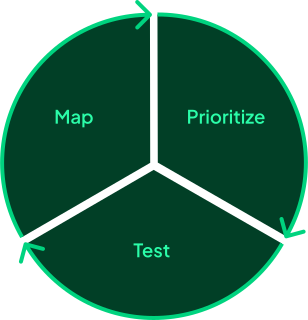
At the minimum, the best practice would be to back up vital data, create a strong disaster recovery plan, and then test these processes to know that they work as expected (meaning you have protected your business-critical data and it can be recovered). Luckily, to help elaborate on this practice, there’s a framework to follow to help guide you through the process: Map, prioritize, test.

Map-prioritize-test framework for NIS2 directive compliance backup and disaster recovery

Map-Prioritize-Test framework to ensure compliance

This framework is helpful for businesses to prepare for compliance with the expected NIS2 requirements by boosting cyber resiliency, most notably by maintaining business-critical functions through protecting key business infrastructure. Here’s more detail about what each leg of the framework entails:

1. Map critical systems

Assess and analyze critical infrastructure across on-premises, native cloud, and public cloud environments. Identify and prioritize crucial data, ensuring business continuity. Don’t overlook SaaS applications like Entra ID; safeguarding identity and credential data is vital.


Neglecting identity and access data can impact business continuity even if other data is fully restored. Microsoft recognizes identity systems as more critical than human life support systems due to how important this data is for businesses: Read what Microsoft has to say about the importance of backing up Entra ID (formerly Azure AD).

2. Prioritize: What is critical to maintain access to?

Understanding the nature of your data is key to strengthening your organization’s data resilience. As you consider the types of data you handle, such as SaaS data from Microsoft 365 (M365) or Entra ID, it becomes evident that not all data holds equal importance. This realization forms the basis for strategic prioritization, a critical step in preparing for NIS2 compliance.


Whether safeguarding CEO emails, logistics data, customer information, intelligence dashboards, or proprietary code, identifying the priority for recovery establishes a strategic foundation. This speeds up recovery time and minimizes downtime, ensuring that your business continuity efforts are precisely aligned with the specific datasets crucial for sustaining your operations.
By determining what needs to be recovered first, you ensure that your business continuity efforts are targeted and aligned with the specific data sets crucial for sustaining your operations. This strategic prioritization not only optimizes your backup plan but also enhances your preparedness for compliance with the NIS2 directive.

3. Test that your backup works

This critical phase of the framework involves validating the effectiveness of your backup and disaster recovery processes. Testing is a key element of continuity, because with regular testing, your business ensures that data recovery is possible in the event of a real crisis — this is best practice data security and compliance in line with the NIS2 framework.


Ensuring the effectiveness of your backup and disaster recovery processes is crucial for maintaining data integrity and business continuity. The following guidelines outline key steps in the testing phase, aimed at validating your organization’s readiness to swiftly recover critical data in diverse scenarios.


From prompt validation of restoration capability to involving relevant stakeholders, this comprehensive testing phase guideline ensures confidence in your disaster recovery plan and ongoing resilience against potential threats:

  • Validate restoration capability promptly:
    Promptly validate that your backup systems can efficiently restore critical data without compromising integrity.
  • Determine acceptable downtime:
    Establish the maximum allowable time for data recovery, aligning with recovery time objectives set during prioritization.
  • Regularly test backups for confidence:
    Frequently test your backups to instill confidence in your disaster recovery plan and promptly address any identified issues.
  • Consider different scenarios:
    Simulate diverse scenarios, testing the recovery of individual files, entire databases, and complete systems to identify weaknesses.
  • Document and analyze results:
    After each testing session, document and analyze the time, accuracy, and challenges encountered to gain insights for improvement.
  • Involve relevant stakeholders:
    Collaborate with IT teams, data custodians, and business continuity managers to ensure comprehensive testing aligns with broader goals.
  • Update and improve:
    Continuously update recovery plans based on testing insights, addressing weaknesses, refining procedures, and adapting to evolving threats.

As organizations diligently adhere to the rigorous testing guidelines outlined above, they pave the way for a robust IT compliance policy essential for NIS2 readiness. The elements of backup management and disaster recovery, as emphasized by Article 21 of NIS2, not only acknowledge its far-reaching impact but also serve as proactive measures against evolving cyber threats.

Keepit as an established expert in EU compliance

Keepit, being a European company based in Denmark, understands the intricacies of EU regulations and their profound impact as we’re also subject to them ourselves. We operate without any sub-processors and maintain our own independent cloud operations within the EU, utilizing data centers in Denmark, Germany, and the UK. With a commitment to excellence in compliance, Keepit holds end-to-end ISO 27001 certification and is audited in accordance with ISAE 3402 type 2.


To guide your company through the complexities of legislative directives such as NIS2, NIS, and GDPR, we invite you to explore a demonstration of how Keepit can assist in ensuring comprehensive compliance.

About Version 2 Limited
Version 2 Digital is one of the most dynamic IT companies in Asia. The company distributes a wide range of IT products across various areas including cyber security, cloud, data protection, end points, infrastructures, system monitoring, storage, networking, business productivity and communication products.

Through an extensive network of channels, point of sales, resellers, and partnership companies, Version 2 offers quality products and services which are highly acclaimed in the market. Its customers cover a wide spectrum which include Global 1000 enterprises, regional listed companies, different vertical industries, public utilities, Government, a vast number of successful SMEs, and consumers in various Asian cities.

About Keepit
At Keepit, we believe in a digital future where all software is delivered as a service. Keepit’s mission is to protect data in the cloud Keepit is a software company specializing in Cloud-to-Cloud data backup and recovery. Deriving from +20 year experience in building best-in-class data protection and hosting services, Keepit is pioneering the way to secure and protect cloud data at scale.

The best compliance books for 2024

Why is it important to be compliant? 

Compliant companies follow industry regulations and implement regulatory standards for data security, privacy protection, and confidentiality.

Digging into the compliance section at Amazon is not an optional extra. Companies that fail to comply face massive penalties or even criminal prosecutions. Compliance also promotes robust security and improves business processes—giving companies a crucial competitive advantage.

Every employee should be aware of compliance. However, compliance books target senior management and security experts. Anyone responsible for handling customer data or defending against cyberattacks should expand their compliance library.

Top compliance books for beginners and professionals

Compliance is a complex and constantly evolving field. It’s also a minefield for poorly informed businesses. Fortunately, a busy community of expert writers interprets regulations and simplifies the compliance challenge.

We don’t have space to list every manual or think-piece here, but the following compliance books are well worth consulting:

  • Governance, Risk Management, and Compliance: It Can’t Happen to Us—Avoiding Corporate Disaster While Driving Success

  • Intentional Integrity: How Smart Companies Can Lead an Ethical Revolution

  • How to Be a Wildly Effective Compliance Officer

  • The Business Guide to Effective Compliance & Ethics

  • Fully Compliant

  • A Concise Guide to HIPAA Compliance

  • The Risk-Based Approach to Data Protection

  • Big Breaches: Cybersecurity Lessons for Everyone

  • How To Pay A Bribe: Thinking Like a Criminal to Thwart Bribery Schemes

Governance, Risk Management, and Compliance: It Can’t Happen to Us—Avoiding Corporate Disaster While Driving Success

Author: Richard M. Sternberg

Steinberg founded Pricewaterhouse Cooper’s Strategic Risk Services division and has become one of America’s leading risk consultants. This text primarily aims at senior executives and managers. It provides a general introduction to risk management from a boardroom perspective.

Steinberg’s book is a how-to guide for designing compliant processes and leadership structures. There’s no better way to learn about integrating gold-standard risk management practices into your business organization.

Intentional Integrity: How Smart Companies Can Lead an Ethical Revolution

Authors: Robert Chesnut and Joan O’C. Hamilton

Wouldn’t it be great if every business had an incentive to meet industry regulations and act like a model citizen? Experience suggests that many companies fail to live up to these ideals. But Chesnut argues that’s a mistake. The future belongs to businesses that uphold stellar compliance records and drive an “ethical revolution.”

Chesnut is an expert on Silicon Valley, and he knows about dubious morals. However, things can change for the better. This book is a clear-eyed guide to a world where companies with poor data protection or security records are shamed and punished.

Readers will find inspiration in Chesnut’s advice about building an enterprise-wide ethical culture. And they will also come away with plenty of nuggets about improving corporate governance and how to join the ethical elite.

How to Be a Wildly Effective Compliance Officer

3 Compliance books-How to be a wildly effective compliance officer

Author: Kristy Grant-Hart

Grant-Hart is the CEO of Spark Compliance and a regular winner of Women in Compliance awards. This short primer targets compliance officers. Distilling all of her experience, Grant-Hart provides invaluable advice about persuading colleagues and shaping corporate culture.

This isn’t one of those dust-dry compliance books that overwhelm readers with statistics. Grant-Hart specializes in motivation. Readers will close the book feeling energized, confident, and with a renewed sense of their potential to change business processes.

The Business Guide to Effective Compliance & Ethics

Authors: Tony Osborn and Andy Hayward

Hayward and Osborn tackle the critical question, “Why is corporate compliance failing to prevent scandals and data breaches?” Their answer is radically simple. Tick-box checklists and compliance strategies based on documentation are not enough. Businesses need to be proactive and dynamic to build a culture of compliance.

This book lays out a strategy to create a compliance management program that works. The authors contextualize compliance, focusing on benefits like trust and employee satisfaction. As with all good compliance books, the reader emerges empowered and clear about how to move forward.

Fully Compliant

Author: Travis Waugh

Waugh is a leading expert in compliance training. If you struggle to convey compliance information to employees, this book is an essential read.

Fully Compliant argues that it is not enough to tell employees about the consequences of non-compliance. Successful compliance programs immerse learners in real-life scenarios. Immersive learning induces long-term behavior change—a critical component of continuous compliance strategies.

A Concise Guide to HIPAA Compliance

Author: Lucas M. Slattery

Health Insurance Portability and Accountability Act (HIPAA) compliance is stressful and complicated. It helps to have a go-to reference text as you design compliant systems. Slattery’s work is one of the best compliance books for anyone who needs a grounding in HIPAA rules.

Based on official documents from the Department for Health and Human Services (HHS), this book explains tricky issues like defining personally identifiable health information and applying security controls. Slattery keeps things practical, focusing on affordable and proportionate solutions that meet HIPAA standards.

The Risk-Based Approach to Data Protection

Author: Raphael Gellert

Regulations like the General Data Protection Regulation (GDPR) and the California Consumer Privacy Act (CCPA) have made data protection a hot topic for all digital businesses. Adopting a risk-based approach to compliance balances security and costs—but what does “risk-based” mean? If you have any doubts, Gellert’s expert advice will come in handy.

Gellert is a Professor of Private Law at Radboud University in the Netherlands and isn’t afraid of complexity. His book delves into the history of data protection and conceptual approaches to risk. But it shines when discussing modern-day compliance programs.

Expect to come away with a deeper understanding of how to execute GDPR risk assessments. With Gellert’s help, you should be able to lock down personal data without wasting scarce resources.

Big Breaches: Cybersecurity Lessons for Everyone

Authors: Neil Daswani and Moudy Elbayadi

Brushing up on your compliance knowledge is great, but it also helps to consider the consequences of lax security and privacy processes. Daswani and Elbayadi mercilessly explain worst-case scenarios, using real-world case studies to paint a grisly picture.

Big Breaches range widely. The authors explore phishing and ransomware attacks. They look at software exploits, compromised supply chains, and encryption foul-ups. But it’s not just a tale of woe. Readers learn seven critical habits to avoid data breaches and design a rock-solid compliance program.

How To Pay A Bribe: Thinking Like a Criminal to Thwart Bribery Schemes

Author: Alexandra Wrage and Severin Wirz

This short book dates back to 2016, but it sadly remains evergreen. Comprising a series of essays from prominent anti-corruption lawyers, “How to Pay a Bribe” explains how corruption occurs. The authors use real-life examples of ordinary companies falling victim to bribery or other scandals. They also frame corruption as a compliance failure—suggesting ways to eradicate it from business culture.

Both a good read and a useful guide, this book is essential reading for companies that do business abroad or work in sectors like finance, where US bribery regulations are extremely tight.

Reading compliance books is a great way to refresh your knowledge and gain insights into compliance best practices. However, reading is not enough. Compliance professionals should leverage every source of information and assistance to stay one step ahead of the pack.

Podcasts supplement books with expert interviews and analysis and are perfect for gym sessions or commutes, providing up-to-date opinions from the compliance battlefront. YouTube channels also mix entertainment and information. Webinars from experts provide a gold mine of information about GDPR compliance.

Universities and accreditation bodies offer online compliance courses. There are plenty of course options, including specialized HIPAA or anti-corruption certificates. It’s also worth bookmarking relevant information libraries and referring to them for practical guidance.

NordLayer’s learning center is a good starting place. We have created regulatory compliance articles about regulatory requirements, penalties, and frameworks companies can use to make their operations compliant. Learn about compliance basics and fundamental to advanced techniques, and integrate the latest knowledge into your compliance strategy.

Businesses should never face compliance challenges alone. Order relevant books, binge on podcasts, and bookmark resources to guide your way. You’ll soon find that others have confronted similar problems, and solutions should be easily achievable.


IoT Malware Attacks Hit a 400% Increase

So, what’s the problem with these handy IoT devices? In short: they can be hacked – easily. Designed with functionality and convenience in mind, security has taken a back seat. This low level of protection leaves users vulnerable to attack, and IoT devices have become prime targets for cyberattacks. In fact, the Zscaler ThreatLabz research team found that IoT malware attacks increased 400% in the first half of 2023 compared to 2022.

EU Cyber Resilience Act

On a legislative level, the EU is taking this seriously. The upcoming Cyber Resilience Act (CRA) is already striking fear into the hearts of device manufacturers the world over. But for consumers, the future of IoT looks bright, or at least more secure.

If passed, the CRA “would see inadequate security features become a thing of the past with the introduction of mandatory cybersecurity requirements for manufacturers and retailers of such products, with this protection extending throughout the product lifecycle.”

This is a huge development: Device makers will have to ensure the security of their products past sale. That means regular updates, security patches, and consumer safety being higher on the priority list than ever before. It’s a big shift towards a more secure digital landscape. Smart and secure homes are the future.

US Cyber Trust Mark

While the EU is laying down the law, the US Federal Communications Commission (FCC) is planning to roll out its new “labeling program for smart devices” in 2024. The Cyber Trust Mark will be the shiny new seal of approval for cyber-secure products.

Jessica Rosenworcel, FCC Chairwoman says: “The Cyber Trust Mark will help consumers make more informed decisions about what kind of devices they bring into their homes and businesses. So when you need a baby monitor, or a new appliance, you’ll be able to look for a Cyber Trust Mark… device manufacturers are going to be able to showcase privacy and security in the marketplace by displaying this mark”.

Manufacturers will be permitted to place the seal on products only after official assessment. And though this is still a voluntary seal, i.e. manufacturers aren’t legally obliged to earn it, it’s a step in the right direction for IoT cybersecurity. If you’re in the US, keep an eye out for this logo when making future device purchases.

IoT vulnerabilities & security tips

While most IoT malware attacks are aimed at businesses (manufacturing and education are among the most targeted sectors), consumers should stay vigilant as well. There are several avenues through which attackers can infiltrate your home networks using IoT devices. Here are a few ways that you can protect yourself.

  • Default logins – ISPs and modem/router companies tend to distribute network devices with default logins. These credentials are easily accessible online. A typical username is “admin”, passwords might be basic codes like 1234 or 0000. Easy pickings for hackers – and easy for you to change.

  • Auto-update – If this feature is turned off and you miss security updates, your device will stay open to vulnerabilities longer. Turn on auto-update to avoid this. Smart devices with legacy firmware are the bread and butter of IoT hackers.

  • Separate network for IoT – Keep your devices insulated from your main home network. This acts as an effective layer of security if one of your devices is compromised.

  • Principle of least privilege – Turn off certain “smart” features that you don’t use. Why does your toaster have a camera anyway?

With new regulations taking effect this year and our own proactive security measures at home, a safer cyber future is possible for all.

Listen to the Cyberview podcast on Spotify.

About Version 2 Limited
Version 2 Digital is one of the most dynamic IT companies in Asia. The company distributes a wide range of IT products across various areas including cyber security, cloud, data protection, end points, infrastructures, system monitoring, storage, networking, business productivity and communication products.

Through an extensive network of channels, point of sales, resellers, and partnership companies, Version 2 offers quality products and services which are highly acclaimed in the market. Its customers cover a wide spectrum which include Global 1000 enterprises, regional listed companies, different vertical industries, public utilities, Government, a vast number of successful SMEs, and consumers in various Asian cities.

About Nord Security
The web has become a chaotic space where safety and trust have been compromised by cybercrime and data protection issues. Therefore, our team has a global mission to shape a more trusted and peaceful online future for people everywhere.

About NordLayer
NordLayer is an adaptive network access security solution for modern businesses – from the world’s most trusted cybersecurity brand, Nord Security.

The web has become a chaotic space where safety and trust have been compromised by cybercrime and data protection issues. Therefore, our team has a global mission to shape a more trusted and peaceful online future for people everywhere.

ESET Research joins global operation to disrupt the Grandoreiro banking trojan operating in Latin America and Spain

  • ESET worked alongside the Federal Police of Brazil in an attempt to disrupt the Grandoreiro botnet.
  • ESET contributed to the project by providing technical analysis, statistical information, and known command and control (C&C) server domain names and IP addresses.
  • This disruption operation was aimed at individuals who are believed to be high up in Grandoreiro’s operational hierarchy.
  • Further investigation performed by the Federal Police of Brazil led to the identification and arrest of the individuals in control of the botnet.
  • Grandoreiro has been active since at least 2017.
  • Grandoreiro targets Brazil, Mexico, Spain, and Argentina.
  • Grandoreiro can block a victim’s screen, log keystrokes, simulate mouse and keyboard activity, share the victim’s screen, and display fake pop-up windows.

BRATISLAVA, PRAGUE — January 30, 2024 — ESET collaborated with the Federal Police of Brazil in an attempt to disrupt the Grandoreiro botnet. ESET contributed to the project by providing technical analysis, statistical information, and known command and control (C&C) server domain names and IP addresses. Due to a design flaw in Grandoreiro’s network protocol, ESET researchers were also able to get a glimpse into the victimology.

This disruption operation was aimed at individuals who are believed to be high up in Grandoreiro’s operational hierarchy. The investigation by the Federal Police of Brazil led to multiple arrests. ESET researchers provided data crucial to identifying the accounts responsible for setting up and connecting to the Grandoreiro C&C servers.

Grandoreiro is one of many Latin American banking trojans. It has been active since at least 2017, and ESET researchers have been closely tracking it since then. Grandoreiro targets Brazil, Mexico, Spain, and, since 2023, Argentina.

Functionality-wise, Grandoreiro hasn’t changed very much since the last ESET Research blog post about the group in 2020. Despite that, Grandoreiro has been undergoing rapid and constant development. Occasionally, we even observed several new builds a week; for example, this has amounted to a new version on average every four days between February 2022 and June 2022.

The operator still has to interact manually with the compromised machine in order to steal a victim’s money. The malware allows the following actions:

  • Blocking victims’ screens
  • Logging keystrokes
  • Simulating mouse and keyboard activity
  • Sharing the victims’ screen(s)
  • Displaying fake pop-up windows

“ESET automated systems have processed tens of thousands of Grandoreiro samples. The domain generation algorithm (DGA) that the malware has used since around October 2020 produces one main domain per day, and it is the only way Grandoreiro is able to establish connection to a C&C server. Beside the current date, the DGA accepts a huge static configuration as well,” says ESET Researcher Jakub Souček, who coordinated the team that analyzed Grandoreiro and other Latin American banking trojans. “Grandoreiro is similar to other Latin American banking trojans mainly via its obvious core functionality and in bundling its downloaders within MSI installers.”

Grandoreiro’s implementation of its network protocol allowed ESET researchers to take a peek behind the curtain and get a glimpse of the victimology. Grandoreiro’s C&C servers give away information about victims connected at the time of the initial request made to each newly connected victim. By examining this data for more than a year, we conclude that 66% were Windows 10 users, 13% used Windows 7, Windows 8 represented 12%, and 9% were Windows 11 users. Since Grandoreiro reports unreliable geographical distribution of its victims, we refer to ESET telemetry: Spain accounts for 65% of all victims, followed by Mexico with 14%, Brazil with 7%, and Argentina with 5%; the remaining 9% of victims is located in other Latin American countries.. We also note that in 2023, we saw a significant decrease of Grandoreiro’s activity in Spain, compensated with increased campaigns in Mexico and Argentina.

For more technical information about Grandoreiro, check out the blog post “ESET takes part in global operation to disrupt the Grandoreiro banking trojan” on WeLiveSecurity. Make sure to follow ESET Research on Twitter (currently known as X) for the latest news from ESET Research.

About Version 2 Limited
Version 2 Digital is one of the most dynamic IT companies in Asia. The company distributes a wide range of IT products across various areas including cyber security, cloud, data protection, end points, infrastructures, system monitoring, storage, networking, business productivity and communication products.

Through an extensive network of channels, point of sales, resellers, and partnership companies, Version 2 offers quality products and services which are highly acclaimed in the market. Its customers cover a wide spectrum which include Global 1000 enterprises, regional listed companies, different vertical industries, public utilities, Government, a vast number of successful SMEs, and consumers in various Asian cities.

About ESET
For 30 years, ESET® has been developing industry-leading IT security software and services for businesses and consumers worldwide. With solutions ranging from endpoint security to encryption and two-factor authentication, ESET’s high-performing, easy-to-use products give individuals and businesses the peace of mind to enjoy the full potential of their technology. ESET unobtrusively protects and monitors 24/7, updating defenses in real time to keep users safe and businesses running without interruption. Evolving threats require an evolving IT security company. Backed by R&D facilities worldwide, ESET became the first IT security company to earn 100 Virus Bulletin VB100 awards, identifying every single “in-the-wild” malware without interruption since 2003.

Unleashing XDR Security: Leading the Charge Against Cyber Attacks

As we stand at the forefront of a new era in cybersecurity, one thing is abundantly clear: old paradigms are no longer sufficient. We need a robust and comprehensive approach to tackling the multifaceted, persistent cyber threats that companies face daily. This is where the evolution of endpoint detection and response (EDR) and the emergence of extended detection and response (XDR) comes into play. These advanced security solutions are not just tools; they are the embodiment of a visionary strategy that every security manager should consider to effectively stand up against today’s cyber attacks.

The Genesis of Endpoint Detection and Response

The inception of endpoint detection and response marked a significant milestone in the history of cybersecurity. Born in an era marked by rampant cybercrime escalation, EDR sought to fortify the last line of defense – the endpoints. These comprise hardware devices that, without adequate protection, could serve as entryways for cyber threats into the organizational landscape.

The essence of EDR lies in its dual ability to not only recognize ominous activities but also equip systems with the means to counteract these threats promptly. This feature was a quantum leap from the modus operandi of its predecessors, traditional antivirus software, which primarily focused on detection rather than an active response. With real-time surveillance and incident response features, EDR turned a new page in cybersecurity, offering more effective tools to navigate the ever-morphing threat landscape.

Unlike earlier, rather passive security tools, EDR solutions allowed for an active defense strategy, ushering in an era of proactive security management. Real-time threat monitoring and incident response capabilities provided by EDR tools were instrumental in this change, offering a significant edge in a world where threats could emerge and evolve in a matter of seconds. The real triumph of EDR, however, lay in its capacity to understand and learn from attack methodologies, setting the stage for forensic capabilities that have now become the backbone of modern cybersecurity.

However, the evolution of cybersecurity did not stop with the emergence of EDR. As cyber threats continued to grow in complexity and subtlety, the demand for a more all-encompassing approach to security became increasingly evident. This growing need, combined with the ever-expanding digital ecosystems of modern businesses, paved the way for the emergence of a more advanced, comprehensive solution – Extended Detection and Response, or XDR. This evolution demonstrates the dynamic nature of cybersecurity and underlines the need for continuous adaptation and enhancement in our strategies to keep pace with emerging threats.

Strengths and Shortcomings of EDR

While EDR has been instrumental in elevating the security landscape, it’s crucial to scrutinize both its virtues and its limitations. On one hand, EDR solutions have proven to be a powerful defense against an array of cyber threats, including but not limited to ransomware, malware, and phishing exploits. These tools don’t merely act as sentinels, but they offer real-time responses to threats, creating a dynamic line of defense that can adapt to evolving attack vectors.

Further adding to its allure, EDR possesses a forensic flair, allowing it to dissect attack patterns, providing invaluable insights into the adversary’s playbook. This feature is paramount for security teams aiming to stay one step ahead, equipping them with the ability to predict and preempt future threats.

However, like any innovation, EDR isn’t without its flaws. One of its main limitations lies in its domain – the endpoints. As such, it may turn a blind eye to threats lurking in the shadows of network traffic, cloud workloads, and emails. This confined purview can leave the organization’s security fabric vulnerable, creating chinks in the armor that could be exploited by cyber adversaries.

Another noteworthy challenge with EDR is the data deluge it produces. As these systems diligently monitor and document every irregularity, they generate a plethora of data. While this wealth of information could be invaluable, it can also become overwhelming, creating an analysis paralysis for security teams. The sheer volume of data to be scrutinized can dilute focus, increasing the risk of missing subtle but significant signs of security threats.

Ultimately, while EDR has reshaped cybersecurity with its real-time response and forensic capabilities, the increasing complexity and pervasiveness of cyber threats necessitate an evolution beyond EDR. The next chapter in this security narrative belongs to a more inclusive and integrated solution – Extended Detection and Response.

The Emergence of XDR Security

To stay ahead in the continuously evolving cyber battlefield, it’s vital to adapt and augment our strategies. This necessary evolution heralded the advent of a cutting-edge approach to cybersecurity – the extended detection and response (XDR). Conceived out of the need to fortify our security frameworks against an ever-diversifying array of cyber threats, XDR aims to eclipse the boundaries of endpoint-centric defense.

XDR is a formidable next-gen security tool that provides a broader and deeper analysis of potential threats across all enterprise environments. It’s not limited to endpoints alone but extends its vigilance to network traffic, cloud workloads, and email security. This unified perspective creates a more comprehensive view of potential vulnerabilities, resulting in a more complete understanding of the threats at hand.

Unlike its predecessor, EDR, XDR does not merely concentrate on a single domain. It gathers and correlates data from various sources, cutting through the noise to provide a holistic picture of the security landscape. The fusion of information from disparate domains enhances the precision and speed of threat detection, providing a distinct edge in the high-stakes game of cyber defense.

With XDR, the cybersecurity narrative takes a significant leap forward. It represents a comprehensive integration of diverse security layers into one cohesive system, shedding light on hidden vulnerabilities and blind spots in the security fabric. This inclusive approach sets a new paradigm in cybersecurity, shifting the focus from reactive protection to a more proactive, all-encompassing security posture.

The emergence of XDR is a testament to the necessity of continuous innovation in the face of evolving threats. In this new chapter of cybersecurity, XDR security stands tall as a robust and inclusive solution, capable of weathering the relentless storm of cyber threats. By synergistically merging different areas of the security landscape into a unified whole, XDR is redefining the way we tackle the ever-present challenge of cyber attacks.

XDR Security: A Quantum Leap in Response

As we delve deeper into the realm of XDR security, one aspect is distinctly clear: it is not just an upgrade but a monumental leap in cybersecurity. XDR is an embodiment of comprehensive protection, a forward-thinking solution born out of the need to surpass the limitations of its precursor, Endpoint Detection and Response (EDR). By transcending these constraints, XDR propels cybersecurity to new heights of precision, speed, and efficiency.

At its core, XDR offers a unified platform for threat detection, investigation, and response across diverse security layers. What sets it apart is its inherent capacity to automate incident responses. This automated response feature dramatically reduces the time and resources typically required for threat neutralization, enabling security teams to devote their efforts towards more strategic endeavors. In this sense, XDR is not just a tool but an enabler, paving the way for security teams to operate at their full potential.

Yet, the real power of XDR security lies in its panoramic visibility. By consolidating data from disparate domains of the IT ecosystem, XDR delivers an unprecedented level of clarity and context to the incident response process. The integration of this myriad data creates a cohesive and comprehensive security narrative, arming security teams with the holistic intelligence needed to mount effective responses to evolving threats.

With XDR, the security response isn’t just about addressing threats as they arise, but it’s also about using the garnered insights to strengthen the organization’s security posture proactively. This dynamic, forward-thinking approach heralds a new era of cybersecurity, moving away from isolated, reactive measures to a holistic, proactive defense strategy.

The transformative power of XDR is a testament to the incredible progress in cybersecurity, illustrating how continuous innovation can redefine the way we approach and manage cyber threats. In this rapidly changing landscape, XDR stands as a beacon of advancement, embodying a more strategic, efficient, and effective approach to cybersecurity. It’s this evolutionary mindset that will equip security teams with the tools they need to face the ongoing onslaught of cyber threats with confidence and foresight. In the high-stakes world of cybersecurity, XDR is indeed a quantum leap.

Navigating the Future with XDR Security

In this digital age, cybersecurity threats continue to evolve, becoming more intricate and menacing. The conventional security tools of the past are no longer enough to stand up to the escalating wave of cyber threats. This shifting terrain calls for a more advanced, all-inclusive approach to cybersecurity, one that goes beyond surface-level detection and reactionary defenses. This is where Extended Detection and Response (XDR) takes the center stage, enabling us to outmaneuver the complexity of the cyber threat landscape.

XDR, with its broad and in-depth perspective of the entire IT ecosystem, offers a clarity and control previously unseen in cybersecurity. By creating a unified view of threats across all facets of the IT infrastructure, XDR provides security teams with a vantage point, enabling a comprehensive understanding of the threat scenario. This wide-ranging insight empowers them to pivot from a reactive stance to a more proactive, preventive approach, bolstering the organization’s security posture.

The real strength of XDR lies in its ability to connect the dots, drawing on diverse data sources to create a coherent picture of the threat landscape. This integrated, cross-domain perspective goes beyond the tunnel vision of traditional security tools, allowing for a swift and precise threat detection and response. By offering this high-resolution view of the cyber battlefield, XDR equips security teams with the intelligence they need to make informed, strategic decisions.

XDR, however, isn’t just about strengthening defenses; it’s about enabling growth. By automating the incident response process, XDR security frees up time and resources for security teams to focus on strategic initiatives. This enhanced efficiency allows them to develop innovative security solutions and stay ahead of the curve, ensuring they’re not just responding to threats, but outsmarting them.

As we navigate this brave new world of cybersecurity, it’s clear that XDR will be pivotal in shaping our collective response to cyber threats. As a beacon of progress in this challenging landscape, XDR symbolizes a shift in how we perceive and manage cybersecurity, pushing us towards a more comprehensive, proactive, and strategic approach. In the face of relentless cyber attacks, the future belongs to those who can harness the power of tools like XDR. The future belongs to the visionaries, the forward-thinkers, the innovators who dare to take the helm and lead the charge against cyber threats. Are you ready to navigate the future with XDR?

About Version 2 Limited
Version 2 Digital is one of the most dynamic IT companies in Asia. The company distributes a wide range of IT products across various areas including cyber security, cloud, data protection, end points, infrastructures, system monitoring, storage, networking, business productivity and communication products.

Through an extensive network of channels, point of sales, resellers, and partnership companies, Version 2 offers quality products and services which are highly acclaimed in the market. Its customers cover a wide spectrum which include Global 1000 enterprises, regional listed companies, different vertical industries, public utilities, Government, a vast number of successful SMEs, and consumers in various Asian cities.

About Portnox
Portnox provides simple-to-deploy, operate and maintain network access control, security and visibility solutions. Portnox software can be deployed on-premises, as a cloud-delivered service, or in hybrid mode. It is agentless and vendor-agnostic, allowing organizations to maximize their existing network and cybersecurity investments. Hundreds of enterprises around the world rely on Portnox for network visibility, cybersecurity policy enforcement and regulatory compliance. The company has been recognized for its innovations by Info Security Products Guide, Cyber Security Excellence Awards, IoT Innovator Awards, Computing Security Awards, Best of Interop ITX and Cyber Defense Magazine. Portnox has offices in the U.S., Europe and Asia. For information visit http://www.portnox.com, and follow us on Twitter and LinkedIn.。

What is Prompt Engineering? Detailed guide

Digital-First has become the trend of organizations in the world and Latin America, in which a digital strategy is chosen first for product and service delivery, especially when a greater impact of the brand is sought more immediately to a certain segment of the market along with a wider dissemination on the offer, in a more customized way and, above all, if it seeks to get closer to the end customer. According to Marketing4Commerce, Digital Report, the number of internet users in the world reaches 5.16 billion (64.4% of the world’s population, as of 2023) with an internet browsing time greater than 6 hours, and people with mobile devices reach 5.44 billion (68% of the world’s population, as of 2023).

Also, we see this reflected in an Adobe report (Digital Trends 2023) in which more than 70% of organizations, both leaders and followers, believe that their customers’ expectations are constantly adjusted to align with improved omnichannel experiences, this is because end customers are constantly evaluating their experiences in comparison to their last best experience. Certainly, the most memorable experiences will be created by organizations that know how to leverage data and combine it with human knowledge to anticipate customer needs, with greater empathy and in a more individualized way.

In this scenario, Artificial Intelligence (AI) becomes an ally to implement customer experience strategies in a customized and innovative way, taking advantage of voice recognition tools, understanding of natural language, data on behavior patterns and customer preferences. In recent years, interactions with virtual assistants have become commonplace, prompting the development of language models for certain tasks or expected outcomes. This is known as Prompt Engineering, which is the process of building alerts or inputs to guide a certain AI system behavior and get desired and accurate answers from AI models. So AI assumes a digital collaborator role that not only works as a point of contact with customers, but also boosts knowledge and productivity for the organization’s collaborators.

Content:

What is Prompt Engineering?

According to Techopedia, (Prompt Engineering) refers to a technique used in artificial intelligence (AI) to optimize and adjust language models for particular tasks and desired outcomes. Also known as Prompt design, which carefully builds prompts or inputs for AI models in order to improve their performance of specific tasks. Properly designed prompts are used to guide and modify the desired performance of the AI system and obtain accurate and desired responses from AI models.

Prompt Engineering uses the capabilities of language models and optimizes their results through properly designed prompts. This allows not only to rely on pre-training or fine-tuning, but also to help users guide models to specific goals by encouraging accurate responses and providing direct directions, exceptions, or examples in prompts.

According to a survey conducted by COPC Inc. During 2022, “Improving Customer Experience” reached 87% as the most mentioned goal in terms of implementing AI-based solutions. In this regard, 83% of respondents stated that they use AI-based solutions mainly for contact applications with their customers, and that AI has endless uses that directly impact Customer Experience. According to a study conducted by CX optimization 2023, the most implemented uses are content creation, customer profiling and reduction of internal calls.

Large Language Models, LLM),which are advanced linguistic models based on Deep Learning algorithms to process and analyze large amounts of text data. LLM works from artificial neural networks (systems that are inspired by the function of the human brain), which are trained to learn patterns and relationships in a text and generate answers to users’ questions. This enables LLM to be able to analyze large volumes of text data and from that, use that information to understand words, phrases and sentences and their contexts, enabling human-IA communication.

Prompt Engineering Technical Side

As we mentioned earlier, LLMs are trained from large amounts of text data to teach the model to recognize relationships and patterns in a text. All this data is processed to adjust model parameters and thereby improve language accuracy and understanding. Text preprocessing techniques (removal of irrelevant words, standardization of words to detect the variability of a text), hyperparameter adjustments and optimization are also used to achieve the highest model accuracy. To implement Prompt Engineering, there are several techniques, such as:

  1. Zero-Shot Prompting: It generates a response without giving linguistic models examples or previous context. It is used for quick answers to general questions or topics.
    • Example: “What is a prompt?”
    • Answer: “A Prompt is…”
  2. One-Shot Prompting: A response is retrieved from an example or context provided by the user.
    • Example: “If budget in Portuguese is orçamento, how can I translate Supplier?”
    • Answer: “Fornecedor”.
  3.  Information Retrieval: Generative AI is asked a specific question for detailed answers. The key to this is the data source from which the LLMs are fed. For example, ChatGPT only has access to data after September 2021.
    • Example: “What are the advantages of LLM?”
    • Answer: “1. Content diversification. 2. Customization…”
  4. Creative Writing: Through this technique it is possible to develop texts with imagination, stories and textual expressions that adapt to the preferences of the audience.
    • Example: “Write a poem to the moon”
    • Answer: “The moon can be taken in tablespoons…or as a capsule every two hours. It is good as a hypnotic and sedative and also relieves. “
  5. Context Enrichment: Enrichment of information to Artificial Intelligence to improve understanding using methods 5W and 1H, (which refers to 5 W questions: Who, What, Where, When, Why); and 1 H, which is the How of a topic.
    • Example: “Is it good to eat Beets?”
    • Answer: “Who: Most people can eat Beet; What: “Beet or beetroot refers to an edible deep red tuber…”
  6. Content Summary with a Specific Focus: It consists of directing the attention of AI to specific aspects of instruction, with a particular emphasis. It can be highlighted which elements should be prioritized in the model, so that the summary reflects the essence of the approach.
    • Example: “Full guide on website optimization techniques, but I only want the mobile optimization strategies.”
    • Answer: “The key aspects are: Mobile Cache – enabling this option allows…; List of Mobile User Agents – if the Mobile Cache feature is enabled…”
  7. Fill Templates: To create versatile and structured content. A template with placeholders is used to customize prompts in different instructions while maintaining consistency. Content managers or web developers use this strategy to create custom content snippets, which have been generated by AI on their websites. An example is using a standard template for quoting, making AI fill in customer data, products, pricing, etc. Another example is automating custom emails from a template with a general structure – from the greeting, main text, farewell (‘Hello {Name}, Thank you for requesting our {Service}… {Close}.”
  8.  Prompt Customization or Prompt Reframing: It allows you to change the wording of the questions while maintaining the original intent of the query. The language model can be designed to give multiple answers that respond to the original query in different ways. This can be done with synonyms or question rephrasing.
    • Example: “Original prompt: What are the ways to reduce network latency? Reworded Prompt: Can you list techniques to optimize network speed?”
  9. Prompt Combination: It consists of merging different prompts or questions in the same instruction to obtain a complete answer.
    • Example: “Can you explain the differences between shared hosting and VPS hosting and recommend which one is better for a small e-commerce website?”
    • Answer: “Shared hosting and VPS hosting are two types of hosting services… Shared Hosting: …”
  10. CChain-Of-Thought Prompting: It uses real-time AI interactions to guide toward more accurate and complete responses. It is not based on a single question, but on a sequence of questions or examples associated with it in order to elaborate on the original query. To do this, you need to divide a query or a complex topic into smaller sections. These parts are then presented as a sequence of queries that build on top of each other, to drive AI toward a desired answer.
    • Example: “What is the Main Theme?… For what purpose?… Who is the audience?…”
  11. Iterative Prompting: It consists of making follow-up queries based on previous responses to dive into a certain topic, obtain additional information, or clarify any ambiguities about the initial result. This technique requires experts in (Natural Language Processing) to design iterative prompts and elaborate responses similar to those made by a human being.
    • Example: “What are the best movies of 2022?”
    • Answer: “‘Drive My Car’ by Ryûsuke Hamaguchi; ‘The Alley of Lost Souls’ by Guillermo del Toro; Martin McDonagh’s ‘The Banshees of Inisherin’; ‘Holy Spider’ by Ali Abbasi…”
  12.  Interactive Storytelling & Role-Playing: It leverages AI’s ability to tailor responses based on previous prompts and interactions, developing a fluid narrative.
    • Example: “Prompt: I want to start a collaborative storytelling exercise with you. We will write a fantasy story about a land where magic exists,… The character will be….”
    • Answer: “In the shadows of a forest there was a…”
  13. Implicit Information Injection: The particularity of this technique is that context is subtly given so that AI understands the needs without the need to express it explicitly.
    • Example: “Can you mention the best practices of Modernizing a Datacenter?”
    • Answer: “1- Raise the operating temperature of your data center; 2- Upgrade servers and systems for better consolidation and efficiency.”
  14. Translation of Languages with Contextual Nuances: Generation of multilingual content, beyond translating words from one language to another, considering the cultural context or situation for a more accurate and natural translation.
    • Example: “Translate the sentence “She took the ball and ran with it” from English to French, bearing in mind that it is a business metaphor to refer to taking the reins of a project.”
    • Answer: “Elle a pris le ballon et a foncé avec”, considering the idea of taking the initiative of a project.”

In addition to these, we can mention Automatic Prompt Engineering (APE) as an advance in Artificial Intelligence that leverages LLMs to help AI automatically generate and select instructions on its own. The main steps are:

  1. Assign the chatbot a specific task and show some examples.
  2. The chatbot comes up with different ways to do the job, either by direct reasoning or by taking into account similar tasks that it knows.
  3. These different methods are then tested in practice.
  4. The chatbot assesses the effectiveness of each method.
  5. AI will then choose a better method and apply it.

By means of Machine Learning, Generative AI tools can streamline tasks, from in-context data analysis to automated customer service, without the need for constant human-generated prompts.

It is worth mentioning that in Prompt Engineering it is important to consider basic technical aspects such as Temperature and what we call Top-K Sampling ,to improve the quality and diversity of AI-generated content, by influencing the model’s token (word or subword) selection process:

  • Temperature: A higher temperature value (e.g., 1.0 or higher) will result in more diverse and creative text, while a lower value (e.g., 0.5 or lower) will produce more focused and deterministic results. To do this, it is recommended to encourage creativity based on higher temperature values when generating creative writing, brainstorming sessions or exploring innovative ideas. It is also recommended to improve coherence, opting for lower temperature values with well-structured, coherent and focused content, such as technical documentation or formal articles.
  • Top-k sampling: is another recommended technique in AI text generation to control the model token selection process, from a restricted set of most likable k tokens. A smaller k value (e.g., 20 or 40) will result in more focused and deterministic text, while a larger k value (e.g., 100 or 200) will produce more diverse and creative results. Applications of top-k sampling include driving content diversity, using larger k-values when generating content that requires a wide range of ideas, perspectives, or vocabularies. It is also about ensuring focused results, choosing smaller k-values, generating content that requires a high degree of concentration, accuracy or consistency.

To implement the Temperature and Top-k Sampling techniques, Experimentation (testing multiple combinations of temperature and top-k values to identify the optimal configuration for tasks or contents) and Sequential Adjustments, are recommended, during the text generation process to control the performance of the AI model at different stages. For example, start with a high temperature and a large k-value to generate creative ideas, then switch to lower values for further refinement and focus.

Finally, it is recommended to apply the downward gradients which consist of an optimization algorithm to minimize an objective function and calculate the rate of change or gradient of the loss function. In Machine Learning this objective function is usually the loss function to evaluate the performance of the model. Parameters are updated iteratively using downward gradients until a local minimum is reached.

Why Question Engineering Matters

The speed with which OpenAI ChatGPT works since 2022 is overwhelming, today it is being used by millions of people, as a form of conversational artificial intelligence, based on advanced deep learning algorithms to understand human language.

Currently, organizations use multiple AI techniques such as Natural Language Processing, Question Engineering, Artificial Neural Network (NN), Machine Learning, and Markov Decision Processing, (MDP) to automate different tasks.

The importance of Question Engineering is that it improves the customer experience and interactions between people and AI, and contributes to building better conversational AI systems. These conversational AI systems dominate and will dominate the market in the coming years by using LLM in a consistent, relevant and accurate way. Just for reference, we have ChatGPT reaching 100 million active users within weeks of its launch.

For developers, Question Engineering helps to understand how AI-based models arrive at the expected answers and also obtain accurate information on how AI models work on the back-end. Of course, the development of prompts covering several topics and scenarios will be needed. Other benefits that you may mention are: that Question Engineering and the context of the text-image synthesis, allow to customize the features of the image (the style, the perspective, the aspect ratio, the point of view and the image resolution). It also plays an important role in the identification and mitigation of prompt injection attacks, thus protecting AI models from possible malicious activities.

Evolución de la Ingeniería de Preguntas

Natural Language Processing (NLP), is part of AI that helps perceive, as its name says, the “natural language” used by humans, enabling interaction between people and computers, thanks to its ability to understand words, phrases and sentences. It also includes syntactic (meaning of words and vocabulary) and semantic (comprehension within a sentence or combination of sentences) processing. The first lights of NLP were seen in the 1950s, when rule-based methods began to be adopted, consisting mostly of machine translation. Its application was in word/sentence analysis, answering questions and machine translation. Until the 1980s, computational grammar appeared as an active field of research. There was more availability of grammar tools and resources, which boosted their demand. Towards the 90s, the use of the web generated a large volume of knowledge, which boosted statistical learning methods that required working with NLP. In 2012 Deep Learning appeared as a solution for statistical learning, producing improvements in NLP systems, deepening raw data and learning from its attributes.

By 2019, the Generative Pre-trained Transformer (GPT) a remarkable advance in the domain of natural language processing emerged, as it is possible to pre-train large-scale language models to teach AI systems how to represent words and sentences in context. This enabled the development of machines that can understand and communicate using language in a manner very similar to that of humans. Its most popular application is ChatGPT, which obtains information from texts published since 2021 on the Internet, including news, encyclopedias, books, websites, among others, but lacks the ability to discriminate which information is true and which is not. Precisely for this reason, Question Engineering emerges as a method to optimize natural language processing in AI and improve the accuracy and quality of its answers.

The Art and Science of Creating Questions

A prompt is itself a text included in the Language Model (LM), and Question Engineering is the art of designing that text to get the desired result, with quality and accuracy. This involves tailoring data input so that AI-driven tools can understand user intent and get clear and concise answers. Which tells us that the process must be effective to ensure that AI-driven tools do not generate inappropriate and meaningless responses, especially when GPT solutions are based mostly on the frequency and association of words, and may yield incomplete or erroneous results.

To create Questions in Generative AI tools, it is recommended to follow this essential guide:

  • Understanding the Desired Outcome

    Successful Prompt Engineering starts with knowing what questions to ask and how to do it effectively. So the user must be clear about what they want in the first place: objectives of the interaction and a clear outline of the expected results (what to get, for what audience and any associated actions that the system must perform).

  •  Choose words carefully

    Like any computer system, AI tools can be precise in their use of commands and language, not knowing how to respond to unrecognized commands or language. It is recommended to avoid ambiguity, metaphors, idioms and specific jargon so as not to produce unexpected and undesirable results.

  • Remember that form matters

    AI systems work based on simple, straightforward requests, through informal sentences and simple language. But complex requests will benefit from detailed, well-structured queries that adhere to a form or format consistent with the internal design of the system. This is essential in Prompt Engineering, as the shape and format may differ for each model, and some tools may have a preferred structure involving the use of keywords in predictable locations.

  • Make clear and specific requests

    Consider that the system can only act on what it can interpret from a given message. So you have to make clear, explicit and actionable requests and understand the desired outcome. From there, work should then be done to describe the task to be performed or articulate the question to be answered.

  • Pay attention to length

    Prompts may be subject to a minimum and maximum number of characters. Even though there are AI interfaces that do not impose a strict limit, extremely long indications can be difficult for AI systems to handle.

  • Raise open-ended questions or requests

    The purpose of Generative AI is to create. Simple Yes or No questions are limiting and with possible short and uninteresting results. Open-ended questions allow for more flexibility.

  • Include context

    A generative AI tool can meet a wide range of objectives and expectations, from brief and general summaries to detailed explorations. To take advantage of this versatility, well-designed prompts include context that helps the AI system tailor its output to the intended audience.

  • Setting goals or production duration limits

    Although generative AI claims to be creative, it is often advisable to include barriers in factors such as output duration. Context elements in prompts may include, for example, requesting a simplified and concise response versus a long and detailed response. Also consider that natural language processing models, such as GPT-3, are trained to predict words based on language patterns, not to count them.

  • Avoid contradictory terms

    Also derived from long prompts and may include ambiguous or contradictory terms. It is recommended for Prompt engineers to review Prompt training and ensure all terms are consistent. Another recommendation is to use positive language and avoid negative language. The logic is that AI models are trained to perform specific tasks, not to do them.

  • Use punctuation to clarify complex cues

    Just like humans, AI systems rely on punctuation to help analyze a text. AI prompts can also make use of commas, quotation marks, and line breaks to help the system analyze and operate in a complex query.

Regarding images, it is recommended to consider their description, the environment and mood in their context, colors, light, realism.

How Question Engineering Works

Prompt Engineering is a discipline to promote and optimize the use of language models in AI, through the creation and testing of data inputs, with different sentences to evaluate the answers obtained, based on trial and error until the training of the AI-based system is achieved, following these fundamental tasks

  1. Specify the task: Definition of an objective in the language model, which may involve NLP-related tasks such as complementation, translation, text summary.
  2.  Identify inputs and outputs: Definition of the inputs that are required in the language model and the desired outputs or results.
  3. Create informative prompts: Creation of prompts that clearly communicate the expected behavior in the model, which must be clear, brief and in accordance with the purpose for which it was created.
  4. Interact and evaluate: It is tested using language models and evaluating the results that are returned, looking for flaws and identifying biases to make adjustments that improve their performance.
  5. Calibrate and refine: It consists of taking into account the findings obtained, making adjustments until the behavior required in the model is obtained, aligned with the requirements and intentions with which the prompt was created.

Throughout this process, the Prompt Engineer should keep in mind that when designing questions it is critical to be clear and accurate. If the designed message is ambiguous, the model will have difficulties for responding with quality. When designing prompts, attention should be paid to the sources used during the previous training, considering audiences without gender and cultural bias, to promote respect and inclusion. What is recommended is to focus on responses aimed at helping, learning, and providing neutral, fact-based responses

Also, the Role Play application is recommended in which a scenario is created where the model assumes a role and interacts with another entity. For example, if you wish to create a product review, you may take on the role of a customer who tried a product and writes down their satisfactory experience.

The Role of a Question Engineer

A Prompt Engineer es el responsable de diseñar, desarrollar, probar, depurar, mantener y actualizar aplicaciones de IA, en estrecha colaboración con otros desarrolladores de software para garantizar que el software responda y funcione de manera eficiente. En su función se requiere creatividad y atención al detalle para elegir palabras, frases, símbolos y formatos correctos que guíen al modelo IA en la generación de textos relevantes y de alta calidad. Este rol emergente ha cobrado mayor relevancia en la necesidad de que IA contribuya a mejorar y agilizar los servicios ante el cliente y en forma interna. Ahora, si nos preguntamos quiénes puede ser Ingenieros de Preguntas, no solo para agilizar sus tareas sino para desarrollarse profesionalmente, podemos decir que pueden ser los investigadores e ingenieros de IA, los científicos y analistas de datos, los creadores de contenido, ejecutivos de atención al cliente, personal docente, profesionales de negocios, investigadores. Se espera que la demanda de Ingenieros de Preguntas crezca en la medida que las organizaciones requieran de personas que sepan manejar las herramientas impulsadas por IA.

The Future of Prompt Engineering

It is anticipated that trends towards a future of Prompt Engineering will be linked to integration with augmented reality (AR) and virtual reality (VR), in the sense that the proper application of prompts can enhance immersive AR/VR experiences, optimizing AI interactions in 3D environments. Advances in Prompt Engineering allow users to converse with AI characters, request information, and issue natural language commands in simulated, real-time environments. This is based on the fact that, with Prompt Engineering, AI can be provided with a context or situation, a conversation and the exchange of the human being with AR/VR applications, whether for spatial, educational, research or exploration use.

Another of the forecasts of the use of Prompt Engineering is the possibility of achieving a simultaneous translation in spoken and written languages, taking advantage of the contexts in several languages so that AI translates bi-directionally in real time and in the most reliable way possible. The impact of this is communication in business, multicultural, diplomatic and personal contexts, taking into account regional dialects, cultural nuances and speech patterns.

Regarding interdisciplinary creativity, Prompt Engineering can boost AI to generate art, stories, works and music, combining with human creativity. Of course, this may have ethical implications, although the access of AI for artistic purposes is also democratized.

Of course, as Prompt Engineering matures, questions about fairness, respect and alignment with moral values are raised, from the formulation of the query itself to the type of answers that can be derived. Keep in mind that in the future of AI and Prompt Engineering, technology will always be a reflection of people.

Challenges and Opportunities

As we have seen, Prompt Engineering represents the opportunity to develop well-designed Prompts that improve the features of AI, more efficiently and effectively. The advantage of this is that everyday tasks can be streamlined, in addition to expanding knowledge on different topics and boosting creativity. Inclusion is also encouraged when properly implemented, with a positive impact on gender experiences.

On the other hand there are poorly designed questions that can result in AI responses with bias, prejudice, or erroneous data. Hence, ethical considerations in Prompt Engineering can mitigate these risks, without compromising fairness, respect, and inclusion. Also, the lack of application of best practices, even by professionals in the field, may not achieve the desired result on the first attempt and may be difficult to find a suitable point to start the process.

It can also be difficult to control the level of creativity and uniqueness of the result. Often, Prompt Engineering professionals can provide additional information in the message that may confuse the AI model and affect the accuracy of the answer.

Conclusions

In the digital economy, the most memorable experiences will be those in which data is leveraged and combined with human knowledge to anticipate customer needs, with empathy and customization. In this environment, AI becomes the digital partner, not only as a point of contact with the customer, but also as a driver of productivity in the organization. It is true that GPT has gained traction in a search for closer proximity to the customer; however, it is based on frequency and word association, lacking the ability to differentiate correct from incorrect information. Due to this need to improve the quality of answers that Prompt Engineering takes relevance to develop and optimize AI natural language models and obtain quality and accuracy in their answers, based on a greater understanding of user intent. Without a doubt, the demand for the Prompt Engineer will grow, confirming that organizations require professionals who know how to understand the nature of AI-based tools.

It is clear that, as the adoption of Mature Prompt Engineering will continue to raise issues of equity, respect and alignment with moral values in the formulation of prompts and results, so appropriate techniques are required to achieve its implementation without bias or prejudice. To embark on this journey to Prompt Engineering, it is recommended to be accompanied by a technology partner who transmits to their team the best techniques and practices for its implementation.

About Version 2 Limited
Version 2 Digital is one of the most dynamic IT companies in Asia. The company distributes a wide range of IT products across various areas including cyber security, cloud, data protection, end points, infrastructures, system monitoring, storage, networking, business productivity and communication products.

Through an extensive network of channels, point of sales, resellers, and partnership companies, Version 2 offers quality products and services which are highly acclaimed in the market. Its customers cover a wide spectrum which include Global 1000 enterprises, regional listed companies, different vertical industries, public utilities, Government, a vast number of successful SMEs, and consumers in various Asian cities.

About PandoraFMS
Pandora FMS is a flexible monitoring system, capable of monitoring devices, infrastructures, applications, services and business processes.
Of course, one of the things that Pandora FMS can control is the hard disks of your computers.

Cyberview #6: IoT’s security vulnerabilities & upcoming regulations

This episode of Cyberview delves into the evolving world of “the Internet of Things”. IoT, or when everything from your heating system to your car are actually computers and connected via networks, has become commonplace. Press a button 50 km away to warm up your house as you drive home in what Elon Musk calls “sophisticated computers on wheels”. But this convenience comes with a catch. As these machines evolve into increasingly complex computers, the potential attack surface grows. The Cyberview team explores.


IoT Malware Attacks Hit a 400% Increase

So, what’s the problem with these handy IoT devices? In short: they can be hacked – easily. Designed with functionality and convenience in mind, security has taken a back seat. This low level of protection leaves users vulnerable to attack, and IoT devices have become prime targets for cyberattacks. In fact, the Zscaler ThreatLabz research team found that IoT malware attacks increased 400% in the first half of 2023 compared to 2022.

EU Cyber Resilience Act

On a legislative level, the EU is taking this seriously. The upcoming Cyber Resilience Act (CRA) is already striking fear into the hearts of device manufacturers the world over. But for consumers, the future of IoT looks bright, or at least more secure.

If passed, the CRA “would see inadequate security features become a thing of the past with the introduction of mandatory cybersecurity requirements for manufacturers and retailers of such products, with this protection extending throughout the product lifecycle.”

This is a huge development: Device makers will have to ensure the security of their products past sale. That means regular updates, security patches, and consumer safety being higher on the priority list than ever before. It’s a big shift towards a more secure digital landscape. Smart and secure homes are the future.

US Cyber Trust Mark

While the EU is laying down the law, the US Federal Communications Commission (FCC) is planning to roll out its new “labeling program for smart devices” in 2024. The Cyber Trust Mark will be the shiny new seal of approval for cyber-secure products.

Jessica Rosenworcel, FCC Chairwoman says: “The Cyber Trust Mark will help consumers make more informed decisions about what kind of devices they bring into their homes and businesses. So when you need a baby monitor, or a new appliance, you’ll be able to look for a Cyber Trust Mark… device manufacturers are going to be able to showcase privacy and security in the marketplace by displaying this mark”.

Manufacturers will be permitted to place the seal on products only after official assessment. And though this is still a voluntary seal, i.e. manufacturers aren’t legally obliged to earn it, it’s a step in the right direction for IoT cybersecurity. If you’re in the US, keep an eye out for this logo when making future device purchases.

IoT vulnerabilities & security tips

While most IoT malware attacks are aimed at businesses (manufacturing and education are among the most targeted sectors), consumers should stay vigilant as well. There are several avenues through which attackers can infiltrate your home networks using IoT devices. Here are a few ways that you can protect yourself.

  • Default logins – ISPs and modem/router companies tend to distribute network devices with default logins. These credentials are easily accessible online. A typical username is “admin”, passwords might be basic codes like 1234 or 0000. Easy pickings for hackers – and easy for you to change.

  • Auto-update – If this feature is turned off and you miss security updates, your device will stay open to vulnerabilities longer. Turn on auto-update to avoid this. Smart devices with legacy firmware are the bread and butter of IoT hackers.

  • Separate network for IoT – Keep your devices insulated from your main home network. This acts as an effective layer of security if one of your devices is compromised.

  • Principle of least privilege – Turn off certain “smart” features that you don’t use. Why does your toaster have a camera anyway?

With new regulations taking effect this year and our own proactive security measures at home, a safer cyber future is possible for all.

Listen to the Cyberview podcast on Spotify.

About Version 2 Limited
Version 2 Digital is one of the most dynamic IT companies in Asia. The company distributes a wide range of IT products across various areas including cyber security, cloud, data protection, end points, infrastructures, system monitoring, storage, networking, business productivity and communication products.

Through an extensive network of channels, point of sales, resellers, and partnership companies, Version 2 offers quality products and services which are highly acclaimed in the market. Its customers cover a wide spectrum which include Global 1000 enterprises, regional listed companies, different vertical industries, public utilities, Government, a vast number of successful SMEs, and consumers in various Asian cities.

About Nord Security
The web has become a chaotic space where safety and trust have been compromised by cybercrime and data protection issues. Therefore, our team has a global mission to shape a more trusted and peaceful online future for people everywhere.

About NordLayer
NordLayer is an adaptive network access security solution for modern businesses – from the world’s most trusted cybersecurity brand, Nord Security.

The web has become a chaotic space where safety and trust have been compromised by cybercrime and data protection issues. Therefore, our team has a global mission to shape a more trusted and peaceful online future for people everywhere.