Skip to content

Multi-Factor Authentication: The Ins and Outs

Multi-factor authentication, often referred to simply as MFA, is what we call an additional layer of security that, today, we can enable on most of our online accounts for better security. Unfortunately, MFA is often overlooked. Whether it’s because users don’t know what it is or how it works remains a mystery. Today, we’ll explore MFA. We’ll look into what it is, how it works, and why it is important. Hopefully, by the end of this post, you’ll be rushing to enable MFA on all of your online accounts.

What is MFA?

What does MFA stand for cyber security? Multi-factor authentication, although some security experts refer to it as “multi-step authentication”. Usually MFA is described as an additional layer of security. Technically speaking, MFA is an access management component that requires users to provide two or more factors of authentication to access an account. Essentially, MFA requires users to provide extra proof of identity besides their username and password. Think of MFA as an extra lock on your door.

Unfortunately, misconceptions about MFA exist and often deter users from using it and taking advantage of the security that it provides. The misconceptions seem to be prevalent in the business world. Organizations tend to think that incorporating multi-factor authentication software into their IT infrastructure and rolling out MFA for the entire company is difficult and cumbersome and could be counterproductive.

The reality of the matter is the opposite. With today’s security technologies, enabling MFA for company-wide use can be done quickly and with virtually no interruptions. And once it is done, the benefits that MFA brings to the table far outweigh any possible inconveniences that a company might face during implementation.

How does MFA work?

MFA works by employing a variety of technologies to authenticate the user once they try to access their online account. With MFA enabled, a user first needs to enter their username and passwords, but besides these credentials, the user is also asked to authenticate their identity by some other means. Once the two factors are authenticated, the user is granted access to their account. One of the most popular MFA factors is known as one-time passwords (OTP); these are the 4-8 digit codes that are sent to you via SMS, email, or authentication app.

how does mfa work

Types of MFA factors

A variety of factors could be used by MFA to authenticate the user. Here are some of the most common ones.

What you know (knowledge factor)

The knowledge factor typically consists of a password, PIN, passphrase, or security questions and their answers known only to the rightful account holder. For the knowledge factor to work correctly, the user must enter the correct information requested by the online application.

What you have (possession factor)

Before we had smartphones that we could use for MFA, people carried tokens or smartphones to generate an OTP that would be entered as a factor of authentication. These days, smartphones are the primary physical tools that we use to generate an OTP, usually via authenticator apps. However, physical security keys are also available as a possession factor, which are often considered one of the most secure options when it comes to MFA types.

What you are (inherence factor)

As an additional factor of authentication, users today can use biometric data.

Such data includes the person’s fingerprints, facial features, retina scans, voice recognition, and other biometric information. Biometric authentication is gaining more traction by the day, as authentication is frictionless when compared to other types.

Where you are (location factor)

The last (but not least) of the authentication factors — location-based authentication — usually checks the user’s IP address and their geo-location. Users can whitelist certain geo-locations and block others. If the login attempt comes from an unrecognized location, MFA blocks the access to the account and vice versa.

inner types of mfa

Why is multi-factor authentication important

As cybercrime continues to increase in frequency and sophistication, individuals and companies alike look for effective and simple ways to ensure the security of their online accounts. MFA provides just that.

When bad actors are able to steal passwords and usernames, they can easily gain unauthorized access to accounts and network systems. But with MFA enabled, even hackers with the correct login credentials would need to get through an additional layer of security, whether it’s OTP, biometric authentication, or other means of MFA. All of that complicates things for attackers because for a successful hack they would need to somehow have access to smartphones or other devices related to the user.

Given that up to 80% of data breaches are related to poor password habits in one way or the other, MFA can significantly improve your security. Reports also indicate that the volume of brute force attacks grew by 160% starting in May 2021. But that’s not all. Security experts and researchers continue to see an increase in phishing attacks, which are usually at the top of the hacking funnel. As cybercrime continues to rise in prominence, MFA is quickly becoming a critical part of everyone’s security, whether it’s an individual or a large organization.

Difference between MFA and Two-Factor Authentication

As you can probably guess, the difference between 2FA and MFA — as the names suggest — lies in the number of authentication factors required to authenticate a given user.

Two-Factor Authentication (2FA), unsurprisingly, requires exactly two factors of authentication – no more, no less.

Therefore, following this logic, Multi-Factor Authentication (MFA) requires two or more authentication factors to work as intended.

Basically, this means that every two-factor authentication is an example of multi-factor authentication, but not the other way around.

MFA benefits

The number one thing that MFA brings to the table is enhanced security. MFA works hand in hand with strong passwords to ensure the best possible security. It makes it harder for devious parties to access accounts or system networks without factored authentication. This applies to both individuals and organizations.

However, for businesses, MFA also helps with compliance. Security standards such as the GDPR and HIPAA require the highest level of security to protect sensitive user data and MFA can be that additional layer of security that helps businesses comply with security standards.

Additionally, MFA can boost a company’s reputation among its customers if it offers MFA as an additional layer of security for their accounts. These days, ​​customers trust and appreciate businesses that take precautions to protect them seriously.

Multi-factor authentication examples

As already mentioned, multi-factor authentication is about using two or more authentication factors to identify a given user. Those factors can be passwords, pins, passphrases, tokens, or biometrics (f.ex. fingerprint recognition or face IDs). By creating combinations of the factors above, you can build authentication sequences with different levels of security.

For example, you can make log-in credentials — such as an account number or email address and the password that was set for the account — the first factor (or step) in the multi-factor authentication. By providing these two pieces of information, the user can specify which account they want to access and confirm that they know the password required to log in. That’s a great starting point, but as you know, passwords can be stolen, therefore, you must make sure that the person trying to access the account is its real owner.

So, you can put another line of defense by asking that person to also provide the pin number sent right after they entered the password to the phone number associated with the account. This will be the second factor. If the person provides the pin, this will be an indication that they are in possession of the mobile device with the correct phone number and thus it is very likely that they are the rightful owner of the account.

You can add more factors to be absolutely sure that you do not grant access to the wrong person. For example, you can ask a person to confirm their identity by using biometrics, e.g. scanning their fingerprints with their mobile device. Keep in mind, however, that the introduction of too many authentication factors may negatively affect the user experience, making logging into the application or system too burdensome.

MFA types that NordPass Business supports

NordPass Business is a secure and intuitive password manager purpose-built to facilitate smooth and secure password management in a corporate environment, and it comes equipped with three MFA options: an authenticator app, a security key, and backup codes, which can come in handy when you don’t have access to the authenticator app or a security key. NordPass supports major authenticator apps such as Google Authenticator, Microsoft Authenticator, and Authy.

Besides MFA, NordPass Business is packed with a variety of advanced security and productivity features. Not only does NordPass allow users to create complex and unique passwords on the spot and store them in an encrypted vault, but it also can autofill login credentials and autosave new ones with just a few clicks.

Furthermore, with NordPass Business, organizations can regularly check for weak, old, or reused passwords with Password Health and check if any of company-related domains or emails have been compromised in a data leak with the Data Breach Scanner. A business password manager is quickly becoming a ubiquitous tool for any company wishing to succeed in today’s digital world.

If you are interested in learning more about NordPass Business and how it can fortify corporate security and even bring business closer to cyber insurance eligibility, do not hesitate to book a demo with our representative.
 

About Version 2 Limited
Version 2 Digital is one of the most dynamic IT companies in Asia. The company distributes a wide range of IT products across various areas including cyber security, cloud, data protection, end points, infrastructures, system monitoring, storage, networking, business productivity and communication products.

Through an extensive network of channels, point of sales, resellers, and partnership companies, Version 2 offers quality products and services which are highly acclaimed in the market. Its customers cover a wide spectrum which include Global 1000 enterprises, regional listed companies, different vertical industries, public utilities, Government, a vast number of successful SMEs, and consumers in various Asian cities.

About NordPass
NordPass is developed by Nord Security, a company leading the global market of cybersecurity products.

The web has become a chaotic space where safety and trust have been compromised by cybercrime and data protection issues. Therefore, our team has a global mission to shape a more trusted and peaceful online future for people everywhere.

Five strong password ideas to boost your security

While you only need one key to lock your apartment door, the digital world is far more complicated. People often have dozens of accounts online – and just as many passwords to protect them with. Since building a password that is equal parts unique and secure can be frustrating, we have prepared some ideas and suggestions for strong passwords to keep you one step ahead of hackers.

What is a good password?

You might think that the answer to this question would be very subjective, but that’s far from the case. In simplest terms, a good password is one that’s difficult to crack. The stronger your password is, the better it works to protect your accounts from hackers and other malicious actors. A strong, reliable password can sometimes take millions of years to crack, which means that the hackers are less likely to even try to gain them.

When you’re thinking of good password ideas, you need to keep the following criteria in mind:

  • The password should be at least 12-15 characters long.

  • It should use a combination of letters, numbers, and special characters. Spaces are also allowed.

  • It should not be a common word, product, character, name, or anything you can easily find in a dictionary.

  • It should be a combination that only you know and others could not easily predict. We’ll cover some creative password ideas shortly.

  • Each password should be unique and you shouldn’t reuse them for several accounts. If a password you use on several platforms is cracked, that puts all of your accounts at risk.

What is considered a weak password?

Weak passwords consist of sequential letters or numbers, are fewer than eight characters long, or use common words and phrases. The most popular passwords are well-known by malicious actors and are usually what they try first.

According to NordPass’ annual top 200 most common passwords list, “123456” and “password” are the most commonly used and vulnerable passwords. Another example of a weak password would be using the name of a fictional character like “Superman,” “Batman,” or “Joker.”

Examples of bad passwords

Here are some more examples of weak, easy-to-crack passwords:

  • 123456789

  • abc123

  • qwerty

  • iloveyou

  • hello

  • computer

  • password123

If you’re wondering whether your passwords might be weak links, check out the list of the top 200 most common passwords. You’ll find even more examples, as well as some fun facts about the most common passwords around the world.

The most common password-cracking techniques

Brute-force attack

During a brute-force attack, a malicious actor uses software that tries every possible combination to find the right one. An eight-character password consisting of upper- and lowercase letters, numbers, and special characters can be cracked in just two hours. Good passwords will take months or even years to break through, depending on their uniqueness and complexity.

Dictionary attack

While brute-force attacks try various combinations of special characters, numbers, and letters, a dictionary attack uses a program that goes through a prearranged list of words. Essentially, if your password can be found in a dictionary, specialized software can easily crack it.

Phishing

Phishing is a social engineering method to trick people into revealing their credentials. Phishing attacks often use email services as a medium: hackers send emails pretending to be reputable sources and refer users to fake login pages. A user then inputs their login credentials themselves and inadvertently grants this information to the hackers.

Credential stuffing

Credential stuffing is a popular method for hackers to gain access by collecting usernames and passwords used in previous attacks and trying them on other platforms. This method often proves successful because people tend to reuse the same password for all their accounts.

Keylogging

Keylogging involves a specific type of malware, known as keylogger, infecting the victim’s device. The keylogger can then track the user’s keystrokes and device activity, depending on the software and the device. This can include copied and pasted data, phone calls, location, and screenshots. Using this information, hackers can easily access passwords and other sensitive information, allowing them to launch further attacks on the individual or data from their place of work.

How to create a strong password

  • The longer your password is, the better. Many websites ask you to create eight-character passwords, but we recommend going for at least 15 characters.

  • Avoid ties to your personal information, such as your name, surname, address, or date of birth.

  • Use a combination of numbers, symbols, and upper- and lowercase letters in random order.

  • Don’t use sequential letters and numbers.

  • Avoid substitution: “kangaroo” and “k@ng@r00” are both equally weak passwords, and a brute-force attack can easily crack them.

  • Don’t reuse the same password for multiple accounts.

With our free password security tool, you can check your password strength and if it has been exposed in any data breaches. You can also try the Password Health feature with NordPass Premium. It scans all passwords that you’ve saved in your Vault and checks for vulnerabilities.

Top 5 strong password ideas

Coming up with a strong and unique password can be a challenge. To make this process easier for you, we’ve gathered some examples that will help protect your data and accounts from being breached and taken over. We’ve also included some formulas and passphrase examples that you can try yourself. However, we highly recommend you don’t use the example passwords for your accounts.

1. Shorten each word

Think of a phrase and remove the first three letters of each word (in some cases, that might mean deleting full words, but that’s fine):

“Laptop running free in the jungle” -> “top ning e gle”

Sounds like gibberish? That’s exactly what we want. Just don’t forget to add special characters and numbers to make it more complicated. It would take 94,000 years to crack this password.

2. Create your own formula

Create a formula that will help you remember the password. For example, you can take a phrase and replace every letter with the next one in the alphabet:

“Cucumbers are tasty” -> “dvdvncfst bsf ubtuz”

Another clever way of creating strong passwords is to turn song lyrics into acronyms. This means using only the first letter of each line of your favorite song.

So, “Shine on you crazy diamond” by Pink Floyd becomes “rsnsybccystswrcc.”

The time needed to crack this password is 746 million years.

3. Play with the vowels

This one is much easier to implement and memorize: take a random nonsensical phrase and replace one vowel with another (for example, “a” with “e”):

“A car is floating in a pan” -> “e cer is floeting in e pen”

Don’t forget – spaces are allowed in passwords, and we highly encourage you to use them. The combination of having spaces and switching the vowels around means the above password would take 583 million trillion years to crack.

4. Mix the codes of your favorite countries

This one is quite fun and easy to memorize. You will always generate good passwords with this method. Simply make a list of the ISO codes of your favorite countries and put them together:

“Mexico, Ireland, France, Germany, Japan” -> “mex irl fra deu jpn”

You wouldn’t think so, but a hacker would require a staggering six thousand trillion years to crack this password!

If you want to spice things up and make them even more difficult to crack, you can also add each country’s calling code:

“mex54 irl353 fra33 deu49 jpn81”

Such a password would take 12 decillion years years to crack. How impressive is that?

5. Use a password manager

If creating and remembering random phrases for all your accounts seems too complicated, you can use a password manager, such as NordPass. It’s an easy-to-use app that lets you generate strong, unique passwords and securely store them in an encrypted Vault. You can also easily use NordPass to autofill online forms and fields.

You can add as many passwords as you need and access them from any device. This way, you can get the best of both worlds by combining your creative password ideas with one-of-a-kind secure ones created by the password manager for each account without the risk of forgetting them. You can use a special code and get an additional month of NordPass Premium for free when you purchase a two-year plan.

Additional tips

Here are some more tips to keep in mind when you’re looking for good password ideas:

  • In order to protect your data, remember that passwords must be difficult to predict. Including special characters and spaces increases the time it takes for your password to be cracked.

  • Take your phone security into consideration. According to research, pattern locks are successfully replicated around 64% of the time. Instead, set up a PIN or use our guide to generate some strong phone password ideas.

  • Don’t forget to implement new password ideas for work. Don’t reuse your personal passwords because if they ever get breached, your work accounts could be in danger, too.

  • Always use multi-factor authentication (MFA). Even if your password is definitively strong, accidents can happen and your first line of defense might be breached. Using MFA means that no one can access your accounts without accessing your authentication device. NordPass uses multi-factor authentication to add an additional layer of security to your password vault.

About Version 2 Limited
Version 2 Digital is one of the most dynamic IT companies in Asia. The company distributes a wide range of IT products across various areas including cyber security, cloud, data protection, end points, infrastructures, system monitoring, storage, networking, business productivity and communication products.

Through an extensive network of channels, point of sales, resellers, and partnership companies, Version 2 offers quality products and services which are highly acclaimed in the market. Its customers cover a wide spectrum which include Global 1000 enterprises, regional listed companies, different vertical industries, public utilities, Government, a vast number of successful SMEs, and consumers in various Asian cities.

About NordPass
NordPass is developed by Nord Security, a company leading the global market of cybersecurity products.

The web has become a chaotic space where safety and trust have been compromised by cybercrime and data protection issues. Therefore, our team has a global mission to shape a more trusted and peaceful online future for people everywhere.

Quiz for Cybersecurity Awareness Month: 10 good-to-know facts about digital safety

Welcome to our Cybersecurity Awareness Month quiz! 

In an age where our digital footprints are larger than ever, understanding the importance of cybersecurity is vital. This quiz is designed for companies and their teams to enhance their digital safety knowledge, adopt new practices, and remain vigilant against evolving digital threats.

Are you ready to test your cybersecurity knowledge and learn some essential facts along the way? Let’s go!

1. When was Cybersecurity Awareness Month first celebrated?

Cybersecurity Awareness Month quiz 10 1400x720

Correct answer: October 2004

Cybersecurity Awareness Month was first celebrated in October 2004. Two decades ago, the President and the Congress of the US declared October the official Cybersecurity Awareness Month.

The idea behind it is to dedicate a month to raising awareness about the importance of cybersecurity, educate individuals and organizations about online threats and best practices, and promote a safer digital environment.

Over the years, this initiative helped individuals become more vigilant about online security, encouraged organizations to invest in cybersecurity measures, and fostered collaboration among governments, businesses, and the public in addressing cyber threats.

2. What’s the name of the first cyber attack?

Correct answer: Morris Worm

In November 1988, a graduate student named Robert Tappan Morris created the Morris Worm, one of the first computer worms.

Originally intended to measure the size of the internet, a coding error caused it to replicate uncontrollably, infecting thousands of computers.

This incident exposed vulnerabilities in early internet systems, led to the Computer Emergency Response Team (CERT) creation, and underscored the need for improved cybersecurity practices in the digital world.

3. When was the first antivirus software created?

Correct answer: 1980s

The first antivirus software, known as “Elk Cloner,” was created in 1982 by a high school student named Rich Skrenta.

Unlike modern antivirus tools, Elk Cloner was designed to protect Apple II computers from a playful prank: it spread by attaching itself to floppy disks and displayed a humorous poem upon activation.

While it was more of a benign experiment than a comprehensive antivirus solution, Elk Cloner marked the early beginnings of efforts to protect computers from malicious software.

4. What is the most common cyber threat?

Correct answer: Human error

Human error is the most common and pervasive cybersecurity threat. It occurs when individuals inadvertently make mistakes that compromise the security of digital systems and data. These errors can range from clicking on malicious links in phishing emails to unintentionally sharing sensitive information on public forums.

Human error is responsible for 85% of data breaches and security incidents, often leading to financial losses, reputational damage, and legal consequences for individuals and organizations.

Mitigating this threat requires a combination of user education, training, and implementing safeguards such as multi-factor authentication (MFA) and robust data protection policies based on the Zero Trust model.

5. How much did a ransomware attack cost for businesses on average in 2023?

Correct answer: $4.54 million

According to the IBM Data Breach Report of 2023, the average cost of a ransomware attack was $4.54 million. It’s challenging to pinpoint it precisely due to the many factors involved. However, it is commonly estimated to be in the hundreds of thousands to several million dollars.

These costs encompass the ransom payment (if made) and expenses related to data recovery, cybersecurity improvements, legal assistance, regulatory fines, and the significant operational disruptions that often follow such an attack.

Ransomware is one of the most malicious types of cyber attack, as the true cost can also be considerably higher when considering the long-term reputational damage and loss of customer trust.

6. Does company size matter for a malicious actor wanting to attack?

Correct answer: No, small, medium, and large companies are attacked equally often.

The size of a company doesn’t necessarily deter malicious actors from targeting it. In fact, small and medium-sized businesses are often targeted because they may have weaker cybersecurity defenses compared to larger enterprises.

Additionally, attackers might exploit smaller organizations as stepping stones to reach more substantial targets in supply chain attacks. Ultimately, cybercriminals consider factors such as vulnerabilities, potential rewards, and ease of access more than company size when deciding whom to target.

7. Top 3 industries that are the most vulnerable to cyber attacks?

Correct answer: Finance, Healthcare, Education

The finance industry is highly vulnerable to cyberattacks due to the vast amounts of valuable financial data it handles. Cybercriminals target banks, payment processors, and stock exchanges to steal funds and sensitive information.

In healthcare, the sensitivity of patient data and the increasing use of interconnected medical devices make it a prime target. Breaches can lead to identity theft, medical fraud, and even endanger patients’ lives.

The education sector faces threats as it increasingly relies on online learning platforms and stores student information. Cyberattacks in this industry can result in data breaches, educational disruptions, and the theft of personal information. Proactive cybersecurity measures are crucial for safeguarding the vulnerable education sector.

8. What does a strong password look like?

Correct answer: m#P52s@ap$V.

Strong passwords should mix upper and lower-case letters, numbers, and special symbols. Avoid easily guessable information like birthdays or common words. Never reuse passwords across multiple accounts. Each account should have its distinct, strong password to prevent a breach in one account from compromising others.

Change your passwords periodically, especially for sensitive accounts. This minimizes the risk in case a password is ever compromised.

Best cybersecurity strategies strongly recommend considering a password manager. It can generate and store complex passwords for you, making it easier to manage multiple secure logins without remembering them all. To make it even more resilient for breaches, combine passwords with MFA use.

9. What do you do if you receive an email from an unknown sender?

Correct answer: Don’t open it. If you did, don’t click on anything.

Phishing is leading the Top cyber incidents list of 2022. Phishing usually starts from an email. So, learning to recognize one is extremely important.

Here’s what to do if the email seems suspicious. First, avoid clicking on any links or downloadable attachments – they could be malicious. Then, take a close look at the sender’s email address. If it looks suspicious or doesn’t match the supposed sender, be cautious. Finally, always check for strange language, misspellings, or urgent requests. These can be signs of phishing attempts.

If the email claims to be from a company or organization, verify it independently by contacting the sender directly via alternative channels. Don’t use contact information from the suspicious email.

Mark the email as spam or junk to help train your email provider’s filters. If you’re unsure, it’s safest to delete the email. You can report it to your email provider or IT manager if it seems like a phishing attempt.

10. What does the acronym VPN stand for?

Correct answer: Virtual Private Network

A VPN, or Virtual Private Network, is like your digital secret tunnel to the internet. It keeps your online activities private and secure.

It does two cool things. First, it hides your online footprints from the snoopy eyes of malicious actors and advertisers. Second, it makes you look like you’re browsing from a different place, which is awesome for unlocking content or staying safe on public Wi-Fi.

Think of a VPN as your digital disguise. When you connect to one, it encrypts your data and sends it through a secure server in another location, masking your true identity and protecting your data from prying eyes like an online invisibility cloak.

Well done!

Congratulations on completing our Cybersecurity Awareness Month quiz! Your dedication to improving your digital safety knowledge is commendable. Remember, the world of cybersecurity is ever-evolving, and staying one step ahead of digital threats is an ongoing journey.

We encourage you to keep learning, stay vigilant, and explore additional resources to deepen your understanding of cybersecurity. Share what you’ve learned with your colleagues, friends, and family to help create a safer digital environment for all.

By working together and remaining proactive, we can strengthen our collective defenses against cyber threats and continue to adapt to the continuously shifting digital landscape. Thank you for taking the quiz and being a cybersecurity champion!

About Version 2 Limited
Version 2 Digital is one of the most dynamic IT companies in Asia. The company distributes a wide range of IT products across various areas including cyber security, cloud, data protection, end points, infrastructures, system monitoring, storage, networking, business productivity and communication products.

Through an extensive network of channels, point of sales, resellers, and partnership companies, Version 2 offers quality products and services which are highly acclaimed in the market. Its customers cover a wide spectrum which include Global 1000 enterprises, regional listed companies, different vertical industries, public utilities, Government, a vast number of successful SMEs, and consumers in various Asian cities.

About NordPass
NordPass is developed by Nord Security, a company leading the global market of cybersecurity products.

The web has become a chaotic space where safety and trust have been compromised by cybercrime and data protection issues. Therefore, our team has a global mission to shape a more trusted and peaceful online future for people everywhere.

Evolution of cyber law: how the NIS2 Directive shapes Europe’s security landscape

Ever wondered why even tech giants like Google approach European internet laws with caution? The answer is the Network and Information Systems (NIS2) Directive, a beacon in the world of internet safety. 

The old rules, laid down in 2016 by the NIS Directive, fell short of safeguarding against cyber threats. While they addressed sectors like healthcare and energy, many industries remained uncovered. But now, the tables are turning. The new NIS2 Directive creates a unified EU front against cyber risks, rewriting the rules for this new digital age.

In this piece, we’ll explore how the NIS2 Directive reshapes the cyber security landscape in Europe and what it means for businesses and governments. Learn how to navigate this evolving terrain and stay compliant without incurring penalties.

The need for evolving cyber law in Europe

It’s no secret that online threats have transformed into something far more sinister than we could have imagined. The time has come for Europe to embrace new cybersecurity legislation that will effectively combat the complexities of these threats. This section will explain how online risks have evolved and why new laws are required.

The changing face of cyber threats

In the past, cyber threats were mainly the work of individual cybercriminals. They were like digital graffiti artists, tagging websites and perhaps swiping some data for their bragging rights.

Now, things are more severe. We face organized groups, and sometimes even governments, harnessing the power of cyber attacks. The objective? Stealing vast amounts of data or causing disruption of critical services.

These aren’t just one-off events anymore. Cyber threats have turned into ongoing campaigns targeting sectors like energy or healthcare. With the omnipresence of the internet in everything from our refrigerators to our cars, the risks have infiltrated every nook and cranny of our lives. The cybersecurity landscape has changed, and Europe needs to update its legislative arsenal to counter these digital dangers effectively.

Time for an upgrade: why the old NIS Directive isn’t enough

Back in 2016, the European Union took its first step in the battle for cybersecurity with the Network and Information Systems (NIS) Directive. It was a start, but it soon became evident it had limitations.

For one, it only covered specific sectors, like energy and healthcare. Many other industries that could be vulnerable to cyber-attacks were left out.

Moreover, the directive’s implementation was a patchwork quilt. Each EU country adopted its own interpretation of the rules. This inconsistency meant that while one nation might be doing a great job fortifying its cybersecurity defenses, its neighbor might lag behind.

In short, the old rules weren’t enough, and it was time to bridge the security gaps. This is where the NIS2 Directive stepped in to address them.

Far-reaching impact of the NIS2 on cybersecurity

NIS2: fixing the flaws of its predecessor

The new and improved NIS2 Directive is Europe’s upgraded plan to make the digital world safer. Unlike the old rules, NIS2 covers a lot more ground. Financial services, public administration, and digital platforms all come under its umbrella.

That means more types of companies have to follow the rules and take measures to safeguard their digital assets. But it’s not just about adding more sectors. NIS2 also brings greater unity among EU countries regarding cybersecurity.

Instead of each country making its own rules, NIS2 established baseline requirements that apply everywhere. This way, the EU can act like one big team in defending against cyber threats, making everyone’s digital life safer.

The NIS2 toolkit: key features for cyber safety

So what’s new in NIS2? First, companies must put in specific security measures that match the cyber risks they face. It’s not a one-size-fits-all solution, but it’s more about adapting to the situation at hand.

Training and awareness

While NIS1 has a nod to raining and awareness-raising, NIS2 takes up a notch, possibly requiring more structured training programs. Organizations must show evidence of ongoing training and be subject to audits to ensure that employees are well-prepared.

Streamlining incident reporting

While NIS1 encouraged incident reporting, the requirements weren’t very specific. Organizations were generally advised to have some form of incident reporting but were given more latitude in implementing it.

But NIS2 steps up its game in incident reporting. It aims to standardize procedures with specific timelines, formats, and more detailed reporting requirements. The goal is to make incident reporting more efficient, ensuring quicker response and better mitigation.

Improving overall security posture

Previously, organizations were encouraged to improve their cybersecurity measures continuously, but the directive wasn’t very prescriptive about how this should be done.

NIS2 pushes organizations to enhance their security posture continuously. This could mean more frequent audits, detailed reporting, and specific milestones to demonstrate progress.

Funding of cybersecurity

While NIS1 hinted at the importance of adequate funding for effective cybersecurity, NIS2 goes further, emphasizing the need for ample financial resources for cybersecurity. Organizations may be required to allocate a specific percentage of their budget to cybersecurity or meet minimum spending requirements.

Plus, NIS2 has stiffer penalties for companies that fall short of compliance. This gives companies a solid reason to take cybersecurity seriously.

Now that we’ve uncovered what NIS2 brings to the table, let’s explore how it impacts businesses and government offices in the next section.

The NIS2 impact: what businesses need to know

The legal framework

The NIS2 Directive isn’t just another set of guidelines, it’s the law. Medium-sized and large enterprises should understand that compliance isn’t an option but a legal requirement. And it’s not just about avoiding penalties. It’s about fortifying your business infrastructure to protect valuable assets and customer data.

Cost of compliance vs. cost of non-compliance

Yes, implementing the NIS2 Directive requires an investment in time, personnel, and resources. But think about it this way: the cost of non-compliance, including legal repercussions and potential loss of consumer trust, can be much more damaging to your bottom line and reputation.

The Directive is designed to create a safer digital environment that can serve as a unique selling proposition for customers who value data privacy.

Long-term gains: beyond just avoiding penalties

NIS2 compliance is an investment in the future. While the initial setup may demand resources, robust cybersecurity measures can significantly reduce the risk of data breaches and cyber-attacks, both financially devastating and detrimental to a company’s reputation.

Maintaining a secure digital ecosystem can become your competitive edge in a world where data leaks or breaches make headlines.

Cybersecurity is a public concern: the NIS2 Directive mandates it

For public administration entities, cyber security isn’t just about protecting sensitive data. It’s about safeguarding the lives and well-being of millions. A cyber-attack on a government body isn’t just a headline, it could lead to a national emergency.

Under the NIS2 Directive, these organizations must improve their cybersecurity to prevent such potential disasters.

Layers of government: everyone is affected

It’s not a one-size-fits-all solution. Public administrations, from central to regional and local levels, must go beyond mere software upgrades. The NIS2 rules demand a comprehensive review and transformation of how these entities manage data, deploy security protocols, and respond to incidents. No matter the size or scope of the government body, compliance with these new measures is essential.

Holistic approach to cybersecurity

Public administration entities must adopt a holistic cybersecurity strategy that addresses risk assessment, preventive measures, and contingency planning. This comprehensive approach ensures that damage can be minimized in the event of an attack, and normal operations can swiftly resume.

Even if your company is not based in Europe, you can’t ignore Europe’s online safety rules if you’re doing business there. The rules are like a digital handshake, mandatory for anyone offering digital services or handling data in the EU.

Crossing borders: NIS2’s reach beyond Europe

So, what does it mean for global businesses? If your company has its headquarters halfway across the globe, you’re in the spotlight, too. You must follow these new rules when operating in Europe. But don’t worry, it’s a fantastic opportunity. Following these guidelines can signal to European customers that you take security seriously, boosting your appeal. But, word of caution: getting the details right is crucial because the penalties for messing up can be steep.

Global players: future implications and representative requirements

Under NIS2, you can’t simply wing it. If you’re a foreign company doing business in the EU, you need a representative in the EU. They’re your go-to for ensuring all these rules are followed. And it’s not just a formality, it’s a crucial role.

But here is the exciting part: the implications for the future are significant. Global standards like NIS2 might become the norm as the digital world grows. Companies that get it right in Europe now will be a step ahead of the game when similar laws start popping up in other parts of the world.

Now that we’ve covered the new rules and who they apply to, our next section will dive into best practices for organizations to ensure they stay on the right side of the new guidelines.

NordLayer: your NIS2 compliance partner

Navigating the complex world of NIS2 compliance is like solving a puzzle. And while NordLayer may not be the whole solution, it can help you tick off several boxes on your compliance checklist all at once.

NIS 2 legislation, in Article 5, calls for digital service providers to employ suitable technical and organizational measures to secure their networks and information systems. Virtual Private Networks (VPNs) can be particularly helpful in meeting the “appropriate and proportionate” security measures outlined in Article 5.

Specifically, NordLayer offers a secure tunnel between an employee’s device and the corporate network. This ensures that sensitive data, like customer information or intellectual property, is shielded from unauthorized access. This is a powerful step towards managing network and information system security risks, as NIS2 demands.

Article 16 of NIS 2 emphasizes secure data transmission as a core compliance aspect. And here is where VPNs play a crucial role. They encrypt data during transit between different locations or systems. This encryption aligns directly with the article’s requirements to protect against unauthorized access and data tampering. With NordLayer, you’re well on your way to meeting the “technical and organizational measures” stipulated in this article of NIS 2.

In conclusion

We’ve discussed the necessity for Europe to modernize its cybersecurity laws through the NIS2 Directive. This transformation impacts not just IT teams but entire businesses. As the EU unfolds these comprehensive new guidelines, the responsibility falls on organizations to adapt accordingly.

Don’t hesitate to reach out and explore how NordLayer can be a valuable addition to your cybersecurity arsenal, assisting you on your journey toward alignment with the EU’s evolving digital laws.

About Version 2 Limited
Version 2 Digital is one of the most dynamic IT companies in Asia. The company distributes a wide range of IT products across various areas including cyber security, cloud, data protection, end points, infrastructures, system monitoring, storage, networking, business productivity and communication products.

Through an extensive network of channels, point of sales, resellers, and partnership companies, Version 2 offers quality products and services which are highly acclaimed in the market. Its customers cover a wide spectrum which include Global 1000 enterprises, regional listed companies, different vertical industries, public utilities, Government, a vast number of successful SMEs, and consumers in various Asian cities.

About NordPass
NordPass is developed by Nord Security, a company leading the global market of cybersecurity products.

The web has become a chaotic space where safety and trust have been compromised by cybercrime and data protection issues. Therefore, our team has a global mission to shape a more trusted and peaceful online future for people everywhere.

How to manage passkeys on Apple devices

Apple’s entrance into the world of passkeys began with iOS 16, which marked the introduction of this technology within the ecosystem. By the time iOS 17 rolled out, Apple had seamlessly woven passkey support for Apple ID and started allowing third-party apps such as NordPass to manage passkeys on mobile devices.

Now Apple users no longer need to remember their Apple ID password and can access and use passkeys outside the ecosystem, on any device, at any time.

This progression isn’t just about technological milestones. It paints a picture of a future where our digital interactions are both more secure and more intuitive.

Today we’ll unpack the nuances of the passkey technology and explore and showcase how easy it is to enable, store, and manage passkeys on the NordPass iOS app.

How passkeys work

Before we get into the ins and outs of passkeys, let’s start with passwords. Passwords, while familiar, come with a set of challenges, issues, and potential risks. Weak or reused passwords have been behind more than 80% of security breaches in the past few years. Passkey technology, however, offers a much more secure and hand alternative to traditional passwords.

At the heart of this technology is a dual-key mechanism. When you opt for a service that supports passkey authentication, two cryptographic keys work in tandem: a public key, which is stored on the service’s server, and a private key, kept securely on your device. The beauty of this pairing is its dependency — one key is ineffective without the other.

The authentication process is multi-layered. During login, the server sends a request to your device, which responds with the corresponding passkey. Your identity is then verified at the device level, often through extra layers of authenticity such as biometrics like Face ID or Touch ID. Access is granted only when both keys match and biometric verification succeeds.

This approach offers enhanced security on multiple fronts. Passkeys are resilient to phishing and eliminates the issues of password reuse or forgetfulness. Yes, with passkeys you don’t need to remember or type out crazy strings of characters. The added layer of biometric verification ensures that even if your device is compromised, your data remains out of reach. Passkeys are here and they are taking over for good reason.

How to enable passkeys on iOS devices

With the introduction of iOS 17, Apple has made it even more convenient for users to embrace the security of passkeys. Integrating this feature into your daily routine is simple, especially with the help of NordPass. Keep in mind that support for passkey management on NordPass is available only for devices running iOS17 and iPad OS17 or later.

Here’s a step-by-step guide to enabling passkeys of your iOS device:

  1. Download and install NordPass on your iOS devices.

  2. Go to the “Settings” on your device.

  3. Scroll down and select “Passwords.”

  4. Authenticate your identity as prompted.

  5. Now, tap on “Password options.”

  6. Browse and select “NordPass.” A checkmark will appear, indicating it’s enabled.

  7. Finalize the process by unlocking the NordPass vault.

That’s it, you’ve enabled passkey-based authentication on your iOS device.

How to save and use passkeys with NordPass on iPhone

Harnessing the power of passkeys through NordPass on your iPhone is a step towards a more secure and smooth online experience. This feature simplifies the login process, ensuring both convenience and protection. Here’s how you can make the most of it.

Saving a passkey in NordPass:

  • Navigate through websites or apps as you typically do.

  • Be attentive to sites or apps offering passwordless login options.

  • When presented with an option to use a passkey or integrate one into an account, choose it.

  • A NordPass prompt will emerge, guiding you to save the passkey.

  • Follow the provided steps to ensure it’s securely stored.

Logging in with a stored passkey:

  • Access the website or app where you’ve saved the passkey.

  • Select the passwordless login feature.

  • NordPass will prompt you to use the stored passkey.

  • Adhere to the on-screen guidelines to authenticate and access your account seamlessly.

By joining the passkey revolution, you position yourself at the center of the seamless and secure online life. Try it today!

How to manage passkeys in NordPass

Navigating the online world can be a daunting experience. However, with the introduction of passkeys, the process has become not only more secure but also more user-friendly and instant. Let’s delve into how you can manage passkeys using NordPass.

What can you do with a passkey in NordPass?

  • View passkey creation date. NordPass allows you to see when a particular passkey was created. This feature provides an added layer of transparency, ensuring you always know the age of your digital keys.

  • Share passkeys safely. With NordPass, sharing passkeys is quick and intuitive. Whether it’s for business or personal use, you can securely share your passkeys with trusted individuals without compromising security.

  • Add secure notes. Alongside your passkeys, NordPass provides the option to add secure notes. This feature is especially useful for adding extra information or reminders related to a particular service or account.

Why choose NordPass for passkey management?

NordPass isn’t just another password manager. It’s a comprehensive digital life manager for those on the go. With the introduction of passkeys, NordPass further pushes the envelope of what a password manager can be.

All NordPass users can now store and manage passkeys, ensuring they can access apps and websites securely. NordPass also syncs your passkeys across all devices and operating systems. Unlike many other password managers, NordPass offers seamless sharing of passkeys, making it a top choice for those who prioritize both security and convenience.

Furthermore, NordPass is actively working towards a passwordless future. We support passkey storage but are also in the process of introducing passwordless access to the NordPass app. This means you will soon be able to access your Nord Account and NordPass with just a tap, thanks to biometrics.

In a rapidly evolving online world, it’s crucial to stay ahead of the curve. With NordPass, you are not only equipped with the latest in security technology but are also prepared for the inevitable shift towards a passwordless future.

Login experience
Now that you’re signed-up for an online service with a passkey, logging in is quick, easy and secure. All you need to do is tap the suggested passkey for that account and you are logged in.

How do passkeys work? 
Understanding passkeys and how this technology works can be somewhat tricky, mostly because passwords have been an integral part of our digital lives for so long. So first let’s recap the old and familiar before getting into passkeys. By the end we should understand the whole passkeys vs. passwords deal and why passkeys are the way of the future.

Password technology explained
Passwords — we know them all too well, and most of us have some idea of how they work. But let’s quickly recap.

Password-based authentication is relatively simple and straightforward. Say you create a password for a new online account. That password is then stored in an encrypted format on a server. When you use the password to access that account, the system compares the password you enter with the one in its database. If the two match — you’re good to go.

Simple, right? Well the catch is that this kind of user authentication presents quite a few serious security concerns. People tend to reuse simple and easy-to-crack passwords for multiple accounts, which is a hacker’s dream — crack a single account and you have access to a person’s entire digital life. Databases that store passwords can be breached. In fact, Verizon’s Data Breach Report notes that up to 80% of successful breaches are attributed to weak or stolen passwords.

Passkey technology explained
You can think of passkeys as a new and improved type of password. Both are used to verify a user’s identity upon sign up and login. However, the technology behind passkeys operates in a different way.

Whenever you sign up for an online service which supports passkey authentication, two keys are generated — public and private, both of which are used to authenticate the user when logging in.

The public key is stored in the website’s server, while the private key is stored on your device, whether it’s a phone, tablet, desktop, or laptop. Without each other the two keys are useless.

Upon logging in, the server sends a request to your device, and that request is then answered by a related passkey. The user’s identity is also verified on the device level via biometrics. Finally if the pair of keys match you’re granted access to your account.

Passkeys are widely considered to be a more secure and convenient form of authentication compared to passwords, as they reduce the risk of forgetting or reusing passwords. Passkeys are also resistant to phishing attacks as they can’t be stolen from your device by a third-party.

Store passkeys with NordPass 
All NordPass users now have the ability to store and manage passkeys in NordPass and use them to access apps and websites. NordPass syncs your passkeys across all of your devices as well as operating systems and enables you to safely share passkeys whenever needed. It is important to note that sharing passkeys is not as easy with alternative systems as it is with NordPass.

We’re excited to let you know that with the release of iOS 17, passkey storage is now available on NordPass app for iOS devices. This is a monumental step for us, ensuring that you, our users, enjoy a seamless experience across all platforms and devices.

In addition to mobile access, you can also reach your passkeys on NordPass via the desktop app, web vault, Firefox, and Chrome-based browser extensions. We’re also thrilled to share that support for the Safari extension is on the priority list and will be launched later this year.

Password managers are highly reliant on platform vendors when it comes to passkey technology. Therefore, we welcome the latest move from Apple because it serves as a huge milestone in replacing passwords with more advanced online authentication solutions. With tech giants allowing third-party integrations, internet users will get more user-friendly services and, as a result, will be more keen to stick to using passkeys

– Sorin Manole,

Product Strategist @ NordPass

About Version 2 Limited
Version 2 Digital is one of the most dynamic IT companies in Asia. The company distributes a wide range of IT products across various areas including cyber security, cloud, data protection, end points, infrastructures, system monitoring, storage, networking, business productivity and communication products.

Through an extensive network of channels, point of sales, resellers, and partnership companies, Version 2 offers quality products and services which are highly acclaimed in the market. Its customers cover a wide spectrum which include Global 1000 enterprises, regional listed companies, different vertical industries, public utilities, Government, a vast number of successful SMEs, and consumers in various Asian cities.

About NordPass
NordPass is developed by Nord Security, a company leading the global market of cybersecurity products.

The web has become a chaotic space where safety and trust have been compromised by cybercrime and data protection issues. Therefore, our team has a global mission to shape a more trusted and peaceful online future for people everywhere.

What is a passkey and how to store it in NordPass?

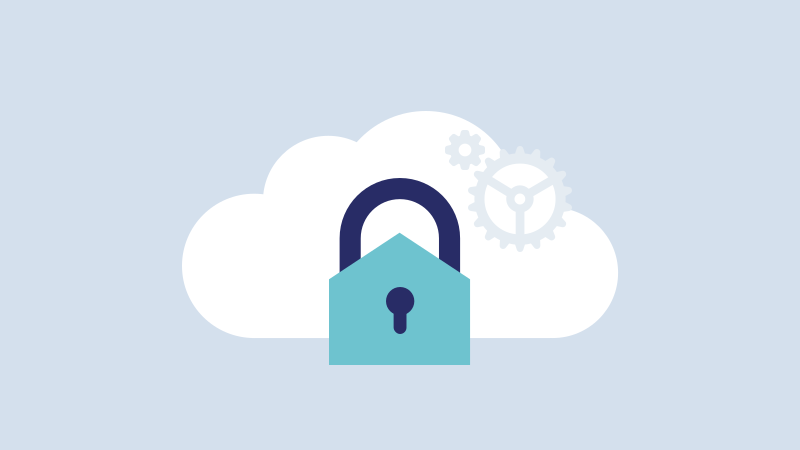
As the digital world continues to expand and evolve, the need for secure authentication has become more critical than ever. Enter passkeys – a modern solution for secure authentication that provides a safer and more convenient way to access apps and websites. Today we will delve into the world of passkeys, explaining what they are, how they work, and why they’re the future of online security. Passkeys explained Essentially, passkeys are a new, more secure and convenient way to sign up for and access apps and websites. Cybersecurity experts tout passkeys as an authentication technology set to replace passwords. Tech giants such as Apple, Microsoft, and Google are working on passkeys and aiming to make their platforms and accounts password-free. The decision is also expected to be taken up by other members of the FIDO Alliance, which is the driver behind passkey technology, and other companies around the globe. When passkeys become the dominant authentication method, you will be able to sign up and access online services the same way you unlock your phone — via biometrics. No longer will you need to create, remember, and type out passwords. Sounds awesome? Well, because passkeys are seriously awesome. Let’s have a peek at how to use passkeys in the real world. Sign-up experience Say you need to sign-up for a new online service that supports passkeys. All you need to do is add your email or username and confirm the prompt to create a passkey. Here’s how the sign-up process works with passkeys:
Login experience
Now that you’re signed-up for an online service with a passkey, logging in is quick, easy and secure. All you need to do is tap the suggested passkey for that account and you are logged in.

How do passkeys work? 
Understanding passkeys and how this technology works can be somewhat tricky, mostly because passwords have been an integral part of our digital lives for so long. So first let’s recap the old and familiar before getting into passkeys. By the end we should understand the whole passkeys vs. passwords deal and why passkeys are the way of the future.

Password technology explained
Passwords — we know them all too well, and most of us have some idea of how they work. But let’s quickly recap.

Password-based authentication is relatively simple and straightforward. Say you create a password for a new online account. That password is then stored in an encrypted format on a server. When you use the password to access that account, the system compares the password you enter with the one in its database. If the two match — you’re good to go.

Simple, right? Well the catch is that this kind of user authentication presents quite a few serious security concerns. People tend to reuse simple and easy-to-crack passwords for multiple accounts, which is a hacker’s dream — crack a single account and you have access to a person’s entire digital life. Databases that store passwords can be breached. In fact, Verizon’s Data Breach Report notes that up to 80% of successful breaches are attributed to weak or stolen passwords.

Passkey technology explained
You can think of passkeys as a new and improved type of password. Both are used to verify a user’s identity upon sign up and login. However, the technology behind passkeys operates in a different way.

Whenever you sign up for an online service which supports passkey authentication, two keys are generated — public and private, both of which are used to authenticate the user when logging in.

The public key is stored in the website’s server, while the private key is stored on your device, whether it’s a phone, tablet, desktop, or laptop. Without each other the two keys are useless.

Upon logging in, the server sends a request to your device, and that request is then answered by a related passkey. The user’s identity is also verified on the device level via biometrics. Finally if the pair of keys match you’re granted access to your account.

Passkeys are widely considered to be a more secure and convenient form of authentication compared to passwords, as they reduce the risk of forgetting or reusing passwords. Passkeys are also resistant to phishing attacks as they can’t be stolen from your device by a third-party.

Store passkeys with NordPass 
All NordPass users now have the ability to store and manage passkeys in NordPass and use them to access apps and websites. NordPass syncs your passkeys across all of your devices as well as operating systems and enables you to safely share passkeys whenever needed. It is important to note that sharing passkeys is not as easy with alternative systems as it is with NordPass.

We’re excited to let you know that with the release of iOS 17, passkey storage is now available on NordPass app for iOS devices. This is a monumental step for us, ensuring that you, our users, enjoy a seamless experience across all platforms and devices.

In addition to mobile access, you can also reach your passkeys on NordPass via the desktop app, web vault, Firefox, and Chrome-based browser extensions. We’re also thrilled to share that support for the Safari extension is on the priority list and will be launched later this year.

Password managers are highly reliant on platform vendors when it comes to passkey technology. Therefore, we welcome the latest move from Apple because it serves as a huge milestone in replacing passwords with more advanced online authentication solutions. With tech giants allowing third-party integrations, internet users will get more user-friendly services and, as a result, will be more keen to stick to using passkeys

– Sorin Manole,

Product Strategist @ NordPass

About Version 2 Limited
Version 2 Digital is one of the most dynamic IT companies in Asia. The company distributes a wide range of IT products across various areas including cyber security, cloud, data protection, end points, infrastructures, system monitoring, storage, networking, business productivity and communication products.

Through an extensive network of channels, point of sales, resellers, and partnership companies, Version 2 offers quality products and services which are highly acclaimed in the market. Its customers cover a wide spectrum which include Global 1000 enterprises, regional listed companies, different vertical industries, public utilities, Government, a vast number of successful SMEs, and consumers in various Asian cities.

About NordPass
NordPass is developed by Nord Security, a company leading the global market of cybersecurity products.

The web has become a chaotic space where safety and trust have been compromised by cybercrime and data protection issues. Therefore, our team has a global mission to shape a more trusted and peaceful online future for people everywhere.

It’s time to talk about cloud security

Reading about the cloud in 2023 has an almost nostalgic feeling to it, a bit like watching that HBO special for the 20th anniversary of the Harry Potter series. You suddenly realize how long it’s been since the whole conversation about cloud computing started.

The cloud has become such a common IT tool that today it is difficult to find an industry (or even a company) that does not use it to some extent. The chances are very high that you yourself are using it frequently.

So, we will not waste your time with generic information explaining the benefits and challenges of the cloud. Instead, we’ll get down to the nitty-gritty and discuss what’s really important — cloud data security.

First things first: What is cloud security?

Cloud data security could be explained as what organizations do to protect their cloud-based systems and applications — and the data they store in the cloud — against cyber threats.

You could also say that it is a set of strategies, procedures, and tools that, when properly applied, can help companies prevent unwanted data exposure or IT infrastructure damage caused by various internal or external factors.

Both explanations are correct. In fact, they complement each other and together provide more context — although they don’t give the whole picture.

Treating it more like a concept, we could say that cloud security is a complex and constantly evolving field in IT that requires attention from all organizations that have either fully or partially based their IT environment on the cloud. So, with that in mind, the question you may be asking yourself right now is…

Why is cloud security so important?

If we had to answer that in one sentence, it would probably be this: cloud security plays an essential role in ensuring the confidentiality, integrity, and availability of sensitive data stored in the cloud. But this only scratches the surface. So, allow us to elaborate a bit because there’s more to this matter than meets the eye.

Each year, more and more organizations start their digital transformation journeys and integrate cloud-based tools and services into their IT infrastructures. All of those companies — no matter if they are small businesses or large-scale enterprises — cannot afford to take any risks regarding the security of their digital assets.

This is why cloud security is one of the aspects that these companies must address if they decide to run even a tiny part of their activities in the cloud — or to keep their data inside one. If they don’t, they risk not only data loss or disruption of their business operations but also financial and reputational damage. They must be aware of the fact that keeping digital assets in the cloud doesn’t mean that they are unreachable to hackers.

This is to say that organizations should make every effort to ensure that their cloud cybersecurity is at the highest level at all times — after all, the success of their business endeavors depends on that.

Main risks associated with cloud security

Security issues in cloud computing often revolve around the potential for unauthorized access — but not only that. Below, you will find descriptions of some of the biggest threats that today’s companies must be aware of while developing their cloud security strategy. Whether a company will be able to address and manage these threats depends not only on the actions they take but also on its awareness of the emerging trends and disruptive forces shaping its industry.

  • Data breaches:

    Whenever an organization starts storing sensitive information in the cloud, it instantly becomes a target for cybercriminals — and they will try to find their way in. A successful breach could result in the exposure of the company’s confidential data including its financial records, customers’ personal information, or even intellectual property.

    In its “Cost of a data breach” report, IBM reveals that the global average cost of a data breach across all sectors in 2023 is almost $4.5 million — which is an amount that has increased by almost 15% over the last three years. This fact alone shows that companies cannot waste time, and they should introduce robust authentication mechanisms, encryption protocols, and access controls as soon as possible to protect themselves against this threat.

  • Insider threats and privilege abuse:

    It should be no surprise to anyone that employees with access to company data sometimes misuse their privileges or can be coerced into revealing sensitive information. This can lead to similar or even the same issues that arise due to data breaches.

    Hackers will use every vulnerability in security controls or protocols to gain unauthorized access to your systems and applications — and that is why companies must work on developing sound cybersecurity policies that, first, their employees will adhere to, and second, will help them mitigate the damage if one of their employees (whether intentionally or not) causes a potential cybersecurity threat.

  • Cloud service providers often operate on a global scale, helping customers from different parts of the world where different sets of data protection laws and regulations apply. It’s no rocket science to point out that complying with these diverse legal requirements can be a challenge for both cloud providers and their customers.

    Non-compliance with the standards may lead to serious financial or reputational losses. Thus, businesses must carefully navigate the regulatory landscape and choose cloud providers that meet the relevant criteria.

Best practices in cloud security

Before we discuss any cloud security best practices, we would like to point out that cloud security as a whole is a continuous process and, therefore, you should stay informed about the latest security trends and practices so that you can protect your cloud environment more effectively. In other words, do not think of the following examples as the only elements you should pay attention to when creating a cloud security strategy. Instead, treat them as a starting point.

  1. Encrypt your data: One of the foundational pillars of cloud security is encryption, which is the process of using combinations of sophisticated algorithms to make sure that no unauthorized party can access your data — whether at rest or in transit. Some cloud service providers offer built-in encryption features, which you can leverage to keep your data secure at all times. If they are not available to you from the get-go, consider using third-party encryption tools to protect your sensitive information.

  2. Implement and use identity and access management (IAM) tools: To manage user access and permissions effectively, you must implement a strong IAM strategy. For example, by following the principle of least privilege, you can ensure that only authorized users with specific roles can access your systems, applications, and data. In other words, you can use IAM tools to provide the right people with access to the right resources — and only them. This will help you protect sensitive information from being compromised.

  3. Carry out audits regularly and monitor all cloud activities: You can stay ahead of potential security risks if you conduct frequent security audits. That way, you will be able to identify cybersecurity areas that require improvement and take necessary measures to address them before any security breach occurs. If you pay close attention to what’s going on in your network, you’ll be able to detect and respond to any anomalies or potential threats before they cause damage.

  4. Find out what your provider does to ensure cloud security: When teaming up with a cloud service provider, you should take the time to understand their shared responsibility model and all the security features they offer. In other words, you should get familiar with your provider’s security practices and security to, first, double-check if their approach aligns with your organization’s specific security requirements, and second, to ensure that your sensitive data and applications are adequately protected in the cloud environment.

  5. Backup your data: You can enhance your organization’s cybersecurity by consistently backing up your business data in a highly secure location and rigorously testing the recovery process. If you take this proactive approach, you will be able to, in the unfortunate event of a security breach or data loss, quickly and seamlessly restore crucial data and applications. Not to mention that it will help you minimize downtime, safeguard your reputation, and ensure business continuity.

How does NordLocker fit into the context of cloud security?

To adequately answer this question, we need to start with a brief explanation of what NordLocker is, namely an end-to-end encrypted cloud storage platform that allows you to securely store, manage, and share your business data with company members and partners.

NordLocker was designed to help companies — no matter the size, location, and nature of their business — protect their digital assets in a highly secure, state-of-the-art cloud environment to which only they have access. Therefore, it is more than fair to say that NordLocker was created with cloud security in mind.

Thanks to its wide range of features — from end-to-end encryption, through multi-factor authentication (MFA), to zero-knowledge architecture (and everything in between) — NordLocker covers all the cybersecurity practices we discussed in this article to help its users create a much safer online business environment. It can help you do that as well.

That’s why we encourage you to go to NordLocker and learn more about the platform and get a 14-day free trial. That way, you will be able to see for yourself if NordLocker is the right fit for your business and if what we’re saying is true.

Enjoy the ride!

About Version 2 Limited
Version 2 Digital is one of the most dynamic IT companies in Asia. The company distributes a wide range of IT products across various areas including cyber security, cloud, data protection, end points, infrastructures, system monitoring, storage, networking, business productivity and communication products.

Through an extensive network of channels, point of sales, resellers, and partnership companies, Version 2 offers quality products and services which are highly acclaimed in the market. Its customers cover a wide spectrum which include Global 1000 enterprises, regional listed companies, different vertical industries, public utilities, Government, a vast number of successful SMEs, and consumers in various Asian cities.

About NordPass
NordPass is developed by Nord Security, a company leading the global market of cybersecurity products.

The web has become a chaotic space where safety and trust have been compromised by cybercrime and data protection issues. Therefore, our team has a global mission to shape a more trusted and peaceful online future for people everywhere.

How to change or reset your PayPal password

It goes without saying that you should protect all your online accounts with strong passwords. Data breaches, phishing attacks, and misplaced Post-it notes could all lead to stolen accounts. But when it comes to financial services, it’s particularly important to be careful.

How to change your PayPal password

PayPal is a quick and easy way to send and receive money. But since it is usually linked to your credit card, it’s important to change your password regularly and always use a strong one.

Please note that you can’t change the password through the PayPal app — you’ll have to log in through a browser.

Here’s how to change your PayPal password in four easy steps:

  1. Log into your PayPal account and click the little gear icon in the upper right corner.

  2. Click on “Security” in the top banner.

  3. Click “Update” in the “Password” field.

  4. Enter your current and new passwords and click “Change password.” All done!

How to reset your PayPal password

If you forgot your PayPal password, you can reset it through the browser and the PayPal app.

  1. Go to PayPal, click “Log in,” and select “Forgot password?”

  2. Enter the email address you used to create your account and click “Next.”

  3. Follow the instructions in the email you receive.

How to change your PayPal security questions

Please note that you can’t change the security questions through the PayPal app — you’ll have to log in through a browser.

Here’s how to change your security questions on PayPal:

  1. Log into your PayPal account and click the little gear icon in the upper right corner.

  2. Click on “Security” in the top banner.

  3. Click “Update” in the “Security questions” field.

  4. Select new security questions and write your answers. Click “Save” and you’re done!

How to set up a passkey for your PayPal account

Passkeys are a new and secure authentication standard introduced by the FIDO Alliance. Think of passkeys as a replacement for passwords that use your fingerprint, face, or a device PIN to sign in to apps and websites across the internet. Designed for supreme security and convenience, passkeys facilitate a seamless login process.

If you are interested in setting up a passkey for your PayPal account, here’s a quick rundown of how to do it:

  • Access your PayPal account using your existing username and passwords.

  • Once you access your account you will see an option “Create a passkey.”

  • Now you will need to authenticate via biometrics.

  • Once you’re authenticated, the passkey will be automatically created, and the next time you log in to your PayPal account, you will not need your username or passwords. The passkey will do the trick.

How to use PayPal safely

Using financial services online is convenient, but it can also be risky — there are many malicious actors lurking on the internet, trying to steal your money. Follow these simple tips to increase your security while making payments online:

Avoid making transactions when connected to public Wi-Fi. Hackers can set up fake hotspots and then monitor your actions online. Using a VPN will encrypt your connection, making it impossible for anyone to see the data you send and receive. You only need to be aware of snoopers looking over your shoulder as you type in your passwords!

Keep the PayPal app up to date. Apps can have vulnerabilities and bugs that are not discovered for months. But once they are brought to light, your account could be in danger. Set up automatic updates on your PayPal app to make sure you have the latest security patch installed.

Be cautious with links and attachments in emails. If you get an alarming email from PayPal claiming that your account is in danger and you must change your password immediately, don’t click any links. Open a new tab, enter the address manually, and check to see if your account is really in danger.

Enable two-factor authentication. Passwords are your first line of defense, but using 2FA will take your account security to another level. You can choose to receive a code via text or use an authenticator app or a security key for your PayPal account’s 2FA.

Set up passkeys. Passkeys are a new, passwordless authentication method that offer a more secure and convenient way to access websites and apps using only your fingerprint, face scan, or a device PIN. Because passkeys leverage public key cryptography, they are resistant to phishing attacks, making them even more secure than most multi-factor authentication methods.

Use a unique and strong password. When you change your password, pick one that is impossible to guess. That means using at least 12 characters that include upper- and lowercase letters, numbers, and special symbols. Need help? Try our password generator.

Keep your PayPal password safe with NordPass. Let’s be frank. All of us have way too many passwords on our hands. Remembering each one — well, that’s just an illusion. But with the NordPass password manager you can have all of your passwords securely stored in a single place, and you can autofill them with just a click. The same goes for passkeys — the NordPass Passkey Holder is designed as a secure storage for all of your passkeys. Tidy mess of online life with NordPass today.

Make using financial services online stress free with NordPass!

About Version 2 Limited
Version 2 Digital is one of the most dynamic IT companies in Asia. The company distributes a wide range of IT products across various areas including cyber security, cloud, data protection, end points, infrastructures, system monitoring, storage, networking, business productivity and communication products.

Through an extensive network of channels, point of sales, resellers, and partnership companies, Version 2 offers quality products and services which are highly acclaimed in the market. Its customers cover a wide spectrum which include Global 1000 enterprises, regional listed companies, different vertical industries, public utilities, Government, a vast number of successful SMEs, and consumers in various Asian cities.

About NordPass
NordPass is developed by Nord Security, a company leading the global market of cybersecurity products.

The web has become a chaotic space where safety and trust have been compromised by cybercrime and data protection issues. Therefore, our team has a global mission to shape a more trusted and peaceful online future for people everywhere.

Single Sign-On: What it is and how it works

Nowadays, single sign-on (SSO) authentication is required more than ever. Many websites offer users the option to sign up with Google, Apple, or any other service. Chances are you have logged in to something via single sign-on today or at least this week. But do you know what it is, how it works, and why it’s used? Take a deep dive into the world of single sign-on and all things related to it.

What is SSO?

Single sign-on is a session and user authentication service that allows the user to use a single set of login credentials – namely, a username and password – to access multiple websites or applications. Put plainly, SSO allows users to sign up and access a variety of online accounts with a single username and password, thus making things a lot easier for the everyday user. SSO’s primary use is as an identification system that permits websites and apps to use the data of other trusted sites to verify a user upon login or sign-up.

Essentially, SSO puts an end to the days of remembering and entering multiple passwords. An added bonus is that SSO gets users out of the vicious password reset loops.

Additionally, SSO can be great for business, as it improves productivity, security control, and management. With a single security token (a username and password), IT professionals can enable or disable a user’s access to multiple systems, which in some cases mitigates cybersecurity risks.

So, how does the magical service work?

How does SSO work?

Single sign-on is a component of a centralized electronic identity known as federated identity management (FIM). FIM, or Identity Federation, is a system that enables users to use the same verification method to access multiple applications and other resources on the web. FIM is responsible for a few essential processes:

  • Authentication

  • Authorization

  • User attributes exchange

  • User management

When we talk about SSO, it is important to understand that it is primarily related to the authentication part of the FIM system. It’s concerned with establishing the user’s identity and then sharing that information with each platform that requires that data.

Fancy jargon aside, here are the basic operational processes of single sign-on:

  • You enter a website.

  • You click “Sign In with Apple” or any other service.

  • The site opens Apple’s account login page.

  • If you’re already logged in, then it gives the site your data.

  • You are logged in to your Apple account.

  • Apple’s site verifies that you are authorized to access the site.

  • If you’re authorized, the site creates a session for you and logs you in.

In technical terms, when the user first signs in via an SSO service, the service creates an authentication cookie that remembers that the user is verified. An authentication cookie is a piece of code stored in the user’s browser or the SSO service’s servers. Next time the user logs in to that same app or website using SSO, the service then transfers the user’s authentication cookie to that platform, and the user is allowed to access it. It’s important to highlight that an SSO service doesn’t identify the exact user since it does not store user identities.

What is an SSO Token?

An SSO token is a digital unit that contains data about a particular user such as their email address. The token is used to transfer user information from one system to another during the single sign-on process. For the recipient to verify that the token comes from a trusted source, it has to be signed digitally.

The SSO service creates a token whenever a user signs in to it. The token works like a temporary ID card which helps identify an already verified user. This means that when the user tries to access a given app, the SSO service will need to pass the user’s authentication token to that app so they can be allowed in.

Password security for your business

Store, manage and share passwords.

30-day money-back guarantee

Single-Sign-On Costs

Because many of the SSO solutions currently available on the market are cloud-based, most of them are offered in a monthly subscription model. The price of a cloud-driven SSO solution designed for small and mid-sized businesses can range from $1 to $10 per user per month.

However, those that want to get an SSO solution designed for a big enterprise will need to either pay more each month or make an entry fee. Enterprise-grade solutions are usually more wide-ranging and require vendors to customize them to each of their client’s needs and requirements. Hence, the price difference.

Is single sign-on secure?

Yes. An SSO protocol is secure when implemented and managed properly and used alongside other cybersecurity tools.

The main benefit introduced by single-sign on with regard to cybersecurity is that, because it allows using a single set of credentials for multiple services, there are fewer login details to be lost or stolen. As long as the server is secure and an organization’s access control policies are established, a malicious user or an attacker will have little to no chance to do any damage.

However, this benefit could also pose a certain kind of risk. Since SSO provides instant access to multiple accounts via a single endpoint, if a hacker gains access to an authenticated SSO account, they will also gain access to all the linked applications, websites, platforms, and other online environments.

This issue can be easily mitigated by implementing an additional layer of security known as Multi-Factor Authentication. Combining SSO with MFA allows service providers to verify users’ identity while giving them easy access to applications or online platforms.

The benefits of SSO

Reduced password fatigue

With SSO in place, users only have to remember one password, making life a lot easier. Password fatigue is real and dangerous. SSO encourages users to come up with a single strong password rather than using a simple one for each account separately. It also helps users escape the vicious cycle of password reset loops.

Increased employee and IT productivity

When deployed in a business setting, SSO can be a real time saver. According to a recent report, people waste 16.3 billion hours a year trying to remember, type, or reset passwords. In a business environment, every minute counts. Thanks to SSO, users don’t need to hop between multiple login URLs or reset passwords and can focus on the tasks at hand.

Enhanced user experience

One of the most valuable benefits of SSO is an improved user experience. Because repeated logins are not required, users can enjoy a digital experience with less hassle. This means that users will be less hesitant to use the service. For any commercial web-based service, SSO is an essential part of their user experience.

Centralized control of user access

SSO offers organizations centralized control over who has access to their systems. In a business setting, you can use SSO to grant new employees specific levels of access to different systems. You can also provide employees with a single set of credentials (username and passwords) to access all company systems.

Top single sign-on solutions

Microsoft Azure AD

Microsoft Azure AD includes Active Directory Federation Services (AD FS) as an option to support SSO. Azure AD also offers reporting, security analytics, and multi-factor authentication services. It’s perfectly suited for any company that uses the Microsoft Azure cloud platform, no matter its size.

Okta Identity Cloud

Okta is well-established in the world of SSO solutions. They are open-source SSO leaders because of their flexibility and ease of use. Okta offers customizable open identity management in real time according to business needs, as well as two-factor authentication and a password reset functionality. Okta can serve the needs of multiple industries, from education and nonprofits to financial services and the government.

OneLogin Unified Access Management Platform

OneLogin is an open-source SSO provider that is often used for employee access to the company’s cloud-based applications. OneLogin is suited for a variety of IT administrator needs since it is designed to enforce IT policy in real time. It can also be updated according to specific needs if any changes occur, such as an employee leaving.

Idaptive Application Services

Idaptive is primarily suited for small to medium-sized businesses. Idaptive is capable of providing support to many users at once, thanks to their new cloud architecture. The company also offers adaptive MFA, enterprise mobility management (EMM), and user behavior analytics (UBA) all in a single solution.

Ping Intelligent Identity Platform

Ping offers services to large enterprises. The solution can serve anywhere between a few hundred to a few million users. Ping provides both on-premises and cloud options for deploying their solution. Additionally, the service comes with multi-factor authentication.

Does NordPass provide SSO?

Yes, NordPass does provide a single sign-on authentication! It can be set up via NordPass Admin Panel for users who want to log in to the NordPass app with their Microsoft Azure, Google Workspace, or Okta credentials.

This means that if you turn on Microsoft Azure Active Directory (AD), Google Single Sign-On, or Okta Single Sign-On, and invite new members who use one of these SSOs, they will be allowed to login in using their Azure AD, Google, or Okta SSO credentials — it’s as simple as that.

About Version 2 Limited
Version 2 Digital is one of the most dynamic IT companies in Asia. The company distributes a wide range of IT products across various areas including cyber security, cloud, data protection, end points, infrastructures, system monitoring, storage, networking, business productivity and communication products.

Through an extensive network of channels, point of sales, resellers, and partnership companies, Version 2 offers quality products and services which are highly acclaimed in the market. Its customers cover a wide spectrum which include Global 1000 enterprises, regional listed companies, different vertical industries, public utilities, Government, a vast number of successful SMEs, and consumers in various Asian cities.

About NordPass
NordPass is developed by Nord Security, a company leading the global market of cybersecurity products.

The web has become a chaotic space where safety and trust have been compromised by cybercrime and data protection issues. Therefore, our team has a global mission to shape a more trusted and peaceful online future for people everywhere.

Storage Beyond Passwords: Securely Save Files in NordPass

Ever been in that awful situation where you’re going through old emails or disorganized folders trying to find that one crucial document? The insurance form, an e-copy of your ID, or even a video detailing how to get into your new office? Wouldn’t it be a game-changer if you had all your important files right next to your passwords, credit card information, or secure notes?

Good news! Today, we are excited to introduce File Attachments — a new and improved way to manage important files with NordPass.

Best for large file attachments

Here’s a quick rundown of how it works. As a NordPass Premium user, you now have the ability to attach files to your saved items in NordPass. It’s not just about enhancing organization. This feature also provides an unmatched level of security. Forget the hassle of disorganized unsafe file storage. Any attached files or documents will be as secure as your passwords thanks to our encrypted storage.

But we didn’t stop at mere functionality. NordPass Premium now provides a whopping 3GB of encrypted storage per account, a giant leap forward. That’s not just more — it’s three times more than any other password manager out there! We’re offering you unrivaled storage and advanced security — and that’s certainly what we call more bang for your buck!

NordPass — The best password manager for large file attachments.

– Attila Tomaschek

CNET

No strings attached (except your files)

With NordPass Premium’s File Attachments, you have the freedom to store documents of any type to one of your existing items. Whether it’s a simple JPEG, PDF, MP4, or DOC file — NordPass supports them all.

Supported file types

The new feature allows for files up to 50MB in size and up to 50 attachments per single item. The only limit is your 3GB storage per user — and that’s a whole lot of space for your files.

While we aim at maximizing convenience, your security is always our top priority. To ensure maximum protection, we currently do not support attaching files to shared items or sharing items with files attached.

You can learn more about how to attach files to your NordPass items in our handy help center article.

Streamline your digital life with NordPass

In the digital age, we often juggle tons of files, documents, and data, and that can lead to a disorganized and chaotic personal digital space. With our new File Attachments feature, we look to help you take back control and streamline your digital life by allowing you to save documents in a quick and efficient way

With NordPass Premium, you can now attach important files to all your saved items. Store any file in one secure place with 3GB encrypted storage.

Instant access

When you’re in a hurry, having quick access to your important documents can make all the difference. That’s where File Attachments shine. Need to view a copy of your ID or an important receipt? No problem! With File Attachments, all your vital images or documents are just a few clicks away.

Effortless downloads

It’s not just about attaching and storing your files along with your passwords. It’s also about being able to retrieve them whenever necessary. Suppose you’ve stored financial documents that you need to share with your spouse. With File Attachments, you can quickly and effortlessly download these files directly from NordPass.

Unprecedented control

The File Attachments feature isn’t just about adding another functionality to NordPass. It’s about giving you greater control over your digital life. You get to decide what files to attach, what items those files are attached to, and when to download or delete them. You can also organize your vault in a way that best suits your personal or professional needs.

A single secure place for files and passwords

Take your password manager experience to the next level with NordPass Premium. Don’t just manage your passwords, manage your life. No more scrambling for documents, no more disorganized files, and certainly no more compromised security.

Your life. Your files. One secure place. Start your NordPass Premium journey today and make the most of our File Attachments feature.

About Version 2 Limited
Version 2 Digital is one of the most dynamic IT companies in Asia. The company distributes a wide range of IT products across various areas including cyber security, cloud, data protection, end points, infrastructures, system monitoring, storage, networking, business productivity and communication products.

Through an extensive network of channels, point of sales, resellers, and partnership companies, Version 2 offers quality products and services which are highly acclaimed in the market. Its customers cover a wide spectrum which include Global 1000 enterprises, regional listed companies, different vertical industries, public utilities, Government, a vast number of successful SMEs, and consumers in various Asian cities.

About NordPass
NordPass is developed by Nord Security, a company leading the global market of cybersecurity products.

The web has become a chaotic space where safety and trust have been compromised by cybercrime and data protection issues. Therefore, our team has a global mission to shape a more trusted and peaceful online future for people everywhere.