Skip to content

Top 5 Benefits of Business VPN Solution

Do you know what the drill is while running a business? Data security, smooth workflows and keeping your team connected, no matter where they are. But how do you manage all of that without your business being vulnerable to cyber threats or losing control of sensitive information? 

Business VPN Solution

A business VPN is your armor where cyber threats are everywhere. It allows your employees to work remotely, access company data securely, and even prevent hackers from sneaking in through the cracks.

Still, that’s just the tip of the iceberg. Let’s dive into the 5 top benefits of a business VPN that will change the way you operate.

5 Benefits of Business VPN Solution

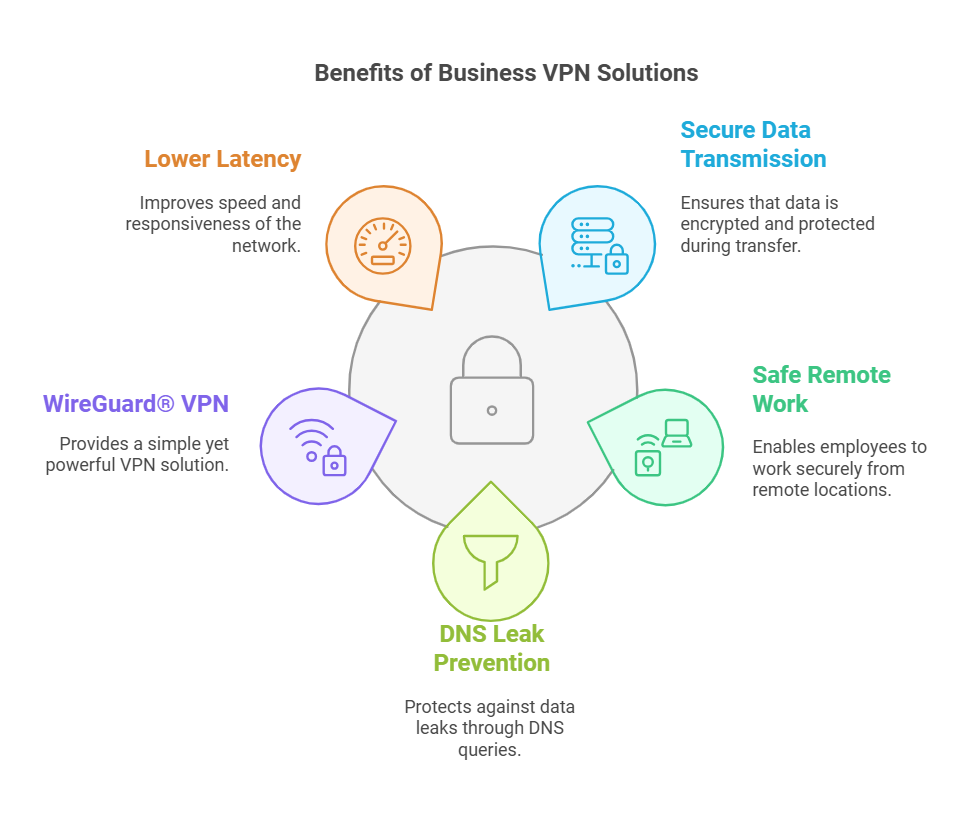
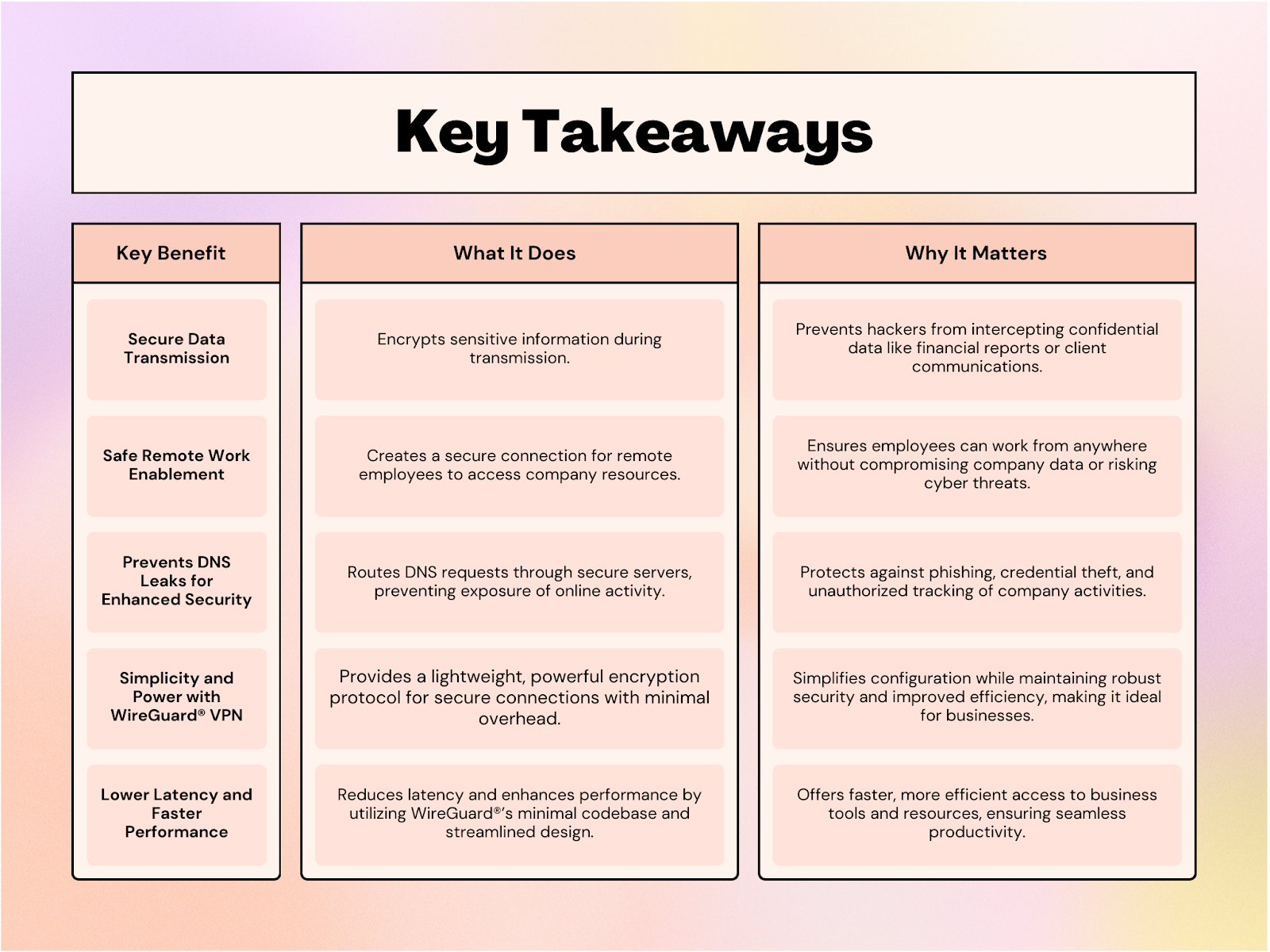
1. Secure Data Transmission

Consider sending sensitive information to a client or sharing company reports over an email. Without the right security measures, those communications could be intercepted by hackers. Here, by encrypting your data, a VPN ensures that what you send stays private, no matter what.

Encryption means that any data traveling across your network is scrambled into unreadable code until it reaches the intended recipient. Without encryption, your business is exposed to a whole world of potential breaches. VPNs make sure no one can eavesdrop or manipulate your communications.

So, whether it’s financial information, employee details, or client data, a business VPN is your lock and key for secure data transmission. You’ll never have to worry about sending a document or email and wondering who might be watching.

2. Safe Remote Work Enablement

With employees scattered across the globe, it’s essential to ensure that they can safely access company resources around the world. This secure connection allows them to access company files, applications, and resources without risking exposure to hackers. VPNs create a secure tunnel between the employee’s device and the company network, ensuring no one can hijack the connection.

Plus, with VPNs, you avoid the headaches that come with managing multiple devices and work environments. Whether employees are on a laptop, tablet, or phone, a VPN ensures their connection is secure, empowering them to work from anywhere without compromising security.

3. Prevents DNS Leaks for Enhanced Security

A Domain Name System (DNS) leak can expose sensitive information about your online activities, even when you’re using a secure network. Details like your network’s IP address, browsing history, and the IP addresses of websites visited can fall into the wrong hands. Hackers often exploit this seemingly minor information to launch targeted attacks, such as stealing employees’ login credentials or carrying out phishing scams.

A business VPN prevents DNS leaks by routing all DNS requests through its secure servers instead of your internet service provider (ISP). This ensures that your company’s online activities remain private and protected. By encrypting DNS queries, a VPN minimizes the risk of unauthorized access to sensitive data and shields your business from potential cyber threats.

4. Simplicity and Power with Veltar VPN

When it comes to balancing security and simplicity, Veltar VPN stands out. Known for its lightweight yet robust encryption, Veltar ensures data integrity without the complexity of traditional VPN protocols. Its streamlined design eliminates unnecessary overhead, making configuration incredibly simple for IT teams while maintaining powerful security features.

Veltar’s minimal codebase not only enhances performance but also reduces the chances of vulnerabilities. Whether it’s setting up secure connections or managing network traffic, the simplicity of Veltar makes it an ideal choice for businesses. With Veltar at its core, a business VPN ensures seamless integration, efficient operation, and uncompromised security, allowing your team to focus on productivity without getting bogged down in technical hurdles.

5. Lower Latency and Faster Performance

One of the standout benefits of WireGuard®-powered VPNs is the ability to offer lower latency and faster performance compared to traditional VPN solutions. Its streamlined design and minimal codebase result in quicker connection speeds and reduced lag, even when accessing resources remotely.

Businesses can enjoy smooth, uninterrupted access to critical tools and data, improving overall productivity. Whether it’s for real-time communication or accessing cloud-based applications, the reduced latency ensures that your teams can work seamlessly, regardless of their location. In a world where speed matters, this performance-enhancing feature provides a crucial advantage for businesses looking to stay ahead of the curve.

Essential Benefits of Business VPNs

Business VPN Solution

Unlock the Full Potential of Business VPN with Veltar

Incorporating a VPN into your business operations benefits you with unlocking efficiency, enabling seamless remote work, and safeguarding your competitive edge. With Veltar, you gain more than just a secure tunnel. Powered by WireGuard®, Veltar provides customizable VPN tunneling, enhanced encryption, and centralized management, making it an essential tool for modern businesses. 

Whether you need to secure sensitive data, optimize traffic routing, or maintain effortless control through a user-friendly console, Veltar empowers your IT admins to keep your corporate resources protected and accessible. 

To know more, contact our experts and schedule a demo. Secure your operations and elevate your business workflows with Veltar. 

About Scalefusion
Scalefusion’s company DNA is built on the foundation of providing world-class customer service and making endpoint management simple and effortless for businesses globally. We prioritize the needs and feedback of our customers, making sure that they are at the forefront of all decision-making processes. We are dedicated to providing comprehensive customer support services, and place emphasis on customer-centric thinking throughout the organization.

About Version 2 Limited
Version 2 Digital is one of the most dynamic IT companies in Asia. The company distributes a wide range of IT products across various areas including cyber security, cloud, data protection, end points, infrastructures, system monitoring, storage, networking, business productivity and communication products.

Through an extensive network of channels, point of sales, resellers, and partnership companies, Version 2 offers quality products and services which are highly acclaimed in the market. Its customers cover a wide spectrum which include Global 1000 enterprises, regional listed companies, different vertical industries, public utilities, Government, a vast number of successful SMEs, and consumers in various Asian cities.

What Is Identity And Access Management?

If you asked an IT expert for a definition of identity and access management, also known as simply “IAM,” they would probably tell you that it is a cybersecurity discipline that, when followed, can help a given organization provide their employees with access to the IT tools that they need to perform their jobs efficiently.

In other words, IAM is a framework that allows companies to significantly boost their cybersecurity. This is done by restricting access to organizational resources to only those people whose identity has been confirmed and who have been assigned specific access privileges.

How does IAM work?

By definition, the goal of today’s IAM systems is to perform two core tasks: authentication and authorization. Both of these play a part in making sure that the right person will get access to the right resources for the right reasons. The process usually goes as follows:

  1. An IAM system confirms the identity of a given user by authenticating their credentials against a database that contains all users’ identities and access privileges.

  2. The IAM system provides that user with access to only those resources to which they were assigned.

An IAM system usually includes a series of dedicated tools which operators can use to easily create, monitor, modify, and delete access privileges for all members of the organization.

The role IAM plays in security

If you’re still asking yourself the question “What is IAM in cybersecurity?”, we are here to tell you that IAM is considered a critical part of cybersecurity these days and that every organization should incorporate it into its cybersecurity strategy. Why? Because IAM security is concerned with reducing identity-related access risks, improving legal compliance, and improving business performance across the entire organization.

What is more, by helping companies manage digital identities and user access to company data, IAM tools make it very hard for non-authorized parties to hack into business networks and cause problems that could lead to big financial losses.

Enterprise identity and access management

As you can probably guess, “enterprise identity and access management” is a phrase that refers to all of the IAM policies, processes, and tools that large-scale businesses can use to manage access to their data and resources more securely and effectively.

Many of today’s enterprise-like organizations have massive IT infrastructures that consist of a vast range of servers, databases, applications, and cloud environments — to which dozens, if not hundreds or thousands, of their employees must have easy access. Enterprise IAM solutions are, therefore, a way for those big enterprises to make their resources available to a large number of employees without making any compromises in regard to cybersecurity.

So, even if your business is a global one — that is, you have thousands of employees and run multiple projects around the world — many of the IAM solutions available today are powerful and flexible enough to give you the ability to manage user permissions and prevent unauthorized access with ease.

What is the difference between identity management and access management?

The difference between identity management and access management essentially boils down to the part each of these two frameworks plays in the process of providing users with access to company resources.

Identity management is about (as its name suggests) user identities and the many ways they can be recognized and verified. Access management, on the other hand, deals with giving or withdrawing permissions and access privileges.

IAM regulatory compliance

Many of today’s lawmakers around the world are striving towards creating and introducing new policies that will help protect the digital lives of their citizens. As a result, many of today’s data privacy regulations (including HIPAA, SOC2, and PCI DSS) require businesses to follow strict IAM policies, which means they are obligated to manage access to data very carefully.

Luckily, identity and access management solutions can be used to meet some of the compliance requirements — which is also one of the reasons why enterprises are interested in making them part of their IT environments.

Let us provide you with an example. To comply with the already-mentioned information security standard called PCI DSS, a vendor is required to establish strict IAM policies (including rules that clearly define user identities, authentication, and authorization methods), and processes that restrict access to environments where cardholder data is stored. Only with such IAM policies in place can a vendor become fully compliant with the PCI DSS standard.

Identity and access management benefits

Implementing IAM solutions offers numerous benefits for businesses, regardless of their size or location. These include:

  1. Enhanced cybersecurity – IAM solutions can help all businesses – no matter their size or location – prevent data breaches and protect themselves against malware, identity theft, and phishing attacks.

  2. Simplified work for IT administrators — With the use of IAM tools, IT administrators can develop new, advanced security policies and processes and implement them across the entire organization in a blink of an eye.

  3. Real-time monitoring of company data access — IAM solutions allow you to remain in control of who can access what at your organization.

  4. Ensuring compliance with data privacy regulations — IAM systems are designed to help users comply with legal requirements such as HIPAA, SOC2, and PCI DSS.

  5. Minimizing financial and reputational losses — By allowing you to prevent fraudulent activities and unauthorized use of company resources, IAM solutions can help you maintain business continuity and avoid costly downtime.

Enterprise identity and access management with NordPass

NordPass Enterprise, an encrypted password, and passkey management platform, can be used as an IAM tool to securely provide members of your organization with access to company data, systems, and applications. How so?

First of all, when you use the Business version of the NordPass platform, you can share an unlimited number of digital entry points that you can assign to different departments or teams. This means that you can fully control access to shared credentials, payment information, and other sensitive data across the entire organization. Moreover, thanks to features such as the Activity Log, you can easily monitor all company logins to know exactly who accessed what and when.

Second, NordPass uses multi-factor authentication (MFA), as well as the single sign-on (SSO) authentication method, to identify and verify each and every user once they try to access one of the company accounts. The platform is equipped with three MFA options — an authenticator app, a security key, and backup codes — so that you can provide your team members with a few options in regard to how they can gain access to company resources.

Third, NordPass can help you achieve regulatory compliance. As mentioned, some standards (e.g., HIPAA and NIST) require organizations to implement secure access management solutions. With NordPass, not only can you easily manage access privileges, but you can also establish rules, procedures, and policies that will allow your company to meet certain specifications.

Of course, the fact that NordPass is an encrypted password management solution also means that you and your team members can use it to securely and easily generate, store, manage, and share company credentials. This is something that IAM tools cannot do — just as they cannot run password health check-ups or scan for data breaches to see if any of the credentials, payment information, or emails have been compromised – but NordPass can.

About NordPass
NordPass is developed by Nord Security, a company leading the global market of cybersecurity products.

The web has become a chaotic space where safety and trust have been compromised by cybercrime and data protection issues. Therefore, our team has a global mission to shape a more trusted and peaceful online future for people everywhere.

About Version 2 Limited
Version 2 Digital is one of the most dynamic IT companies in Asia. The company distributes a wide range of IT products across various areas including cyber security, cloud, data protection, end points, infrastructures, system monitoring, storage, networking, business productivity and communication products.

Through an extensive network of channels, point of sales, resellers, and partnership companies, Version 2 offers quality products and services which are highly acclaimed in the market. Its customers cover a wide spectrum which include Global 1000 enterprises, regional listed companies, different vertical industries, public utilities, Government, a vast number of successful SMEs, and consumers in various Asian cities.

Scalefusion Launches Veltar: Enhancing Device Management with Endpoint Security

ProMobi Technologies announced today that Scalefusion, its leading unified endpoint management solution (UEM), introduces Veltar, an innovative endpoint security product. Designed to enhance the enterprise security posture, Veltar combines advanced threat protection with seamless device management, enabling organizations to operate confidently in an increasingly complex digital landscape.

Veltar has been introduced to tackle the critical challenges posed by fragmented security tools and limited visibility into devices and their security. With the addition of Veltar, Scalefusion now seamlessly combines unified endpoint management (UEM), identity and access management (IAM), and endpoint security (EPS) into one comprehensive solution. As the third pillar of the product, Veltar aims to complete the solution so users can now effectively manage devices, access, and security within organizations.

With Veltar, IT admins get a curated set of security tools with the prime goal of protecting data loss, securing data at rest and in motion. Its features include VPN tunneling to secure data transmission to and from on-prem assets, secure web gateway (SWG) to block domains and websites based on categories, application control to ensure only trusted software runs on your devices, and I/O device control, among others.

“Veltar marks a major leap forward in endpoint security and management, bringing crucial security features together into a single platform. It is a critical component that combines endpoint security driven by the insights of device management. We had a goal of enabling enterprises to enhance their security posture while simplifying device, identity and access management and Veltar is the third piece of the puzzle.” — said Sriram Kakarala, Chief Product Officer at Scalefusion

Veltar is designed for organizations looking to streamline operations, and management of devices that hold critical data without compromising security.

About Scalefusion
Scalefusion’s company DNA is built on the foundation of providing world-class customer service and making endpoint management simple and effortless for businesses globally. We prioritize the needs and feedback of our customers, making sure that they are at the forefront of all decision-making processes. We are dedicated to providing comprehensive customer support services, and place emphasis on customer-centric thinking throughout the organization.

About Version 2 Limited
Version 2 Digital is one of the most dynamic IT companies in Asia. The company distributes a wide range of IT products across various areas including cyber security, cloud, data protection, end points, infrastructures, system monitoring, storage, networking, business productivity and communication products.

Through an extensive network of channels, point of sales, resellers, and partnership companies, Version 2 offers quality products and services which are highly acclaimed in the market. Its customers cover a wide spectrum which include Global 1000 enterprises, regional listed companies, different vertical industries, public utilities, Government, a vast number of successful SMEs, and consumers in various Asian cities.

Keepit’s Data Protection Dashboard

Data backup and recovery in SaaS environments can be complex, but at Keepit, we’re continually simplifying the process. With our Data Protection Dashboard, we’re delivering real-time insights via one centralized hub, providing the visibility needed to help enterprises manage their backups across SaaS applications like Microsoft 365 and Salesforce with confidence.

Our mission with this project is pretty simple: We want to give our users a centralized hub for all application dashboards, thereby simplifying monitoring, license usage, and anomaly detection to enhance cyber resilience and security. 

What is observability, and why does it matter?

In the context of data protection, observability refers to the ability to gain deep visibility into operations, enabling teams to detect, diagnose, and address issues quickly and effectively. This is especially important for ensuring the reliability and effectiveness of backup and restore processes in complex SaaS environments. With enhanced observability, enterprises can maintain confidence in their data protection strategies and stay resilient against potential disruptions.

This focus on observability is what drives Keepit’s latest innovation: The Data Protection Dashboard. By providing real-time insights into backup and restore operations, the dashboard delivers centralized visibility, helping enterprises manage their backups across SaaS applications like Microsoft 365 and Salesforce with ease and confidence. Moreover, Keepit ensures a seamless user experience by supporting flexible transitions between different types of dashboards, tailored to the specific focus of a task at hand.

What is Keepit’s Data Protection Dashboard?

The Data Protection Dashboard is a workload-based tool designed to simplify and centralize the monitoring of all backups across SaaS environments. As a key aspect of observability, it provides real-time visibility into backup health, coverage, and integrity, offering actionable insights in one place. This centralized view enables users to monitor and manage backup and restore operations with ease, reducing complexity and enhancing operational efficiency.

A standout feature of the dashboard is its ability to support seamless transitions between different types of dashboards. This ensures a smooth user experience, allowing users to focus on specific tasks — whether it’s troubleshooting, compliance reporting, or scaling data protection efforts — without losing context or accessibility.

This flexibility reduces the need for users to switch between multiple tools or interfaces, ensuring their workflow remains uninterrupted while managing various tasks like compliance reporting or troubleshooting.

By tailoring the experience to the needs of the task at hand, Keepit ensures flexibility while maintaining comprehensive observability.

Why is a centralized hub for monitoring important?

Today, users are juggling multiple dashboards, each tied to a specific connector. While these dashboards provide some insights, they rarely offer the comprehensive, centralized visibility needed to make informed decisions — particularly at scale — and this brings challenges to visibility and difficulties in managing more complex integrations. For enterprises, this approach is simply not scalable nor sustainable, and ultimately, it leads to uncertainty.

By consolidating backup monitoring into one unified view, our Data Protection Dashboard provides a clear picture of backup operations across connectors and applications, enabling teams to stay on top of their data protection strategies.

This dashboard is part of Keepit’s ongoing effort to make observability more accessible and intuitive for our users, which ultimately strengthens data security and supports business continuity.

Key features of Keepit’s Data Protection Dashboard

1. Backup status overview

Gain quick insights into the operational state of your backups with a comprehensive status overview:

  • Connector health status: Visual indicators highlight any critical issues.
  • Snapshot activity insights: View the time of the latest snapshot, the number of snapshots created in the past 48 hours, and the total backup size.
  • Recommended actions: Quickly identify and resolve issues at the connector level.

These insights ensure that your backup strategy stays on track, maintaining the resilience, compliance, and security of your data.

2. Backup coverage overview

This feature helps users identify potential gaps in their backup coverage, offering a granular view of data protection, and with historic insights:

  • Workload division within applications: Displays selected workloads, such as Exchange or SharePoint, divided into individual areas within applications such as Microsoft 365 and Google Workspace.
  • Coverage comparison: Highlights the number of units selected for backup versus those successfully covered, i.e., users can easily check if the coverage of the top-level SharePoint sites matches the selection. In this context, a “unit” refers to a specific entity, such as a top-level SharePoint site, while the “individual area” represents the overall SharePoint workload.
  • Data size metrics: Provides details on the total size of each workload area.

This comparison ensures that enterprises can address any inconsistencies and maintain comprehensive data protection.

A note on retroactive data: The Data Protection Dashboard applies to backups created after its release date. Data backed up before the launch isn’t included in these new insights. 

3. Backup integrity monitoring (coming soon)

Aimed at reducing vulnerabilities, this upcoming feature monitors items that are recurrently skipped during backups:

  • Skipped items list: Identify and download a detailed list of consistently skipped items.
  • Proactive insights: Pinpoint potential vulnerabilities and share findings with support teams if needed.

This feature is especially valuable for enterprises aiming to refine their backup strategies and ensure maximum data integrity.

Benefits: Why accessible data insights matter

For enterprises managing complex SaaS environments, time is critical, and risks are high. Accessible and intuitive insights are not just convenient — they’re essential to effective SaaS data protection. The insights from Keepit’s Data Protection Dashboard:

  • Enable faster action: Provide real-time visibility into backup health and coverage so teams can respond to issues before they escalate into larger problems.
  • Bridge the gap between complexity and usability: Simplify the management of SaaS environments with complex configurations, including role-based access controls, compliance requirements, and varied workloads, making it easier to monitor backup health, spot vulnerabilities, and ensure compliance.
  • Support the shared responsibility model: Help SaaS customers take ownership of their data protection responsibilities by providing the tools they need to secure and recover data effectively.
  • Align observability with resilience: Ensure users can quickly identify and resolve issues, maintaining the integrity of their data protection strategy and facilitating faster recovery.
  • Reduce risk: Minimize the chances of missed backups, incomplete coverage, or skipped items that could result in data loss.
  • Boost compliance: Provide clear metrics and reports to make demonstrating adherence to regulatory standards and internal policies easier.
  • Simplify scaling: Keep monitoring manageable as the number of workloads and connectors grows, enabling data protection to scale without adding complexity.

Ultimately, accessible insights give enterprises the confidence to protect their data, recover quickly, and maintain compliance in even the most complex SaaS environments.

Building a foundation for resilience

With the Data Protection Dashboard, Keepit is addressing a key challenge for modern enterprises: How to gain real-time, actionable insights into backup operations while managing complex SaaS environments. By providing a centralized hub, we’re helping organizations move away from fragmented dashboards toward a more unified and reliable approach to data protection.

The new dashboard is not just a feature; it’s a reflection of our commitment to improving observability and empowering enterprises to safeguard their critical data with confidence. As we continue to refine and expand its capabilities, our users will have even more tools to strengthen their backup strategies and ensure business continuity.

Stay tuned for updates as we roll out additional features and enhancements to the Data Protection Dashboard.

About Keepit
At Keepit, we believe in a digital future where all software is delivered as a service. Keepit’s mission is to protect data in the cloud Keepit is a software company specializing in Cloud-to-Cloud data backup and recovery. Deriving from +20 year experience in building best-in-class data protection and hosting services, Keepit is pioneering the way to secure and protect cloud data at scale.

About Version 2 Limited
Version 2 Digital is one of the most dynamic IT companies in Asia. The company distributes a wide range of IT products across various areas including cyber security, cloud, data protection, end points, infrastructures, system monitoring, storage, networking, business productivity and communication products.

Through an extensive network of channels, point of sales, resellers, and partnership companies, Version 2 offers quality products and services which are highly acclaimed in the market. Its customers cover a wide spectrum which include Global 1000 enterprises, regional listed companies, different vertical industries, public utilities, Government, a vast number of successful SMEs, and consumers in various Asian cities.

The Go-Giver Approach to MSP Success: Unlocking Growth Through Value, Trust, and Authenticity

As the new year unfolds, MSPs face opportunities to grow their businesses, build stronger client relationships, and stand out in an increasingly competitive market. In a recent fireside chat hosted by Guardz, we had the privilege of learning from Bob Burg, award-winning speaker and co-author of the best-selling book The Go-Giver. Bob shared powerful insights from his book and how its five laws of success can be applied to help MSPs thrive in 2025 and beyond.

Main Takeaways for MSPs

1. Deliver value that exceeds expectations to build lasting client loyalty.

2. Scale your impact by reaching and serving more clients without sacrificing quality.

3. Build trust by prioritizing your clients’ needs and becoming a true partner in their success.

4. Embrace authenticity to differentiate yourself in a crowded market.

5. Stay open to collaboration, opportunities, and feedback to drive growth.

These principles, rooted in The Go-Giver philosophy, offer a roadmap for MSPs looking to create meaningful impact while growing their business. Let’s dive deeper into each law and its relevance to MSPs.

1. The Law of Value: Deliver Beyond Expectations

“Your true worth is determined by how much more you give in value than you take in payment.”

For MSPs, this principle is a cornerstone of success. Clients don’t just want IT services; they want solutions that make their lives easier and their businesses more secure. Delivering beyond expectations means going the extra mile, whether through proactive monitoring, personalized support, or educational resources.

Application for MSPs:

• Offer tailored cybersecurity training for your clients to empower their teams.

• Regularly update clients on emerging threats and how your services mitigate them.

• Surprise clients with added value, such as a complimentary security assessment or system upgrade.

By consistently exceeding client expectations, MSPs can build loyalty, encourage referrals, and set themselves apart from competitors.

2. The Law of Compensation: Scale Your Reach

“Your income is determined by how many people you serve and how well you serve them.”

Scaling an MSP business isn’t just about adding clients—it’s about serving more businesses effectively. This requires creating systems and solutions that allow you to maintain high service quality as your client base grows.

Application for MSPs:

• Develop scalable solutions like automated monitoring, patch management, or AI-powered threat detection.

• Partner with vendors to offer bundled services that address multiple client needs.

• Implement client tiers, allowing small businesses to access critical services at affordable rates while upselling advanced options to larger clients.

The more clients you serve with excellence, the greater your impact—and income.

3. The Law of Influence: Build Trust and Prioritize Clients

“Your influence is determined by how abundantly you place other people’s interests first.”

Trust is at the heart of every successful MSP-client relationship. Clients rely on MSPs to safeguard their businesses from cyber threats and keep their operations running smoothly. Prioritizing their needs isn’t just good ethics; it’s good business.

Application for MSPs:

• Conduct quarterly business reviews with clients to discuss their goals and align your services with their priorities.

• Be proactive in identifying potential issues and presenting solutions before clients even notice a problem.

• Always communicate transparently, even when delivering difficult news about potential vulnerabilities or breaches.

When MSPs prioritize their clients’ success, they build trust and position themselves as indispensable partners.

4. The Law of Authenticity: Stay Genuine

“The most valuable gift you have to offer is yourself.”

In an industry where technical expertise is a given, authenticity can set your MSP apart. Clients want to work with people they trust and feel a connection with, not just a faceless company.

Application for MSPs:

• Share your story—how your MSP started, your mission, and what drives your team.

• Highlight client success stories to showcase the real-world impact of your work.

• Foster genuine connections with clients by understanding their challenges and celebrating their wins.

By being authentic, MSPs can build deeper relationships and foster loyalty that lasts.

5. The Law of Receptivity: Embrace Partnerships and Feedback

“The key to effective giving is to stay open to receiving.”

Success is a two-way street. To grow, MSPs must remain open to new opportunities, collaborations, and client feedback. This principle encourages a mindset of constant learning and adaptability.

Application for MSPs:

• Partner with cybersecurity providers, insurance firms, or other vendors to offer comprehensive solutions.

• Actively seek client feedback and use it to refine your services.

• Stay open to opportunities for professional development, whether through industry events or certifications.

When MSPs embrace collaboration and feedback, they position themselves for continuous growth and innovation.

Bringing It All Together: The Go-Giver MSP

At its core, the Go-Giver approach is about creating value, building relationships, and staying authentic in all aspects of your business. For MSPs, adopting these principles means more than just growing your bottom line—it means becoming a trusted partner to your clients, standing out in a crowded market, and making a meaningful impact.

As you head into 2025, consider how these laws can shape your strategies and help your MSP thrive. At Guardz, we’re here to support you every step of the way, offering tools and insights to help you deliver value, build trust, and grow your business.

Ready to apply the Go-Giver principles to your MSP? Let’s make 2025 a year of growth and success!


Watch the full webinar here: https://youtu.be/aAs5uhyeY-E

Stay tuned for more resources and webinars designed to empower the MSP community.

About Guardz
Guardz is on a mission to create a safer digital world by empowering Managed Service Providers (MSPs). Their goal is to proactively secure and insure Small and Medium Enterprises (SMEs) against ever-evolving threats while simultaneously creating new revenue streams, all on one unified platform.

About Version 2 Limited
Version 2 Digital is one of the most dynamic IT companies in Asia. The company distributes a wide range of IT products across various areas including cyber security, cloud, data protection, end points, infrastructures, system monitoring, storage, networking, business productivity and communication products.

Through an extensive network of channels, point of sales, resellers, and partnership companies, Version 2 offers quality products and services which are highly acclaimed in the market. Its customers cover a wide spectrum which include Global 1000 enterprises, regional listed companies, different vertical industries, public utilities, Government, a vast number of successful SMEs, and consumers in various Asian cities.

Product release: Protect your Google Calendar from data loss with CloudM Backup 1.8

Google Calendar is an essential tool for any company using the Google Workspace productivity suite. Keeping its data safe from cyberattacks, human error and malicious users is imperative to ensure business continuity. Following its latest release, CloudM Backup helps you do just that. 

CloudM Backup 1.8: Improve business continuity by backing up your Google Calendar data

Google Calendar has quickly become an integral part of Google Workspace, including business, personal, public and holiday calendars. Enabling users to schedule events, add reminders, share calendars and access them from anywhere, the data it contains is vital for the running of your business. Not being able to access it temporarily is a nuisance. Losing the data forever can be catastrophic. 

Comprehensive protection for your most important GWS applications

CloudM Backup already protects your users’ Google Mail, Drive and Shared Drives data from data loss due to cyberattacks, malicious users, accidental deletion and more. The most recent release ensures that your Calendar data is now also safe from the consequences of data loss and can be recovered quickly to ensure business can continue. 

CloudM Backup ensures your Google Mail, Drive and Calendar data is protected from the consequences of data loss.


Also in this release: Increased stability when handling large backups
With Backup 1.8.1, which will come a week after 1.8., we’ve invested in improvements to how we handle large files. Now, users and drives with large amounts of data to be backed up will be handled much more effectively, minimising backup times and reducing errors to ensure a smooth backup experience for all customers.

Backing up Google Calendar: Frequently asked questions

With CloudM Backup, you can backup the following Calendar data:

  • Events and meetings: We back up and restore meeting which include meeting links, including Zoom links. We do not back up events without meeting links.

Yes, you can back up recurring meetings with CloudM Backup.

We do not back up Tasks at the moment.

In Google Calendar, attachments are a link to a Drive item. We will back up the item if the user’s Drive is also being backed up and restore the meeting with the link included. The Drive file itself can be backed up separately if required.

These will be backed up as event attendees. Handling of edge cases, such as when a user tries to restore an event and the resource has since become occupied, will be handled by your Workspace administrator.

The default frequency for backing up Calendar is 8 hours.

Please check our knowledge base for detailed information on how to restore a backup of Google Calendar.

About Version 2 Limited
Version 2 Digital is one of the most dynamic IT companies in Asia. The company distributes a wide range of IT products across various areas including cyber security, cloud, data protection, end points, infrastructures, system monitoring, storage, networking, business productivity and communication products.

Through an extensive network of channels, point of sales, resellers, and partnership companies, Version 2 offers quality products and services which are highly acclaimed in the market. Its customers cover a wide spectrum which include Global 1000 enterprises, regional listed companies, different vertical industries, public utilities, Government, a vast number of successful SMEs, and consumers in various Asian cities.

About CloudM
CloudM is an award-winning SaaS company whose humble beginnings in Manchester have grown into a global business in just a few short years.

Our team of tech-driven innovators have designed a SaaS data management platform for you to get the most from your digital workspace. Whether it’s Microsoft 365, Google Workspace or other SaaS applications, CloudM drives your business through a simple, easy-to-use interface, helping you to work smarter, not harder.

By automating time-consuming tasks like IT admin, onboarding & offboarding, archiving and migrations, the CloudM platform takes care of the day-to-day, allowing you to focus on the big picture.

With over 35,000 customers including the likes of Spotify, Netflix and Uber, our all-in-one platform is putting office life on auto-pilot, saving you time, stress and money.

The complete guide to boosting data security in cloud computing

Summary: Discover top strategies to secure your cloud data with NordLayer, from encryption to micro-segmentation. Keep your data safe in the cloud.

According to Gartner, over 80% of organizations will take a cloud-first approach in 2025. This prediction highlights how cloud computing has become the go-to for flexible, cost-effective operations. The benefits of on-premise to cloud migration are clear: scalability, efficiency, savings, and stronger data protection in a cloud environment. 

However, as businesses rely more on the cloud to store, manage, and exchange data, they can also become a bigger target for cyber threats. That’s why data protection is more important than ever. In this article, we will share tips on how to boost your data security in cloud computing.

Basics of data security in cloud computing

Cloud data security includes tools and policies that protect data in the cloud from loss, leakage, or misuse. This helps prevent breaches, data theft, and unauthorized access.

A good cloud security strategy focuses on securing data across networks, applications, containers, and other cloud environments. It also controls who can access data and ensures complete visibility of data on the network. The strategy must protect data in three main ways:

  • Data in use: Secure data while it’s being used by apps or devices through authentication and access control.
  • Data in transit: Protect sensitive data as it moves across the network with encryption and other security methods.
  • Data at rest: Keep stored data safe with access restrictions and authentication.

Cloud environments can be public, private, or a mix of both. Regardless of the environment, the key to strong cloud data security is combining robust access controls, encryption, and continuous monitoring.

Cloud data security: Who is responsible for what?

Cloud security is a shared responsibility between the organization and its cloud service provider (CSP), with the exact breakdown depending on the cloud service. However, 73% of organizations don’t fully understand their role in cloud security responsibilities, which may lead to blind spots.

The cloud service provider (CSP) is responsible for securing the cloud infrastructure, which includes the physical hardware, network, and services like computing, storage, and databases. They also provide security tools to help customers configure their security settings.

The customer, on the other hand, is responsible for cloud data security. Always. Here is how it breaks down in more detail:

  • Private cloud: Since the cloud is hosted in its own data center, the organization handles all cloud security. This includes the physical network, infrastructure, hypervisor, virtual network, operating systems, firewalls, service configuration, identity and access management, and all aspects of data security.
  • Public cloud: In public clouds, like Google Cloud, Amazon Web Services, or Microsoft Azure, the CSP manages infrastructure and network security. The customer manages their apps, data, and access.
  • SaaS: The vendor secures the platform, including physical, infrastructure, and application security. The customer is responsible for their data and access security.

The bottom line is that organizations can’t depend on cloud vendors for data security. No matter the cloud model, they must continue to protect their data.

Why protecting data in the cloud is essential

With the increase of remote work, cloud services, and IoT devices, attack surfaces have grown, making sensitive data more vulnerable than ever. This growing trend makes data security a top concern for organizations.

The main reasons for protecting data security in the cloud are meeting compliance regulations, maintaining trust, and keeping sensitive information safe.

#1 Meet compliance standards

Organizations across industries must follow various data security regulations to safeguard sensitive information. Whether it’s protecting customer data, financial records, or healthcare information, compliance is non-negotiable. Breaking these rules can lead to fines, legal trouble, and costly disruptions.

But it’s not just about avoiding fines—customers and partners expect their data to be handled safely. Good security practices help meet those requirements and show others you can be trusted.

#2 Protect your brand reputation

A data breach can severely damage your company’s reputation. When customers lose trust, they might take their business elsewhere, and it’s tough to win them back.

The damage to a brand often costs more than fixing the breach itself. Years of hard work can be undone in days. By keeping data secure, you’re protecting your reputation and customer confidence in your brand.

#3 Keep your sensitive information safe

Organizations store vast amounts of valuable data, from trade secrets and intellectual property to customer information and operational systems. Cybercriminals know this and target that information to steal or disrupt operations.

Beyond stealing data, some attacks shut down systems or even critical infrastructure, causing major problems. Comprehensive security keeps your valuable data and systems safe so your business can run without interruptions.

Why storing data in the cloud is a smart choice

More and more organizations are adopting cloud computing because it helps digital transformation and offers practical benefits. By storing data in the cloud, businesses can gain advantages like lower costs, better resource use, easier access, and scalability.

Cloud computing simplifies teamwork from anywhere and gives access to tools and technologies without big upfront costs. Its flexibility and reliability make it a key part of modern business growth.

Let’s have a look at the benefits of storing data in the cloud.

Reduced costs

Cloud storage is often more affordable because the costs of servers and infrastructure are shared across many users. Instead of paying for expensive on-site systems, businesses can use cloud solutions to save money without sacrificing performance.

Better resource use

In a cloud model, the cloud service provider (CSP) handles all the maintenance—servers, hardware, databases, and other infrastructure. This means businesses no longer need to manage on-premises systems or dedicate time and money to keeping them up and running.

Easier access

Cloud-based databases can be accessed by authorized users from any device and location, as long as there’s an internet connection. This level of accessibility is essential for remote employees, where teams need to collaborate seamlessly, no matter where they are.

Scalability

Cloud resources are flexible. Businesses can quickly scale their databases up or down to handle changes in demand. Whether managing seasonal spikes, supporting a growing customer base, or dealing with unexpected surges, the cloud makes it easier and more cost-effective to adjust resources as needed.

Business risks to storing data in the cloud

While cloud storage has many benefits, it also comes with cloud security risks. Here are some challenges businesses may face if proper security measures aren’t in place.

Data breaches

Data breaches in the cloud happen differently from those in on-premises systems. Attackers often exploit misconfigurations, weak access controls, stolen credentials, and other security gaps instead of relying on malware.

Misconfigurations

Misconfigurations are the leading security risk in the cloud. They can result in overly broad account permissions, poor logging, and other gaps that make organizations vulnerable to data breaches, insider threats, and attacks by external adversaries.

Unsecured APIs

APIs connect services and transfer data, but they can create security risks. Changes in data policies or privilege levels can make it easier for unauthorized users to access more data than intended, especially if APIs are not properly secured.

Access control and unauthorized access

In multi-cloud or hybrid environments, organizations often rely on the default access controls provided by their cloud services. This can create issues, particularly when insider threats exploit their privileged access to cause damage or hide their actions.

Compliance and regulatory challenges

Data storage in the cloud must follow rules like GDPR, CCPA, and HIPAA. If your business doesn’t comply, it could face fines and damage its reputation. To stay compliant, businesses must ensure their cloud services meet these rules and handle data correctly.

Shared responsibility model

In the shared responsibility model, security is split between the cloud provider and the business. If businesses don’t fully understand what they’re responsible for, it can create security gaps. Misunderstanding this division can leave systems vulnerable.

6 best practices for securing data in the cloud

To keep data safe, organizations need a strong data security plan that specifically tackles cloud-related risks. As cloud environments introduce unique vulnerabilities, a comprehensive security strategy must address these challenges. Here are six best practices to follow:

Use advanced encryption

Encrypting data is a great way to protect it. This changes data into unreadable text before it enters the cloud. Encrypt both data in transit and at rest. Cloud providers offer built-in encryption, but you can also use your tools for more control.

Implement a data loss prevention (DLP) tool

DLP tools help prevent data loss, leaks, or misuse. They also detect unauthorized access or data breaches. Before you choose a DLP tool, make sure it is designed for a cloud environment.

Ensure visibility across your cloud environments

Get full visibility into your private, hybrid, and multi-cloud environments. This helps detect issues like misconfigurations, vulnerabilities, and security threats. Cloud security monitoring provides insights that guide actions to fix problems.

Make compliance your priority

Implementing the Zero Trust approach helps align your security policies with industry and government standards. Built on the principle of trust no one, verify everything, it ensures that only authorized users and compliant devices can access sensitive data.

Additionally, Device Posture Security lets you monitor devices connecting to your company network and block non-compliant ones based on predefined rules.

Strengthen identity and access management (IAM)

Identity and access management tools help manage who can access specific resources. They automate tasks like assigning access, updating privileges, and removing accounts. Follow the principle of least privilege—give users only the access they need for their roles.

Securing your data in the cloud with NordLayer

Protecting your data in the cloud is more than just encryption. It’s about implementing a robust, multi-layered security strategy that covers all aspects of cloud access and control.

Here’s how NordLayer can help you take your cloud security to the next level:

  1. Secure Remote Access: With NordLayer’s Site-to-Site VPN, you can create a safe, encrypted tunnel to access your cloud, protecting your data from cyber risks.
  2. Access control: NordLayer’s Cloud Firewall allows you to implement micro-segmentation strategies, distributing different network access rights for specific users or teams. It adds an extra layer of protection for your critical data, ensuring compliance with stringent data security regulations.
  3. Device security: NordLayer’s Device Posture Security ensures that only authorized and compliant devices can access your network. It monitors device compliance and blocks user access from non-compliant devices to safeguard your resources.
  4. Multi-layered authentication: Enhance security with Single Sign-On (SSO) and multi-factor authentication (MFA) to double-check identities seamlessly.

Get in touch with our sales team today to see how NordLayer’s solutions can strengthen your cloud data security. Also, be sure to download our Data Security Guide for more in-depth tips and actionable strategies.

About Nord Security
The web has become a chaotic space where safety and trust have been compromised by cybercrime and data protection issues. Therefore, our team has a global mission to shape a more trusted and peaceful online future for people everywhere.

About NordLayer
NordLayer is an adaptive network access security solution for modern businesses – from the world’s most trusted cybersecurity brand, Nord Security.

The web has become a chaotic space where safety and trust have been compromised by cybercrime and data protection issues. Therefore, our team has a global mission to shape a more trusted and peaceful online future for people everywhere.

About Version 2 Limited
Version 2 Digital is one of the most dynamic IT companies in Asia. The company distributes a wide range of IT products across various areas including cyber security, cloud, data protection, end points, infrastructures, system monitoring, storage, networking, business productivity and communication products.

Through an extensive network of channels, point of sales, resellers, and partnership companies, Version 2 offers quality products and services which are highly acclaimed in the market. Its customers cover a wide spectrum which include Global 1000 enterprises, regional listed companies, different vertical industries, public utilities, Government, a vast number of successful SMEs, and consumers in various Asian cities.

Redacting Message Fields for Privacy Purposes

Many organizations today have strict data privacy regulations that they must comply with. These privacy regulations can often clash with the requirements of security, application and operations teams who need detailed log information. This how to guide walks you through redacting message fields for privacy purposes.

At Graylog, many of the organizations who use our tool are logging sensitive data that may contain personally identifiable information, health related data or financial data. Often, to ensure compliance with data privacy laws, this information must be redacted or hidden from many of the end users of the tool. 

I’m going to walk through a simple way we can use processing pipelines to scrub personally identifiable information from a log message so that it is only visible to an elevated Graylog user account.

Caution: To achieve this functionality we need to replicate the message. This will increase the amount of data written to OpenSearch which may impact licensing or storage requirements.

Configuration

In my lab environment I have Auditbeat running on my host machine.. Log messages are sent to a Graylog Illuminate stream called “Illuminate:Linux Auditbeat Messages”.

Message Stream

In these messages I can see my username. First in the user_name field and again in the message field.

redacting message fields that require redacting

Pipeline Rule

For privacy purposes I am going to redact these usernames and route the messages into a separate stream, “Auditbeat Redacted”. I’ll retain the unredacted message in the “Illuminate:Linux Auditbeat Messages” stream. We’ll then restrict the access rights to these different streams.

To achieve this we need to write a pipeline rule that will create a copy of the message, edit the contents, route it into the new stream and remove the copy from the original stream.

This is what the complete pipeline rule looks like, I’ll walk through it line by line:

rule “redact_usernames”
when

    // check whether the message has the username field and hasn’t already been redacted
    has_field(“user_name”)
    AND NOT contains(to_string($message.user_name), “REDACTED”)

then   
   
    // clone the message
    let cloned_mess = clone_message();
   
    // grab the username and replace it in the message component
    let x = to_string($message.user_name);
    let new_field = replace(to_string(cloned_mess.message), x, “REDACTED”);
    set_field(field: “message”, value:new_field, message:cloned_mess);
   
    // replace the username field with REDACTED
    set_field(field:“user_name”, value:“REDACTED”, message:cloned_mess);
   
    // route into Auditbeat Redacted stream
    route_to_stream(id:“637e24115833463dd73bf617”, message:cloned_mess, remove_from_default:true);
   
    // remove from original stream
    remove_from_stream(id:“638f5d7cacb74d540a215aa9”, message:cloned_mess);

end

Identify The Message

The first step in the rule is to identify the messages we want to modify. This is achieved by finding messages with the relevant username field and also performing a check to ensure the message hasn’t already been modified. This check is important and I’ll explain why in the next part:


when

    // check whether the message has the username field and hasn’t already been redacted
    has_field(“user_name”)
    AND NOT contains(to_string($message.user_name), “REDACTED”)

Clone The Message


After we have identified the message we want to process we then clone the message. 

IMPORTANT: When a message is cloned an exact copy of the message is created however it will be given a new message ID. From the view of the processing pipeline, this message has not been processed so it will flow through the pipeline as a newly seen message. If the check in the previous block was not performed, we would end up in an infinite loop of cloning the same message:


// clone the message
let cloned_mess = clone_message();


As the message field in the log contains the username, we are going to first redact it from here, before removing it from the auditbeat_user_name field itself. I am using the original $message field to find the username, but then replacing the the message field in the cloned message, cloned_mess:


// grab the username and replace it in the message component
    let x = to_string($message.user_name);
    let new_field = replace(to_string(cloned_mess.message), x, “REDACTED”);
    set_field(field: “message”, value:new_field, message:cloned_mess);


We then replace the username field with “REDACTED”:

// replace the username field with REDACTED
    set_field(field:“user_name”, value:“REDACTED”, message:cloned_mess);

Stream Routing

Before routing and removing from the relevant streams:

    // route into Auditbeat Redacted stream
    route_to_stream(id:“637e24115833463dd73bf617”, message:cloned_mess, remove_from_default:true);
   
    // remove from original stream
    remove_from_stream(id:“638f5d7cacb74d540a215aa9”, message:cloned_mess);

end


Once we have written the rule, we need to apply it to our Auditbeat stream. Create a new pipeline, ensure you have selected the relevant stream in the Pipeline Connections, and apply the rule at an appropriate stage. In my case I only have 1 rule so I am applying it at Stage 0:

redacting message fields pipeline

Search And Share

If we now go to the Search page, we should be able to see the redacted and non-redacted fields when switching between the Auditbeat stream and the Auditbeat Redacted stream:

Search and Share

search and share

We can now share these streams out with the relevant user accounts. In my example I have created a test account of an analyst who is only allowed to view the REDACTED stream. On the Streams page I can click on Share and assign this user Viewer rights to this stream:

Redacting message fields and sharing the information

If we log in under this user, you can see that they only have access to the Auditbeat Redacted stream:

redacting message fields stream

redacting message fields

Additional Thoughts

Finally, with Graylog Operations and Graylog Security, you will be able to audit which users are accessing sensitive data inside of Graylog for even more control and oversight.

As you can see, processing pipelines are a very powerful way to modify, enrich and filter your log messages. If there are particularly novel or complex pipelines that you think would be useful to the rest of the community, please share them on the Graylog Marketplace.

About Graylog
At Graylog, our vision is a secure digital world where organizations of all sizes can effectively guard against cyber threats. We’re committed to turning this vision into reality by providing Threat Detection & Response that sets the standard for excellence. Our cloud-native architecture delivers SIEM, API Security, and Enterprise Log Management solutions that are not just efficient and effective—whether hosted by us, on-premises, or in your cloud—but also deliver a fantastic Analyst Experience at the lowest total cost of ownership. We aim to equip security analysts with the best tools for the job, empowering every organization to stand resilient in the ever-evolving cybersecurity landscape.

About Version 2 Limited
Version 2 Digital is one of the most dynamic IT companies in Asia. The company distributes a wide range of IT products across various areas including cyber security, cloud, data protection, end points, infrastructures, system monitoring, storage, networking, business productivity and communication products.

Through an extensive network of channels, point of sales, resellers, and partnership companies, Version 2 offers quality products and services which are highly acclaimed in the market. Its customers cover a wide spectrum which include Global 1000 enterprises, regional listed companies, different vertical industries, public utilities, Government, a vast number of successful SMEs, and consumers in various Asian cities.

8 Ways to Improve Threat Containment in 2025

The days of hoping a good firewall and strong passwords will keep attackers at bay are long gone. As we approach 2025, cyber threats are not only growing in number but becoming smarter and harder to predict. For large enterprises, the question is no longer if an attack will happen but when—and how well you can keep it from spiraling out of control.

Threat containment is the art (and increasingly the science) of isolating and neutralizing cyber threats before they cause widespread damage. Whether it’s halting a ransomware attack before it spreads across your network or isolating a rogue IoT device that’s been hijacked, effective containment strategies can mean the difference between a manageable incident and a full-blown crisis.

Let’s explore some of the top strategies enterprises should embrace to contain threats in the fast-evolving cybersecurity landscape of 2025.

Top Threat Containment Areas of Focus for 2025

1. Strengthening Endpoint Detection and Response (EDR)

Endpoints—whether laptops, smartphones, or IoT devices—remain among the weakest links in an enterprise’s security perimeter. Endpoint Detection and Response (EDR) systems have become vital tools for detecting and containing threats at the device level.

In 2025, the focus will shift to:

  • Automated remediation: Modern EDR solutions can isolate an infected endpoint immediately, cutting it off from the network to prevent lateral movement.
  • Extended Detection and Response (XDR): Integrating endpoint security with telemetry from email, network traffic, and cloud environments for better threat visibility and faster containment.

2. Investing in AI-Driven Threat Intelligence

Artificial intelligence and machine learning are transforming cybersecurity by providing faster, more accurate insights into potential threats. AI-driven threat intelligence tools can sift through massive amounts of data to identify patterns and anomalies, empowering enterprises to act proactively.

For threat containment, AI-driven solutions help:

  • Predict attack vectors: Understand and anticipate how attackers might pivot after an initial breach.
  • Automate containment measures: Trigger quarantines for specific devices or users based on predefined criteria.
  • Reduce dwell time: Rapidly identify and neutralize threats before they spread.

3. Implementing Network Segmentation

Network segmentation involves dividing an enterprise’s IT infrastructure into smaller, isolated segments. This strategy ensures that a breach in one part of the network doesn’t immediately compromise the entire organization.

For 2025, enterprises should:

  • Use software-defined segmentation: Leverage tools that create virtual segments dynamically, making it harder for attackers to navigate.
  • Integrate NAC solutions: Network Access Control (NAC) ensures only authorized devices can communicate within each segment.
  • Pair with micro-segmentation: Apply granular controls within segments to further limit potential pathways for attackers.

4. Enhancing Incident Response Plans

An incident response (IR) plan is essential for effective threat containment, and 2025 calls for a refresh to reflect modern attack methods. Enterprises should focus on:

  • Tabletop exercises: Regularly simulate breaches to test the efficiency of containment measures and improve cross-team coordination.
  • Playbooks for automated containment: Predefined response scripts can automate threat isolation, such as blocking a malicious IP or disabling compromised accounts.
  • Post-incident analytics: Utilize insights from past incidents to fine-tune response strategies and close security gaps.

5. Focusing on Secure IoT Management

With IoT devices proliferating across industries, securing these endpoints has become a critical challenge. Many IoT devices lack robust security features, making them easy targets for attackers seeking entry points into enterprise networks.

To contain threats originating from IoT devices:

  • Enforce IoT-specific NAC policies: Ensure that IoT devices can only access designated network segments.
  • Conduct regular firmware updates: Patch vulnerabilities to reduce attack vectors.
  • Implement anomaly detection: Monitor IoT behavior for deviations that could indicate compromise.

6. Leveraging Cloud-Native Security

As enterprises continue to migrate workloads to the cloud, containing threats in hybrid and multi-cloud environments becomes increasingly complex. Cloud-native security solutions provide flexibility and scalability to manage threats across diverse environments.

Key strategies include:

  • Cloud workload protection platforms (CWPP): Secure workloads with automated scanning and threat remediation.
  • Cloud Security Posture Management (CSPM): Continuously assess and rectify misconfigurations that could lead to breaches.
  • Identity and Access Management (IAM): Enforce least privilege principles and conditional access in cloud environments.

7. Utilizing Deception Technology

Deception technology deploys traps and decoys within the network to lure attackers away from valuable assets. By wasting an attacker’s time and resources, these tools give security teams the upper hand.

In 2025, expect to see:

  • Integrated deception solutions: Combined with EDR and SIEM systems, deception tools can automatically trigger containment measures when triggered.
  • Dynamic decoys: Deploying decoys that adapt based on the attacker’s tactics.

8. Prioritizing Human-Centric Security

While technology plays a critical role in threat containment, human error remains a significant vulnerability. Training employees to recognize and respond to threats effectively is crucial.

Enterprises should:

  • Run phishing simulations: Test employee awareness and improve response times.
  • Promote a security-first culture: Ensure employees understand their role in minimizing risks and containing threats.
  • Empower incident reporting: Create an environment where employees can report potential threats without fear of reprisal.

The Road Ahead for Threat Containment Success

Threat containment is a critical pillar of a comprehensive cybersecurity strategy, especially as the sophistication of cyberattacks continues to grow. For large enterprises, implementing these strategies not only minimizes potential damage but also ensures a resilient security posture. In 2025, success will depend on combining cutting-edge technology with proactive planning and robust human collaboration. By staying ahead of the curve, enterprises can turn threat containment from a reactive response into a strategic advantage.

About Portnox
Portnox provides simple-to-deploy, operate and maintain network access control, security and visibility solutions. Portnox software can be deployed on-premises, as a cloud-delivered service, or in hybrid mode. It is agentless and vendor-agnostic, allowing organizations to maximize their existing network and cybersecurity investments. Hundreds of enterprises around the world rely on Portnox for network visibility, cybersecurity policy enforcement and regulatory compliance. The company has been recognized for its innovations by Info Security Products Guide, Cyber Security Excellence Awards, IoT Innovator Awards, Computing Security Awards, Best of Interop ITX and Cyber Defense Magazine. Portnox has offices in the U.S., Europe and Asia. For information visit http://www.portnox.com, and follow us on Twitter and LinkedIn.。

About Version 2 Limited
Version 2 Digital is one of the most dynamic IT companies in Asia. The company distributes a wide range of IT products across various areas including cyber security, cloud, data protection, end points, infrastructures, system monitoring, storage, networking, business productivity and communication products.

Through an extensive network of channels, point of sales, resellers, and partnership companies, Version 2 offers quality products and services which are highly acclaimed in the market. Its customers cover a wide spectrum which include Global 1000 enterprises, regional listed companies, different vertical industries, public utilities, Government, a vast number of successful SMEs, and consumers in various Asian cities.

EasyVista Recognized for ROI, User Adoption and Customer Satisfaction in G2’s Summer 2024 Reports


EasyVista has been awarded 13 badges by software marketplace leader G2 in its Summer 2024 rankings. EasyVista’s EV Reach, the IT Remote Support solution, was recognized as a Momentum Leader in the Remote Support, Remote Desktop and Enterprise IT categories, and it was voted a favorite among users with the “Users Love Us” badge awarded in all three categories.  
 

G2, the world’s largest software marketplace, bases its badges on 100% validated user reviews. These badges highlight products that rank in the Leader or High Performer quadrants, underscoring EasyVista’s commitment to delivering exceptional value and satisfaction to its customers.

EV Reach was also recognized in these categories: 

  • Best Estimated ROI, Small Business in Enterprise IT Management
  • Highest User Adoption, Small Business in Enterprise IT Management
  • High Performer for Remote Support
  • High Performer for Remote Desktop (Enterprise, Europe Regional)
  • High Performer for Enterprise IT Management (Mid-Market, Enterprise) 

The Importance of IT Service Management and Remote Support Access Solutions 

As digital transformation accelerates, IT Service Management (ITSM) and remote support access solutions are more critical than ever. Efficient ITSM practices ensure that IT services are aligned with the needs of the business, providing a seamless experience for both employees and customers. Remote support access solutions enable IT teams to diagnose and resolve issues from anywhere, minimizing downtime and enhancing productivity. 

By leveraging robust ITSM tools, companies can improve service delivery, reduce operational costs, and increase user satisfaction. Remote support access solutions, like EasyVista’s EV Reach, empower IT support teams with the visibility and control needed to manage complex IT environments effectively. This combination of ITSM and remote support is vital for maintaining business continuity and driving innovation in an increasingly digital world. 

EasyVista’s Commitment to Innovation and Customer Satisfaction  

EasyVista’s leadership in the IT Service Management market is evident through its products that simplify IT for both customers and employees. EV Reach’s process automation technology provides comprehensive remote support, allowing agents to proactively address issues before they affect business operations. This proactive approach not only improves the efficiency of IT teams but also ensures a seamless and uninterrupted user experience. 

“We’re proud that our dedication to empowering IT teams is reflected in our customers’ positive feedback,” said Enrico Celotto, Chief Marketing Officer at EasyVista. “This recognition aligns with our commitment to setting the standard for customer-centric IT solutions and our mission for simplifying IT through a fully integrated ITSM platform that prioritizes customer needs and maximizes business value.”

Some of the reviews that highlight why users love EV Reach include:   

  • “The most helpful aspect of EV Reach is its user-friendly interface and comprehensive features, making remote support tasks smooth and efficient for IT specialists like myself. One of the best features I enjoy from EV Reach is the capability of seeing multiple monitors on a remote support session. Additionally, you can run multiple sessions at the same time and can elevate admin permissions with a click of a button. EV has a great onboarding team that sets you up for success.” – Nabil A., Director of Client Services
  • “User-friendly and intuitive interface, making it easy to navigate and utilize its features effectively. And great customer support.” – Tomas C., Information Technology Administrator
  • “EV Reach is a game-changer in the realm of IT process automation, and its innovative software has revolutionized the way we streamline our operations”. – Steve B., Systems & Support Administrator
  • “EV has a great onboarding team that sets you up for success.” – Nabil A., Director of Client Services


Conclusion 

As EasyVista continues to innovate and enhance its offerings, it remains dedicated to providing solutions that meet the evolving needs of its customers. The recognition in G2’s Summer 2024 reports are a testament to EasyVista’s unwavering focus on delivering value and excellence in the IT Service Management space. As businesses continue to navigate the complexities of the digital age, EasyVista’s innovative solutions will play a crucial role in ensuring efficient, reliable, and user-friendly IT services.  

About EasyVista  
EasyVista is a leading IT software provider delivering comprehensive IT solutions, including service management, remote support, IT monitoring, and self-healing technologies. We empower companies to embrace a customer-focused, proactive, and predictive approach to IT service, support, and operations. EasyVista is dedicated to understanding and exceeding customer expectations, ensuring seamless and superior IT experiences. Today, EasyVista supports over 3,000 companies worldwide in accelerating digital transformation, enhancing employee productivity, reducing operating costs, and boosting satisfaction for both employees and customers across various industries, including financial services, healthcare, education, and manufacturing.
About Version 2 Limited
Version 2 Digital is one of the most dynamic IT companies in Asia. The company distributes a wide range of IT products across various areas including cyber security, cloud, data protection, end points, infrastructures, system monitoring, storage, networking, business productivity and communication products.
Through an extensive network of channels, point of sales, resellers, and partnership companies, Version 2 offers quality products and services which are highly acclaimed in the market. Its customers cover a wide spectrum which include Global 1000 enterprises, regional listed companies, different vertical industries, public utilities, Government, a vast number of successful SMEs, and consumers in various Asian cities.