Skip to content

The risks of using spreadsheets for cyber asset management

An accurate and comprehensive asset inventory is vital for an effective cybersecurity program. Relying on basic spreadsheets for asset management could introduce severe risks to your entire organization. 

Read on as we explore the downsides of using spreadsheets for cyber asset management and highlight the clear advantages of using a dedicated cyber asset management tool to empower your security program, rather than hinder it.

Spreadsheets are simply inefficient for cyber asset management

A recent study found that a staggering 73% of cybersecurity and IT professionals use spreadsheets to manage security hygiene and posture.

There are two primary reasons why one might use spreadsheets for asset management:

  1. An asset inventory tool has never been used in your organization.
  2. You need to work around your current asset inventory tools.

While spreadsheets can adapt to numerous use cases since they handle all sorts of data, this dexterity also makes them less than ideal for IT asset management. Furthermore, while Excel and Google Sheets can be an easy first step to track asset data for an IT environment, they fail entirely as an efficient cyber asset management solution.

7 disadvantages to spreadsheets asset management

  1. Manual data collection
    Spreadsheets require time-consuming manual updates. Without automation, they often become outdated. Reliance on tracking changes and identifying responsible parties manually introduces errors, hindering the detection and resolution of security incidents. This limitation makes it harder to monitor the integrity of the asset inventory and respond swiftly to cyber threats.
  2. Inconsistent attributes
    Different departments and individuals have discrepancies in what attributes they prioritize for data collection. Security teams may focus on listening ports, while IT may prioritize warranty expiration. This can lead to confusion and inconsistent data collection over time.
  3. Outdated information
    Asset records in spreadsheets can vary widely in age, ranging from a week to a year, depending on when someone bothered to update them. This significantly hampers effective incident response and security program management.
  4. Lack of detail
    Due to the aforementioned points, spreadsheets often lack sufficient detail. Humans dislike repetitive manual work, and the limitations of spreadsheets prevent them from containing comprehensive information.
  5. Incomplete inventory / managed-only devicesThe Achilles’ heel of any asset inventory program is unmanaged devices. Spreadsheets cannot be updated with assets that are unknown.

    According to a Deloitte research report, 32% of organizations believe that “Shadow IT” assets pose the greatest challenge for ITAM. Rogue devices installed by employees, third-party vendors, or through shadow IT lack standard security controls like EDR agents, making them easy targets for adversaries.

    The same report states that 18% of organizations are considering non-active or repurposed IT assets. With manual data entry, unmanaged devices can go unnoticed or neglected for extended periods, leading to uncertainty within teams regarding their significance or reluctance to invest effort in investigating them.

    Here are just some of the key problems unmanaged assets pose:

    • Audit violations
    • Cannot be patched
    • Cannot be upgraded
    • Cannot be automated
    • Cannot be turned off
  6. Hard to shareSharing is not built into Excel. Sharing Excel sheets linked to other dependencies also causes all sorts of problems. In the meantime, Google Sheets copies come with a touch of showmanship, flaunting a prepending “Copy of” like a magician demonstrating a trick. However, with it being so easy to duplicate documents, one sleight-of-hand from a nefarious user could go easily unnoticed.
  7. No version controlVersion control becomes a challenge as spreadsheets lack proper mechanisms to track changes and maintain data consistency. It is difficult and time-consuming to trace back who updated which asset in whose copy of which version of the spreadsheet.

    Multiple copies of the same spreadsheet create confusion and hinder the ability to have accurate and up-to-date information. This limitation affects data integrity and poses challenges in maintaining a reliable asset inventory. With Excel, sharing automatically creates a copy, and with Google Sheets, anyone with edit access can make a copy. These copies can take on a life of their own, resulting in various states of inaccuracy.

Spreadsheets are high-risk for sensitive information

As if the inefficiencies weren’t bad enough, spreadsheets lack sophisticated controls and are easily duplicated, increasing the risk of information exposure. In truth, using spreadsheets for any sensitive information is a liability. Storing asset details in a spreadsheet is perilous.

PeopleDAO, a group formed to buy a copy of the U.S. Constitution, lost 76.5 ETH ($120,000) after the accounting lead mistakenly shared a Google Sheet with edit access to a payout form on a public Discord channel.

Human error aside, hackers have a notorious history of exploiting enterprise products. In 2021, Microsoft fell victim to a malware attack spread through Excel spreadsheets, and in 2019, hackers bypassed Google filters to launch CSV malware via Google Sheets.

Both companies have continued to be victims of vulnerabilities and phishing campaigns over the years:

Access to just one spreadsheet could be the key to everything that a bad actor needs to compromise your entire network. The potential repercussions, including the costs associated with a data breach, loss of profits, expensive lawsuits, and customer and partner attrition, far exceed the investment required for a secure and comprehensive asset inventory solution.

Beyond spreadsheets – go CAASM

It is clear to see that there are significant downsides to using spreadsheets to manage cyber assets, yet organizations proceed to adopt this method with the support of other tools. However, EDRs, vulnerability scanners, CMDBs, NACs, and free asset management solutions all have asset management limitations. Not only do these tools lack comprehensive visibility into the asset landscape, but using spreadsheets to supplement or work around them only inherits the same limitations.

The manual process involved with spreadsheets introduces the risk of human error, especially as the number of assets and data sources increases. Managing access and enforcing the principle of least privilege, as well as restricting who can view, edit, or delete the inventory, becomes increasingly difficult. Without proper access controls, maintaining a secure environment and protecting sensitive information becomes a daunting task.

Correlating asset data from different sources poses challenges because each tool or data source uses its own format. It becomes arduous to accurately compare and analyze data when it is not normalized within the same time ranges. Without proper correlation and normalization, the ability to understand asset relationships, identify vulnerabilities or misconfigurations, and respond to security incidents in a timely manner is negatively impacted.

Although Google Sheets and Excel allow third-party plugins and extensions to enhance usability and functionality, granting this type of access is also high-risk. Third-parties gain access using an OAuth process. As part of this process applications can request specific scopes, gaining formidable privileges.

Example of an OAuth scope request
Example of an OAuth scope request from a third-party application for a Google product

The wrong plugin, developed with malicious intent, could wreak havoc by pilfering your sensitive information. Furthermore, once a third-party add-on has been granted access permissions, it will retain them until they are manually revoked. This means that forgotten add-ons, not used for several years, could still have access to your data. Managing this situation without a CASB or SSPM solution becomes a near-impossible task, adding yet another tool to your stack.

In contrast, a cyber asset attack surface management (CAASM) solution addresses all of these limitations, offering security, automation, integration, scalability, reporting, collaboration, and compliance support. One major benefit of CAASM is the ability to bring in data from multiple sources, allowing for automated data collection, correlation, and normalization. The best CAASM solutions also include active scan data. With a comprehensive view of all assets, organizations can prioritize security efforts, identify potential security gaps, and make informed decisions to protect their network. Correlation among different sources is not only a desirable feature but also a table stakes requirement for an effective cyber asset management solution. It enables organizations to have a holistic view of their assets, streamline workflows, and implement proactive security measures to effectively mitigate risks.

runZero is a cyber asset management solution that includes CAASM functionality, and can safely and securely integrate with other security tools and systems, such as vulnerability management platforms, Security Information and Event Management (SIEM) solutions, and Internet scanning services.

As a standalone solution, runZero performs unauthenticated active scans powered by high-fidelity fingerprinting to quickly and safely provide a complete and accurate asset inventory, even on fragile IoT and OT networks. As a whole, runZero is designed to effectively address the unique challenges and requirements of cybersecurity asset management, which a spreadsheet could never achieve.

Learn how Presidio eliminated spreadsheets for greater visibility across their internal and client networks with runZero

Read the case study

Spreadsheets vs runZero

As a whole, runZero is designed to address the unique challenges and requirements of cybersecurity asset management effectively, which a spreadsheet comparatively could never do. Below are the notable ways runZero far surpasses spreadsheets for cyber asset management:

Automation

Unlike spreadsheets, runZero automates the entire asset discovery, inventory and tracking process; offering real-time updates, accurate data synchronization, and a holistic view of an organization’s assets and network.

Scalability

Spreadsheets struggle to handle large-scale asset inventories, leading to performance issues and decreased efficiency. runZero is built to handle vast amounts of data, and millions of assets, providing a scalable solution to accommodate growing asset portfolios, from small business to large enterprise.

Advanced Security

Spreadsheets lack robust security features, making it easier for unauthorized individuals to access and manipulate them. runZero prioritizes security and provides robust features, offering advanced role-based access control (RBAC) and organizational hierarchies to ensure that only authorized individuals can access and modify the asset inventory. Our SSO and RBAC features are available in all editions. Our commitment to helping the world be more secure means we don’t gate security features in the higher tiers.

Reporting and Analytics

runZero has robust reporting and analytics capabilities, allowing organizations to generate detailed reports on asset inventory, services running on the network, current vulnerabilities, and more. This is essential when needing to provide insights and metrics that can assist in decision-making, resource allocation, and risk mitigation strategies.

Collaboration and Workflow

Spreadsheets make it difficult to collaborate and streamline workflows. runZero enables IT and security teams to work together more efficiently, share insights, and coordinate response efforts through asset ownership, alerts, third-party integrations, and canned queries for rapid zero-day response.

Compliance and Audit Support

It is near impossible to maintain an up-to-date asset inventory with spreadsheets. runZero helps organizations maintain exemplary cyber hygiene through automatic asset tracking, documenting information, changes, and security controls, making it easy to demonstrate compliance with industry regulations and standards.

Try runZero free

Upgrade your asset management.

Find out what’s connected to your network in less than 20 minutes with a 21-day trial, after which, downgrade to our free tier for personal use or for organizations with fewer than 256 devices.

Start trial

Join our team

About Version 2 Limited
Version 2 Digital is one of the most dynamic IT companies in Asia. The company distributes a wide range of IT products across various areas including cyber security, cloud, data protection, end points, infrastructures, system monitoring, storage, networking, business productivity and communication products.

Through an extensive network of channels, point of sales, resellers, and partnership companies, Version 2 offers quality products and services which are highly acclaimed in the market. Its customers cover a wide spectrum which include Global 1000 enterprises, regional listed companies, different vertical industries, public utilities, Government, a vast number of successful SMEs, and consumers in various Asian cities.

About runZero
runZero, a network discovery and asset inventory solution, was founded in 2018 by HD Moore, the creator of Metasploit. HD envisioned a modern active discovery solution that could find and identify everything on a network–without credentials. As a security researcher and penetration tester, he often employed benign ways to get information leaks and piece them together to build device profiles. Eventually, this work led him to leverage applied research and the discovery techniques developed for security and penetration testing to create runZero.

Conducting a Cyber Security Audit Regularly & Why You Should Be

In an increasingly interconnected world where cyber threats loom large, the role of Chief Information Security Officers (CISOs) has never been more critical. As sentinels guarding the digital fortresses of their companies, CISOs face a formidable challenge – the need to conduct regular security audits. These audits, often overlooked or underestimated, are the shield that ensures organizations can stand tall against the onslaught of cybercriminals and protect their invaluable assets.

Now is Not the Time to Skip a Cyber Security Audit

The modern business landscape is fraught with risks, from sophisticated hacking attempts to insider threats lurking within the very walls of an organization. Understanding and assessing these vulnerabilities is paramount to staying one step ahead of the ever-evolving threat landscape. This is where the importance of regular security audits becomes indisputable.

By conducting these audits, CISOs can gain invaluable insights into the weak spots in their company’s armor. They can assess vulnerabilities, identify potential risks, and gauge the likelihood and impact of security breaches. Armed with this knowledge, proactive measures can be taken to shore up defenses, safeguarding sensitive information, intellectual property, and most importantly, customer data.

Maintaining Compliance with a Cyber Security Audit

Regulatory compliance is another critical aspect that should not be overlooked. Industries across the board have stringent regulations and compliance requirements pertaining to data protection and privacy. Failure to adhere to these standards can result in severe penalties, legal repercussions, and irreparable damage to a company’s reputation. Regular security audits not only ensure compliance but also provide evidence of an organization’s dedication to safeguarding customer trust and upholding privacy rights.

security audit portnox

In today’s fiercely competitive landscape, a company’s intellectual property is its lifeblood. From proprietary technologies to trade secrets, safeguarding intellectual property is crucial for maintaining a competitive edge and preserving business viability. Cybersecurity audits serve as a litmus test, evaluating the effectiveness of security measures in fending off threats such as theft, unauthorized access, or compromise of this invaluable asset.

Security Auditing & Preserving Customer Trust

Beyond regulatory requirements and proprietary concerns, a company’s ability to preserve customer trust is paramount. Customers now, more than ever, demand the assurance that their personal and financial information is handled securely. A single breach can have devastating consequences, leading to financial losses, lawsuits, and irreversible damage to a brand’s reputation. Regular security audits not only highlight a company’s commitment to protecting customer data but also build trust, instilling confidence in the brand.

conducting security audit portnox

Moreover, the fallout from a successful cyber attack extends far beyond the immediate impact. Downtime, loss of productivity, and financial implications can cripple even the most robust organizations. Regular security audits allow companies to identify vulnerabilities in critical systems, evaluate the resilience of backup and disaster recovery plans, and ensure prompt restoration of essential functions in the event of an attack or breach. The ability to maintain operational continuity becomes a key differentiator in an era where cyber threats can paralyze even the most technologically advanced companies.

Thwarting Insider Threats Across Your Network

In the digital realm, the enemy within can be as dangerous as external threats. Insider threats, whether intentional or accidental, pose a significant risk to a company’s security. Regular security audits serve as a powerful tool in detecting signs of unauthorized access, unusual activity, or potential sabotage. Identifying and addressing these threats promptly can mitigate the risk of data breaches, intellectual property theft, and untold damage to an organization’s reputation.

network security audit portnox

As the digital landscape continues to evolve, so must an organization’s security measures. Regular security audits provide an opportunity for CISOs and their teams to evaluate existing policies, procedures, and security frameworks. They help identify weaknesses and areas for improvement, empowering organizations to refine their strategies, implement best practices, and more.

About Version 2 Limited
Version 2 Digital is one of the most dynamic IT companies in Asia. The company distributes a wide range of IT products across various areas including cyber security, cloud, data protection, end points, infrastructures, system monitoring, storage, networking, business productivity and communication products.

Through an extensive network of channels, point of sales, resellers, and partnership companies, Version 2 offers quality products and services which are highly acclaimed in the market. Its customers cover a wide spectrum which include Global 1000 enterprises, regional listed companies, different vertical industries, public utilities, Government, a vast number of successful SMEs, and consumers in various Asian cities.

About Portnox
Portnox provides simple-to-deploy, operate and maintain network access control, security and visibility solutions. Portnox software can be deployed on-premises, as a cloud-delivered service, or in hybrid mode. It is agentless and vendor-agnostic, allowing organizations to maximize their existing network and cybersecurity investments. Hundreds of enterprises around the world rely on Portnox for network visibility, cybersecurity policy enforcement and regulatory compliance. The company has been recognized for its innovations by Info Security Products Guide, Cyber Security Excellence Awards, IoT Innovator Awards, Computing Security Awards, Best of Interop ITX and Cyber Defense Magazine. Portnox has offices in the U.S., Europe and Asia. For information visit http://www.portnox.com, and follow us on Twitter and LinkedIn.。

When Time Stands Still: The Business & Operational Impacts of System Downtime

It happens to businesses worldwide every day: A routine day turns into chaos as systems crash, bringing operations to a grinding halt. This is system downtime – an IT nightmare that can have significant implications for any business. In our fast-paced, digitally interconnected world, even a few minutes of system unavailability can lead to substantial financial losses, operational disruptions, and reputational damage.

Despite being an issue that falls squarely in the IT domain, system downtime reverberates throughout the entire business. Yet, many firms fail to fully understand its actual cost and reach. Knowledge is power, and by better understanding the wide-ranging implications of system downtime, businesses can implement effective strategies to mitigate its impacts.

Top Causes of System Downtime

Before we dive into the cost of system downtime, let’s familiarize ourselves with why these events occur in the first place.

  1. Hardware Failures: Hardware components can break down over time due to wear and tear or sudden malfunctions. This includes servers, hard drives, and network devices.
  2. Software Malfunctions: Bugs, compatibility issues, or incorrect configuration can cause a software crash, leading to downtime.
  3. Cyber Attacks: Hackers can cause system downtime through various methods such as Distributed Denial of Service (DDoS) attacks, viruses, ransomware, and other types of malicious software.
  4. Network Failures: This includes server overload, connectivity problems, or problems with service providers.
  5. Human Error: Mistakes made by staff, such as incorrect system configuration, accidental deletion of critical data, or the mishandling of hardware, can cause system downtime.
  6. Power Outages: Unexpected loss of power can cause immediate system downtime. Even with UPS systems in place, prolonged power outages can lead to downtime.

Cyber attacks are an increasingly alarming cause of system downtime, posing a serious threat to businesses and critical sectors. When these attacks occur, not only do they cause immediate disruption, but they can also have long-lasting implications. This is especially dangerous for vital industries like healthcare, manufacturing, and the industrial sector.

In healthcare, system downtime can impede access to crucial patient information, delay treatments, and disrupt emergency services – literally becoming a matter of life and death. For manufacturing and industrial sectors, a cyber attack can halt production lines, disrupt supply chains, and cause severe financial losses that ripple through industries. In all cases, such attacks can damage a company’s reputation and erode customer trust.

Understanding IT Downtime Costs – Real Business Impacts

IT downtime can result in a significant financial hit, but calculating that cost may seem complex. Luckily, there’s a simple formula: 

Hourly Cost of Downtime = Lost Revenue + Lost Productivity + Recovery Costs + Intangible Costs

Let’s break this down.

Lost Revenue

How much does your business earn per hour? Dividing your weekly revenue by 40 should give you that figure. The key factor here is your reliance on uptime. Uptime indicates how long your site or system is functional. If you’re a business like an online store that entirely depends on the internet for sales, your uptime dependency is 100%. So, the loss of revenue during downtime is directly tied to your uptime percentage.

Here’s how you can calculate Lost Revenue:

Hourly Revenue x Downtime (hours) x Uptime (%) = Lost Revenue

For example, if your hourly revenue is $5,000, your network was down for 3 hours, and your uptime percentage is 35%, your lost revenue would be $5,250.

Lost Productivity

When your servers crash, your employees can’t work. Still, their salaries are constant. So to calculate lost productivity, you need to figure out each employee’s hourly salary, then the percentage of their productivity that relies on uptime (Utilization Percentage).

Lost Productivity = Employee’s Hourly Salary x Utilization % x Number of employees (with the same Utilization %)

Recovery Costs

Recovery costs are the expenses incurred in rectifying the issue(s) that led to the downtime. These can include:

  1. Repair Services: When a system goes down, the first step in recovery is identifying and fixing the issue. This might require the services of IT professionals, either from your in-house team or external consultants. The associated costs could include their hourly rate and any additional fees for emergency service or overtime work. For example, in a hardware failure scenario, an IT technician might need to be called in to diagnose and repair the faulty component.
  2. Replacement Parts: In some cases, repair might not be an option. When a piece of hardware fails beyond repair, it needs to be replaced. This could range from a faulty network router to a server or an entire data center in the case of catastrophic events, like natural disasters.
  3. Lost Data Recovery: Data is often the lifeblood of a business. If data is lost during a downtime event, it may need to be recovered. This could involve using special software or hiring a data recovery service. Costs can vary greatly depending on the complexity of the recovery, the amount of data, and the extent of what has been lost. For example, if a hospital’s patient records are lost due to a system crash, recovering this information would be critical, potentially requiring the services of a specialized data recovery firm.
  4. Miscellaneous Costs Due to Data Loss: Lost data can have additional costs beyond the recovery efforts. There might be regulatory penalties if the lost data includes sensitive customer information. Businesses may also lose customer trust, resulting in lost sales. Moreover, employees might need to spend time recreating lost data, leading to lost productivity.

Although less straightforward than revenue and productivity costs, recovery costs are equally vital in determining the total cost of downtime.

Intangible Costs

Intangible costs might not be apparent immediately but can lead to lasting damage. For example, these costs arise when your reputation or brand image suffers due to downtime. For businesses highly reliant on uptime, these intangible costs can be significant. Incorporating intangible costs into your Total Down Cost Formula will help reveal the potential long-term consequences of downtime.

Final Thoughts

Here’s the bottom line. System downtime can cripple operations, reputation, and revenue streams. Understanding its cost isn’t just about dealing with a crisis, but about proactive planning and prevention. It equips businesses to invest wisely in robust IT infrastructure, practical training, and comprehensive recovery plans, enabling resilience in the face of unexpected outages.

About Version 2 Limited
Version 2 Digital is one of the most dynamic IT companies in Asia. The company distributes a wide range of IT products across various areas including cyber security, cloud, data protection, end points, infrastructures, system monitoring, storage, networking, business productivity and communication products.

Through an extensive network of channels, point of sales, resellers, and partnership companies, Version 2 offers quality products and services which are highly acclaimed in the market. Its customers cover a wide spectrum which include Global 1000 enterprises, regional listed companies, different vertical industries, public utilities, Government, a vast number of successful SMEs, and consumers in various Asian cities.

About Portnox
Portnox provides simple-to-deploy, operate and maintain network access control, security and visibility solutions. Portnox software can be deployed on-premises, as a cloud-delivered service, or in hybrid mode. It is agentless and vendor-agnostic, allowing organizations to maximize their existing network and cybersecurity investments. Hundreds of enterprises around the world rely on Portnox for network visibility, cybersecurity policy enforcement and regulatory compliance. The company has been recognized for its innovations by Info Security Products Guide, Cyber Security Excellence Awards, IoT Innovator Awards, Computing Security Awards, Best of Interop ITX and Cyber Defense Magazine. Portnox has offices in the U.S., Europe and Asia. For information visit http://www.portnox.com, and follow us on Twitter and LinkedIn.。

Evolving Cyber Threats Demand Refined BYOD Policies

As the world continues to adapt to the evolving landscape of hybrid work, IT security teams find themselves at the forefront of a relentless battle against increasingly sophisticated cyber threats. With the proliferation of Bring Your Own Device (BYOD) policies in organizations, the need to carefully define and enforce security protocols has never been more critical. As cyber attackers constantly refine their techniques, the effectiveness of BYOD policies becomes a vital component in safeguarding sensitive data and protecting corporate networks. 

The past few years witnessed a significant surge in remote work, with organizations quickly pivoting to virtual operations amid the global pandemic. This shift, while essential for business continuity, also opened up new avenues for cybercriminals to exploit vulnerabilities. A multitude of ransomware attacks, data breaches, and phishing attempts have left organizations grappling with the dire consequences of inadequate security measures.

Blurred Lines Between Devices & Networks

Enterprises across sectors are now embracing hybrid work models, blurring the lines between personal and professional devices and networks. This integration necessitates a reevaluation of existing BYOD policies, as cyber threats become more insidious and sophisticated. It is imperative for IT security teams to establish clear guidelines and protocols that strike the delicate balance between convenience and protection.

While organizations have historically struggled to balance employee autonomy and data protection, the urgency to fortify BYOD policies has never been more pressing. With the potential for a single compromised device to become a gateway for cyber attackers to infiltrate corporate networks, IT security teams must adopt a proactive approach to safeguarding sensitive information.

A robust BYOD policy should encompass stringent device registration and authentication protocols, regular security updates, and mandatory encryption measures. Educating employees about the importance of strong passwords, identifying phishing attempts, and adhering to security best practices must also be a core component of any comprehensive BYOD strategy.

Enforcing BYOD Policies with NAC

Furthermore, organizations can enhance their BYOD policies by implementing Network Access Control (NAC) solutions, which play a vital role in enforcing security measures across the network. NAC enables IT security teams to authenticate and authorize devices before granting access to the corporate network, thereby reducing the risk of unauthorized devices compromising sensitive information.

NAC solutions offer a comprehensive set of features that aid in implementing and enforcing BYOD policies effectively. Firstly, they provide device profiling capabilities, allowing IT teams to identify and categorize devices based on their characteristics and security posture. This profiling enables organizations to enforce specific policies tailored to different device types, ensuring that each device meets the required security standards before connecting to the network.

Secondly, NAC solutions can conduct pre-connect and post-connect assessments to validate the security posture of devices. Pre-connect assessments verify whether devices have up-to-date operating systems, antivirus software, and security patches. Post-connect assessments continuously monitor devices to detect any malicious activities or changes that could pose a security risk. These assessments help ensure that devices remain compliant with security policies throughout their connection to the corporate network.

The Need for a BYOD Strategy is Now

The dynamic nature of cyber threats necessitates constant evaluation and refinement of BYOD policies. IT security teams must collaborate closely with stakeholders across the organization, including legal, human resources, and IT departments, to ensure policies align with evolving industry standards and compliance regulations. Regular audits and assessments of the BYOD infrastructure will provide valuable insights into potential vulnerabilities and areas for improvement.

Furthermore, leveraging cutting-edge technologies such as artificial intelligence and machine learning can bolster security measures by identifying anomalies, detecting suspicious activities, and responding swiftly to potential threats. As cyber attackers continually adapt their tactics, organizations must remain agile and embrace innovative solutions to safeguard their digital assets effectively.

In an era where the consequences of a security breach can be devastating, IT security teams must assume a proactive stance to mitigate risks. Clear and well-defined BYOD policies, in tandem with ongoing employee education, will form the backbone of a robust defense against the ever-evolving cyber threats. By doing so, organizations can confidently navigate the hybrid work landscape while ensuring the integrity and security of their sensitive data.

As organizations strive to thrive in the new normal, one thing remains clear: a comprehensive and refined BYOD policy is no longer a luxury but a necessity. The time to act is now, as cyber attackers grow more sophisticated and relentless. The resilience of our digital infrastructure depends on it.

About Version 2 Limited
Version 2 Digital is one of the most dynamic IT companies in Asia. The company distributes a wide range of IT products across various areas including cyber security, cloud, data protection, end points, infrastructures, system monitoring, storage, networking, business productivity and communication products.

Through an extensive network of channels, point of sales, resellers, and partnership companies, Version 2 offers quality products and services which are highly acclaimed in the market. Its customers cover a wide spectrum which include Global 1000 enterprises, regional listed companies, different vertical industries, public utilities, Government, a vast number of successful SMEs, and consumers in various Asian cities.

About Portnox
Portnox provides simple-to-deploy, operate and maintain network access control, security and visibility solutions. Portnox software can be deployed on-premises, as a cloud-delivered service, or in hybrid mode. It is agentless and vendor-agnostic, allowing organizations to maximize their existing network and cybersecurity investments. Hundreds of enterprises around the world rely on Portnox for network visibility, cybersecurity policy enforcement and regulatory compliance. The company has been recognized for its innovations by Info Security Products Guide, Cyber Security Excellence Awards, IoT Innovator Awards, Computing Security Awards, Best of Interop ITX and Cyber Defense Magazine. Portnox has offices in the U.S., Europe and Asia. For information visit http://www.portnox.com, and follow us on Twitter and LinkedIn.。

Meet the Team: coffee break with the Managing Director at NordLayer

We had the opportunity to sit down with Donatas Tamelis, the Managing Director at NordLayer, the driving force behind the company’s strategy and vision. He mapped out what sets NordLayer apart in the competitive cybersecurity landscape and how the team plays a crucial role in bringing the company to the top.

Donatas, how many cups of coffee have you already had today?

Only five, and it’s not even the end of the day 🙂

You must be fueled with energy all the time! But, on a more serious note, could you share with us what it takes to be a part of one of the most promising cybersecurity companies in the country and navigate it through the industry challenges?

Well, it happens that I work with companies in their early stages, so NordLayer is no exception. Most early-stage companies share the same denominator – they start from something very small.

I joined the company about four years ago, and even back then, what set it apart was the well-developed product and market positioning. It helped eliminate the unknown factor if the product has any potential and gave the freedom to start strong.

Being there from the beginning has its own magic. Establishing strong foundations and building high-performing teams are key moments for a successful start and ongoing achievements. It’s no secret that jumpstarting a business that develops superior products is an exciting journey for a Managing Director and, I presume, for everyone else involved.

As a leader, how important is the team to you? What are you looking for when you are forming your squad?

I’m happy that now at NordLayer, we have a full leadership team and key people who run the processes and take care of our organization units. Personally, I invest a lot of thought into the hiring process. I carefully interview and select individuals to see if they fit the picture I have for the successful organization direction.

For me, as a manager, the previous experience or future focus fade away compared to what personality traits and attitude the prospect has. It has little to no importance if someone has graduated from Harvard five times. What matters most is our ability to work together and good chemistry.

In a leadership role, it is important to have resilience to stress. Running a business can sometimes lead to very uncertain situations when you don’t know how it’s supposed to be and don’t have an instant solution. And panicking isn’t the way to proceed. So people who manage should listen to others, observe, weather the storm and return to the problem the next day to make informed decisions. When the stakes get high, I choose to work with the team members who exhibit those qualities.

What is your strategy-building process?

My approach is always to have a bottom-up perspective. If you take a helicopter view of the problem, you get a scattered and disjointed overview of priorities. To avoid wasting time, energy and resources, I crystalize the main problems that are really important at the time instead of focusing on a million irrelevant issues that can be addressed later.

I believe that for a leader, it’s important to be present and get their hands deep into the problem. This level of involvement helps clearly understand the situation and manage the expectations for possible outcomes, scope, and the team’s role in it.

Could you name a few top highlights and achievements of NordLayer?

As an organization, we achieve quite a lot in those four years. One of the highlights was creating a fundamental leadership team as the base for organizational growth and progress. From a company evolution perspective, it puts NordLayer in a very good place. The help of balanced leadership enables me to have better insights into the life of every company unit and gauge the team dynamics.

Another achievement is a well-defined product roadmap. We have identified the crucial components, how we validate them, and how we treat external information. Our product management team has introduced a methodical approach to product development strategy.

Knowing that our product solves real customer problems is a huge achievement for our company and all contributors. Through various metrics, such as retention and growth, we can see that there is a  demand for the product we create.

What is your idea of standing out as a product in a saturated cybersecurity market?

Mobility, flexibility, and security are the features that lead to current business needs. NordLayer sets itself apart from other cybersecurity solutions by enabling all ways of working in a digital world.

We aim to help businesses make this shift in the most accessible and organization-friendly way, catering to companies of all sizes and structures. With our flexible and easy-to-implement cybersecurity solutions, NordLayer ensures enhanced protection against cyber attacks, surpassing the capabilities of traditional VPNs.

Our driving force is to make complex things easy, so users can enjoy the benefits of the solved problem rather than struggling with it. NordLayer focuses on three key pillars – internet access security, network and resources access management and achieving compliance. This comprehensive approach ensures business network and device security against cyber attacks and potential risks.

I’ve recently had a nice and in-depth discussion with Security Detectives about NordLayer’s focus and unique offering. I’d really like to encourage you to check it out to gain further insights.

Could you reveal what to expect from NordLayer in the near future?

We recently released the NordLayer Browser Extension, an alternative agent to our application that our team worked tirelessly on. We are happy about the successful launch because the extension provides security on a browser level for users who need a lighter option to use NordLayer in various work scenarios.

Firewall as a Service (FWaaS) is the next thing brewing this year. It’s the most significant project in the product’s history to this date in terms of its complexity, resources and competencies. All our focus and development efforts are concentrated on finalizing and launching another element of the Security Service Edge (SSE) framework.

FWaaS will bring NordLayer to a more unified SSE provider, as we already offer Zero Trust Network Access (ZTNA) and Secure Web Gateway (SWG) functionalities. We constantly improve our product, its solutions, and user experience for our customers and partners. It allows us to maintain a clear direction in the ever-evolving cybersecurity landscape.

What would be your tips and recommendations for envisioning and building a business cybersecurity strategy?

When building a strategy, whether cybersecurity or business development, the most essential element is the team. It’s the foundation for a good starting point.

Then it’s crucial to assess the priorities for securing your business. If it’s unclear where to begin, a helpful practice is to break down the OSI levels and audit your organization’s security practices against them. This will give you a better understanding of what to improve and work on first.

Naturally, everything starts from an idea, but taking a constructive approach to a problem helps achieve the best results with minimum resource waste. Balance the team and start with a plan. We at NordLayer know how difficult it may be to grasp the complexity of effective cybersecurity, so we introduced the Decision Maker’s Kit, a guide that leads you through all the stages of creating a cybersecurity strategy.

Thank you.


About Version 2 Limited
Version 2 Digital is one of the most dynamic IT companies in Asia. The company distributes a wide range of IT products across various areas including cyber security, cloud, data protection, end points, infrastructures, system monitoring, storage, networking, business productivity and communication products.

Through an extensive network of channels, point of sales, resellers, and partnership companies, Version 2 offers quality products and services which are highly acclaimed in the market. Its customers cover a wide spectrum which include Global 1000 enterprises, regional listed companies, different vertical industries, public utilities, Government, a vast number of successful SMEs, and consumers in various Asian cities.

About Nord Security
The web has become a chaotic space where safety and trust have been compromised by cybercrime and data protection issues. Therefore, our team has a global mission to shape a more trusted and peaceful online future for people everywhere.

About NordLayer
NordLayer is an adaptive network access security solution for modern businesses – from the world’s most trusted cybersecurity brand, Nord Security.

The web has become a chaotic space where safety and trust have been compromised by cybercrime and data protection issues. Therefore, our team has a global mission to shape a more trusted and peaceful online future for people everywhere.

NordLayer use case: internet access security

Modern businesses heavily rely on internet access for communication and collaboration. This also makes it the #1 channel for cybercriminals trying to access sensitive data. This modern threat landscape is a critical cybersecurity challenge that businesses must be aware of and be prepared to defend against.

Therefore, in this blog post, we’ll discuss the importance of internet access security for businesses operating in all work models, including remote, office, and hybrid. With the number of cyberattacks ramping up, it’s crucial not to hope for the best and believe it will never happen to your company.

What internet access security challenges affect businesses?

Businesses hold and manage large amounts of sensitive data, including customer information, financial data, and trade secrets. If this information isn’t properly secured, unauthorized users can obtain access to it, causing a data breach.

Now, these challenges are even harder to avoid because after the pandemic many businesses have adopted different work models. As a result, secure internet access can mean completely different approaches and unique sets of challenges.

Remote work challenges

During the COVID-19 pandemic, remote work has been the norm for many companies. Even after the quarantines had ended, many businesses kept working from home. While remote work brings benefits and flexibility, it also comes with challenges.

Use of personal devices

The practice of employees bringing their own device for work-related tasks, known as (BYOD), became widespread during the pandemic. Employees hired remotely usually had no personal contact with IT administration, so they worked with their home devices.

The risk lies in the fact that they’re unmanaged and may lack the same level of security as company-issued devices. These circumstances leave them vulnerable to all kinds of attacks, with limited capabilities for IT administrators to stop them.

Unsecure networks

Home networks may not have the same level of security as properly managed corporate networks. Employees using outdated or vulnerable network devices are more susceptible to exploits that hackers could use to gain entry into company systems.

Remote employees are solely responsible for securing their own devices, but they may not always have the necessary knowledge to do it effectively. This also allows hackers to initiate phishing messages or cause disruptions.

Access control

When allowing employees to work remotely, a security policy should clearly state how and who can access sensitive data. Without such a policy, organizations may fall into the trap of being unable to verify who is accessing their networks or data. This is a sure route to costly data breaches and reputational damage.

In addition, compliance regulations like GDPR and HIPAA require organizations to have robust access control policies to protect sensitive data. Failure to do so may result in legal liabilities and hurt business financially.

Office work challenges

While working in the office seems more secure than remote work in most managers’ eyes, it’s not immune to various security threats. In fact, several cybersecurity risks may be more prevalent for employees working in an office than in other models.

Social engineering

Social engineering attacks target the human aspect of security, making them harder to detect and prevent. Very little stands in a dedicated hacker’s way if they plan out a fake identity, impersonating legitimate employees, and using other psychological tactics. For example, tailgating is based on following a genuine employee through the door without authorization.

Employees in an office environment have physical access to sensitive documents and data. This can mean that once a hacker is inside the building, all the sensitive data can be compromised (or stolen).

Insider threats

While network segmentation helps to introduce boundaries that prevent users’ lateral movement in the network, all these boundaries are much more fluid in an office setting. Employees may write their passwords on sticky notes and leave them on their desks, which is something that malicious colleagues could exploit.

In-office identity thefts and malicious leaks may be harder to stop or detect. Additionally, deliberate leaks or theft of physical documents and devices by someone working on-premises are scenarios that an IT manager should prepare for.

Hybrid work challenges

Hybrid work, which combines remote and office models, adds up challenges from both approaches. Employees must be provided with secure methods to connect to hosted resources when working remotely. Meanwhile, when they’re back in the office, they need to be vigilant about risks they could be lurking in shared spaces. This makes the hybrid model the most difficult to secure.

Double the maintenance

Hybrid work puts a huge strain on IT administrators. They must simultaneously support and manage two fronts: office employees must be provided with secure network access when working on-premises and remote employees must be provided with secure routes into their network.

Both modes must be compatible, operate without interruptions, and be secure. It’s an intricate system with many moving parts, so naturally, it’s much harder to supervise.

Increased physical security risks

Hybrid employees carry work devices back and forth between the office and their homes, increasing the risk of theft or loss. A lost device may not be a serious risk if properly secured with strong passwords or encryption. However, if not, it could easily lead to a data breach.

Additionally, working in public areas or during transit increases the potential for shoulder surfing attacks, when an attacker can physically view the device screen. As the attacker needs to be physically close to their victim, this has become quite prevalent with the growing popularity of hybrid work models.

Why is internet access security important for businesses?

Modern-day enterprises heavily rely on the internet to enable all kinds of their operations. As a result, its secure access is important, regardless of the connection method an organization uses. Achieving secure internet access also enables businesses:

  • Protecting sensitive information. Unsecured communication channels may lead to the loss of sensitive information, which could be disastrous for a company’s reputation and cause legal complications.

  • Mitigating cyber threats. Mostly, the internet is a publicly used platform, and it exposes businesses to various risks like malware, phishing, and hacking attempts.

  • Complying with regulations. Many industries are subject to regulations requiring them to maintain strict security measures. Failure to comply can result in heavy fines or legal repercussions.

  • Ensuring business operations continuity. Cyberattacks have the potential to disrupt day-to-day business operations, leading to downtime and lost revenue.

By tackling internet access security challenges, businesses can avoid risks and establish a proper foundation for uninterrupted growth and operational continuity.

How do businesses secure their internet access against various threats?

Securing work environments against threats can vary depending on the business size and risks faced by businesses. Some companies have the manpower and resources to build their own in-house solutions. Others take the simplest approach and turn to a third-party provider adopting their already established tools. Here are two real-life examples.

Whatagraph

A digital marketing reporting platform, Whatagraph transitioned to a hybrid work model when faced with the challenge of local talent shortage. This also meant that they needed to figure out how to allow their remote hires to connect securely to their infrastructure. A comprehensive cybersecurity solution establishing a private gateway to the company’s data and applications was an obvious choice. As Whatagraph is a rapidly scaling company, the solution must also integrate admin features and provide uncomplicated scaling.

To address their needs, Whatagraph turned to NordLayer, using it mainly as a business VPN back when it was still called NordVPN Teams. They leveraged NordLayer’s Virtual Private Gateways with dedicated IP addresses to securely connect to their company network, sealing the sensitive data in an encrypted tunnel.

What also helped was that NordLayer seamlessly integrated with their existing solutions, eliminating the need for additional technical integration. This provided Whatagraph with optimal internet access security within minutes.

Atlantis Games

A mobile game development company, Atlantis Games, found themselves trapped in a corner when manual user handling ways weren’t keeping up with their growth. Initially, their setup was manually allowlisting individual users’ IP addresses, which worked for a small team. However, once a business expanded and developers and customer support specialists needed multiple IP addresses, the manual approach proved to be too much of a task.

NordLayer came to the rescue by providing a smoothly running client with uninterrupted connections. By using Virtual Private Gateways with IP allowlisting for organization members, Atlantis Gamest eliminated the need for manual maintenance or in-house hardware purchases. Plus, they were able to segment teams by projects and allowlist their IP addresses accordingly. The setup mitigated the data breach risk and introduced more granular data access controls.

As the tool seamlessly integrated with their existing company cloud systems, the transition was smooth and freed them from tedious manual management. This resulted in a more efficient and secure connectivity model with additional NordLayer features.

Actionable tips and best practices

Businesses must handle the data that they hold responsibly, not only to fulfill their promise to their clients, but also to meet requirements from the government bodies. By following best industry tips and practices, organizations can help prevent cybersecurity incidents and mitigate the risk of lawsuits and financial penalties.

Organizations can take several steps to improve internet access security in all working environments. These include: 

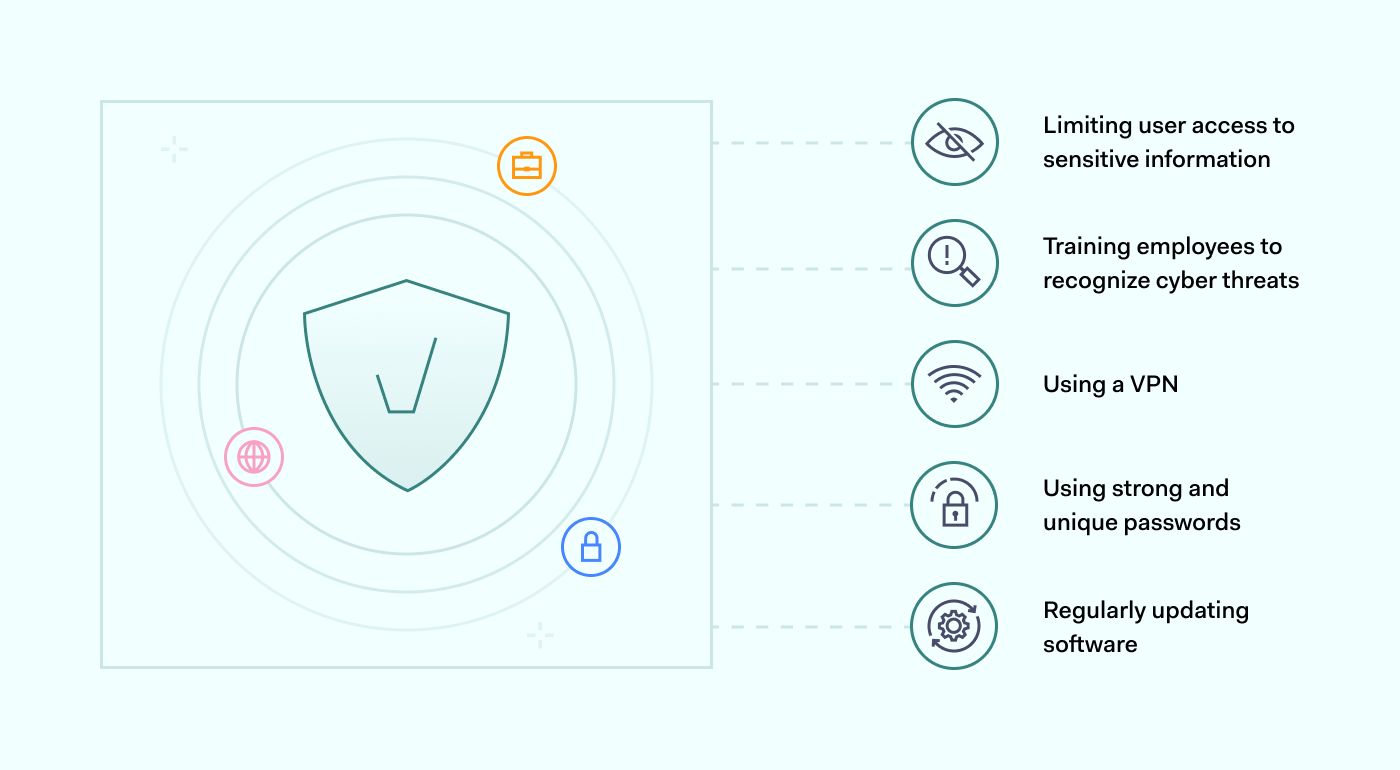
  • Using strong and unique passwords. Online account protection largely rests on the strength of your users’ passwords. Reusing passwords makes it easier for hackers to gain entry into multiple accounts with the same set of credentials. Therefore, requiring a strong and unique password is a simple yet effective way to secure against the simplest threats.

  • Regularly updating software. Periodically updating software is crucial to maintaining a secure system and protecting against cyber threats. As vulnerabilities are discovered daily, using outdated software makes it easier for hackers to exploit known flaws. The only way to avoid those exploits is to patch vulnerabilities to reduce your system’s susceptibility to attacks.

  • Using a VPN. When a user connects to a VPN, its internet traffic is encrypted, protecting all exchanged information under a seal. VPNs also mask your real IP address, making it more difficult for websites and services to track your online activity or location. This alone can make remote working risks less severe.

  • Limiting user access to sensitive information. Enforcing a need-to-know basis for accessing all data. By restricting access to only those who require it, you can reduce the risk of unauthorized access or exposure to confidential information. This can minimize the likelihood of insider threats and ensure accountability for information access.

  • Training employees to recognize cyber threats. Cybercriminals often target employees through phishing emails to gain access to sensitive information. This makes employees a key component of the organization’s defense system. For this reason, they should be equipped to recognize and stop hacking attempts, alongside our technical systems.

How can NordLayer help?

Internet access security is a priority for most companies, no matter what industry they work in. Nowadays, it poses unique security challenges businesses need to address due to various work models like remote, office, and hybrid.

NordLayer can assist enterprises in protecting their connections over the public internet. This is achieved by encrypting the connection between the user’s device and the middleman server using advanced ciphers. It ensures that all data exchanged is kept secure and cannot be read by outsiders.

With cutting-edge security technologies, NordLayer can block access to malicious websites and control entry to specific content categories. Using Public Shared Gateways, NordLayer expands browsing capabilities, allowing global business exploration and guaranteeing the confidentiality of users’ and resources’ true location.

Businesses can enhance their internet access security by implementing best industry practices and regularly training employees on security threats. This is a sure way to protect sensitive information from data breaches, no matter what work model your organization is.

Contact our sales team and discover how to achieve greater internet access security.

About Version 2 Limited
Version 2 Digital is one of the most dynamic IT companies in Asia. The company distributes a wide range of IT products across various areas including cyber security, cloud, data protection, end points, infrastructures, system monitoring, storage, networking, business productivity and communication products.

Through an extensive network of channels, point of sales, resellers, and partnership companies, Version 2 offers quality products and services which are highly acclaimed in the market. Its customers cover a wide spectrum which include Global 1000 enterprises, regional listed companies, different vertical industries, public utilities, Government, a vast number of successful SMEs, and consumers in various Asian cities.

About Nord Security
The web has become a chaotic space where safety and trust have been compromised by cybercrime and data protection issues. Therefore, our team has a global mission to shape a more trusted and peaceful online future for people everywhere.

About NordLayer
NordLayer is an adaptive network access security solution for modern businesses – from the world’s most trusted cybersecurity brand, Nord Security.

The web has become a chaotic space where safety and trust have been compromised by cybercrime and data protection issues. Therefore, our team has a global mission to shape a more trusted and peaceful online future for people everywhere.

ESET Research deconstructs Asylum Ambuscade: group focused on cybercrime, cyberespionage and attacking countries bordering Ukraine

  • Asylum Ambuscade has been operating since at least 2020.
  • It is a crimeware group that targets individuals, small and medium businesses, bank customers, and cryptocurrency traders in various regions, including North America and Europe.
  • Asylum Ambuscade also performs espionage against government entities in Europe and Central Asia: in 2022, the group reportedly targeted government officials in several European countries bordering Ukraine.

BRATISLAVA, MONTREAL — June 8, 2023 — Today, ESET Research released its analysis of Asylum Ambuscade, a cybercrime group that has been performing cyberespionage operations on the side. The group has been running cyberespionage campaigns since at least 2020. ESET found previous compromises of government officials and employees of state-owned companies in Central Asian countries and Armenia. In 2022 the group reportedly targeted government officials in several European countries bordering Ukraine. ESET Research assesses that the goal of the attackers was to steal confidential information and webmail credentials from official government webmail portals. Asylum Ambuscade usually targets small- and medium-sized businesses (SMBs) and individuals in North America and Europe.

“It appears Asylum Ambuscade is branching out, running some recent cyberespionage campaigns on the side, against governments in Central Asia and Europe from time to time. It is quite unusual to catch a cybercrime group running dedicated cyberespionage operations, and as such we believe that researchers should keep close track of its activities,” explains ESET researcher Matthieu Faou, who investigated the activities of the group.

In 2022, when the group targeted government officials in several European countries bordering Ukraine, the compromise chain started with a spearphishing email containing a malicious Excel spreadsheet or Word document attachment. If the machine was deemed interesting, the attackers eventually deployed AHKBOT, a downloader that can be extended with plugins to spy on the victim’s machine. These plugins provide various capabilities, including taking screenshots, recording keystrokes, stealing passwords from web browsers, downloading files and executing an infostealer.

Even though the group entered the spotlight because of its cyberespionage operations, it has mostly run cybercrime campaigns since early 2020. Since January 2022, ESET Research has counted more than 4,500 victims worldwide. While most of these are located in North America, it should be noted that we have also seen victims in Asia, Africa, Europe and South America. Targeting is very wide and mainly includes individuals, cryptocurrency traders, bank customers, and SMBs in various verticals.

“Asylum Ambuscade’s crimeware compromise chain is, overall, very similar to the one we see for their cyberespionage campaigns. The main difference is the compromise vector, which could be a malicious Google Ad redirecting to a website delivering a malicious JavaScript file or multiple HTTP redirections,” adds Faou.

For more technical information about Asylum Ambuscade, check out the blogpost “Asylum Ambuscade – A curious case of a threat actor at the border between crimeware and cyberespionage” on WeLiveSecurity. Make sure to follow ESET Research on Twitter for the latest news from ESET Research.

Geographical distribution of victims since January 2022.


About Version 2 Limited
Version 2 Digital is one of the most dynamic IT companies in Asia. The company distributes a wide range of IT products across various areas including cyber security, cloud, data protection, end points, infrastructures, system monitoring, storage, networking, business productivity and communication products.

Through an extensive network of channels, point of sales, resellers, and partnership companies, Version 2 offers quality products and services which are highly acclaimed in the market. Its customers cover a wide spectrum which include Global 1000 enterprises, regional listed companies, different vertical industries, public utilities, Government, a vast number of successful SMEs, and consumers in various Asian cities.

About ESET
For 30 years, ESET® has been developing industry-leading IT security software and services for businesses and consumers worldwide. With solutions ranging from endpoint security to encryption and two-factor authentication, ESET’s high-performing, easy-to-use products give individuals and businesses the peace of mind to enjoy the full potential of their technology. ESET unobtrusively protects and monitors 24/7, updating defenses in real time to keep users safe and businesses running without interruption. Evolving threats require an evolving IT security company. Backed by R&D facilities worldwide, ESET became the first IT security company to earn 100 Virus Bulletin VB100 awards, identifying every single “in-the-wild” malware without interruption since 2003.

Setting your office to autopilot

How do you want your IT team to spend their valuable time?

Do you want them to prioritize the big ticket, business critical projects such as keeping your business secure and optimizing your internal systems, continuing to add value to your company?

Or do you want them to spend hour after hour (after hour) responding to the backlog of little time sync tasks that stack up through the day? The “can you add my new job title to my email?” or the “John’s just joined but he can’t access…”

With CloudM Automate, you can put thousands of tasks a year on autopilot, saving days worth of work hours and allowing your team to concentrate on the important, interesting challenges keeping your organization moving forward.

Onboarding

When a new employee joins the business, or an employee moves to a new role, we want them to hit the ground running. Nothing stalls this enthusiasm more than having to wait for access to the resources that they need.

With CloudM Automate, you can make sure that they have access to all the shared documents, drives and calendars required for their role and department, on day one. All you have to do is make sure they are added to the correct dynamic user group.

You don’t need to go into each resource that they need and share it with the new starter. A 30 minute slog is now down to 2 minutes, at most!

Offboarding

When it comes time to say goodbye to an employee, a lot of individual tasks land in your IT team’s inbox. For example, you need to secure the user’s account (including changing passwords), transfer the ownership of Docs, Sites, Calendars and Groups, migrate emails, and claim back licenses. Even a simple manual offboarding process can take up roughly 30 minutes of your IT team’s valuable time.

CloudM Automate allows you to craft bespoke offboarding workflows of up to 30 individual tasks, automatically assigned to users based on group membership, all triggered with the press of a single button. No more delays, no more errors, no more manual tasks.

Archive

You need to keep your leavers data – It’s as simple as that. Whether it’s to comply with domestic or global data regulations such as GDPR, or just so you can recall a piece of crucial evidence as part of a legal or HR issue.

CloudM Archive allows you to make sure you are always sending your user’s data to a secure cloud storage bucket, 100% owned and managed by you, as part of an offboarding workflow. When it comes time to delete archived data, in accordance with data retention laws, CloudM Archive automatically purges it based on retention policies.

You will be 100% compliant with none of the manual hassle.

***Added Bonus*** Storing your data in the cloud with CloudM Archive is up to 75% cheaper than using Google Archive User licenses so you will save time AND money.

Integrations

CloudM Automate plays well with a host of other SaaS applications including Slack, Box, Dropbox, Bamboo HR and ADP, giving you even more ways to put menial tasks on autopilot.


The first way we do this is to allow you to secure and delete SaaS licenses assigned to a leaver as a simple, single step in your offboarding workflows. This is great for making sure that leavers no longer have access to your company data, but will also save you money on used SaaS licenses.

Then, secondly, we have integrations that allow you to make changes to a user’s profile in one SaaS application and have them automatically sync to CloudM Automate. Even better, these changes can automatically trigger onboarding and offboarding workflows, and email signature changes.

Email Signature Management

Any recently promoted or hired employee needs to update their email signature, but instead of hassling the IT department with a ticket, what if it was all done automatically? We use “variable” labels in our templates that take the latest synced information from a user’s CloudM profile or your organization profile.

In fact, with the integrations mentioned in the section above, your HR team can even change the details directly in Bamboo HR or ADP (as they would have to do normally), with the changes syncing over to CloudM Automate, and triggering changes to the user’s email signature. With ZERO interaction from your IT team required.

Also, our role permissions means you can give the right people the right access to our platform. IT admins can give a Marketing or HR team the permissions to create and assign email signatures, without allowing access to any other administrative features, such as onboarding, offboarding and archive.

Streamline your business with CloudM Automate, the award-winning platform that gives you the ability to automate your office, saving you time, stress and money. 

Contact us today and discover for yourself just how valuable office automation can be.

About Version 2 Limited
Version 2 Digital is one of the most dynamic IT companies in Asia. The company distributes a wide range of IT products across various areas including cyber security, cloud, data protection, end points, infrastructures, system monitoring, storage, networking, business productivity and communication products.

Through an extensive network of channels, point of sales, resellers, and partnership companies, Version 2 offers quality products and services which are highly acclaimed in the market. Its customers cover a wide spectrum which include Global 1000 enterprises, regional listed companies, different vertical industries, public utilities, Government, a vast number of successful SMEs, and consumers in various Asian cities.

About CloudM
CloudM is an award-winning SaaS company whose humble beginnings in Manchester have grown into a global business in just a few short years.

Our team of tech-driven innovators have designed a SaaS data management platform for you to get the most from your digital workspace. Whether it’s Microsoft 365, Google Workspace or other SaaS applications, CloudM drives your business through a simple, easy-to-use interface, helping you to work smarter, not harder.

By automating time-consuming tasks like IT admin, onboarding & offboarding, archiving and migrations, the CloudM platform takes care of the day-to-day, allowing you to focus on the big picture.

With over 35,000 customers including the likes of Spotify, Netflix and Uber, our all-in-one platform is putting office life on auto-pilot, saving you time, stress and money.

23.6.0 ‘Voyager’ released

Changes compared to 23.5.0

NOTICE: The “Run when PC Starts” option will now also apply to devices waking up from Sleep

New Features

  • Protected Items defined by Policy can now optionally remain linked for future changes
  • Added several new admin permissions to allow a global admin to help prevent a tenant admin from seeing the Comet service or storage provider types in use. The global admin can hide server history and server info widgets on the dashboard, prevent creation of storage via templates or custom storage, and can also filter the list of allowed cloud storage providers

About Version 2 Limited
Version 2 Digital is one of the most dynamic IT companies in Asia. The company distributes a wide range of IT products across various areas including cyber security, cloud, data protection, end points, infrastructures, system monitoring, storage, networking, business productivity and communication products.

Through an extensive network of channels, point of sales, resellers, and partnership companies, Version 2 offers quality products and services which are highly acclaimed in the market. Its customers cover a wide spectrum which include Global 1000 enterprises, regional listed companies, different vertical industries, public utilities, Government, a vast number of successful SMEs, and consumers in various Asian cities.

About Comet
We are a team of dedicated professionals committed to developing reliable and secure backup solutions for MSP’s, Businesses and IT professionals. With over 10 years of experience in the industry, we understand the importance of having a reliable backup solution in place to protect your valuable data. That’s why we’ve developed a comprehensive suite of backup solutions that are easy to use, scalable and highly secure.

Elevating healthcare: a definitive guide to robust cloud security in the industry

As new data breaches are making the headlines, cybersecurity is becoming one of the most critical elements of a long-term business strategy. To protect their sensitive data and mitigate potential risks, businesses are actively looking for ways to move into the 21st century in terms of their infrastructure. However, as many soon discover, cybersecurity integration within an existing business is rarely a one-click solution.

Even putting all the technical questions aside, cybersecurity raises many questions regarding return on investment. This article will provide a broad overview of how to approach cybersecurity spending. We’ll briefly cover what makes up cybersecurity costs, what factors could affect them, the financial impacts of cyberattacks, potential benefits, and some guidelines on approaching cybersecurity estimates in your company.

Costs of cybersecurity

Cybersecurity spending can mean several things. The exact route will depend on the actual business case and the risks that the company is trying to mitigate. Still, no matter which options your company is considering, this is something where budget constraints will have to become a consideration.

Let’s look at the costs from different cybersecurity ecosystem components: solutions, services, personnel, and training.

Solutions

One of the go-to routes for organizations looking to shield themselves against cyberattacks is purchasing cybersecurity hardware or software solutions. This allows companies to flexibly integrate them into the infrastructure, strengthening the areas needing attention.

As such, businesses have numerous options available. Cybersecurity hardware and software provide easy access to firewalls, antivirus, access control mechanisms, intrusion detection and prevention systems. When used collectively, these technologies work together to halt cyberattacks or mitigate their impact if they do occur.

While it’s also true that their costs depend on various factors (which we will address later on), let’s look at the average industry costs associated with various cybersecurity solutions. Please note that the distinction between solutions and services isn’t as set in stone as it used to be due to modern service delivery models (like SaaS) and the popularity of cloud computing.

Firewalls

If an organization relies on a network, a firewall is a must as it monitors and controls network traffic. Acting as a barrier between the internet and/or other untrusted networks and your private network, it’s the first defense against malicious connections based on predefined rules.

The tricky part for the comparison is that they can be implemented at different levels of the network stack, i.e., from the network layer (filtering packets) to the application layer (proxy servers). Finally, they can be hardware or software-based, or a combination of both, affecting the final price tag.

Therefore, an average firewall configuration can range between $450 and $2,500 (as a one-off investment not factoring in its maintenance which costs extra). That doesn’t take into account setup or maintenance costs, so the final cost can be higher.

Antivirus software

Antiviruses are still staples to protect computer systems from malware, viruses, and other security threats. As an essential component of comprehensive cybersecurity strategy, they can be used as the last line of defense. Usually, in business settings, they’re deployed across an organization’s network to protect all connected devices.

It’s often the case that antiviruses also include additional features like firewalls, intrusion prevention systems, and email filtering to provide further protection against cyber threats. This also makes our comparison more difficult.

Still, if we’re looking for rough estimates, which is what we’re doing here: basic antivirus usually costs between $3 and $5 per user and $5 to $8 per server monthly. While the final price tag will entirely depend on your organization’s size, the estimate could be at least $30 a month if you have around five users.

Spam filters

Business communication primarily still takes place over emails. This is something that hackers are exploiting in phishing attacks. For this reason, having spam filters is essential to identify and block harmful emails before they end up in employees’ inboxes. Spam filters rely on various technologies to analyze the content and metadata of incoming messages to determine whether they are legitimate.

Some email providers offer spam filters already integrated into their suite. Meanwhile, for other cases, it’s required to set up a spam filter on top of it. It’s estimated that the price for this ranges between $3 – $6 per user per month.

Services

What makes cybersecurity services different from cybersecurity solutions is that they’re typically provided by a third-party provider, who may offer the service on a subscription basis. While a cybersecurity service may include various cybersecurity solutions, the two concepts are not interchangeable. Cybersecurity service by definition encompasses ongoing protection against cybersecurity threats.

Frequently this also means that cybersecurity services can help against threats of greater sophistication. This makes them a good pick for organizations looking into securing their digital assets and preventing unauthorized access, theft, and exploitation of sensitive information.

VPN

With plenty of employees working remotely, businesses need a secure way for their employees to access company resources. VPN encryption seals the sensitive data in a secure tunnel, enabling secure exchanges to the company’s network. This additional protection layer also helps mitigate cyber threats by masking the user’s IP address.

Yet, as with most cybersecurity components, there are multiple routes to consider here. A VPN could be set up as a hardware stack with ongoing third-party maintenance fees or a software-only solution. This is something that can skew the price.

While the software-only is cheaper and can be up to $10 per user, the hardware setup can range up to $3,500 per device. That’s a significant gap between them, while both options provide similar functionality. The particular business case will be a deciding factor.

Consulting and testing

Cybersecurity consulting and testing service providers have a high level of expertise in identifying and mitigating security risks. This is something that few companies can manage to achieve out of their own resources. Specialized cybersecurity professionals perform various checks to properly evaluate the used cybersecurity measures’ effectiveness and outline the most critical areas.

Due to the nature of their services, this can be a pretty expensive endeavor. A vulnerability assessment for a network with up to three servers would cost $1,500 to $6,000. It goes without saying that if the scope of investigations needs to be broader, this will only add up to the final price tag.

Endpoint detection and response

Businesses turn to endpoint detection and response (EDR) services because they provide high protection against cyber threats by monitoring and detecting potential security breaches. This allows businesses to detect and respond to cyber threats quickly and before they cause significant damage to the organization’s assets, reputation, and financial standing. EDR solutions typically operate through a combination of software agents and cloud-based systems.

Endpoint detection and response solutions cost around $5 to $10 per month per device. Yet, as with most subscription-based services, there are discounts: with more devices, EDR usually becomes cheaper per single device. Still, EDR solutions come in different depths and feature sets, so the final cost can be higher.

Personnel

Personnel is one of the most important cybersecurity assets at any company’s disposal. These specialists will protect your data from various forms of cyberattacks and ensure the risks are minimal. Whatever cybersecurity solutions or services you’ve purchased, the IT personnel will set up and maintain those tools.

Cybersecurity doesn’t become an integral part of an organization’s DNA just by purchasing some subscriptions. It needs to be cultivated. One way to ensure this is sustainable is to develop security policies and protocols — exactly what cybersecurity personnel will do.

Network administrators

Network administrators are responsible for setting up and maintaining the organization’s network infrastructure. They must ensure the network is secure from unauthorized access and that all transmitted data is protected from interception and other potential threats. The administrators will be configuring and managing firewalls, blocking specific ports, managing user permissions, monitoring the network, and patching system components.

As for their cost, you can look at conflicting data sources: depending on the region, experience, market saturation, and other factors. Still, if we’re looking for a broad view based on data from Payscale, this should be within $63,244 per year.

Compliance officers

Compliance officers are specialists who ensure an organization’s cybersecurity by implementing policies and procedures to align compliance with regulations and industry standards. They identify risks, monitor security measures, and ensure employees follow security protocols. These key people outline how an organization should handle sensitive data, access controls, and incident response.

A compliance officer’s salary is $73,255 a year based on publicly available data. Mind you, compliance is one of the trickiest landscapes to navigate, so these specialists must periodically refresh their knowledge to stay updated with the latest policy changes.

Security analysts

Security analysts identify potential threats to an organization’s network, systems, and data. They’re using various tools and techniques to detect and prevent cyberattacks before they can cause damage. Security analysts identify vulnerabilities in an organization’s systems and infrastructure by conducting risk assessments.

Security analysts are crucial in protecting an organization’s assets and cyber threats. Based on Glassdoor data, their salaries, on average, are around $90,283 a year. Due to the increased frequency and complexity, professional cyber security analysts are in high demand, which can further increase their salaries.

Trainings

The cybersecurity landscape is constantly changing. Therefore employees’ skills and knowledge need to be periodically refreshed. This is where cybersecurity training and certifications ensure that employees know the best practices for protecting this information and can identify potential threats. These trainings can be expensive, and organizations must ensure they are effective.

Courses

Cybersecurity courses can be an invaluable resource in helping to understand the importance of protecting company data from cyberattacks. By teaching employees how to identify potential security threats and how to take preventative measures, companies can reduce the risk of data breaches and protect their sensitive information. Nowadays, there are plenty of resources, ranging from in-person training to online lectures.

For this reason, cybersecurity training costs vary significantly and can range from freely available online resources to $5,000 or more. Mind you that the price is affected by factors like depth and competencies. Courses intended for niche specializations will always cost more than a basic introduction.

Certifications

Cybersecurity certifications provide credibility to professionals working in the field, demonstrating that they have met rigorous standards and have the necessary knowledge and skills to protect against cyber threats. Using certification as a standardized measure allows aligning the team and ensuring that best practices are applied when making organization-level cybersecurity improvements.

There are several popular cybersecurity certifications widely recognized in the industry. For example, the Certified Information Systems Security Professional (CISSP) exam costs around $699. Certified Ethical Hacker (CEH), another important pick for cybersecurity professionals, costs around $1199. Along with GIAC Security Essentials (GSEC) certification and exam, it’s priced around $1699, which makes it one of the more expensive courses.

Factors that affect cybersecurity costs

It’s important to note that the cybersecurity costs provided in the previous section are only rough estimates. The final price will depend on numerous factors, which will be the key differentials from business to business when calculating cybersecurity costs. Let’s look at some of them to see how they factor into the final price tag.

Size

The size of an organization is one of the most important factors which can drastically alter cybersecurity costs. As larger companies have more complex IT infrastructures, more employees to train, and a higher risk of cyber attacks due to their visibility and financial resources — their security naturally costs more. When compared to smaller organizations, the difference might be night and day.

Keep in mind that, in some cases, some cybersecurity tools will need to be adjusted. They cannot operate that well when used in corporate settings, which are within a completely different pricing category. However, numerous reports confirm that small businesses are three times more likely to be targeted by cybercriminals than larger companies. So while the risks remain high, not all companies are as well equipped to tackle the potential risks.

Industry

The industry in which an organization operates and any regulatory requirements it must comply with can impact its cybersecurity costs. Organizations working in highly regulated industries like healthcare and finance will have higher cybersecurity costs because more regulations apply to the data they’re holding.

As a side note, the industry determines an organization’s risk tolerance. Different industries can have very different thresholds for acceptable risk levels. This means that security’s scope will have to be aligned, which will also, in turn, affect cybersecurity costs. In addition, businesses in certain industries seem to fall victim to more cyberattacks than others, which is also a factor.

Financial impact of cyber attacks

While up until this point, you got the impression that cybersecurity is expensive, let’s move on to an overview of the financial impact of cyber attacks. Depending on what business operations are targeted, the attack scope, and the kinds of data leaking to the public, all constitute significant financial losses. Let’s look at revenue losses, legal fees, and reputational damage.

Revenue

Cyberattacks can disrupt normal organizations’ day-to-day operations and compromise sensitive data. This can easily make an organization’s systems and networks inaccessible or unusable. The downtime when the IT team is trying to patch together a solution and get the operations back up and running costs time, which also translates into lost revenue.

2 financial impact of cyberattacks

The recovery costs can also be factored in as damaged equipment needs to be replaced, and systems need to be restored from the backups. It’s not a coincidence that a quarter of companies that have experienced a cyber attack have lost between $50,000 and $99,999 in revenue. These are steep numbers, and they don’t factor in the costs of getting the operations back up and running.

Legal fees

After data breach remediation and operations restoration, the trouble isn’t over. Especially in cases of a large data breach, companies need to hire legal counsel, forensic experts, and other professionals to help manage the aftermath. So there’s the precedent of estimation and cleaning up.

3 post-breach legal fees breakdown

Additionally, depending on the data breach’s severity, the company may also be held responsible for the damage suffered by affected customers or clients. If there are lawsuits, this can quickly mount legal fees, including settlement costs. For smaller companies, that’s an instant endgame as they often just aren’t equipped to handle such expenses. For instance, it’s estimated that legal costs range from $50,000-$148 million, with a median of $1.6 million and a mean of $13 million.

Reputational damage

A data breach leaves a permanent black mark on a company’s reputation. Companies will need to spend a lot of resources to repair their image and reassure the customers that they have learned from their mistakes and won’t happen again. This long process involves public statements and social media management and should be an aspect of long-term customer trust remediation.

4 cybersecurity reputational costs

According to various reports, the proportion of the total costs that can be attributed to reputational costs like abnormal customer turnover and loss of goodwill was around $1.57 million. Mind you that this is something that affects companies for a long time, provided that a company even makes a recovery from a data breach.

Benefits of cybersecurity spending

Cybersecurity spending can minimize various risks associated with revenue, reputation, or legal fees. While this is a solid argument advocating for cybersecurity solutions, this is far from the only benefit. Having a functioning infrastructure with a cybersecurity-focused mindset also generates a positive outcome for organizations. Let’s look at some of the indirect benefits of cybersecurity spending.

Better compliance alignment

Many compliance regulations, like General Data Protection Regulation (GDPR) and the Health Insurance Portability and Accountability Act (HIPAA), require organizations to implement specific security measures to protect sensitive data. Therefore, investments in cybersecurity help to achieve two goals simultaneously:

  • The risk profile is contained, and the organization is more resistant to cyberattacks.

  • The organization ensures that it has all the necessary technologies and policies in place to meet compliance requirements.

Reports confirm that achieving substantial compliance goals require holistic and integrated security solutions, ensuring that every aspect of an organization is covered. For this alone, cybersecurity investments should be at the top of the business manager’s list.

Increased productivity

Cybersecurity matters can often be a catalyst for workplace modernization. While this may not always be a seamless transition, the change often allows the work to be performed more efficiently and securely. A good example of this is the remote and hybrid work trend, which became very popular after the global pandemic.

In fact, securing identities and endpoint devices enables users to do their work quickly and securely from anywhere. Nowadays, there are many ways of working, and cybersecurity can be a good contributor to breaking the cycle of outdated tech and enabling all ways of working.

How to apply cost-benefit analysis for your organization

Our rough estimates demonstrate that data breach costs outweigh cybersecurity expenses. While this is a valid statement, this doesn’t provide clear guidelines on what actionable steps should be taken when considering cybersecurity spending. Businesses have finite resources, and cybersecurity is just one area that needs to be addressed. Thankfully, there are some models that we can use as a basis to evaluate cybersecurity costs and benefits.

Let’s start by looking at one of the most widely used schemes: the National Institute of Standards and Technology (NIST) Cybersecurity Framework. This is a helpful document consisting of standards, guidelines, and best practices to manage cybersecurity risks. It’s especially useful because it’s applicable to companies from all industries.

The problem with it is that while it recognizes that management of cybersecurity risks is always organization-specific, which will also shape how the final cost-benefit evaluation will look, it doesn’t outline how the cost-benefit analysis should be provided. For this reason, some researchers suggest integrating mathematical models Lawrence A. Gordon and Martin P. Loeb developed into the NIST Cybersecurity Framework. The model calculates an optimal investment in cybersecurity based on the cost of an attack, the expected probability, and the effectiveness of the security measures put in place.

The basic premise of the Gordon-Loeb model is that there is a tradeoff between the cost of an attack and the cost of investing in cybersecurity. Organizations want to minimize the total cost, including the cost of an attack and the security investment. The model assumes that the cost of an attack is proportional to the value of the information assets that could be compromised.

The model also considers the probability of an attack occurring, which is a function of the number of potential attackers, the likelihood that they will attempt an attack, and the effectiveness of the security measures. The effectiveness of security measures is assumed to be proportional to the level of investment in cybersecurity.

To calculate the optimal investment in cybersecurity, a balance needs to be found between the level of investment and the expected total cost. This relies on the relation between the expected cost of an attack and the cost of the security investment. This leaves us with a four-step approach:

  1. The value of protected information should be estimated as it represents the potential loss (L)

  2. The probability of the information being breached should be estimated (v)

  3. These first two values should be combined to derive the expected loss (vL)

  4. Cybersecurity investments should be allocated to the information based on the productivity and cost of the investments, so an optimal investment level (z)

Putting this data in the graph gives us some perspective on the diminishing returns. If the values of v and L are small, for instance, when v equals 0.1, and L equals $1M, extensive investments in cybersecurity aren’t optimal, as the expenses are higher than the benefits.

However, as the values of v and L increase, the optimal investment amount (z) and the expected loss resulting from a cybersecurity breach (vL) increase in this scenario.

5 graph showing optimal cybersecurity spending

In other words, the more valuable data an organization has, the more it has to lose. Once that threshold is met, not investing in cybersecurity is sitting on a powder keg. It’s a simple exercise to go through to better evaluate your organization’s standing in terms of cybersecurity. As a rule of thumb, the authors of the study suggest that organizations should generally invest less than 37% of the expected loss from a cybersecurity breach. The actual number will then need to be individually calculated based on your organization’s specifics.

How to improve your cybersecurity with NordLayer?

Cybersecurity is unavoidable in the current business environment because cyber threats aren’t going anywhere. This also has associated costs: solutions, services, personnel, and trainings. Organizations aren’t left alone without help, so for those willing to team up with cybersecurity providers — the market offers numerous opportunities that could make your company more resistant to cyber threats.

When it comes to the price, though, there are numerous factors that can also affect cybersecurity costs, like industry and size. As most cyberattacks are financially motivated, the companies with the most sensitive data are the prime targets. Although, it’s always fair to assume that no matter the industry or size, no one is immune to them.

That is why organizations need modern cybersecurity solutions that adapt to changing complexities of today’s working environments. All organizations have information that needs protecting, so all communication channels are interesting to hackers.

With NordLayer’s solutions, organizations can secure access to sensitive information and prevent reputational, legal, and financial damage. No matter what industry, NordLayer can be a reliable ally to help you stay secure. Contact us, and let’s discuss your cybersecurity journey together.

About Version 2 Limited
Version 2 Digital is one of the most dynamic IT companies in Asia. The company distributes a wide range of IT products across various areas including cyber security, cloud, data protection, end points, infrastructures, system monitoring, storage, networking, business productivity and communication products.

Through an extensive network of channels, point of sales, resellers, and partnership companies, Version 2 offers quality products and services which are highly acclaimed in the market. Its customers cover a wide spectrum which include Global 1000 enterprises, regional listed companies, different vertical industries, public utilities, Government, a vast number of successful SMEs, and consumers in various Asian cities.

About Nord Security
The web has become a chaotic space where safety and trust have been compromised by cybercrime and data protection issues. Therefore, our team has a global mission to shape a more trusted and peaceful online future for people everywhere.

About NordLayer
NordLayer is an adaptive network access security solution for modern businesses – from the world’s most trusted cybersecurity brand, Nord Security.

The web has become a chaotic space where safety and trust have been compromised by cybercrime and data protection issues. Therefore, our team has a global mission to shape a more trusted and peaceful online future for people everywhere.