Skip to content

Comparison N-Able vs Kaseya vs Pandora FMS: Fight !!!

Official comparison: N-Able vs Kaseya vs Pandora FMS

Lemons, oranges, grapefruits, limes… We know that they are not the same, but if necessary, you can make juice with all of them. And yes, we can and we will. We are in summer and it makes you want to make a good cocktail, doesn’t it? Today, in PFMS blog, we are going to analyze the commonalities of N-Able (Solarwinds MSP), Kaseya and Pandora FMS. Also their -remarkable- differences of course.

Both Kaseya and N-Able stand out for being RMM solutions and integral IT management systems in SaaS mode for MSP. In short, they are a very good solution for managing remote workstations and being able to manage and monitor them remotely. This includes tasks such as patch installation, remote software installation, network equipment configuration, remote desktop access, backups, and of course, receiving alerts when something goes wrong on managed machines.

Kaseya’s client is usually an MSP that provides services to different users, so it needs a tool that with a single license can serve different clients, managing them in an isolated, but centralized and homogeneous manner. This saves costs and is more efficient, since both Kaseya and N-Able are specific tools for Windows desktops that need to be managed remotely.

Pandora FMS client is usually an end company, or an MSP specialized in managing more complex infrastructures, which requires a tool with a more technical profile, which allows its technicians to apply their existing knowledge, scripts, etc. integrating them to compose an effective monitoring that allows them to go where other tools cannot. They are more oriented towards base infrastructure (communications, servers and applications) than to desktop computers.

In this comparison, we will also talk about prices, and both Kaseya and N-Able are above 20K USD in projects of 250 teams, yes, they are expensive tools and they also have a complex and peculiar pricing model, so much so that you will not be able to find these prices clearly on their respective websites.

A very important difference is that both Kaseya and N-Able are usually used in a cloud model (SaaS) (although they also have on-premise licensing), while Pandora FMS is a much more conservative model and is totally on-premise. This is especially relevant regarding the impact on security, since as the last hack to the Kaseya infrastructure showed us, attacking the manufacturer may imply that they can reach the end customer. As we teased long ago, Solarwinds is also not spared from this plague of security problems, and has suffered, since the first attack in 2020, several more attacks.

Given that Pandora FMS is a 100% autonomous installation (it can be installed in an environment without Internet access), and that Pandora FMS agents are not accessible from the outside nor can they be updated remotely, it is, by design, somewhat safer than Kaseya and Solarwinds. However, no one is spared, and Pandora FMS during 2020 and 2021 has published several security patches, as it can be seen in the CVE registry of Mitre.org.

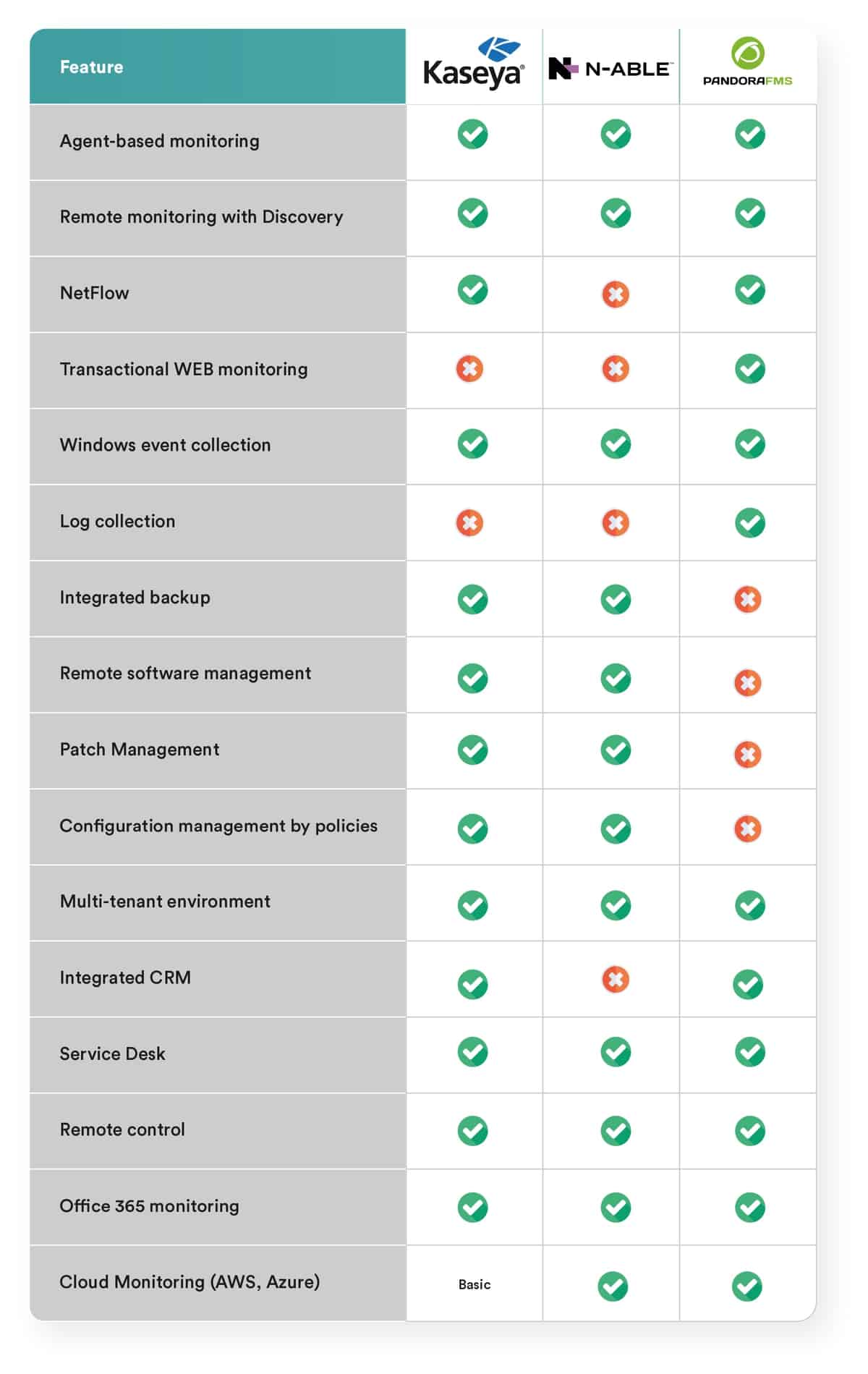
As a summary, we have created a table that describes features. Below there are some additional explanations.

N-Able vs Kaseya vs Pandora FMS
Prices

Others don’t talk about prices, we do. And we do it because it is something that everyone wants and needs to see. We know that it is very difficult to compare them because no product is licensed the same and they do not even share the same concepts. What we do is propose a more or less understandable and standard project to be able to compare the costs in three years. Let’s say, for example, that you want to monitor about 250 computers distributed among virtualized servers (30), workstations (200), physical network equipment and physical servers. Making a total of 250 teams. Well, the cost of a THREE-year project, without professional services and with standard support, would be the following:

  • Kaseya: 30,000 USD
  •  N-Able: 50,000 USD
  •  Pandora FMS: 15,000 USD

Conclusions

Both N-Able and Kaseya are products that excel in desktop management capabilities: patch management, software installation, and configuration change management. They provide added value such as monitoring, backup, security policy management and remote control. To all of this, they offer a layer of additional services such as ticketing and a portal for MSPs to offer their clients an integrated management and billing platform (the latter only in the case of N-Able).

They are very oriented to job monitoring. Monitoring, although it covers many aspects, is not the main focus of the product, especially if we consider some advanced features such as:

  • Distributed transaction monitoring (web applications).
  •  Monitoring Linux environments.
  •  Service-oriented monitoring (defining of service trees).
  •  High capacity (more than 10,000 devices).
  •  Advanced monitoring of enterprise technologies (Oracle, SAP, VMware …).
  •  Detailed monitoring of cloud environments (AWS, Azure).

In general, both N-Able and Kaseya have monitors for all kinds of applications, but only from a very superficial and remote point of view. That is, they are limited and not easily extensible.

If we add the high costs to this, Kaseya and N-Able do not seem like a good option for server monitoring projects or core infrastructure. For that, Solarwinds has a more traditional on-premise solution, although with costs of a similar order of magnitude, while Kaseya can only offer its product in an on-premise model.

About Version 2 Limited
Version 2 Digital is one of the most dynamic IT companies in Asia. The company distributes a wide range of IT products across various areas including cyber security, cloud, data protection, end points, infrastructures, system monitoring, storage, networking, business productivity and communication products.

Through an extensive network of channels, point of sales, resellers, and partnership companies, Version 2 offers quality products and services which are highly acclaimed in the market. Its customers cover a wide spectrum which include Global 1000 enterprises, regional listed companies, different vertical industries, public utilities, Government, a vast number of successful SMEs, and consumers in various Asian cities.

About PandoraFMS
Pandora FMS is a flexible monitoring system, capable of monitoring devices, infrastructures, applications, services and business processes.
Of course, one of the things that Pandora FMS can control is the hard disks of your computers.

The Pillars of Information Security – Part 2

Currently, the use of information is a great ally for companies from different industries. However, along with this, comes the need to protect this information with what is called information security. But do you know what the pillars of information security are?

This article will address these pillars to bring greater clarification and knowledge on the topic, which is of great importance.

Importance of Information Security

Information security works to protect the data and information that a company has against external attacks and data theft. That is because, with technological transformation, the data that a company owns has become one of its most important and valuable assets.

Also, concerning data from third parties, such as customers, it is essential to have protection for a company to work in compliance with the Brazilian legislation that deals with the matter.

In this sense, the company must have excellent information security behavior, with strategies and mechanisms that are efficient and guarantee the integrity and complete security of all data. 

To guide the entire protection network, some pillars are used to obtain the maximum level of security.

They are the following:

  • Confidentiality;
  • Integrity;
  • Availability.

In the following topics, take a look at what each of the pillars described above means to understand more how information security works.

Learn More About Confidentiality

With the Confidentiality pillar, information security works with limited access to the content of stored data. Access to information can only be allowed to authorized people.

With that, not everyone can have unrestricted access, and the system is designed to open information exclusively under authorization.

Learn More About Integrity

In addition to the pillar above, Integrity is another one that must be respected so that information security is robust and adequate.

In other words, integrity means that there must be confirmation that the information is truthful. For this, the pillar protects the data so that it is not tampered with or changed without the proper authorization of those who have access.

Visit our website and find other articles like this one to learn more about information security and related topics of great importance!

Learn More About Availability

Furthermore, the third pillar is Availability, which states that, whenever necessary, data will be available for access. Of course, as the pillars are complementary, this one is only valid for authorized accesses.

Therefore, it offers, within the system, the guarantee that data will not be deleted or relocated and that it can be requested and accessed by authorized people, entities, or processes when it is necessary to have access to the stored information.

So, by integrating these three main pillars, an organization is robust and prepared to offer what the information needs in terms of security.

When all pillars are in place, the company does not have the risk of losing data, suffering unwanted changes, or even theft or unwanted leaks.

This is all thanks to the pillars guiding the protection system and that will work whenever something contrary to the guidelines is identified, such as in the case of an unauthorized person trying to gain access to information.

Also, depending on the type of system created, whenever an attack attempt happens, it is recorded in the system so that further action can be taken, such as investigation and verification of where the found threat came from.

With this, this type of system becomes even more secure and data is more protected.

Therefore, it is through these pillars that companies must protect data they have and that is of great value to their activities and to prevent the law from being breached, especially in relation to customer data and information.

That is because companies that keep personal customer information must maintain strict confidentiality and are responsible for protecting this data, under penalty of even suffering legal consequences.

Thus, the use of information security is extremely important and must always be done carefully, using what is most developed in the industry, because it is one of the segments in which updates and the speed of monitoring must be compatible with the emergence of new systems.

About Version 2 Limited
Version 2 Digital is one of the most dynamic IT companies in Asia. The company distributes a wide range of IT products across various areas including cyber security, cloud, data protection, end points, infrastructures, system monitoring, storage, networking, business productivity and communication products.

Through an extensive network of channels, point of sales, resellers, and partnership companies, Version 2 offers quality products and services which are highly acclaimed in the market. Its customers cover a wide spectrum which include Global 1000 enterprises, regional listed companies, different vertical industries, public utilities, Government, a vast number of successful SMEs, and consumers in various Asian cities.

About Segura®
Segura® strive to ensure the sovereignty of companies over actions and privileged information. To this end, we work against data theft through traceability of administrator actions on networks, servers, databases and a multitude of devices. In addition, we pursue compliance with auditing requirements and the most demanding standards, including PCI DSS, Sarbanes-Oxley, ISO 27001 and HIPAA.

How AI Technology Complements Document Cameras in Education

The traditional idea of education used to be limited to the four walls of the classrooms. Employees and students alike were in many cases compulsorily required to be physically present. The possibilities of technology in enhancing education were not fully exploited.

Everything changed after the pandemic hit the world. Almost every sector had to find a way to survive amidst the lockdown. Learning had to continue without the possibility of spreading the virus. A lot of measures were put in place. Academic institutions engaged students virtually as an alternative to physical classes. Students were given access to recordings and video presentations of educational materials in their various remote locations.

As the pandemic slows down, it is undoubted that the gains of technology in enhancing education are enormous. For this reason, many have adopted a hybrid model of teaching and work as the new norm.

DOCUMENT CAMERAS, A MUST-HAVE.

Sometimes called Visualizers or Doc Cams, these are high-resolution cameras used to magnify or project images of objects, paper notes are usually mounted on the arm to facilitate their placement over a page.

Document cameras are designed to display a three or two-dimensional object while the audience watches. The camera takes a picture and produces a live image using a monitor or a projector. Besides education, it has also been utilized to present materials in conferences, evidence in courtrooms, and even medical applications.

As the world changed its dynamic to a remote environment, Document Cameras have helped maintain an effective learning experience without regard to physical boundaries. Doc Cams have had to evolve to include more features that can improve remote learning regardless of the user’s surroundings, such as a microphone or a built-in LED light.

ARTIFICIAL INTELLIGENCE, A GREAT ADDITION TO A DOC CAM.

The main feature of artificial intelligence is a machine’s ability to mimic human actions and rationalize and exhibit traits associated with the human mind, such as learning and problem-solving. We can take the advantage of AI to enhance existing features, for example, the Microphone of a Document Camera.

Artificial intelligence technology in microphones is concerned with the suppression of background noise and enhancement of voice. The human brain can identify whether sounds come from a voice discussion between people or noise in the background. The hearing system can also focus on vocal sounds and ignore surrounding noises to make the conversation intelligible and clear.

Standard noise suppression technologies need to guess what type of emitted noise they need to suppress, resulting in random and poor efficiency. They rely on learning signals compiled manually by engineers. That means only noise that is stable and regular is removed.

IPEVO, a leading Document Camera provider, has introduced V4K PRO, the World’s first Doc Cam with an AI-Enhanced Microphone that is built to extract vocal sounds from a noisy environment and let you enjoy an apparent crystal conversation or lecture.

How?

It does this by acting as a filter to eliminate noise while still maintaining the natural sound of the voice. The artificial intelligence in V4K PRO has been trained with over 500 million data to effectively distinguish and preserve the human voice exactly as it would sound in a face-to-face conversation.

HOW CAN IT HELP SUPPORT EDUCATION

AI-powered devices like the IPEVO V4K PRO can help increase the efficiency of education workers in the following ways;

  • Achieve virtual courses and presentations with sounds just as flawless as they should naturally be. Even if you are in a noisy or dim-lit environment, teachers can carry on with their lessons without interruptions.
  • Make high-quality pre-recordings of your lessons or materials to share with your students.
  • Set up hybrid classrooms where remote students can be just as engaged as your in-class students.
  • Integrate your Document Camera with most existing software and hardware in your class set-up. For example, in-class projectors, computers, and 3rd party video conferencing apps.

It is evident from the pandemic experiences that education transcends the four walls of a physical classroom. To fully explore the gains of technology in education, consider adding a powerful, yet affordable, tool like the IPEVO V4K PRO. It is essential to delivering quality education and adapting to the ‘New Normal’, which features a blend of distant, in-person, and hybrid models of collaboration across institutions.

Find out more about the IPEVO V4K PRO Ultra HD Document Camera here: https://www.ipevo.com/products/v4k-pro

About Version 2 Limited
Version 2 Digital is one of the most dynamic IT companies in Asia. The company distributes a wide range of IT products across various areas including cyber security, cloud, data protection, end points, infrastructures, system monitoring, storage, networking, business productivity and communication products.

Through an extensive network of channels, point of sales, resellers, and partnership companies, Version 2 offers quality products and services which are highly acclaimed in the market. Its customers cover a wide spectrum which include Global 1000 enterprises, regional listed companies, different vertical industries, public utilities, Government, a vast number of successful SMEs, and consumers in various Asian cities.

About IPEVO
IPEVO makes versatile teaching tools instead of specialized “classroom equipment”.
We go beyond the usual conventions of classroom technology—large, expensive, specialized and complex—to rethink simple and flexible solutions for interactive teaching in today’s classrooms.
IPEVO’s interactive teaching tools empower educators and teachers with radically affordable and compact technology that is simple, intuitive and flexible, so that precious time and resources can be wholly dedicated to teaching. We intend to make educational technology accessible and available to all.