Two zero-day vulnerabilities impacting Craft CMS are being actively exploited by chaining the vulnerabilities together to compromise the affected systems.
CVE-2025-32432 is rated critical with a CVSSv3 base score of 10.0.
CVE-2024-58136 is rated critical with a CVSSv3 base score of 9.0. This vulnerability is found within the Yii framework, which is used by Craft CMS.
Successful exploitation of the vulnerabilities when chained together potentially allows a remote attacker the ability to breach vulnerable systems and transfer potentially sensitive data after installing a PHP-based file manager on compromised systems.
Although the Yii framework update is not included in the latest Craft CMS patch, the primary vulnerability was patched within 3.9.15, 4.14.15, and 5.6.17. Users are strongly encouraged to update their installation as soon as possible. In addition to applying a patch, users might want to rotate their security keys as a safety precaution. Additionally, a best practices write-up is available online with steps on how to harden the security of the installation.
How do I find potentially vulnerable instances with runZero? #
From the Service Inventory, use the following query to locate systems running potentially vulnerable software:
_asset.protocol:http AND protocol:http AND (has:http.head.xPoweredBy AND http.head.xPoweredBy:="Craft CMS")
In late January, CraftCMS published a security advisory for a code injection vulnerability that can lead to remote code execution. On February 20, 2025 CISA added CVE-2025-23209 to the known exploited vulnerabilities catalog (KEV).
Successful exploitation of the vulnerability requires that a remote attacker already has control of the installation’s security key. In this case, the attacker can then inject code using an specially crafted backup directory variable provided by the user.
The affected versions include:
Versions greater than or equal to 5.0.0-RC1 through 5.5.5 (exclusive)
Versions greater than or equal to 4.0.0-RC1 through 4.13.8 (exclusive)
The vulnerability was patched in 5.5.8 and 4.13.8. Users are strongly encouraged to update their installation as soon as possible. In addition to applying a patch, users might want to rotate their security keys as a safety precaution. Additionally, a best practices write-up is available online with steps on how to harden the security of the installation.
How do I find potentially vulnerable instances with runZero? #
From the Service Inventory, use the following query to locate systems running potentially vulnerable software:
_asset.protocol:http AND protocol:http AND (has:http.head.xPoweredBy AND http.head.xPoweredBy:="Craft CMS")
About runZero runZero, a network discovery and asset inventory solution, was founded in 2018 by HD Moore, the creator of Metasploit. HD envisioned a modern active discovery solution that could find and identify everything on a network–without credentials. As a security researcher and penetration tester, he often employed benign ways to get information leaks and piece them together to build device profiles. Eventually, this work led him to leverage applied research and the discovery techniques developed for security and penetration testing to create runZero.
About Version 2 Limited Version 2 Digital is one of the most dynamic IT companies in Asia. The company distributes a wide range of IT products across various areas including cyber security, cloud, data protection, end points, infrastructures, system monitoring, storage, networking, business productivity and communication products.
Through an extensive network of channels, point of sales, resellers, and partnership companies, Version 2 offers quality products and services which are highly acclaimed in the market. Its customers cover a wide spectrum which include Global 1000 enterprises, regional listed companies, different vertical industries, public utilities, Government, a vast number of successful SMEs, and consumers in various Asian cities.
This vulnerability is only found within the 11.38 Innovation Release (11.38.0 through 11.38.19). A path traversal vulnerability identified in the Command Center installation allows an unauthenticated attacker to upload ZIP files, which could lead to remote code execution.
Commvault has issued a 11.38.20 release that patches the vulnerability.
How do I find potentially vulnerable software with runZero? #
Vulnerable services can be found by navigating to the Services Inventory and using the following query:
_service.last.http.uri:="%commandcenter%" AND _service.protocol:http AND _asset.protocol:http
About runZero runZero, a network discovery and asset inventory solution, was founded in 2018 by HD Moore, the creator of Metasploit. HD envisioned a modern active discovery solution that could find and identify everything on a network–without credentials. As a security researcher and penetration tester, he often employed benign ways to get information leaks and piece them together to build device profiles. Eventually, this work led him to leverage applied research and the discovery techniques developed for security and penetration testing to create runZero.
About Version 2 Limited Version 2 Digital is one of the most dynamic IT companies in Asia. The company distributes a wide range of IT products across various areas including cyber security, cloud, data protection, end points, infrastructures, system monitoring, storage, networking, business productivity and communication products.
Through an extensive network of channels, point of sales, resellers, and partnership companies, Version 2 offers quality products and services which are highly acclaimed in the market. Its customers cover a wide spectrum which include Global 1000 enterprises, regional listed companies, different vertical industries, public utilities, Government, a vast number of successful SMEs, and consumers in various Asian cities.
A few weeks ago, we launched powerful new capabilities in runZero that mark a new era in exposure management. As part of that release, we took direct aim at overcoming long-standing challenges with vulnerability scanners.
Traditional vulnerability management platforms were designed for a world that no longer exists — and they stopped innovating a long time ago. They were introduced back when networks were static, assets stayed on-prem, and scans could reach everything. But today’s environments are anything but predictable and controllable.
Hybrid infrastructure, distributed workforces, edge devices, and IT/OT convergence have completely reshaped the attack surface. Vulnerability scanners haven’t kept up, producing overwhelming volumes of alerts while completely missing critical exposures that are highly exploitable.
So, what’s the move?
Ditch your vulnerability scanners. Leverage your endpoint agents for authenticated discovery. Use runZero for everything else.
This modern approach gives you better coverage, deeper visibility, and less operational overhead. It’s exposure management reimagined for today’s dynamic environments.
Legacy vulnerability scanners were built for a different time — when networks had clear perimeters, assets were reachable, and credential-based scanning was feasible across the board.
That world doesn’t exist anymore.
Today, your environment is:
Hybrid and constantly changing
Remote-first, with endpoints scattered across the globe
Full of unmanaged, unknown, and unscannable assets
Populated with fringe devices at the network edge
The latter are precisely the types of assets most likely to be missed by agents and excluded from scheduled scans — yet they often present the highest risk.
Legacy scanners also tend to be disruptive to sensitive systems and prone to crashing things you don’t want to knock over. This renders them useless in OT environments and for things like IoT and unmanaged devices, yet these assets are frequently targeted by attackers. Plus, these tools are typically slow, delivering results well after windows of exploitability have opened.
So what now? Stick with what’s familiar and hope nothing slips through the cracks? Of course not. But ripping out your existing scanner and starting from scratch isn’t always realistic either — especially when your workflows and metrics are tied to vulnerability counts.
You Already Have Authenticated Vulnerability Data #
Here’s the irony: you already have a better source of authenticated vulnerability data. You may just not be using it.
If you’ve deployed endpoint detection and response (EDR) agents, then you may already have real-time, authenticated vulnerability data at your fingertips.
There’s no need for complex credential vaults, no limited scan windows, no waiting for point-in-time scan results. You’ve already got what you need. Why not use it?
But here’s the challenge — these tools give you vulnerability data without the network context. They tell you what’s wrong, but not whether those vulnerabilities are exposed or reachable by an attacker. That’s where runZero comes in to connect the dots, plus identify additional exposures that agent-based approaches still miss.
Endpoint agents are powerful, but they can’t see everything.
runZero’s exposure management platform is purpose-built to find assets and risks traditional tools and endpoint agents can’t. We discover and fingerprint every device across your total attack surface including IT, OT, IoT, cloud, and mobile devices. We even find unmanageable, rogue, or entirely unknown assets that agents can’t touch.
Additionally, we highlight risks that other tools may report, but not at the appropriate severity level. For example, many vulnerability scanners detect unauthenticated “ZooKeeper” services, but report this as an information-vulnerability, not an exposure that can leak application secrets to an unauthenticated attacker.
Want to find protocols running on unusual ports, exposed remote access services, open databases with default credentials, segmentation violations, or devices improperly bridged across internal and external networks? runZero sees them.
We’re also leading the way in uncovering exploitable paths that never show up in external scans but pose massive internal risk. Learn more about our inside-out attack surface management capabilities.
runZero + Endpoint Agents: A Smarter, Integrated Approach #
Modern exposure management doesn’t need more tools — it needs a more effective approach.
runZero’s deep integrations with leading endpoint detection and response vendors enable you to:
Enrich asset records with agent details, OS info, and operational state
Ingest full software inventories
Pull in authenticated vulnerability data direct from the agent
This data merges seamlessly with runZero’s unauthenticated discovery and fingerprinting to give you a complete, contextualized view of every asset in your attack surface and its exposures including which ones are reachable, misconfigured, or otherwise primed for compromise.
It’s time to move away from legacy vulnerability management. There’s a smarter path forward — one that pairs the endpoint agents you already have with what you’ve been missing: runZero.
About runZero runZero, a network discovery and asset inventory solution, was founded in 2018 by HD Moore, the creator of Metasploit. HD envisioned a modern active discovery solution that could find and identify everything on a network–without credentials. As a security researcher and penetration tester, he often employed benign ways to get information leaks and piece them together to build device profiles. Eventually, this work led him to leverage applied research and the discovery techniques developed for security and penetration testing to create runZero.
About Version 2 Limited Version 2 Digital is one of the most dynamic IT companies in Asia. The company distributes a wide range of IT products across various areas including cyber security, cloud, data protection, end points, infrastructures, system monitoring, storage, networking, business productivity and communication products.
Through an extensive network of channels, point of sales, resellers, and partnership companies, Version 2 offers quality products and services which are highly acclaimed in the market. Its customers cover a wide spectrum which include Global 1000 enterprises, regional listed companies, different vertical industries, public utilities, Government, a vast number of successful SMEs, and consumers in various Asian cities.
Rockwell Automation has disclosed a vulnerability in their GuardLogix and Compact GuardLogix products.
CVE-2025-24478 is rated high, with a CVSS score of 7.1. Successful exploitation of this vulnerability would allow attackers to create an unrecoverable denial-of-service condition, requiring power cycling of the device to restore function. This vulnerability is exploitable over the network and without authentication.
The following devices are affected by this vulnerability:
GuardLogix 5580 (SIL 3 with the safety partner 3): Versions prior to V33.017, V34.014, V35.013, V36.011
Compact GuardLogix 5380 SIL 3: Versions prior to V33.017, V34.014, V35.013, V36.011
Are updates or workarounds available?
Rockwell Automation has released patches for the affected product. Users are advised to update their systems as quickly as possible.
How to find potentially vulnerable systems with runZero
From the Asset Inventory, use the following query to locate potentially vulnerable systems:
hw:"Rockwell Automation%Logix%5_80"
October 2024: FactoryTalk ThinManager
Rockwell Automation has disclosed multiple vulnerabilities in their FactoryTalk ThinManager product.
CVE-2024-10386 is rated critical, with a CVSS v4 score of 9.3 and allows attackers with network access to send specially crafted packets that result in database manipulation.
CVE-2024-10387 is rated high, with CVSS v4 score of 8.7 and allows attackers with network access to send specially crafted packets to the device potentially triggering a denial-of-service.
The following versions are currently affected by these vulnerabilities:
ThinManager: Versions 11.2.0 to 11.2.9
ThinManager: Versions 12.0.0 to 12.0.7
ThinManager: Versions 12.1.0 to 12.1.8
ThinManager: Versions 13.0.0 to 13.0.5
ThinManager: Versions 13.1.0 to 13.1.3
ThinManager: Versions 13.2.0 to 13.2.2
ThinManager: Version 14.0.0
Are updates or workarounds available?
Rockwell Automation has released patches for the affected product. Users are advised to update their systems as quickly as possible. In addition, users are advised to limit communications to TCP 2031 to only the devices that need connection to the ThinManager.
How to find potentially vulnerable systems with runZero
From the Asset Inventory, use the following query to locate systems running potentially vulnerable software:
vendor:"Rockwell Automation" AND tcp:2031
September 2024: ControlLogix, GuardLogix, CompactLogix, and Compact GuardLogix
Rockwell Automation has disclosed multiple vulnerabilities in their ControlLogix, GuardLogix, CompactLogix, and Compact GuardLogix products.
Successful exploitation of these vulnerabilities result in devices becoming inaccessible remotely and crashing and then require manual intervention to restart them.
CVE-2024-6077 is rated high, with a CVSS v4 score of 8.7.
Are updates or workarounds available?
Rockwell Automation has released patches and guidance for affected systems. Users are advised to upgrade as quickly as possible. Users may also disable CIP security on these devices to mitigate the issue.
How to find potentially vulnerable systems with runZero
From the Asset Inventory, use the following query to locate systems running potentially vulnerable software:
vendor:"Rockwell Automation" AND (hw:"1756-EN2" OR hw:"1756-EN2" OR hw:"1756-ENBT" OR hw:"1756-CN2/B" OR hw:"1756-CN2/A" OR hw:"1756-CNB/D," OR hw:"1756-CNB/E")
August 2024: ControlLogix, GuardLogix, CompactLogix, and Compact GuardLogix
Rockwell Automation has disclosed multiple vulnerabilities in their ControlLogix, GuardLogix, CompactLogix, and Compact GuardLogix products.
Successful exploitation of these vulnerabilities result in devices becoming inaccessible remotely and crashing and then require manual intervention to restart them.
CVE-2024-40619 is rated medium with CVSS score of 7.5 and indicates a denial-of-service scenario due to a malformed CIP packet which causes a device to crash and require a manual restart.
Affected Product
First Known in Firmware Revision
Corrected in Firmware Revision
ControlLogix 5580
v34.011
v34.014+
GuardLogix 5580
v34.011
v34.014+
Are updates or workarounds available?
Rockwell Automation suggests updating devices to the corrected firmware revision.
CVE-2024-7515 is rated high with CVSS score of 8.6 and indicates a denial-of-service scenario due to a malformed PTP management packet which causes a device to crash and require a manual restart.
CVE-2024-7507 is rated medium with CVSS score of 7.5 and indicates a denial-of-service scenario due to a malformed PCCC packet which causes a device to crash and require a manual restart.
Rockwell Automation suggests updating devices to the corrected firmware revision. Additionally, they recommend restricting communication to CIP object 103 (0x67).
Affected Product
Firmware Revision Prior To
Corrected in Firmware Revision
CompactLogix 5380 (5069 – L3z)
v36.011, v35.013, v34.014
v36.011, v35.013, v34.014
CompactLogix 5480 (5069 – L4)
v36.011, v35.013, v34.014
v36.011, v35.013, v34.014
ControlLogix 5580 (1756 – L8z)
v36.011, v35.013, v34.014
v36.011, v35.013, v34.014
GuardLogix 5580 (1756 – L8z)
v36.011, v35.013, v34.014
v36.011, v35.013, v34.014
Compact GuardLogix 5380 (5069 – L3zS2)
v36.011, v35.013, v34.014
v36.011, v35.013, v34.014
In all of the cases above users should ensure these devices are isolated in their own networks to prevent unwanted packets flooding the device.
How to find potentially vulnerable systems with runZero
From the Asset Inventory, use the following query to locate systems running potentially vulnerable software:
vendor:"Rockwell Automation" AND (hw:"1756-EN2" OR hw:"1756-EN2" OR hw:"1756-ENBT" OR hw:"1756-CN2/B" OR hw:"1756-CN2/A" OR hw:"1756-CNB/D," OR hw:"1756-CNB/E")
August 2024: ControlLogix, GuardLogix, and 1756 ControlLogix I/O Modules
On August 1st, 2024, Rockwell Automation disclosed a vulnerability in their ControlLogix, GuardLogix, and 1756 ControlLogix I/O Modules products.
CVE-2024-6242 is rated high with CVSS score of 7.3 and allows a threat actor to bypass the Trusted® Slot feature in a ControlLogix® controller.
Successful exploitation of these vulnerabilities on any affected module in a 1756 chassis, a threat actor could potentially execute CIP commands that modify user projects and/or device configuration on a Logix controller in the chassis.
Are updates or workarounds available?
Rockwell Automation recommends upgrade devices to apply fixes for the affected devices.
Affected Product
First Known in Firmware Revision
Corrected in Firmware Revision
ControlLogix® 5580 (1756-L8z)
V28
V32.016, V33.015, V34.014, V35.011 and later
GuardLogix® 5580 (1756-L8zS)
V31
V32.016, V33.015, V34.014, V35.011 and later
1756-EN4TR
V2
V5.001 and later
1756-EN2T , Series A/B/C
1756-EN2F, Series A/B
1756-EN2TR, Series A/B
1756-EN3TR, Series B
v5.007(unsigned) / v5.027(signed)
No fix is available for Series A/B/C. Users can upgrade to Series D to remediate this vulnerability
1756-EN2T, Series D
1756-EN2F, Series C
1756-EN2TR, Series C
1756-EN3TR, Series B
1756-EN2TP, Series A
1756-EN2T/D: V10.006
1756-EN2F/C: V10.009
1756-EN2TR/C: V10.007
1756-EN3TR/B: V10.007
1756-EN2TP/A: V10.020
V12.001 and later
Additionally, limit the allowed CIP commands on controllers by setting the mode switch to the RUN position.
How runZero users found potentially vulnerable systems
From the Asset Inventory, runZero users applied the following query to locate systems running potentially vulnerable software:
hw:"1756-EN2" OR hw:"1756-EN3" OR hw:"1756-EN4"
April 2024: ControlLogix 5580, Guard Logix 5580, CompactLogix 5380, and 1756-EN4TR
In April 2024, Rockwell Automation disclosed a vulnerability in their ControlLogix 5580, Guard Logix 5580, CompactLogix 5380, and 1756-EN4TR products.
CVE-2024-3493 was rated high with CVSS score of 8.6 and involved a specific malformed fragmented packet type which could cause a major nonrecoverable fault (MNRF) in Rockwell Automation’s ControlLogix 5580, Guard Logix 5580, CompactLogix 5380, and 1756-EN4TR. If exploited, the affected product would become unavailable and require a manual restart to recover it.
What was the impact?
Successful exploitation of these vulnerabilities resulted in devices becoming inaccessible remotely and crashing and then require manual intervention to restart them.
Rockwell Automation provided software updates for the impacted versions.
Affected Product
First Known in Firmware Revision
Corrected in Firmware Revision
ControlLogix® 5580
V35.011
V35.013, V36.011
GuardLogix 5580
V35.011
V35.013, V36.011
CompactLogix 5380
V35.011
V35.013, V36.011
1756-EN4TR
V5.001
V6.001
How runZero users found potentially vulnerable systems
From the Asset Inventory, runZero users could use the following query to locate systems running potentially vulnerable software:
hw:"1756-EN4TR"
March 2024: Rockwell Automation PowerFlex 527
In March 2024, Rockwell Automation disclosed multiple vulnerabilities in their PowerFlex 527 product.
CVE-2024-2425 and CVE-2024-2426 are both rated high with CVSS score of 7.5 and both involve improper input validation which could cause a web server to crash and CIP communication disruption, respectively, which leads to requiring manual restarts.
CVE-2024-2427 is rated high with CVSS score of 7.5 and indicates a denial-of-service scenario due to improper network packet throttling which causes a device to crash and require a manual restart.
What was the impact?
Successful exploitation of these vulnerabilities result in devices becoming inaccessible remotely and crashing and then require manual intervention to restart them.
Are updates or workarounds available?
Rockwell Automation does not currently have a fix for these vulnerabilities. Users of the affected software are encouraged to apply risk mitigations and security best practices, where possible.
Users should disable the web server if it is not needed, which should be disabled by default. Additionally, users should ensure these devices are isolated in their own networks to prevent unwanted packets flooding the device.
How to find potentially vulnerable PowerFlex products
From the Asset Inventory, runZero users used the following query to locate systems running potentially vulnerable software:
hw.product:"powerflex"
About runZero runZero, a network discovery and asset inventory solution, was founded in 2018 by HD Moore, the creator of Metasploit. HD envisioned a modern active discovery solution that could find and identify everything on a network–without credentials. As a security researcher and penetration tester, he often employed benign ways to get information leaks and piece them together to build device profiles. Eventually, this work led him to leverage applied research and the discovery techniques developed for security and penetration testing to create runZero.
About Version 2 Limited Version 2 Digital is one of the most dynamic IT companies in Asia. The company distributes a wide range of IT products across various areas including cyber security, cloud, data protection, end points, infrastructures, system monitoring, storage, networking, business productivity and communication products.
Through an extensive network of channels, point of sales, resellers, and partnership companies, Version 2 offers quality products and services which are highly acclaimed in the market. Its customers cover a wide spectrum which include Global 1000 enterprises, regional listed companies, different vertical industries, public utilities, Government, a vast number of successful SMEs, and consumers in various Asian cities.
Siemens disclosed multiple vulnerabilities in various product lines:
SSA-111547 – cleartext storage of sensitive information in SIPROTEC 5 (CVSS score 5.1)
SSA-195895 – user enumeration vulnerability in the web server of SIMATIC Products (CVSS score 6.9)
SSA-224824 – denial of service vulnerabilities in SIMATIC S7-1200 CPU Family before V4.7 (CVSS score 8.7)
SSA-246355 – multiple vulnerabilities in Tableau Server Component of Opcenter Intelligence before V2501 (CVSS score 10.0)
SSA-342348 – insufficient session expiration vulnerability in Siemens SIMATIC PCS neo, TIA Administrator, and TIA Portal (CVSS score 8.7)
SSA-687955 – accessible development shell via physical interface in SIPROTEC 5 (CVSS score 7.0)
SSA-698820 – multiple vulnerabilities in FortiGate NGFW before V7.4.4 on RUGGEDCOM APE1808 devices (CVSS score 9.0)
SSA-767615 – information disclosure via SNMP in SIPROTEC 5 devices (CVSS score 8.7)
SSA-769027 – multiple vulnerabilities in SCALANCE W700 IEEE 802.11ax devices before V3.0.0 (CVSS score 8.6)
SSA-770770 – multiple vulnerabilities in FortiGate NGFW before V7.4.5 on RUGGEDCOM APE1808 devices (CVSS score 7.5)
What is the impact?
The disclosed vulnerabilities range in severity. For the most critical vulnerabilities, unauthenticated remote attackers could execute arbitrary code and completely take over a vulnerable system. Successful exploitation of other disclosed vulnerabilities could result in denial-of-service conditions, disclosure of sensitive information, or access to the underlying filesystem.
Are updates or workarounds available?
For the disclosed vulnerabilities, Siemens has released updates or patches. Siemens recommends that access is restricted to trusted sources. Refer to Siemens’ website for more information about their operational guideline recommendation.
How to find potentially vulnerable systems
From the Asset Inventory, runZero users applied the following query to locate systems running potentially vulnerable software:
hw:"SCALANCE M8" OR hw:"SIMATIC" OR hw:"RUGGEDCOM" OR hw:"SCALANCE"
Ten vulnerabilities disclosed in Siemens products (December 2024)
Siemens disclosed ten vulnerabilities in a variety of Siemens products, including their RUGGEDCOM, SENTRON, and other product lines. These vulnerabilities have CVSS scores that range from 5.1 (moderate) to 8.6 (high).
The disclosed vulnerabilities range in severity. For the most the critical vulnerabilities, unauthenticated remote attackers could perform unauthorized administrative actions if they are able to get a local user to click on a malicious link. Successful exploitation of other disclosed vulnerabilities could result in denial-of-service conditions or disclosure of sensitive information.
Siemens has released updated patches for these vulnerabilities. Siemens also recommends that all systems be kept behind firewalls and have unnecessary services disabled.
How to find potentially vulnerable systems
From the Asset Inventory, use the following query to locate systems running potentially vulnerable software:
vendor:Siemens
Multiple vulnerabilities (November 2024)
Siemens disclosed multiple vulnerabilities in various product lines:
SSA-354112 – multiple vulnerabilities in SCALANCE M-800 Family devices (CVSS score 8.6)
SSA-654798 – unauthenticated remote access to the filesystem in SIMATIC CP devices (CVSS score 8.7)
SSA-454789 – deserialization of untrusted data in TeleControl Server (CVSS score 10.0)
What is the impact?
The disclosed vulnerabilities range in severity. For the most critical vulnerabilities, unauthenticated remote attackers could execute arbitrary code and completely take over a vulnerable system. Successful exploitation of other disclosed vulnerabilities could result in denial-of-service conditions, disclosure of sensitive information, or access to the underlying filesystem.
Are updates or workarounds available?
For the disclosed vulnerabilities, Siemens has released updates or patches. Siemens recommends that access is restricted to trusted sources. Refer to Siemens’ website for more information about their operational guideline recommendation.
How to find potentially vulnerable systems
From the Asset Inventory, runZero users applied the following query to locate systems running potentially vulnerable software:
hw:"SCALANCE M8" OR hw:"SCALANCE S615" OR hw:"SIMATIC CP" OR (os:"Windows" AND tcp_port:26865)
35 vulnerabilities (September 2024)
Siemens disclosed 35 vulnerabilities in a variety of Siemens products, including their LOGO!, SIMATIC, SINEMA, and other product lines. These vulnerabilities have CVSS scores that range from 4.3 (moderate) to 10 (extremely critical).
The most critical vulnerabilities disclosed include:
SSA-832273 – multiple vulnerabilities in RUGGEDOM devices (CVSS score 9.8)
SSA-721642 – multiple vulnerabilities in SCALANCE devices (CVSS score 9.1)
SSA-673996 – multiple vulnerabilities in SICAM and SITIPE devices (CVSS score 8.2)
SSA-629254 – remote code execution vulnerability in SIMATIC SCADA and PCS 7 systems (CVSS score 9.1)
SSA-455250 – multiple vulnerabilities in RUGGEDCOM devices (CVSS score 9.8)
SSA-039007 – heap-based buffer overflow in the Siemens User Management Console component (CVSS score 9.8)
The disclosed vulnerabilities range in severity. For the most critical vulnerabilities, unauthenticated remote attackers could execute arbitrary code and completely take over a vulnerable system. Successful exploitation of other disclosed vulnerabilities could result in denial-of-service conditions or disclosure of sensitive information.
For most of the disclosed vulnerabilities, Siemens has released updates or patches. However, some vulnerabilities mentioned above, including some critical vulnerabilities, do not have patches released and it is unclear when such updates would be available. Siemens recommends that all systems be kept behind firewalls and have unnecessary services disabled.
How to find potentially vulnerable systems
From the Asset Inventory, use the following query to locate systems running potentially vulnerable software:
vendor:Siemens
SCALANCE and RUGGEDCOM products (August 2024)
Siemens disclosed multiple vulnerabilities for a variety of products and devices, including the SCALANCE and RUGGEDCOM product lines.
CVE-2024-41976 is rated high, with a CVSS score of 7.2, and allows an attacker to issue invalid VPN configuration data causing an authenticated attacker to execute arbitrary code.
CVE-2024-41977 is rated high, with a CVSS score of 7.1, and allows an attacker to escalate their privileges due to devices not properly enforcing user session isolation.
CVE-2024-41978 is rated high, with a CVSS score of 6.5, and allows an authenticated attacker to forge 2FA tokens of other users due to devices storing sensitive 2FA information in log files on disk.
CVE-2024-44321 is rated medium, with a CVSS score of 2.7, and allows an attacker to issue large input data causing an unauthenticated denial-of-service.
Successful exploitation of this vulnerability would allow an authenticated attacker to remotely execute code, escalate their privileges, or forge other users credentials. The first three do require attacks be authenticated initially to exploit these vulnerabilities.
The last vulnerability is on the lower score, but would still require the device be restarted if the denial-of-service condition was triggered.
Siemens recommends upgrading all affected devices to firmware V8.1 or later. Additionally, users should ensure these devices are isolated in their own networks to prevent unwanted network traffic to the device.
How to find potentially vulnerable systems
From the Asset Inventory, use the following query to locate systems running potentially vulnerable software:
CVE-2024-35292 is rated high, with a CVSS score of 8.2, and allowed attackers to predict IP ID sequence numbers as their base method of attack and eventually could allow an attacker to create a denial-of-service condition.
Successful exploitation of this vulnerability would allow an attacker to issue a denial-of-service condition.
The only workaround was to restrict access to the network where the affected products were located by introducing strict access control mechanisms.
How to find potentially vulnerable systems
From the Asset Inventory, runZero users applied the following query to locate systems running potentially vulnerable software:
hw:SIMATIC
SENTRON, SCALANCE, and RUGGEDCOM vulnerabilities (March 2024)
In March, 2024, Siemens released security advisories for a variety of products and devices, including the SENTRON, SCALANCE, and RUGGEDCOM product lines.
Several of the vulnerabilities had CVSS scores in the 7.0 to 8.9 range (high) and several more in the 9.0 to 10.0 range (critical).
Several of these vulnerabilities allowed for unauthenticated remote code execution, allowing for compromise of the vulnerable systems. Other vulnerabilities could lead to privilege escalation, information disclosure, or denial of service. Users were urged to upgrade as quickly as possible.
Siemens released updates via a variety of channels. See Siemens ProductCERT for details.
How to find potentially vulnerable systems
From the Asset Inventory, runZero users applied the following query to locate Siemens assets that were potentially vulnerable:
hardware:Siemens OR hardware:RuggedCom
About runZero runZero, a network discovery and asset inventory solution, was founded in 2018 by HD Moore, the creator of Metasploit. HD envisioned a modern active discovery solution that could find and identify everything on a network–without credentials. As a security researcher and penetration tester, he often employed benign ways to get information leaks and piece them together to build device profiles. Eventually, this work led him to leverage applied research and the discovery techniques developed for security and penetration testing to create runZero.
About Version 2 Limited Version 2 Digital is one of the most dynamic IT companies in Asia. The company distributes a wide range of IT products across various areas including cyber security, cloud, data protection, end points, infrastructures, system monitoring, storage, networking, business productivity and communication products.
Through an extensive network of channels, point of sales, resellers, and partnership companies, Version 2 offers quality products and services which are highly acclaimed in the market. Its customers cover a wide spectrum which include Global 1000 enterprises, regional listed companies, different vertical industries, public utilities, Government, a vast number of successful SMEs, and consumers in various Asian cities.
PSV-2023-0039 is rated highly critical with a CVSS score of 9.8. Successful exploitation of this vulnerability would allow an attacker to execute arbitrary code on the vulnerable device.
PSV-2024-0117 is rated highly critical with a CVSS score of 9.6. Successful exploitation of this vulnerability would allow an attacker to bypass authentication and take control of the vulnerable device.
There is evidence that these vulnerabilities are being actively exploited in the wild. Note that some of the affected devices, notably the WAX206 and WAX220 wireless access points are end-of-life; the vendor has still released a security update for these devices due to the severity of the issue.
What is the impact?
Successful exploitation of these vulnerabilities would allow an attacker to take control of the vulnerable devices. As these devices are generally located at the network edge, they are often exposed to the public internet.
Are updates or workarounds available?
Netgear has released updated firmware for the affected devices. Users are urged to update as quickly as possible.
How do I find potentially vulnerable systems with runZero?
From the Assets Inventory, use the following query to locate systems running potentially vulnerable systems:
    hw:"XR1000" OR
    hw:"XR1000v2" OR
    hw:"XR500" OR
    hw:"WAX206" OR
    hw:"WAX220" OR
    hw:"WAX214v2" OR
    hw:"WAX2xx"
Welcome to the club! Your subscription to our newsletter is successful.
About runZero runZero, a network discovery and asset inventory solution, was founded in 2018 by HD Moore, the creator of Metasploit. HD envisioned a modern active discovery solution that could find and identify everything on a network–without credentials. As a security researcher and penetration tester, he often employed benign ways to get information leaks and piece them together to build device profiles. Eventually, this work led him to leverage applied research and the discovery techniques developed for security and penetration testing to create runZero.
About Version 2 Limited Version 2 Digital is one of the most dynamic IT companies in Asia. The company distributes a wide range of IT products across various areas including cyber security, cloud, data protection, end points, infrastructures, system monitoring, storage, networking, business productivity and communication products.
Through an extensive network of channels, point of sales, resellers, and partnership companies, Version 2 offers quality products and services which are highly acclaimed in the market. Its customers cover a wide spectrum which include Global 1000 enterprises, regional listed companies, different vertical industries, public utilities, Government, a vast number of successful SMEs, and consumers in various Asian cities.
In this article, we walk through common scenarios that attribution-based attack surface management tools miss and demonstrate how you can use runZero’s new Inside-Out Attack Surface Management (IOASM) capabilities to close these gaps. IOASM helps you defend against opportunistic attacks by leveraging precise device fingerprinting to uncover exposures that are impossible to find through attribution alone.
The attribution challenge
Attackers are continuously scanning and prodding internet-facing systems, looking for easy wins. Although many campaigns start by knocking on your front door — testing assets clearly associated with your domain and IP space — attackers are just as likely to stumble upon an exposed system, compromise it, and only later realize it belongs to you. Opportunistic attacks drive an entire sub-category of the cyber-crime economy: initial access brokers. These criminal groups gain a foothold into your organization and then sell that access to other groups that steal data and attempt to extort money.
External attack surface management (EASM) tools (including runZero!) can reduce your risk by quickly flagging exposures before they can be exploited. You provide these tools with a list of domain names, IP addresses, autonomous system numbers (ASNs), and other identifiers, and the EASM attribution process will iterate on these “seeds” to identify internet-exposed assets. This process works great for well-known organizational resources, but often misses exposures where attribution is impossible using IP addresses and domain names alone.
Flipping the script with Inside-Out Attack Surface Management
This is where Inside-Out Attack Surface Management (IOASM) changes the game. While attribution-based EASM tools often struggle to identify exposures beyond their predefined “seeds,” IOASM flips the script by leveraging detailed knowledge of your internal assets to quickly and accurately identify external exposures, no matter where they are.
Instead of starting with known IPs or domains, the runZero Platform builds device fingerprints from attributes it gathers through external and internal active and passive discovery, as well as integrations with systems like cloud provider APIs and vulnerability scanners. This fingerprinting process captures details such as TLS certificates, SSH host keys, and SNMP metadata, in addition to other system-specific attributes, which tend to remain consistent even when a device changes IP addresses, network segments, or is redeployed from an image. By beginning with an internal baseline of these fingerprints, runZero can pinpoint each device’s unique identity deep within the environment, and then correlate those same devices against information collected externally.
If an asset that was once detected in an isolated subnet suddenly appears on the internet — or if a device spins up in a public cloud and shares the same cryptographic fingerprint as one on-prem — runZero recognizes that it’s the same underlying system. This is why inside-out discovery is so effective: rather than relying on traditional attribution methods like IP ranges or domain registries, runZero focuses on inherent device characteristics.
Once a device’s fingerprint is known, any reappearance gets flagged — be it behind corporate firewalls or exposed on a public IP. This allows security teams to see connections and gaps that external-only scans would miss. Through this inside-out lens, organizations can uncover at-risk assets faster and more accurately, significantly reducing blind spots that attackers often exploit.
To demonstrate, the scenarios outlined below highlight why attribution-based external attack surface management tools struggle with certain types of exposures and how IOASM can help you find the blind spots.
Common scenarios missed by attribution-based EASM
1. The Legacy VPN
A global manufacturer migrated from per-site VPN gateways to zero-trust network access (ZTNA) using endpoint agents. After the migration was complete, the per-site VPN gateways were decommissioned. Unfortunately, the VPN gateway at a small branch office was never turned off. Months later, this gateway was compromised through a zero-day vulnerability in the SSL VPN function, allowing attackers to gain access to the corporate network. Worse, cached credentials dumped from the compromised gateway enabled further ingress into the network.
Why was this missed?
After migrating to ZTNA, the DNS records for the VPN gateways were removed. For small offices, the VPN gateways were connected through business broadband connections, and those IPs were not recorded in the organization’s inventory or part of their EASM configuration.
How did runZero help?
A comprehensive internal discovery scan identified the legacy VPN gateway, leveraging runZero’s advanced device fingerprinting to ensure no assets were overlooked. The runZero Platform’s ability to perform regular, automated scans ensures that similar devices are identified promptly, even if they are misconfigured or hidden in unexpected network segments. Once the gateway was flagged, an alert was configured to notify the security team if any similar devices appeared on the network in the future.
2. The Mobile Broadband Leak
A large financial organization issued laptops to their senior staff, each equipped with built-in mobile broadband cards (cellular modems). The intent was to ensure their team could stay connected even during transit, without relying on public WiFi. These Windows laptops were continuously connected to the mobile network and roamed between cellular providers, even while simultaneously connected to the corporate network through WiFi and wired Ethernet. Depending on which cellular provider was in use, these laptops would sometimes receive public IPv4 and IPv6 addresses, yet the firewall was not configured to block inbound connections. As a result, some portion of the senior staff’s laptops were directly exposed to the internet on semi-random IP addresses. This, in turn, exposed the Remote Desktop and the SMB (CIFS) services to internet attacks. Fortunately, one of these systems was identified in the public Shodan search portal based on the organization’s unique Active Directory domain, and the issue was resolved by deploying a group policy for Windows Firewall that always treated the mobile broadband connection as a public network.
Why was this missed?
Mobile broadband connections can vary dramatically by provider and location. Some providers place customers into private IP space, while others assign public IPs. In some cases private IPv4 addresses are assigned in addition to public IPv6 addresses. Attribution-based exposure management tools struggle to find these connections.
How did runZero help?
An internal scan identified the public IP addresses of these Windows laptops using a combination of unauthenticated NetBIOS (UDP) and DCEPRC (Oxid2Resolver), leveraging runZero’s advanced asset fingerprinting capabilities to detect and categorize devices accurately. The runZero Platform’s ability to conduct both internal and external scans ensured that no public IP addresses associated with these devices were overlooked, even as they roamed between cellular providers. A direct scan of these public IPs confirmed that the mobile broadband connections were exposing these machines directly to the internet, including the Remote Desktop and SMB services.
Additionally, runZero’s automated inventory and exposure tracking ensured that any newly exposed IP addresses were promptly identified. An alert rule was configured to notify the security team whenever a Windows machine on the internal network was detected with a public IP address, enabling real-time monitoring of at-risk devices. This proactive visibility not only mitigated the immediate risk but also provided actionable insights for implementing policies to prevent future exposures, such as refining firewall rules and deploying group policies for Windows Firewall.
3. The “Smart” IP Camera
A national construction firm needed to install a camera in the lobby of their headquarters. They chose an IP camera made by Hikvision, one of the most prolific manufacturers and a type of device that is commonly sold under different brand names. This camera was “smart”; it could detect people and faces and send an alert when particular behavior was observed, such as someone loitering in the lobby after hours. Unfortunately, this camera was too smart; the default configuration caused it to open a hole in the firewall using the UPnP protocol and automatically port-forward several services from the internet to the camera. These services included the video service (RTSP), the web server used for device administration, and a few proprietary Hikvision services.
Shortly after installation, the camera was compromised using an off-the-shelf exploit that enabled remote, unauthenticated command execution through the web service. The attacker gained complete access to the camera and leveraged the Linux operating system shell to explore the company’s internal network. The UPnP-enabled network gateway was an issue on its own, but the automatic port forwarding behavior of the camera escalated the situation into a full-blown crisis.
Why was it missed?
This is an example where EASM can help, but only if the issue was identified and mitigated quickly. EASM tools can be noisy, and investigating the results of new exposures can often take days or weeks to track down the appropriate owner.
How did runZero help?
An internal network scan combined with IOASM capabilities immediately flagged this system as being externally exposed and accurately matched the internal asset to its corresponding external exposure. runZero’s advanced fingerprinting techniques ensured that the match was precise, even for devices with dynamic configurations or those hidden behind network complexities. By leveraging a combination of passive and active discovery, the platform provided comprehensive visibility into both internal and external networks.
Once the exposure was identified, an alert rule was created to notify the security team of similar vulnerabilities in the future. Additionally, runZero’s integration capabilities allowed the organization to correlate this exposure with existing threat intelligence feeds, enabling the team to assess whether the exposed device had been targeted or exploited. This integration also streamlined remediation efforts by generating actionable insights, such as misconfiguration details and recommended mitigation steps.
4. The Developer Tunnel
A global retailer was developing a new version of their online storefront. This work was being coordinated across multiple groups worldwide, including several external contractors. A standard test environment was configured in the cloud, but deployments were taking too long. As a result, the development team began using “tunnel” software, such as Cloudflare Tunnel and ngrok.io, to share their work-in-progress from their developer machines with the wider group.
An attacker stumbled over one of these tunnels and identified a development console in the application that exposed all environment variables. These environment variables contained a wide range of credentials, including access keys to the production cloud account. Fortunately, rather than backdooring the application or stealing data, the attacker instead launched mining bots for cryptocurrency. The organization noticed the resulting cost spike, traced the leaked credential to the developer workstation, and implemented a policy prohibiting the use of tunnels going forward.
Why was it missed?
The internet-side of the tunnel can pop out almost anywhere, including common providers like Cloudflare and ngrok, as well as on virtual machines hosted by cloud providers like Digital Ocean and Linode. These endpoints have no known relationship to the organization’s domain or registered IP ranges, making them difficult to detect with attribution-based tools.
How did runZero help?
This is another example of how IOASM was able to match the internal fingerprint of the web server to an externally exposed service on a tunnel provider. By leveraging advanced fingerprinting, runZero ensured the match was precise, even for services hosted in dynamic or ephemeral environments like those created by tunnel software. This capability provided visibility into hidden or misconfigured exposures that traditional attribution-based methods would likely miss.
After identifying the exposure, an alert rule was configured to notify the security team of any similar issues in the future. Additionally, runZero’s ability to integrate with SIEMs and other security tools allowed the team to automate follow-up actions, such as blocking traffic to unapproved tunnel providers or initiating incident response workflows. The runZero Platform’s continuous monitoring ensures that new tunnels or services appearing in the environment are flagged immediately, reducing detection and response times.
Minimal noise and no real false positives
An important point to note is that IOASM uses detailed fingerprints and a set of layered heuristics to determine if a match between an internal and external asset represents an exposure. This process isn’t perfect, but even in cases where a match doesn’t indicate a true exposure, it still highlights a risk. For example, if the same TLS certificate is found on an internal storage device and also observed on the internet, it could either mean this is the same device or that the device is using a hardcoded TLS key. runZero’s heuristics automatically report duplicated and widely shared keys.
In addition to reporting shared keys, runZero also assigns varying severity levels based on the confidence of the match. For instance, if an internal web server is using a TLS certificate observed on the internet, and that certificate is signed by a valid authority, this is likely either the internal side of an internet-facing web server cluster or a case where the public TLS certificate is also used on internal systems. runZero will report this as a low-risk exposure. Conversely, if the match involves a Remote Desktop service or a SSH host key that is not widely shared, this is almost certainly a critical issue requiring immediate action, and the exposure is reported as high risk.
From theoretical to operational
While it’s easy for us to describe how runZero can detect these threats, it’s even better to show you how to do it in your own instance. The good news is that Inside-Out exposure detection is enabled by default for all runZero customers.
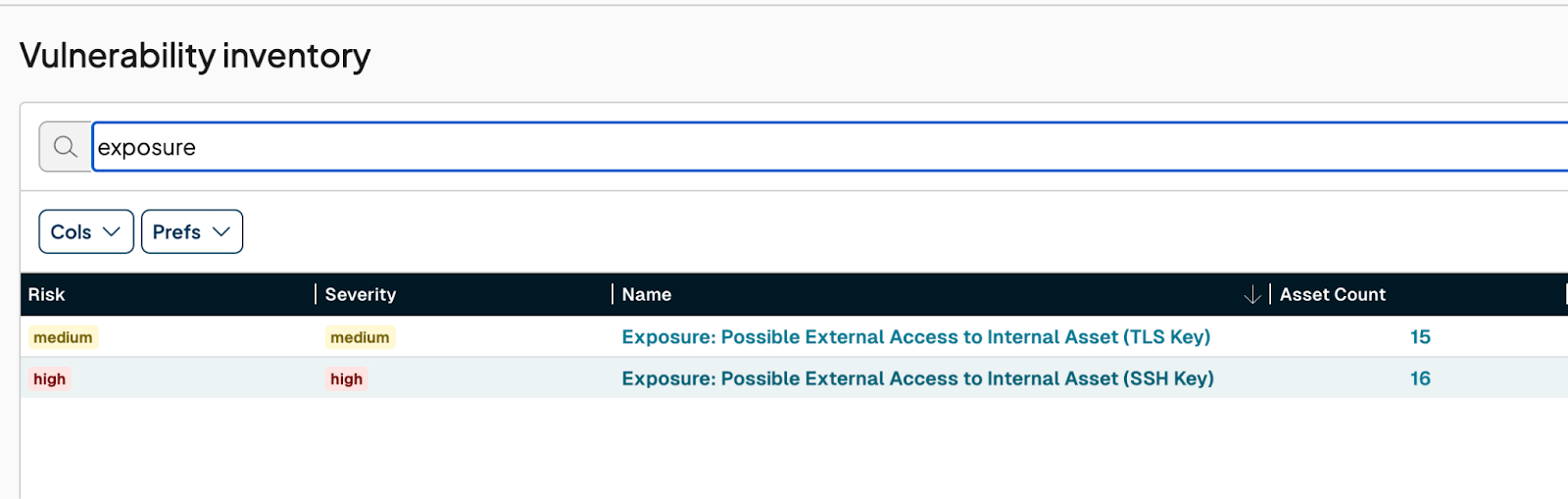
To get started, navigate to the Inventory -> Vulnerabilities section and search for the word “Exposure”. Any internal assets that runZero was able to identify externally, regardless of IP address or location, will be flagged with a vulnerability record based on the type of exposure.
The three exposure detection methods available today are:
TLS Certificate
SSH Hostkey
MAC Address
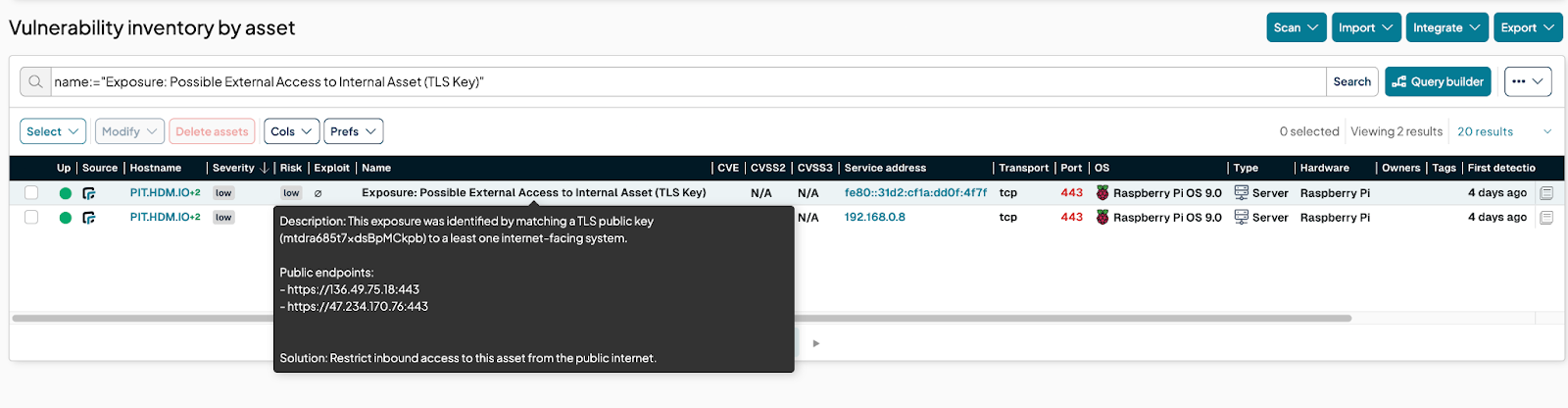
Here’s an example of an exposure that was identified by matching a TLS public key:
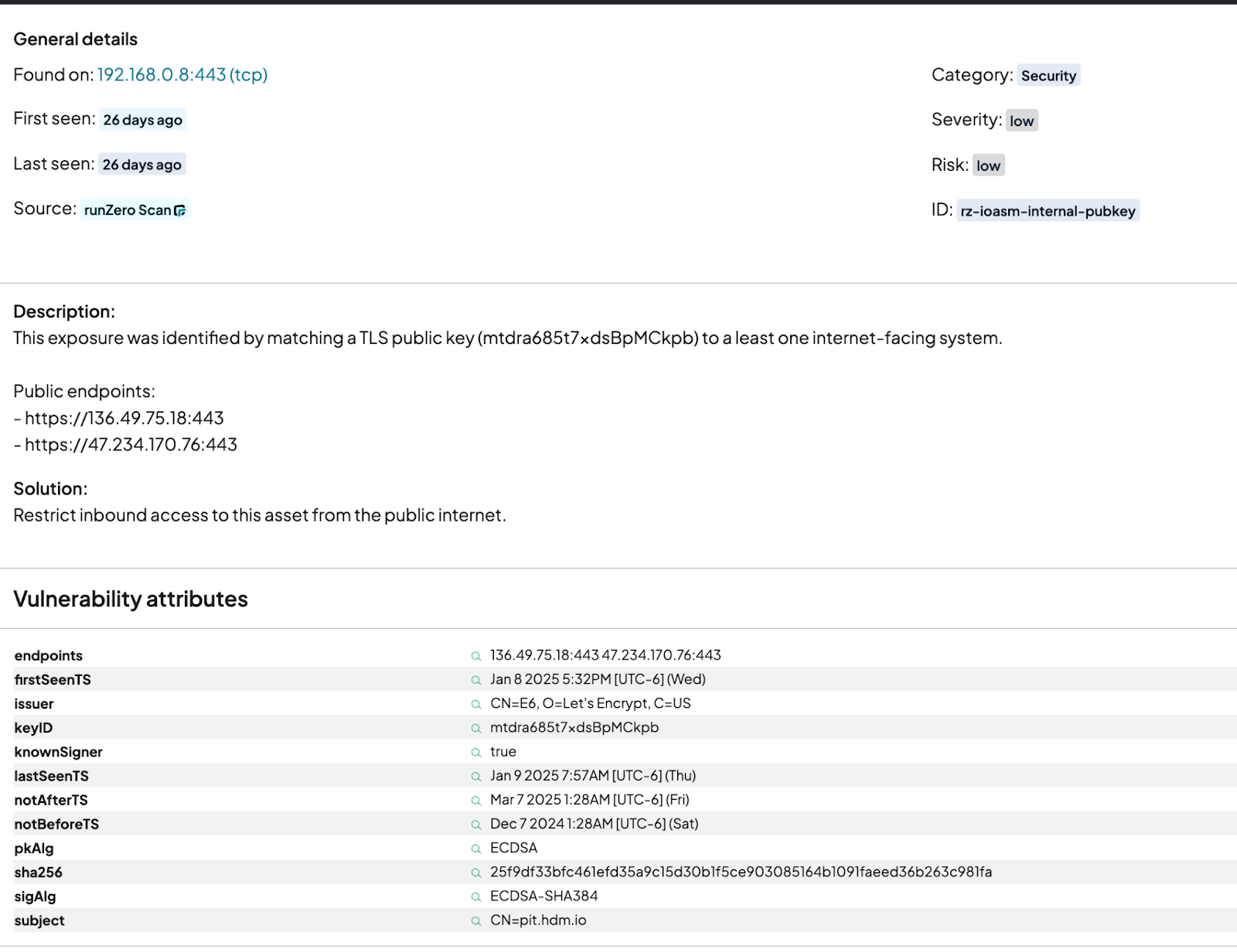
Clicking on the name of the vulnerability will open the details page. This page also provides a list of the public endpoints where this internal system was observed:
About runZero runZero, a network discovery and asset inventory solution, was founded in 2018 by HD Moore, the creator of Metasploit. HD envisioned a modern active discovery solution that could find and identify everything on a network–without credentials. As a security researcher and penetration tester, he often employed benign ways to get information leaks and piece them together to build device profiles. Eventually, this work led him to leverage applied research and the discovery techniques developed for security and penetration testing to create runZero.
About Version 2 Limited Version 2 Digital is one of the most dynamic IT companies in Asia. The company distributes a wide range of IT products across various areas including cyber security, cloud, data protection, end points, infrastructures, system monitoring, storage, networking, business productivity and communication products.
Through an extensive network of channels, point of sales, resellers, and partnership companies, Version 2 offers quality products and services which are highly acclaimed in the market. Its customers cover a wide spectrum which include Global 1000 enterprises, regional listed companies, different vertical industries, public utilities, Government, a vast number of successful SMEs, and consumers in various Asian cities.
On January 8th, 2025, Ivanti disclosed vulnerabilities in their Ivanti Connect Secure, Ivanti Policy Secure, and Neurons for ZTA products.
CVE-2025-0282 – is rated critical with a CVSS score of 9.0. Successful exploitation of this vulnerability would allow a remote unauthenticated attacker to execute arbitrary code on the vulnerable system.
CVE-2025-0283 – is rated high with a CVSS score of 7.0. Successful exploitation of this vulnerability would allow a local authenticated attacker to execute arbitrary code on the vulnerable system.
Note that the vendor has indicated that there is evidence that these vulnerabilities are being exploited in the wild.
What is the impact?
Successful exploitation of these vulnerabilities would allow an attacker to execute arbitrary code, potentially leading to complete system compromise.
Are updates or workarounds available?
Ivanti has released updates to address these vulnerabilities. Users are urged to update all systems as quickly as possible.
How to find potentially vulnerable systems with runZero
From the Service Inventory, use the following query to locate systems running potentially vulnerable software:
product:"Policy Secure" OR product:"Connect Secure"
December 2024 (Multiple CVEs)
On December 10th, 2024, Ivanti disclosed vulnerabilities in their Ivanti Connect Secure and Ivanti Policy Secure products.
CVE-2024-11633 and CVE-2024-11634 are rated critical with CVSS scores of 9.1. Successful exploitation of these vulnerabilities would allow an authenticated attacker to execute arbitrary code on the affected system.
CVE-2024-37401 and CVE-2024-37377 are rated high with a CVSS score of 7.5 and could allow a remote, unauthenticated attacker to create a denial-of-service condition on vulnerable systems.
CVE-2024-9844 is rated high with a CVSS score of 7.1 and could allow a remote, authenticated attacker to bypass application restrictions.
What is the impact?
Successful exploitation of these vulnerabilities would allow an attacker to execute arbitrary code, read potentially sensitive resources, or create a denial-of-service (DoS) condition on affected devices.
Are updates or workarounds available?
Ivanti has released patches to address these vulnerabilities, and all users are urged to update as quickly as possible.
How to find potentially vulnerable systems with runZero
From the Service Inventory, use the following query to locate systems running potentially vulnerable software:
product:"Policy Secure" OR product:"Connect Secure"
April 2024 (Multiple CVEs)
On April 2, 2024, Ivanti disclosed multiple vulnerabilities in their Ivanti Connect Secure and Ivanti Policy Secure products.
CVE-2024-21894 is rated high with CVSS score of 8.2 and allows an unauthenticated attacker to potentially execute arbitrary code on the affected system.
CVE-2024-22052 is rated high with CVSS score of 7.5 and allows an unauthenticated attacker to create a denial-of-service (DoS) condition on affected systems.
CVE-2024-22053 is rated high with a CVSS score of 8.2 would allow an unauthenticated attacker to read potentially sensitive memory contents.
CVE-2024-22023 is rated medium with a CVSS score of 5.3 and would allow an unauthenticated attacker to create a denial-of-service (DoS) condition on affected systems.
What is the impact?
Successful exploitation of these vulnerabilities would allow an attacker to execute arbitrary code, read potentially sensitive memory, or create a denial-of-service (DoS) condition on affected devices.
Are updates or workarounds available?
Ivanti has released patches to address these vulnerabilities, and all users are urged to update as quickly as possible.
How to find potentially vulnerable systems with runZero
From the Service Inventory, use the following query to locate systems running potentially vulnerable software:
product:"Policy Secure" OR product:"Connect Secure"
Additional fingerprinting research is ongoing, and additional queries will be published as soon as possible.
February 2024 (CVE-2024-22024)
On February 8th, 2024, Ivanti disclosed a serious vulnerability, CVE-2024-22024, which allowed attackers to bypass authentication on the affected device to reach restricted resources. This vulnerability earned a CVSS score of 8.3 out of 10, indicating a high degree of severity.
The vendor reported that there were no indications that this vulnerability had been exploited in the wild.
What was the impact?
Upon successful exploitation of these vulnerabilities, attackers could access restricted resources on the vulnerable system without authentication. The vendor did not specify which resources were reachable without authentication, but did indicate that such resources were restricted.
Ivanti released an update to mitigate the issue (note that the provided link also discusses previous vulnerabilities in the same products). Users were urged to update as quickly as possible.
January 2024 vulnerabilities
On January 10th, 2024, Ivanti disclosed two serious vulnerabilities in the Ivanti Connect Secure and Ivanti Policy Secure products.
The first issue, CVE-2023-46805, allowed attackers to bypass authentication controls to access restricted resources without authentication. This vulnerability earned a CVSS score of 8.2 out of 10, indicating a high degree of impact.
The second issue, CVE-2024-21887, allowed attackers to inject arbitrary commands to be executed on the affected device. Attackers had to be authenticated to exploit this vulnerability, but attackers might have been able to use the authentication bypass vulnerability above to achieve this. This vulnerability had a CVSS score of 9.1 out of 10, indicating a critical vulnerability.
The vendor reported that there were indications that these vulnerabilities had been exploited in the wild.
What was the impact?
Upon successful exploitation of these vulnerabilities, attackers could execute arbitrary commands on the vulnerable system. This included the creation of new users, installation of additional modules or code, and, in general, system compromise.
Ivanti released an update to mitigate this issue. Users were urged to update as quickly as possible.
How to find potentially vulnerable products that expose a web interface
From the Services Inventory, use the following query to locate assets running the vulnerable products in your network that expose a web interface and which may need remediation or mitigation:
_asset.protocol:http AND protocol:http AND http.body:"welcome.cgi?p=logo"
About runZero runZero, a network discovery and asset inventory solution, was founded in 2018 by HD Moore, the creator of Metasploit. HD envisioned a modern active discovery solution that could find and identify everything on a network–without credentials. As a security researcher and penetration tester, he often employed benign ways to get information leaks and piece them together to build device profiles. Eventually, this work led him to leverage applied research and the discovery techniques developed for security and penetration testing to create runZero.
About Version 2 Limited Version 2 Digital is one of the most dynamic IT companies in Asia. The company distributes a wide range of IT products across various areas including cyber security, cloud, data protection, end points, infrastructures, system monitoring, storage, networking, business productivity and communication products.
Through an extensive network of channels, point of sales, resellers, and partnership companies, Version 2 offers quality products and services which are highly acclaimed in the market. Its customers cover a wide spectrum which include Global 1000 enterprises, regional listed companies, different vertical industries, public utilities, Government, a vast number of successful SMEs, and consumers in various Asian cities.
The issue, assigned CVE-2024-45337, could result in an authentication bypass or potentially incorrect permissions granted to a remote user when connecting to the SSH server. The issue stems from a common usage pattern of the library, which does not verify or report which of multiple SSH public keys were used for authentication to a server.
Note that this is a vulnerability in the Go standard library’s implementation, and thus any product using the standard library to construct an SSH server could be vulnerable. Approximately 19,000 publicly-accessible projects import the relevant package.
Are any updates or workarounds available?
The Go Project has released a new version of Go that partially addresses the issue by making the commonly-misused programming pattern less likely to be used, and offered guidance to programmers on how to more safely use the library.
How to find potentially vulnerable systems with runZero
Because the vulnerable SSH implementation is generally embedded inside other applications, it is not generally possible to determine by filesystem or software examination if the the server is in use. However, runZero’s direct scanning of asset services provides a reliable and powerful mechanism to detect what SSH implementations are listening on your network.
From the Software Inventory you can use the following query to locate potentially vulnerable systems:
product:="Go SSH"
About runZero runZero, a network discovery and asset inventory solution, was founded in 2018 by HD Moore, the creator of Metasploit. HD envisioned a modern active discovery solution that could find and identify everything on a network–without credentials. As a security researcher and penetration tester, he often employed benign ways to get information leaks and piece them together to build device profiles. Eventually, this work led him to leverage applied research and the discovery techniques developed for security and penetration testing to create runZero.
About Version 2 Limited Version 2 Digital is one of the most dynamic IT companies in Asia. The company distributes a wide range of IT products across various areas including cyber security, cloud, data protection, end points, infrastructures, system monitoring, storage, networking, business productivity and communication products.
Through an extensive network of channels, point of sales, resellers, and partnership companies, Version 2 offers quality products and services which are highly acclaimed in the market. Its customers cover a wide spectrum which include Global 1000 enterprises, regional listed companies, different vertical industries, public utilities, Government, a vast number of successful SMEs, and consumers in various Asian cities.
China’s state-sponsored cyber operations—aptly nicknamed with “Typhoon” monikers—have been brewing trouble for over a decade. From Violet to Salt Typhoon, these advanced persistent threat (APT) groups have been wreaking havoc on government entities, critical infrastructure, and other high-value targets. Their evolution highlights one thing loud and clear: attackers are always one step ahead, looking for the weakest link.
But fear not—there’s a way to outpace these storms. Let’s break down what these Typhoons have been up to and how runZero brings calm to the chaos with unparalleled visibility and proactive defense.
The Typhoon Timeline: An Evolution of Threats
The Typhoon story began with Violet Typhoon, which stuck to the basics: phishing, exploiting known vulnerabilities, and going after traditional IT systems. They were your typical “steal the sensitive data and run” kind of crew.
Then came Volt Typhoon, which shifted focus to U.S. critical infrastructure. They embraced “living off the land” techniques, cleverly blending into hybrid IT and OT environments while avoiding detection. Think of them as the first innovators of the Typhoons.
Not to be outdone, Flax Typhoon targeted IoT devices like cameras and DVRs, transforming these “unimportant” devices into powerful botnets. It was a wake-up call for organizations ignoring their IoT inventory.
And now, Salt Typhoon has arrived, skillfully exploiting IT, OT, and IoT systems with alarming precision. Their primary focus? Telecommunications providers and ISPs, where they leverage trusted devices and connections to steal customer call records, compromise private communications—particularly those of individuals involved in government or political activities—and access sensitive information tied to U.S. law enforcement requests under court orders.
Why Visibility is the Game-Changer
The Typhoon saga reveals one critical truth: attackers will find the blind spots in your network. Whether it’s a forgotten IoT device, an outdated VPN concentrator, or a misconfigured firewall, these gaps become open doors for adversaries.
That’s why visibility—complete visibility—is key to staying ahead. Enter runZero.
How runZero Helps You Outmaneuver Salt Typhoon
Salt Typhoon thrives on exploiting edge devices and blending into your network. But runZero makes their job infinitely harder. Here’s how we give you the upper hand:
Proactive Edge Discovery: With real-time scanning and unmatched fingerprinting capabilities, runZero identifies every device—routers, firewalls, switches—before attackers can. Firmware versions? Check. Misconfigurations? Double-check.
Mapping Internal Pathways: Once inside, attackers aim to move laterally. runZero lights up internal pathways, exposing high-risk devices and connections that could serve as stepping stones for adversaries.
Correlating Internal and External Risks: Unlike siloed tools, runZero connects the dots between internal and external assets, revealing shared vulnerabilities and dependencies. That’s insight no other platform offers.
Risk-Based Prioritization: runZero doesn’t just throw vulnerabilities at you. It ranks them by exploitability, exposure pathways, and criticality, so you can tackle the most pressing issues first.
Continuous Monitoring: Networks change constantly, and so do risks. With runZero’s continuous discovery, you’ll always have an up-to-date picture of your attack surface.
If feasible, limit exposure of management traffic to the Internet. Only allow management via a limited and enforced network path, ideally only directly from dedicated administrative workstations. Do not manage devices from the internet. Only allow device management from trusted devices on trusted networks.
# Service Query
(type:router OR type:switch OR type:firewall) AND (port:80 OR port:443) AND has_public:true
Monitor user and service account logins for anomalies that could indicate potential malicious activity. Validate all accounts and disable inactive accounts to reduce the attack surface. Monitor logins occurring internally and externally from the management environment.
# Users Query
alive:t AND (
  isDisabled:true
OR
  (source:googleworkspace suspended:t)
OR
  (source:googleworkspace isEnforcedIn2Sv:f)
OR
  (has:accountExpiresTS)
OR
  (isDisabled:true)
OR
  (passwordExpired:true OR msDS-UserPasswordExpiryTimeComputedTS:<now))
Ensure the inventory of devices and firmware in the environment are up to date to enable effective visibility and monitoring. runZero can track and incorporate end-of-life data from a variety of sources.
# Asset Query
os_eol_expired:t
Monitoring: Network Engineers
Closely monitor all devices that accept external connections from outside the corporate network
# Asset Query
has_public:t
IPsec tunnel usage
# Service Query
protocol:ike
Hardening Systems & Devices: Protocols and Management Processes: Network Engineers
Additionally, as a general strategy, put devices with similar purposes in the same VLAN. For example, place all user workstations from a certain team in one VLAN, while putting another team with different functions in a separate VLAN. runZero’s innovative outlier score can help locate devices that don’t look like others in the same site.
# Asset Query
outlier:>=2
if using Simple Network Management Protocol (SNMP), ensure only SNMP v3 with encryption and authentication is used
# Service Query
protocol:snmp1 or protocol:snmp2 or protocol:snmp2c
Disable all unnecessary discovery protocols, such as Cisco Discovery Protocol (CDP).
# Service Query
protocol:cdp
Ensure Transport Layer Security (TLS) v1.3 is used on any TLS-capable protocols to secure data in transit over a network.
# Service Query
tls.supportedVersionNames:"SSL" OR tls.supportedVersionNames:"TLSv1.0" OR tls.supportedVersionNames:"TLSv1.1" OR tls.supportedVersionNames:"TLSv1.2"
Disable Secure Shell (SSH) version 1.
# Service Query
banner:"SSH-1"
Hardening Systems & Devices: Protocols and Management Processes: Network Defenders
Disable any unnecessary, unused, exploitable, or plaintext services and protocols, such as Telnet, File Transfer Protocol (FTP), Trivial FTP (TFTP), SSH v1, Hypertext Transfer Protocol (HTTP) servers, and SNMP v1/v2c
# Service Query
protocol:telnet OR protocol:ftp OR protocol:tftp OR banner:"SSH-1" OR (protocol:http AND NOT protocol:tls) OR protocol:snmp1 OR protocol:snmp2 OR protocol:snmp2c
Conduct port-scanning and scanning of known internet-facing infrastructure
# Service Query
has_public:t
The Final Word
The Typhoon threat is real, but with runZero, you don’t have to weather the storm alone. Whether you’re facing state-sponsored attackers like Salt Typhoon or just trying to get a handle on your sprawling network, runZero does more than uncover what’s hiding in your network—we redefine what’s possible in exposure management. Our agentless, credential-free approach means you get instant insights without the hassle. And our advanced fingerprinting technology? It’s second to none, giving you detailed device profiles that competitors can only dream of.
But it’s not just about tech; it’s about speed and adaptability. As networks grow more complex and threats more advanced, runZero ensures you’re always one step ahead of these Typhoons no matter how their tactics evolve. From shadow IT to unmanaged IoT, we uncover everything—because the very things you didn’t know existed are exactly what these attackers are looking for.
About runZero runZero, a network discovery and asset inventory solution, was founded in 2018 by HD Moore, the creator of Metasploit. HD envisioned a modern active discovery solution that could find and identify everything on a network–without credentials. As a security researcher and penetration tester, he often employed benign ways to get information leaks and piece them together to build device profiles. Eventually, this work led him to leverage applied research and the discovery techniques developed for security and penetration testing to create runZero.
About Version 2 Limited Version 2 Digital is one of the most dynamic IT companies in Asia. The company distributes a wide range of IT products across various areas including cyber security, cloud, data protection, end points, infrastructures, system monitoring, storage, networking, business productivity and communication products.
Through an extensive network of channels, point of sales, resellers, and partnership companies, Version 2 offers quality products and services which are highly acclaimed in the market. Its customers cover a wide spectrum which include Global 1000 enterprises, regional listed companies, different vertical industries, public utilities, Government, a vast number of successful SMEs, and consumers in various Asian cities.