On September 27th, Progress Sofware announced eight vulnerabilities in the WS_FTP Server software. These issues can lead to a full compromise of exposed WS_FTP systems and their data through the FTP, SSH, and web management services, which are often externally exposed.
The four most serious vulnerabilities in this set:
CVE-2023-40044 (CVSS 10.0). An exposure in the web interface that leads to remote code execution through a .NET deserialization vulnerability. This is the issue most likely to be mass-exploited due to the lack of authentication and likelyhood of this web interface being exposed to untrusted networks. Rapid7 noted that this appears to be exploitable with a single HTTP POST request using an existing pauload from the ysoserial.net project.
CVE-2023-42657 (CVSS 9.0). An exposure in the FTP/SCP (SSH) implementation that enables file operations outside of the WS_FTP data folder through a directory traversal vulnerability. This issue can allow an attacker to access, modify, and delete files on the server, which can expose data, but also allow remote code execution in some configurations.
CVE-2023-40046 (CVSS 8.2). An exposure in the web interface that allows for database access through a SQL injection vulnerability. It’s not clear if a valid user account is required to access this code path, but an attacker could use this to read and modify database contents, which in turn can lead to a full server compromise.
CVE-2023-40049 (CVSS 5.3). An exposure in the web interface that exposes file and directory lists within the WebServiceHost folder. Although this does not lead to remote code execution on it’s own, it may be an important exposure in that it will help attackers identify systems vulnerable to the more serious issues above.
What is Progress Software WS_FTP Server?
WS_FTP is a product that allows customers to easily share files between teams and organizations. Progress Software (formerly ipswitch) describes WS_FTP as:
WS_FTP Professional is the safest and easiest way to securely upload and download files. Enjoy SFTP transfers with the highest levels of encryption, ease of use, customization, and low administrative overhead.
Are updates available?
Progress Software has patched these issues in version 8.8.2.
How do I find potentially vulnerable versions of WS_FTP with runZero?
Assets with the WS_FTP FTP, SSH, and web services enabled can be found by navigating to the Service Inventory and using the following pre-built query:
product:ws_ftp OR (_asset.protocol:http AND (http.head.location:"/ThinClient/WTM/" OR html.title:="Web Transfer Client"))
To determine if the the instance has the WS_FTP Ad Hoc module installed, browse to https://[instance-host:port]/AHT/AHT_UI/public/index.html.
If the module is installed, this page will include an image like the one shown below:
As always, any prebuilt queries are available from your runZero console. Check out the documentation for other useful inventory queries.
About Version 2 Limited Version 2 Digital is one of the most dynamic IT companies in Asia. The company distributes a wide range of IT products across various areas including cyber security, cloud, data protection, end points, infrastructures, system monitoring, storage, networking, business productivity and communication products.
Through an extensive network of channels, point of sales, resellers, and partnership companies, Version 2 offers quality products and services which are highly acclaimed in the market. Its customers cover a wide spectrum which include Global 1000 enterprises, regional listed companies, different vertical industries, public utilities, Government, a vast number of successful SMEs, and consumers in various Asian cities.
About runZero runZero, a network discovery and asset inventory solution, was founded in 2018 by HD Moore, the creator of Metasploit. HD envisioned a modern active discovery solution that could find and identify everything on a network–without credentials. As a security researcher and penetration tester, he often employed benign ways to get information leaks and piece them together to build device profiles. Eventually, this work led him to leverage applied research and the discovery techniques developed for security and penetration testing to create runZero.
On September 27th, Trend Micro’s Zero Day Initiative (ZDI) published details of a critical zero-day vulnerability that allows an unauthenticated attacker the ability to remotely execute arbitrary code within the context of an Exim SMTP service account. In addition, ZDI disclosed five additional zero-day vulnerabilities with lower severity rankings:
Exim mail is an open source, message transfer agent (MTA) that runs on Unix/Linux operating systems. Exim is also the default MTA configured on Debian Linux distributions.
Are updates available?
Recently, maintainers of the Exim mail server issued a 4.96.1 patch that appears to resolve four of the six vulnerabilities listed above. Although the maintainers are still working to resolve the remaining vulnerabilities, if you are running Exim mail servers on your network, you should apply the security patch immediately.
How do I find potentially vulnerable Exim mail servers with runZero?
A Shodan search showed nearly 3.5 million Exim servers exposed to the internet. Their accessibility makes these mail transfer agents targets for attackers.
With runZero, you can find Exim mail servers in your inventory with this pre-built query. This query searches for any live asset that has the exim product exposed over SMTP.
product:exim
As always, any prebuilt queries are available from your runZero console. Check out the documentation for other useful inventory queries.
About Version 2 Limited Version 2 Digital is one of the most dynamic IT companies in Asia. The company distributes a wide range of IT products across various areas including cyber security, cloud, data protection, end points, infrastructures, system monitoring, storage, networking, business productivity and communication products.
Through an extensive network of channels, point of sales, resellers, and partnership companies, Version 2 offers quality products and services which are highly acclaimed in the market. Its customers cover a wide spectrum which include Global 1000 enterprises, regional listed companies, different vertical industries, public utilities, Government, a vast number of successful SMEs, and consumers in various Asian cities.
About runZero runZero, a network discovery and asset inventory solution, was founded in 2018 by HD Moore, the creator of Metasploit. HD envisioned a modern active discovery solution that could find and identify everything on a network–without credentials. As a security researcher and penetration tester, he often employed benign ways to get information leaks and piece them together to build device profiles. Eventually, this work led him to leverage applied research and the discovery techniques developed for security and penetration testing to create runZero.
The new and improved runZero Platform represents the culmination of four years of innovation, so it’s only fitting this is version 4.0 of our technology! Over the last few years, runZero has evolved and matured from an innovative asset inventory and network discovery product to a world-class CAASM (cyber asset attack surface management) solution. We couldn’t have reached this major milestone without our community and our awesome customers, and we thank you for supporting us on this journey.
The new Platform introduces passive discovery functionality, making runZero the only CAASM solution to combine proprietary active scanning, native passive discovery, and API integrations. Unifying all of these approaches makes runZero unique in its ability to deliver comprehensive coverage across managed and unmanaged devices, including the full spectrum of IT, OT, IoT, cloud, mobile, and remote assets.
With the introduction of the runZero Platform, we also have a new Community Edition that will replace Starter Edition effective immediately. Community Edition is a completely free version of the runZero Platform that is perfect for small businesses, individuals, and security researchers who have 100 or fewer assets.
You might be asking, is this just a name change for the free version? It’s not. It’s much better than that! We want all runZero users to benefit from the full power of the runZero Platform and our new Community Edition makes that possible. See the details below.
We hope the new Platform will help you better manage risk and exposure by giving you the most complete visibility possible across all your environments. Let’s dive into the details.
runZero Platform, Community Edition: CAASM for everyone #
The Community Edition is an improved version of the free Starter Edition. It now includes three important discovery approaches: unauthenticated active scanning, API integrations, and passive discovery.
Here’s why this is a significant leap forward:
Complete coverage: With three different discovery methods available, you can achieve a complete view of all your assets across IT, OT, IoT, cloud, mobile, and remote environments. runZero helps you uncover your unknowns and provides visibility across your internal network and external attack surface, consolidating everything into a single view.
Cost-efficiency: The Community Edition remains completely free, ensuring that advanced CAASM capabilities are accessible to organizations of all sizes and budgets.
runZero Platform: Unleash the full power of CAASM #
Our new runZero Platform brings together all of the features you know and love from our legacy Enterprise Edition with new functionality like passive discovery that is designed to provide the most complete security visibility possible. It includes:
Complete feature set: The Platform provides you with every tool in the runZero arsenal, ensuring you can tackle all the CAASM use cases like building a comprehensive asset inventory, eliminating security controls gaps, understanding vulnerabilities and identifying insecure configurations in your attack surfaces.
Unparalleled flexibility: API integrations, active scanning, and passive discovery are seamlessly integrated, offering you unparalleled flexibility to manage exposures of your ever-evolving attack surfaces.
Priority support: Platform customers can unlock premium support, also known as runZero Care, which enjoys priority access to our support team, ensuring you have expert guidance whenever you need it.
Scale to fit your needs: The Platform is perfect for organizations that manage a large number of assets. Whether you have thousands, hundreds of thousands, or even millions of assets to manage, runZero Platform can handle the load.
Current customers will receive further information about migrations.
Unlike other CAASM solutions, runZero offers visibility into OT environments, through both safe active scanning and now a passive discovery capability called traffic sampling. Traditional passive network monitoring tools require significant effort to deploy and compute resources to collect and analyze all network traffic. runZero’s passive traffic sampling only examines a small fraction of network traffic for asset discovery and fingerprinting, which customers can leverage with existing Explorers. This feature allows companies who have a policy against active scanning to build an asset inventory by analyzing traffic observed through SPAN ports, TAP interfaces, and broadcast. Passive traffic sampling is also helpful for organizations with scan windows that are too short to enable active discovery of the entire environment. Both active and passive approaches use the same fingerprinting database that was developed using data collected across tens of thousands of environments and OT devices.
We are very excited to introduce this novel approach to passive discovery as a complement to our reinvention of active scanning. We love a good challenge and like to rethink how we can improve on what’s already out there. Unlike traditional passive discovery solutions, runZero’s passive traffic sampling is faster, easier, and more cost-effective to deploy — and doesn’t require expensive dedicated hardware appliances. Our innovative approach to traffic sampling enables runZero Explorers to process existing network traffic as a software deployment on existing hardware or virtual machines.
Updates to the runZero interface make it easier than ever to leverage all the flexible discovery capabilities available to you. runZero is the only CAASM solution that provides comprehensive asset inventory coverage for managed and unmanaged devices, including IT, OT, IoT, cloud, mobile, and remote assets. This is only possible by combining three specific data sources: proprietary active scanning, native passive discovery, and API integrations. These combined capabilities give customers ultimate flexibility in a single, unified solution, eliminating the need for multiple siloed tools.
With 4.0, you can now enrich your inventory with an authenticated API connection to Tenable Security Center, similar to existing integrations with Tenable.io and Nessus. This allows you to search for Tenable attributes, and vulnerabilities in runZero, as well as find assets not monitored by Tenable Security Center. runZero automatically correlates Tenable assets to runZero assets based on unique fields. Vulnerability data can be viewed in the asset details, as well as a dedicated inventory tab. Vulnerability attributes include CVSS score, relevant CVEs, vulnerability description, and any recommended remediation actions.
You asked and we delivered. Now you can quickly see the matching field that runZero used to merge data into existing records. Consolidating asset and exposure information from disparate sources into a single normalized view makes it easier for you to manage your ever-changing environment. As networks grow in complexity, sometimes it is not obvious how the correlation engine merges data from a new source and this important quality-of-life improvement shows what field and value was used, as well as the specific task, and time of the merge.
Take a look at any recently-updated asset with multiple sources to check it out!
Improved new user workflow
New to runZero? You’ll be greeted by an updated onboarding flow that introduces all of runZero’s discovery capabilities and makes it easier than ever to get started.
New users will automatically see the new flow. Existing users can check it out too.
We continue to add new methods of discovery and to improve fingerprinting. Here’s what’s new in this latest version:
Support for EtherNet/IP probing and the MODBUS/TCP protocol, improving discovery and fingerprinting for OT networks.
Support for MQTT, improving discovery and fingerprinting for IoT devices constrained by resources or bandwidth
Improved fingerprinting of devices using the Mopria Alliance eSCL protocol, such as paper scanners and multifunction printers
Improved discovery for VoIP endpoints using the Voice Services Discovery Protocol (VSDP)
Improved fingerprinting for SMBv1 endpoints, assets based on AzureAD, Microsoft Intune, Microsoft 365 Defender, and NFS data, BACnet devices, devices that provide UPnP information, and devices that use Spotify Connect
See runZero 4.0 in action
Release notes
The runZero 4.0 release includes a rollup of all the 3.10.x updates, which includes all of the following features, improvements, and updates.
Moved to a new versioning scheme for the Console and Explorers, <major>.<minor>.<yymmdd>.<revision>.
New features
Build your inventory through passive discovery
Discover assets the way you want to
Integrate with Tenable Security Center
Understand correlations quickly
Improved new user workflow
Integration improvements
A bug that could cause some long-running connection tasks to restart repeatedly has been resolved.
A bug that could prevent Intune assets from merging with other sources has been resolved.
A bug that could prevent Tenable Security Center syncs from completing has been resolved.
A bug that could result in an incorrect ts attribute for Azure AD, Google Workspace, and Microsoft Intune has been resolved.
A bug that could result in invalid Shodan credentials still validating has been resolved.
A bug that prevented some queries from correctly matching Intune assets has been resolved.
A bug where existing assets were incorrectly fingerprinted after importing data from Microsoft 365 Defender has been resolved.
A performance regression when processing third-party assets has been resolved.
A rotation date for stored credentials is now available through both console and API via a new secret_updated_at field.
CrowdStrike and Azure AD assets will no longer be merged if they have a different globally unique ID. This may lead to more offline assets being generated if devices are frequently reimaged and given new GUIDs.
Custom Integrations now support the exclude unknown option.
Error logging for the Shodan integration has been improved.
Improved handling of API request retries for the Microsoft Intune integration.
The Tenable integration has been updated to reduce the possibility of asset and vulnerability export timeouts.
The Tenable integration has been updated to reduce the possibility of vulnerability export timeouts.
The request timeout has been increased for the Microsoft Intune and Azure AD integrations.
Inventory management improvements
A bug causing inconsistent navigation for Explorer configuration editing has been resolved.
A bug causing incorrect assertion of Microsoft Defender for Endpoint in edr.name has been resolved.
A bug causing pending new tasks to be seen as editable has been resolved, so that only new tasks scheduled to start in the future can be modified.
A bug causing project expiration to be miscalculated has been resolved.
A bug causing tasks in the process of stopping to be seen as dismissible has been resolved, so that only failed and completely stopped tasks can be dismissed.
A bug that could cause foreign service attributes to be attributed to the wrong source has been resolved.
A bug that could cause tasks to be copied with an incorrect discovery scope has been resolved.
A bug that could lead to improper stale service removal on rescan has been resolved.
A bug that could lead to orphaned tasks when an Explorer is removed has been resolved.
A bug that could prevent import of wireless networks has been resolved.
A bug that could prevent in-scope, unscanned addresses from being cleared on runZero assets has been resolved.
A bug that could prevent queries containing mixed-case search terms from returning results has been resolved.
A bug that could result in an unnecessary screenshot warning for connector tasks has been resolved.
A bug that could result in duplicate service warnings has been resolved.
A bug that could result in duplicate software entries for some sources has been resolved.
A bug that could result in orphaned tasks when removing an explorer has been resolved.
A bug that enabled SNMP credentials when modifying or copying existing scan tasks has been resolved.
A bug that prevented SNMPv3 credentials from being saved has been resolved.
A bug that prevented the scan.explorer_id value from being populated in alert templates has been resolved.
A bug that prevented the Find assets in this site icon from working properly in some cases has been resolved.
A bug that resulted in the Nmap XML Export having a zero start time has been resolved.
An issue that caused the asset details page to load very slowly has been resolved.
An issue that could result in an empty dashboard until a metrics recalculation was triggered has been resolved.
An issue that could result in an empty dashboard when selecting a single site has been resolved.
An update for improved asset matching for tasks importing both scan and third-party data sources has been added.
An update to the runZero Explorer now logs when the host operating system receives an interrupt or terminate signal, such as when the OS reboots.
Event rules now support conditions for Explorer and task type, where relevant.
Exports of task data now include timestamps which differentiate time spent acquiring data from time spent processing data.
Improved merging of assets with NetBIOS or SMB services.
Improved performance when deleting large organizations, projects, or sites.
License-based size limits are now applied to file imports.
Recurring tasks now stop with an error if they use a task template that has been deleted.
Task name and description can now be modified for tasks created via file imports.
Task processing times are improved.
Tasks in the stopping state are now included in the Processing section of the Tasks overview.
The maximum number of ownership types has been increased from 10 to 25.
The tasks CSV export now includes the template_name column.
The tasks JSON export and API responses now include the site_name, agent_name, and template_name columns.
New vulnerability queries
Hardware: MegaRAC BMC
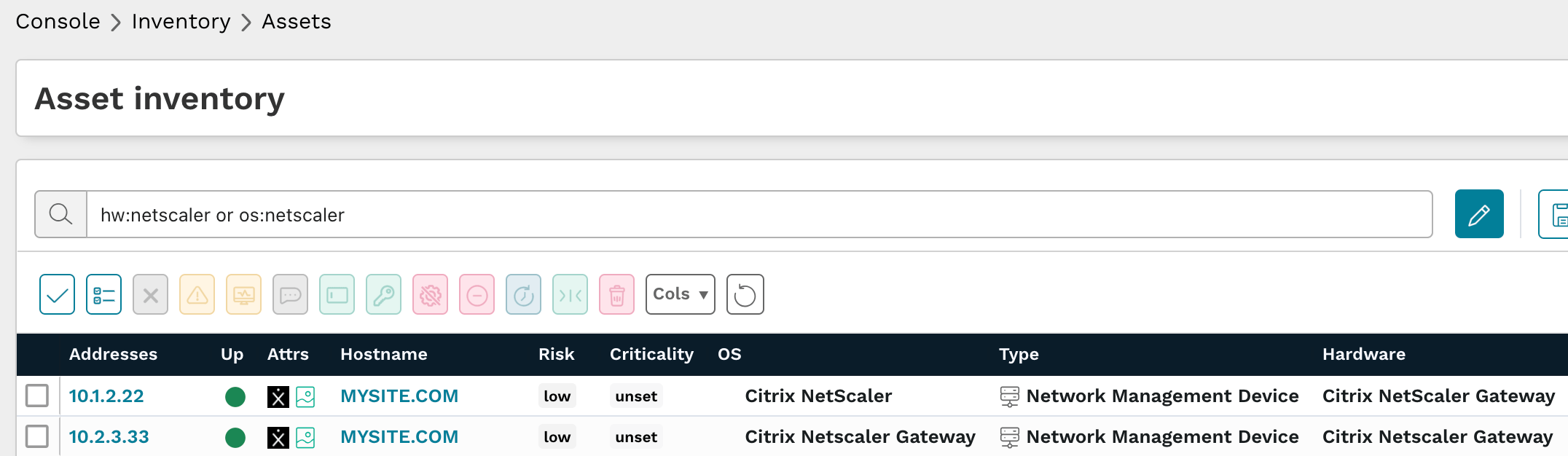
Hardware: Citrix NetScaler
Scan and monitor engine improvements
A bug that could cause a memory leak in the Explorer between stopped tasks has been resolved.
A bug that could lead to bogus assets appearing in scans through Fortigate proxies has been resolved.
A bug that could prevent bogus services from certain firewalls from being completely filtered has been resolved.
A bug that could prevent some Windows-based Explorers from connecting with the same ID has been resolved.
A bug that could prevent the Explorer from reading the .env configuration file has been resolved.
A number of small parsing bugs in the protocol parsing engine have been resolved.
A bug which could leave SYN and LAYER2 probes in a perpetual error condition loop has been resolved.
A warning is now recorded for scan tasks if a host is ignored for responding on too many ports.
An issue that could result in stalled scans has been resolved.
Improved automatic asset filtering for certain web proxy assets.
Improved detection of spurious services when scanning certain firewalls.
Passive traffic sampling tasks now set source:sample instead of source:passive for assets.
The Explorer now uses the “runZero” brand by default (and matching filesystem/registry locations).
The TCP SYN scanner is now friendlier to stateful firewalls in the network path.
The scanner now supports a new syn-reset-sessions option that can be used to reduce session usage in middle boxes.
Self-hosted platform improvements
The self-hosted console now defaults to PostgreSQL 15 and provides an install option to select a version.
The self-hosted console now uses the “runZero” brand (and runzeroctl command) by default.
A bug causing the user details page to display permissions incorrectly has been resolved.
A bug in the user permissions display interface has been resolved.
A bug preventing some users from being able to manage their user’s group membership has been resolved.
A bug that could cause scan templates to be hidden when configured with invalid permissions has been resolved.
A bug that could prevent new SSO users from authenticating has been resolved.
A bug that could result in the wrong hostname being used in password reset links has been resolved.
A bug where users logging in for the first time with SSO would not have access to any organizations from the SSO group mappings has been resolved.
A security improvement has been added to clear password reset tokens after a password change or when link-based authentication is requested.
An issue that could result in login errors for invited users using Single Sign-On has been resolved.
API improvements
The api/v1.0/org/sites/{site_id}/import route now returns the proper 400 http status code error when the request body is empty instead of a status code 500.
UI/UX improvements
A bug causing app banners to not be visible has been resolved.
A bug causing the datepicker to close when navigating by year has been resolved.
A bug preventing columns from retaining their custom ordering has been resolved.
A bug that prevented display of the user permissions table in the User Details screen has been resolved.
A bug that prevented download commands from being displayed on the redesigned scanner page has been resolved.
On-screen text explaining the interaction between a user’s default organization role and the granted per-org role is clearer.
The Explorer and scanner download pages have been redesigned for improved UX and performance.
The Integrate page now shows active and suggested integrations for the current organization.
The asset details screen now has pagination when viewing an asset with more than 30 services.
About Version 2 Limited Version 2 Digital is one of the most dynamic IT companies in Asia. The company distributes a wide range of IT products across various areas including cyber security, cloud, data protection, end points, infrastructures, system monitoring, storage, networking, business productivity and communication products.
Through an extensive network of channels, point of sales, resellers, and partnership companies, Version 2 offers quality products and services which are highly acclaimed in the market. Its customers cover a wide spectrum which include Global 1000 enterprises, regional listed companies, different vertical industries, public utilities, Government, a vast number of successful SMEs, and consumers in various Asian cities.
About runZero runZero, a network discovery and asset inventory solution, was founded in 2018 by HD Moore, the creator of Metasploit. HD envisioned a modern active discovery solution that could find and identify everything on a network–without credentials. As a security researcher and penetration tester, he often employed benign ways to get information leaks and piece them together to build device profiles. Eventually, this work led him to leverage applied research and the discovery techniques developed for security and penetration testing to create runZero.
IT and security teams rely on an array of cybersecurity tools to manage their network assets. However, these tools often fall short of providing a comprehensive and detailed asset inventory. Consequently, as an organization’s attack surface evolves, the risk of undiscovered or unmanaged assets increases, heightening the potential for network infiltration.
The 2023 State of Cyber Assets Report uncovered a remarkable 133% year-over-year growth in cyber assets for organizations, surging from an average of 165,000 in 2022 to 393,419 in 2023. This rapid increase in assets resulted in a staggering 589% rise in security vulnerabilities or unresolved findings, accentuating the snowball effect caused by more than doubling the number of assets.
As organizations incorporate an ever-growing number of devices, their attack surface inevitably expands. Thus, gaining a comprehensive understanding of the status of each connected asset becomes crucial.
Each article linked below highlights the limitations of various types of cybersecurity tools for asset management, contrasting them with runZero—an all-encompassing cyber asset management solution that surpasses them all by comparison.
EDR works well for endpoint protection but not asset inventory. When incident responders find assets that are compromised but can’t find them in the asset inventory, many teams realize that they went down the wrong path.
Microsoft Excel and Google Sheets can be an easy first step to track asset data for an IT environment, but they fail entirely as an efficient cyber asset management solution. Spreadsheets require manual data collection resulting in inconsistent attributes, outdated information, lack of detail and incomplete inventory.
Some try to build an asset inventory using vulnerability scanners. Beyond a lack of detail, vulnerability scanners sometimes simply get it wrong; crashing devices, providing a backward-looking view, finding phantom assets, among other concerns. Leading vulnerability scanners simply do not provide a full, accurate, current asset inventory in everyday practice.
CMDBs are designed to track data relating to managed IT assets, such as routers, switches, or servers. However, according to Gartner, only 25% of organizations achieve meaningful value with their CMDBs. Beyond incompleteness, data inaccuracy is also a major concern. If you are relying on your CMDB to be a source of truth, you need to be able to trust the information in it. The data in a CMDB will only be as good as its sources.
IT and security teams often depend on data from NAC’s and associated network aggregation tools for asset inventory. However, they are designed to control access to the network, an entirely different task from building a comprehensive inventory of devices on the network. If a compromised asset cannot be found in the inventory, it indicates that NACs are suboptimal for asset discovery; a fundamental component of cyber asset management.
Free network scannersMost free network scanners don’t scale easily out of the box, often requiring custom databases and scripts to make them suitable for continuous monitoring and collecting inventory from multiple segments or sites.
Why effective cyber asset management matters
In the ever-changing digital landscape of an organization, prioritizing cyber asset management is essential for ensuring the resilience and continuity of operations, as well as safeguarding the reputation and trust of the organization, its stakeholders and the data with which it governs.
It’s foundational to cybersecurity
You simply need to know about the assets on your network before you can manage them. Before effective asset management can take place, it is crucial to have a comprehensive understanding of the assets on your network. By accurately identifying, tracking, and protecting critical assets, organizations can proactively defend against cyber threats, minimize vulnerabilities, and ensure the confidentiality, integrity, and availability of sensitive information.
Preparation is key
IBM’s Cost of a Data Breach Report 2023 shares that the global average cost of a data breach in 2023 was USD 4.45 million, a 15% increase over 3 years.
By integrating a comprehensive asset inventory into business continuity planning, organizations can effectively identify and prioritize the protection of vital assets crucial for maintaining operations during disasters or disruptions. This proactive strategy enhances the organization’s resilience during times of crisis.
It’s required by regulations and insurance
Various industries, including healthcare, energy, financial services, and government, are all subject to specific regulatory or insurance requirements related to asset management and data protection. A comprehensive asset inventory helps organizations ensure compliance. It enables them to demonstrate their efforts in safeguarding sensitive information and critical infrastructure, thereby avoiding legal penalties and reputational damage.
Take the SolarWinds supply chain attack in 2020, for example. This sophisticated attack involved hackers compromising the software supply chain of SolarWinds, a prominent IT management software provider. The attackers injected malicious code into SolarWinds’ Orion platform updates, which were then distributed to thousands of the company’s customers, major corporations, the Department of Defense, the Department of State, and the Department of Homeland Security to name just a few.
Not only did SolarWinds report upwards of $3.5 million in expenses related to incident investigation and remediation, they were subject to numerous lawsuits, domestic and foreign. Including an investigation into the possible breach of the European Union’s General Data Protection Regulation and other data protection and privacy regulations.
It’s the bedrock of business operations
On the financial aspect, maintaining an asset inventory empowers organizations to monitor their IT investments and infrastructure effectively. Comprehensive knowledge of all assets enables teams to make informed decisions regarding upgrades or replacements for outdated assets, prioritize patching and updates, and avoid unnecessary expenses on redundant or non-essential devices.
Presidio, a global digital services and solutions found immediate success with runZero, using it to onboard clients to their managed service programs. With runZero, they were able to eliminate spreadsheets, thereby reducing the amount of time spent manually collecting client data. Instead, they can focus on delivering outcomes for their clients.
runZero: a complete cyber asset management solution
runZero is a cyber asset management solution that includes CAASM functionality. It combines integrations with EDR and other sources with a proprietary network scanner that is fast and safe even on fragile IoT and OT networks.
runZero scales up to millions of devices, and it’s easy to try. The free 21-day trial even downgrades to a free version for personal use or organizations with less than 256 devices.
About Version 2 Limited Version 2 Digital is one of the most dynamic IT companies in Asia. The company distributes a wide range of IT products across various areas including cyber security, cloud, data protection, end points, infrastructures, system monitoring, storage, networking, business productivity and communication products.
Through an extensive network of channels, point of sales, resellers, and partnership companies, Version 2 offers quality products and services which are highly acclaimed in the market. Its customers cover a wide spectrum which include Global 1000 enterprises, regional listed companies, different vertical industries, public utilities, Government, a vast number of successful SMEs, and consumers in various Asian cities.
About runZero runZero, a network discovery and asset inventory solution, was founded in 2018 by HD Moore, the creator of Metasploit. HD envisioned a modern active discovery solution that could find and identify everything on a network–without credentials. As a security researcher and penetration tester, he often employed benign ways to get information leaks and piece them together to build device profiles. Eventually, this work led him to leverage applied research and the discovery techniques developed for security and penetration testing to create runZero.
The OT (Operational Technology) sector faces significant challenges when it comes to network scanning. OT systems frequently utilize proprietary protocols that may not be compatible with legacy scanners. Consequently, this incompatibility significantly hinders the effective scanning and information gathering from OT devices. As a result, the asset inventory obtained is often incomplete or inaccurate, posing a major security risk.
Fortunately, runZero avoids aggressive scan tactics, which could destabilize certain IT and OT devices. With runZero, organizations of all types can safely create comprehensive and detailed asset inventories without any disruptions.
How does runZero safely scan OT environments?
runZero employs an innovative incremental fingerprinting approach specifically designed to identify and handle fragile devices effectively. When a fragile device is detected, the method is automatically adjusted to ensure safe scanning. Unlike other scanners that may utilize security probes, runZero’s proprietary scan technology solely utilizes well-formed IP packets. This approach eliminates the risk of disrupting critical operations or causing downtime.
Thanks to its unique and reliable method, runZero has garnered a large and satisfied customer base in various industries including manufacturing, energy, and healthcare. These customers confidently conduct regular scans in their OT environments without encountering any issues.
For a more in-depth understanding of runZero’s approach to OT environments, we invite you to listen to the two podcasts below, featuring runZero founders HD Moore and Chris Kirsch, respectively.
runZero’s approach to scanning ‘fragile devices’ – HD Moore and Dale Peterson on Unsolicited Response podcast
In this episode HD Moore and Dale Peterson spend the first third of the show talking about Metasploit; early reaction, OT modules, and whether Metasploit is still necessary and useful today.
The conversation then shifts to creating asset inventories in IT and OT environments, a core feature of runZero.
Below is a summary of the main talking points in this podcast:
Why HD decided to run back into the cybersecurity startup world?
How it started as a solo shop with HD writing all the code.
How HD thinks Shodan and runZero are different.
What technique runZero uses to ‘scan’. A term that many fear in OT.
The OT reaction to this type of scanning.
What role uses the runZero product?
runZero adds passive scanning for OT networks – Chris Kirsch on the Risky Business podcast
In this Risky Business News sponsor interview Tom Uren talks to Chris Kirsch about how runZero has evolved from an IT network active scanning product to one that can now discover assets on OT and cloud environments using both active and passive scanning approaches.
The top three players will win one of the following prizes:
Flipper Zero
Bash Bunny
Alfa Wifi Card
runZero is safe for OT environments, but legacy scanners are not!
In this game, you are a legacy scanner with 30 seconds (and ten total attempts) to recon the network without getting noticed in the fastest time. Just don’t crash any OT devices!
About Version 2 Limited Version 2 Digital is one of the most dynamic IT companies in Asia. The company distributes a wide range of IT products across various areas including cyber security, cloud, data protection, end points, infrastructures, system monitoring, storage, networking, business productivity and communication products.
Through an extensive network of channels, point of sales, resellers, and partnership companies, Version 2 offers quality products and services which are highly acclaimed in the market. Its customers cover a wide spectrum which include Global 1000 enterprises, regional listed companies, different vertical industries, public utilities, Government, a vast number of successful SMEs, and consumers in various Asian cities.
About runZero runZero, a network discovery and asset inventory solution, was founded in 2018 by HD Moore, the creator of Metasploit. HD envisioned a modern active discovery solution that could find and identify everything on a network–without credentials. As a security researcher and penetration tester, he often employed benign ways to get information leaks and piece them together to build device profiles. Eventually, this work led him to leverage applied research and the discovery techniques developed for security and penetration testing to create runZero.
MegaRAC baseboard management controllers (BMCs) provide “lights out” management capabilities for remotely monitoring and managing servers. Manufactured by American Megatrends International (AMI), MegaRAC BMCs include a service processor and network connection that operate separately from the server they are connected to. Modern MegaRAC BMC firmware includes support for the Redfish API.
What is the impact?
These two newly disclosed vulnerabilities involve the Redfish service running on the MegaRAC:
CVE-2023-34329 can be exploited with specially crafted HTTP headers to trick the Redfish service into believing the request is coming from an interface that does not require authentication, such as USB0. On systems which have the No Auth option enabled, these spoofed headers will allow attackers to access and interact with any Redfish API endpoints.
CVE-2023-34330 can be exploited via an HTTP POST action to execute arbitrary code on the MegaRAC processor. While this code-execution-via-POST was an intentional design choice by AMI, it likely was intended for internal development only. However, it is enabled by default in vulnerable versions of the firmware, making it available to a broader audience.
Chaining exploitation of the two above vulnerabilities together can provide attackers with unauthenticated remote code execution and full control over a vulnerable MegaRAC target. Following successful exploitation, attackers can establish persistence, perform data exfiltration, perform lateral movement in the network, deploy malware, and more. Attackers can also perform a denial of service by forcing the server into a reboot loop or even bricking the system so it will no longer properly function.
Are updates available?
AMI has made patched firmware available in versions SPx_12.4 and SPx_13.2. Admins should update MegaRAC BMCs to the newer firmware as soon as possible.
Eclypsium Research also shared mitigations to help reduce the chance of a successful attack, including:
Ensuring all remote server management network interfaces are NOT exposed externally and operate on networks dedicated to management traffic only.
Ensuring access to remote server management network interfaces is restricted to administrative users via ACLs or firewalls per Zero Trust Architecture principles.
Results from the above query should be triaged to verify if those assets are running updated firmware versions.
As always, any prebuilt queries are available from your runZero console. Check out the documentation for other useful inventory queries.
About Version 2 Limited Version 2 Digital is one of the most dynamic IT companies in Asia. The company distributes a wide range of IT products across various areas including cyber security, cloud, data protection, end points, infrastructures, system monitoring, storage, networking, business productivity and communication products.
Through an extensive network of channels, point of sales, resellers, and partnership companies, Version 2 offers quality products and services which are highly acclaimed in the market. Its customers cover a wide spectrum which include Global 1000 enterprises, regional listed companies, different vertical industries, public utilities, Government, a vast number of successful SMEs, and consumers in various Asian cities.
About runZero runZero, a network discovery and asset inventory solution, was founded in 2018 by HD Moore, the creator of Metasploit. HD envisioned a modern active discovery solution that could find and identify everything on a network–without credentials. As a security researcher and penetration tester, he often employed benign ways to get information leaks and piece them together to build device profiles. Eventually, this work led him to leverage applied research and the discovery techniques developed for security and penetration testing to create runZero.
Knowing what’s connected to a network is important for securing your organization. There are a fair amount of free and commercial options out there. We see security teams using a mix of runZero, Nmap (sometimes with Zenmap), Angry IP and Masscan.
In this article, we compare and contrast several free tools and provide our take on why we believe runZero is best suited for corporate security teams – particularly teams that are looking to gain continuous visibility into their asset inventory for risk management, incident response, and penetration testing purposes.
Easy scan of a local network to see which IPs are up
Research scans of the entire Internet
Graphical user interface
•
•
•
○
Internal database
•
◐
◐
○
Scalable deployment (distributed architecture)
•
○
○
○
Scan by IP range (internal & external)
•
•
•
•
Scan by domain
•
○
○
○
Scan by ASN
•
○
○
○
Identifies hardware platform
•
○
○
○
Covers managed on-premise assets
•
•
•
•
Covers unmanaged / IoT assets
•
◐
◐
◐
Safely scans OT assets
•
○
○
○
Covers cloud assets
•
◐
◐
◐
Covers remote assets
•
○
○
○
On-premise deployment
•
•
•
•
SaaS deployment
•
○
○
○
Free option available
•
•
•
•
Paid option available
•
◐
○
○
Supported platforms
Windows, Linux, macOS, BSD
Windows, Linux, macOS, BSD
JVM
Windows, Linux, macOS, BSD
Programming language
Go
C
Java
C
runZero
runZero was founded in 2018 by HD Moore, the creator of Metasploit, to help solve the problem of discovering both managed and unmanaged devices on the network. The product has grown to a full cyber asset management solution that covers managed and unmanaged IT/IoT, OT environments, cloud assets, and remote devices. runZero offers a free enterprise trial that downgrades to the free Starter Edition, which is used by more than 20,000 individuals and organizations.
runZero is enterprise grade in terms of its user interface, query language, and ability to collect an inventory even in highly distributed environments without having to write scripts or maintain a custom database. Like all of the other scanners in this article, its scans are unauthenticated but yield a surprising amount of depth of information, such as fully searchable attributes for all services, hardware and firmware details, as well as layer 2 and 3 network topologies. In addition, the solution can use SNMP credentials as well as integrations with vulnerability scanners, EDR, MDM, directories and other solutions to provide deeper insights into cyber assets and their security posture. runZero also provides integrations with CMDB and SIEM solutions to enrich asset inventory on other platforms.
runZero’s scanning technology is safe to use in many OT environments, making it an ideal passive discovery option for critical infrastructure OT environments.
Best for
Continuous and scalable cyber asset management
Advantages
Easy to deploy and scalable for larger organizations
Free Starter Edition for up to 256 assets (including commercial use)
Safe to use on fragile OT & IoT devices
Accurate OS & hardware fingerprinting
Paid editions offers integrations with security and IT infrastructure as well as coverage of cloud & remote assets in addition to on-premise devices
Drawbacks
Use above 256 assets requires paid license (free trial available)
Nmap and Zenmap
Nmap has been around for 25 years and is the gold standard for ad-hoc network scanning. The free and open source utility is most often used for network discovery and security auditing. It integrates with many other security auditing tools, such as Metasploit.
Many systems and network administrators also find it useful for tasks such as network inventory, managing service upgrade schedules, and monitoring host or service uptime.
In addition to the classic command-line Nmap executable, the Nmap suite includes an advanced GUI and results viewer (Zenmap). The Nmap Scripting Engine (NSE) is one of Nmap’s most powerful and flexible features. It allows users to write simple scripts for network discovery, more sophisticated version detection, and vulnerability detection. NSE can even be used for vulnerability exploitation.
Best for
Ad-hoc network discovery and security auditing
Security researchers that want to write nmap scripts for custom projects
Advantages
Very well known and documented
Most flexible option of all tools due to configurability
Extensible through the Network Scanning Engine
Free for private and commercial use
Drawbacks
Command line can be complex to use
Can disrupt fragile OT/IoT devices
Paid license required for hardware and software vendors that wish to distribute Nmap with their solution
Must be scripted for continuous use
Angry IP
Angry IP Scanner is an open-source network scanner designed to be fast and simple to use. It scans IP addresses and ports. It is widely used by network administrators.
Angry IP is a good solution for teams that are looking for the fastest and easiest way to see which IPs are in use on a network. However the solution doesn’t provide a lot of information about each device, limited to IP, ping time, hostname, ports, TTL, MAC address, filtered ports, NetBIOS.
Best for
Easy scan of a local network to see which IPs are up
Advantages
Very quick and easy to get going for an an ad-hoc scan
Drawbacks
Little information about each asset
Not scalable for larger or distributed environments
Can disrupt fragile OT/IoT devices
Masscan
Masscan is a port scanner that can cover the entire Internet in under 5 minutes by using asynchronous transmission, sending 10 million packets per second from a single machine. It is purely a command-line tool and its usage is similar to Nmap. While Nmap is more often used to scan individual machines and smaller IP ranges, Masscan is primarily used for very large IP ranges.
Best for
Research scans of the entire Internet on a small handful of ports
Advantages
Lightning-fast scans of large IP ranges
Drawbacks
Command-line only
Very little information on each asset
Not suitable for internal asset inventory
Can disrupt fragile OT/IoT devices
Must be scripted for continuous use
Recommended network scanner for security teams: runZero
Most free network scanners don’t scale easily out of the box, often requiring custom databases and scripts to make them suitable for continuous monitoring and collecting inventory from multiple segments or sites. Out of the mix of tools, only runZero comes with a central repository and a distributed system of Explorers to scan all parts of a network, from inside and outside the firewall.
While all of the scanners we looked at are robust and suitable for their specific use cases, runZero is the best option for corporate security teams. runZero wins on flexibility of deployment, ease of use, and scalability for larger organizations. If your security team consists of more than one person or your organization operates at more than one physical location, runZero is for you.
About Version 2 Limited Version 2 Digital is one of the most dynamic IT companies in Asia. The company distributes a wide range of IT products across various areas including cyber security, cloud, data protection, end points, infrastructures, system monitoring, storage, networking, business productivity and communication products.
Through an extensive network of channels, point of sales, resellers, and partnership companies, Version 2 offers quality products and services which are highly acclaimed in the market. Its customers cover a wide spectrum which include Global 1000 enterprises, regional listed companies, different vertical industries, public utilities, Government, a vast number of successful SMEs, and consumers in various Asian cities.
About runZero runZero, a network discovery and asset inventory solution, was founded in 2018 by HD Moore, the creator of Metasploit. HD envisioned a modern active discovery solution that could find and identify everything on a network–without credentials. As a security researcher and penetration tester, he often employed benign ways to get information leaks and piece them together to build device profiles. Eventually, this work led him to leverage applied research and the discovery techniques developed for security and penetration testing to create runZero.
Earlier this week, Citrix alerted customers to three vulnerabilities in its NetScaler ADC and NetScaler Gateway products. Surfaced by researchers at Resillion, these vulnerabilities include a critical flaw currently being exploited in the wild to give attackers unauthenticated remote code execution on vulnerable NetScaler targets (CVE-2023-3519). Compromised organizations include a critical infrastructure entity in the U.S., where attackers gained access last month and successfully exfiltrated Active Directory data. And at the time of publication, there appear to be over 5,000 public-facing vulnerable NetScaler targets.
NetScaler Application Delivery Controller (ADC), formerly known as Citrix ADC, acts in a number of capacities to ensure reliable application delivery to users. This can include load balancing across application servers, off-loading of certain operations, security protections, and policy enforcement.
NetScaler Gateway, formerly known as Citrix Gateway, provides single sign-on (SSO) from any device to multiple applications through a single URL.
The three reported vulnerabilities affecting NetScaler ADC and Gateway products are of various types, and each include different preconditions required for exploitation:
Successful exploitation requires the NetScaler target be configured as a Gateway (VPN virtual server, ICA Proxy, CVPN, or RDP Proxy) or “authentication, authorization, and auditing” (AAA) virtual server.
Successful exploitation requires the victim to be on the same network as the vulnerable NetScaler target when the victim loads a malicious link (planted by the attacker) in their web browser.
Results from the above query should be triaged to verify they are affected ADC or Gateway products and if they are running updated firmware versions.
You can also use the following query in your Software and Services inventory pages to locate NetScaler software:
product:netscaler
Results from the above query should be triaged to verify they are affected ADC or Gateway products and if they are updated versions.
As always, any prebuilt queries are available from your runZero console. Check out the documentation for other useful inventory queries.
About Version 2 Limited Version 2 Digital is one of the most dynamic IT companies in Asia. The company distributes a wide range of IT products across various areas including cyber security, cloud, data protection, end points, infrastructures, system monitoring, storage, networking, business productivity and communication products.
Through an extensive network of channels, point of sales, resellers, and partnership companies, Version 2 offers quality products and services which are highly acclaimed in the market. Its customers cover a wide spectrum which include Global 1000 enterprises, regional listed companies, different vertical industries, public utilities, Government, a vast number of successful SMEs, and consumers in various Asian cities.
About runZero runZero, a network discovery and asset inventory solution, was founded in 2018 by HD Moore, the creator of Metasploit. HD envisioned a modern active discovery solution that could find and identify everything on a network–without credentials. As a security researcher and penetration tester, he often employed benign ways to get information leaks and piece them together to build device profiles. Eventually, this work led him to leverage applied research and the discovery techniques developed for security and penetration testing to create runZero.
Asset inventory is foundational to security: before you protect a device, you must know about it. You may rely on data from your network access control (NAC) and associated network aggregation tools to provide your asset inventory. However, if you’ve found compromised assets but can’t find them in your asset inventory, you may have realized that NACs aren’t the best at asset discovery. Allowing or denying access to the network on Layer 2 is their primary function, but finding everything on your network is a different problem. Let’s examine why.
NACs have limited visibility to endpoints on the network #
Cyber asset management aims to maintain a complete inventory of everything connected to your network, from IT to OT, cloud to remote devices. NACs, such as ISE, FortiNAC, CounterACT, and Portnox, employ discovery methods that miss and mis-fingerprint devices.
Listening to broadcasts
NACs listen for endpoint attributes directly via a couple of broadcast protocols: CDP/LLDP and DHCP. Cisco Discovery Protocol (CDP) and its vendor-agnostic cousin Linked Layer Discovery Protocol (LLDP) primarily provide information about networking devices or phones only. The standard Dynamic Host Control Protocol (DHCP) only provides information about an endpoint’s IP address, operating system, and MAC addresses.
Direct network calls
NACs collect attributes from individual hosts rather than a network-wide scan. They use many protocols: DNS, HTTP, RADIUS, and SNMP. Remote Authentication Dial-In User Service (RADIUS) also provides low-level information like MAC, IP address, and location information. Domain Name System (DNS) only provides information about hostnames and IP addresses. If a web service exists, Hypertext Transfer Protocol (HTTP) can provide additional details like application type, operating system, software vendor, and software revision. DNS and HTTP must work alongside other discovery methods since NACs require IP-to-MAC mappings for each endpoint.
Nmap
Nmap is the gold standard for ad-hoc network scanning. Network discovery and security auditing are frequent use cases for this free and open-source utility. However, it has some challenges for general asset discovery at scale.
Passive network monitor
Deploying one or more appliances on a network to eavesdrop on network traffic is a common technique. To make it work, you must send network traffic to the appliance(s) through switch reconfiguration or tap insertions. It’s important to note that network location matters. Eavesdropping at a network “choke point” is ideal since it ensures visibility into all traffic. However, the fingerprints lack precision and accuracy if an asset rarely talks on the network or is terse. As more devices encrypt traffic, the fingerprinting accuracy gets worse.
NetFlow
NetFlow is a (marginally) cheaper and easier alternative to a passive network monitor. It collects and stores only Layer 2-4 information, such as source and destination IP and ports, as well as MAC address.
Agent
All NAC vendors provide agents (e.g., AnyConnect, FortiNAC agent, SecureConnector, AgentP). Even NAC solutions that claim to be agentless include them. Running software on the endpoint provides a wealth of details that help NACs apply granular policies, which works well for managed devices if IT can install the agent.
Credentialed queries
Some NAC will log in to a device via Windows Management Instrumentation (WMI) to profile it. Similar to agents, this approach gives a lot of details. Unfortunately, you need to know the credentials first, which means this only works well for managed IT devices.
Note: Organizations rarely use CDP and Nmap in production for NACs, but I’ve included them here for completeness.
The current methods of discovery may overlook assets and incorrectly identify them. Broadcasts aren’t propagated over the network and don’t give a broad view of assets. Direct network calls and Nmap (as used by NACs) only provide additional details about devices already known to the NAC. Passive network monitors and NetFlow collectors, despite the effort invested, provide limited detail. Agents are great, but only for managed IT devices.
Unmanaged IT machines
NACs do not cover these servers, laptops, and desktops. Either the installation got missed, or nobody knew that these machines existed. The other methods won’t tell you much more than an IP address, MAC address, and operating system.
Corporate IoT
Offices contain many IoT devices that can’t install an NAC agent because the platform is not supported. The NAC uses alternative discovery methods to identify a device only as a Linux machine or an IoT platform device (such as Espressif or Raspberry Pi). But they could be anything. Think of your printer, IP phone, video conferencing device, thermostat, surveillance camera, and door controller that lets you in when you swipe your access badge. Knowing the hardware matters in a security investigation.
OT equipment
Usually, industry-specific operational technology (OT) includes warehouse technology, production lines, biomedical equipment, and energy transmission. A programmable logic controller (PLC) that controls the production-line robot does not support installing an agent.
Here’s an example of device details detected by a leading NAC:
Hostname: dev
Operating system: Windows 7 SPI1
VLAN: 77
Current switch: 1.1.1.1
Connection: Up
Location: Office
First Seen: 05/24/2023 at 10:39 AM
Last Seen: 05/24/2023 at 10:39 AM
IPv4 Address: 192.168.40.248
MAC Address: 00:0c:29:59:c4:65
Asset information from leading NAC includes the IP and MAC addresses and the network location of the discovered device.
By contrast, runZero provides a great deal of detail by default:
runZero shows much richer information about networked devices than NAC profiling (without agents).
Asset detail comparison: Leading NACs vs. runZero #
Let’s compare and contrast what each solution found:
Leading NACs
(without agents or credentialed queries)
First seen
⏺
⏺
Last seen
⏺
⏺
IP address
⏺
⏺
Secondary IPs
○
⏺
MAC address
⏺
⏺
Seen by sensor/scanner
⏺
⏺
Device type
◐
⏺
Operating system
⏺
⏺
Hardware
○
⏺
Risk
○
⏺
Outlier score
○
⏺
Vulnerabilities
○
⏺
Hostnames
⏺
⏺
Domain names
○
⏺
Ownership
○
⏺
Recent user
○
⏺
Open ports
○
⏺
Searchable banners
◐
⏺
Protocols
○
⏺
Software products
◐
⏺
Upstream switches & ports
⏺
⏺
Location
◐
⏺
Missing devices or mis-fingerprinting them become even more problematic when using NACs for enforcement. Suppose a NAC incorrectly identified an IP camera as a Linux server. Your NAC is applying policy to a camera when it’s clearly not.
Underutilizing NAC features to handle all types of devices #
Allowing and denying access to individual endpoints is a central selling point for NACs and an essential control as part of a larger zero-trust networking strategy. Organizations do one of two things to meet the challenge of partial asset inventory and vague fingerprinting regarding their NAC.
Partial enforcement
Without a full and accurate asset inventory, you risk booting legitimate, business-critical assets off the network. Many organizations selectively enforce based on the relative number of unmanaged devices. Enforcement is commonplace on wireless segments, more miss than hit on wired IT segments, and rare on OT segments.
Exclude MAC addresses
Organizations that attempt enforcement at scale must maintain a list of MAC addresses that bypass enforcement control. Keeping that list up to date is time-consuming and error-prone without a bespoke tool, which accents the depth of the problem, especially in OT environments.
The security posture of a device viewed by the attacker is not in the scope of a NAC. They adjudicate network access which worked well in a time when most of an organization was in the corporate office. A cyber asset management solution, on the other hand, provides an inside-out and outside-in view of the inventory. This view includes the external attack surface of an asset, which can be valuable information, such as when RDP is active on a public IP.
If you are missing assets in your inventory, you can’t actively manage your security posture. You can only successfully find EOL devices, insecure configurations, and vulnerabilities if you know about all your network’s devices.
Asset inventory gaps can impede quick action by causing delays when identifying potentially compromised devices on specific IP addresses. Still, you can’t figure out what that device is. You lose valuable hours while the bad guys get deeper into your network.
An accurate, complete cyber asset inventory is crucial.
A cyber asset management solution that covers assets from IT to OT, cloud to remote devices #
runZero is a cyber asset management solution that includes CAASM functionality. It combines integrations with EDR and other sources with a proprietary network scanner that is fast and safe even on fragile IoT and OT networks.
runZero scales up to millions of devices, but it’s easy to try. The free 21-day trial even downgrades to a free version for personal use or organizations with less than 256 devices. Find out what’s connected to your network in less than 20 minutes.
About Version 2 Limited Version 2 Digital is one of the most dynamic IT companies in Asia. The company distributes a wide range of IT products across various areas including cyber security, cloud, data protection, end points, infrastructures, system monitoring, storage, networking, business productivity and communication products.
Through an extensive network of channels, point of sales, resellers, and partnership companies, Version 2 offers quality products and services which are highly acclaimed in the market. Its customers cover a wide spectrum which include Global 1000 enterprises, regional listed companies, different vertical industries, public utilities, Government, a vast number of successful SMEs, and consumers in various Asian cities.
About runZero runZero, a network discovery and asset inventory solution, was founded in 2018 by HD Moore, the creator of Metasploit. HD envisioned a modern active discovery solution that could find and identify everything on a network–without credentials. As a security researcher and penetration tester, he often employed benign ways to get information leaks and piece them together to build device profiles. Eventually, this work led him to leverage applied research and the discovery techniques developed for security and penetration testing to create runZero.
On September 11th, the venerable OpenSSL 1.1.1 reached its end of life date. That means that it will no longer be receiving publicly-available security fixes. Users without a third-party extended support contract will no longer receive security fixes or updates.
With this end-of-life announcement, no versions of OpenSSL prior to 3.0.0 are publicly supported.
What is OpenSSL?
OpenSSL is a library that implements a large variety of security functionality, including the Transport Layer Security (TLS) cryptographic protocol that underlies most secure protocols on the Internet like HTTPS. It also provides the cryptographic functionality needed to compute secure hashes, validate certificates, and perform various other critical operations involving cryptography.
(The early versions of TLS were known as the Secure Sockets Layer, hence “SSL” in the name.)
OpenSSL is extremely widely deployed, and is built into or included by default in a large number of operating systems and distributions. It is present in countless embedded and mobile devices, and is used by the majority of websites on the Internet to secure their traffic.
Despite (or because of) its popularity, numerous vulnerabilities have been discovered in OpenSSL over the years. Perhaps most famously, the Heartbleed vulnerability, disclosed in 2014, allowed for sensitive memory disclosure.
Are updates available?
OpenSSL 3.0.0 is available and publicly supported until 2026, while OpenSSL 3.1.0 is available and publicly supported until 2025. A migration guide has been made available to ease upgrades to these new versions.
How do I find older versions of OpenSSL with runZero?
Detecting OpenSSL can be difficult, since it is a library used by countless other software products. However, runZero’s advanced scanning and fingerprinting is often able to detect the OpenSSL version used by analyzing the telltale features of cryptographic exchanges.
To find services running on your network that use OpenSSL 1.1.1 or earlier, you can use the following query in the runZero asset inventory:
tls.stack:"openssl=1.1"
Results from the above query should be triaged to determine if they require patching or vendor intervention.
As always, any prebuilt queries are available from your runZero console. Check out the documentation for other useful inventory queries.
About Version 2 Limited Version 2 Digital is one of the most dynamic IT companies in Asia. The company distributes a wide range of IT products across various areas including cyber security, cloud, data protection, end points, infrastructures, system monitoring, storage, networking, business productivity and communication products.
Through an extensive network of channels, point of sales, resellers, and partnership companies, Version 2 offers quality products and services which are highly acclaimed in the market. Its customers cover a wide spectrum which include Global 1000 enterprises, regional listed companies, different vertical industries, public utilities, Government, a vast number of successful SMEs, and consumers in various Asian cities.
About runZero runZero, a network discovery and asset inventory solution, was founded in 2018 by HD Moore, the creator of Metasploit. HD envisioned a modern active discovery solution that could find and identify everything on a network–without credentials. As a security researcher and penetration tester, he often employed benign ways to get information leaks and piece them together to build device profiles. Eventually, this work led him to leverage applied research and the discovery techniques developed for security and penetration testing to create runZero.