


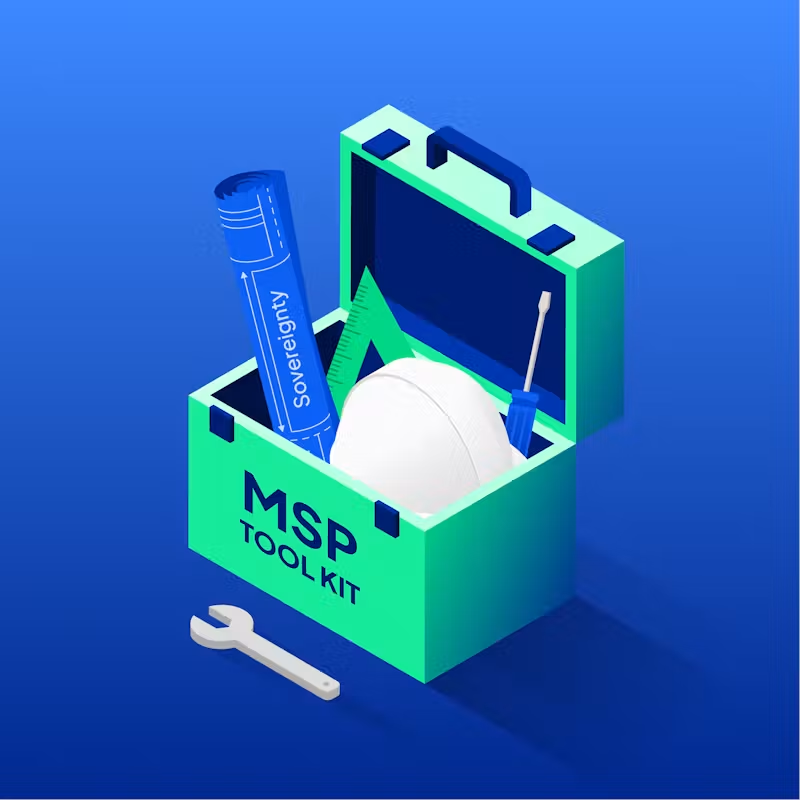
The Sovereignty Gap
Why MSPs Must Transition from Infrastructure Operators to Active Data Custodians in the SaaS Era
This operational model is broken. Modern regulatory scrutiny and enterprise expectations require a strategic pivot toward verifiable resilience. It is no longer defensible to claim data is merely “protected.” Service providers must actively demonstrate repeatable, auditable recovery under real-world conditions independent of the primary cloud ecosystem.
“The Sovereignty Gap defines the critical exposure vector between having enterprise data stored within a third-party hyperscaler and possessing true, unconstrained execution rights over that data during a primary tenant outage.”
Deconstructing Production Telemetry: The 2026 Metrics
Empirical metrics from the newly released Keepit Annual Data Report 2026 strip away theoretical assumptions, revealing the real-world cadence of data loss and restoration lifecycles:
- Granular Operational Disruption: 90% of all administrative restore actions are targeted, single-file recoveries. Data loss is rarely a singular apocalyptic event; it is an everyday operational friction point that occurs continuously during business hours.
- The Resilience Maturity Gap: Regular recovery validation directly correlates with organizational scale. Only 28% of small and mid-sized businesses (SMBs) run routine restore checks, compared to 91% of commercial mid-market tiers and 95% of mature enterprise environments.
- The Awareness Paradox: The data confirms that macro-level infrastructure outages do not trigger an increase in baseline recovery testing. Awareness of threat vectors does not automatically translate into organizational readiness.
The Shared Responsibility Illusion in Multi-SaaS Environments
The widespread orchestration of modern enterprise workloads across fragmented SaaS applications creates a hidden dependency chain. Many organizations operate under the incorrect assumption that native SaaS hyperscalers provide comprehensive long-term data protection.
In reality, the cloud architecture functions on a shared responsibility model. While the primary platform guarantees global service availability and infrastructure uptime, long-term data custodianship, compliance archiving, and discrete recoverability remain the sole responsibility of the subscriber.
If an organization’s access to a primary SaaS tenant is locked due to an identity breach, malicious configuration change, or localized API throttling, relying on the provider’s native restore tools creates a dangerous single point of failure. True sovereignty requires a decoupled, vendor-agnostic data vault.
Engineering Services for Absolute Sovereignty
Closing the sovereignty gap requires MSPs to systematically re-engineer their backup and resiliency portfolios across four specific pillars:
Ensuring that the backup repository is physically, logically, and cryptographically isolated from the primary SaaS production environment.
Eliminating single-vendor dependencies in the recovery chain to protect clients against platform lock-in and localized API outages.
Replacing passive monitoring with lightweight, automated, and guided recovery checks to elevate client maturity metrics from “as-needed” to routine.
Delivering comprehensive auditability into recovery velocities, ensuring compliance documentation satisfies strict DORA/NIS2 due diligence.
From Infrastructure Provisioning to Business Assurance
The role of the progressive MSP has permanently transformed. Leading providers are moving away from commodity infrastructure provisioning to deliver absolute business assurance. Conversations focused on cost-per-gigabyte are being replaced by strategic reviews centered on algorithmic control, business velocity, and structural accountability.
MSPs that design their security architectures for platform independence and verifiable recoverability will cleanly differentiate themselves in a commoditized market. Demonstrable data control is the new benchmark of enterprise cybersecurity.
Architect Your Resilience Strategy with Keepit
Move beyond standard availability metrics and align your MSP practice with next-generation data sovereignty standards. Partner with Keepit to deliver true, vendor-independent cloud recovery.