Skip to content

20 Thought Leaders Shaping the MSP Industry in 2025

The Guardz team has curated a list of 20 MSP thought leaders we truly admire.

Whether you’re looking to compare IT solutions, scale marketing efforts, build continuous revenue streams, or learn about the latest breaking industry trends, these 20 elite MSP superstars will provide you with all the insights you need to scale your business and succeed. 

Paul Green

Paul Green is one of the most recognized leaders in the MSP industry. His MSP Marketing Edge newsletter provides a wealth of insights on everything from growth strategies and lead generation to relationship building. Paul’s MSP Marketing Podcast releases new episodes every Tuesday, so make sure you tune in to catch up and become a master of your craft. 

Follow Paul on LinkedIn 

Robin Robins 

Robin has worked with over 10,000 IT business owners from all over the U.S. and in 37 different countries. She has also been a top speaker at many industry-focused events such as CompTIA’s BreakAway, Channel Partners Conference and Expo, and ASCII’s boot camps. Her annual Bootcamps feature some of the biggest celebrity names you can imagine. Robin will teach you how to build a winning MSP system. 

Follow Robin on LinkedIn 

Dave Sobel

Dave Sobel is the host of MSP Radio and The Business of Tech Podcast, where he discusses the latest MSP news, cybersecurity incidents, and goes in-depth on the future of AI for IT, in addition to interviewing some of the industry’s top minds. Dave provides practical advice and valuable strategies any MSP can implement to grow a thriving, sustainable business. One of his latest episodes, “AI to Drive 50% of Business Decisions by 2027,” will certainly make you rethink the possibilities of AI for growth. 

Follow Dave on LinkedIn

Richard Tubb

If you run an MSP or IT consulting business, you have definitely come across Richard Tubb, and if not, we highly recommend following him. His TubbTalk Podcast is among the best in the industry. Richard has also authored the IT Business Owner’s Survival Guide and has over two decades of experience running successful consulting practices.

Follow Richard on LinkedIn

Kathryn Rose

Kathryn Rose is a leading voice in the MSP community. She is the Founder of channelwise, which provides on-demand expert advice for MSPs, and Co-Founder of the Channel Marketing Association (CMA). Kathryn has also been a recipient of many prestigious awards, including the Women in Tech Global Ally Award, Alliance of Channel Women Leadership Award, and the CompTIA Advancing Women in Technology Mentor of the Year Spotlight Award.

Follow Kathryn on LinkedIn

Paco Lebron

Paco Lebron is the Managing Partner and Co-Founder of MSP Unplugged, along with Co-Hosts Rick Smith and Corey Kirkendoll. With over 275 episodes and over a decade running, you’ll find whatever you’re looking for to run a successful IT business, including choosing the right tools for your security stack, pricing strategies, and deep perspectives on AI. 

Paco is also the Founder of ProdigyTeks and the CEO of the MSP Owners Group.

Follow Paco on LinkedIn

Taher Hamid

Taher Hamid is the Founder and Camp Leader of MSP Camp, which provides valuable content and marketing campaigns to help MSPs grow. Taher is also the co-organizer of ScaleCon2025, which brings some of the top MSP leaders together for a 3-day growth-centered conference. ScaleCon2025 will take place September 25th – 27th in New Orleans, so make sure you RSVP your seat today. 

Follow Taher on LinkedIn 

Jennifer Bleam

Jennifer Bleam helps MSPs build scalable marketing and sales systems and grow profitable businesses. Jennifer is also the author of Simplified Cybersecurity Sales For MSPs: The Secret Formula For Closing Cybersecurity Deals Without Feeling Slimy, and has coached over 1,000 MSPs with successful results. She is also the Owner and Founder of MSP Sales Revolution. 

Follow Jennifer on LinkedIn

Steve Taylor

Steve Taylor is the Founder of RocketMSP, one of the top IT channels and MSP podcasts on YouTube. Steve has over 15 years of web design experience, which he combines with technical knowledge to help MSPs get the most out of their cybersecurity investments. 

Steve is also the Lead Content Manager for Alternative Payments and has honed his reputation as a trusted voice in the MSP community.

Follow Steve on LinkedIn

Megan Killion

Megan Killion is a revenue-driven marketer and Chief Consultant at MKC Agency. Her 30-60-90 day plan has helped MSPs double or even triple their revenue, contributing to over $550 million in pipeline generated throughout her illustrious career. We highly recommend checking out her MSP Confidential podcast episode, Build or Buy Marketing?

Follow Megan on LinkedIn 

Harrison Baron

Harrison Baron is the CEO of Growth Generators and the Host of the Brutally Honest Podcast. Harrison understands what it takes for MSPs to build scalable systems and attract more high-value clients. The Growth Generators YouTube channel helps MSPs succeed at every stage, from startup to exit. Check out the episode on The Best Way to Sell Cybersecurity Services in 2025 to learn how to handle common objectives and sell compliance-driven security solutions.

Follow Harrison on LinkedIn 

Zamir Javer

Are you looking to scale your MSP business and add $250K – $2M+ in ARR? Zamir Javer has the answers for you. Zamir is the CEO of Jumpfactor Marketing, with over 15 years of experience, resulting in $1.6 billion in revenue generated for MSPs. Zamir has a specialty for helping MSP & Channel firms generate multiple 7 & 8 figures of revenue in 12 months through advanced MSP marketing strategies. 

Follow Zamir on LinkedIn 

Nigel Moore

Nigel Moore is the CEO and Founder of The Tech Tribe, one of the largest MSP communities out there, with over 3,500 connected members. Nigel began his IT journey over two decades ago and has become a prominent figure in the industry since. 

Follow Nigel on LinkedIn

Erick Simpson

Erick Simpson is the CEO of Channel Mastered and MSP Mastered, and creator of the MSP Mastered® Methodology, a framework trusted by 30,000+ IT Solution Providers.

Some of his accolades include being named a Channel Futures’ “7 Thought Leaders Defining the MSP Market,” Jay McBain’s “100 Most Visible Channel Leaders,” and Syncro’s “#1 MSP Business Growth Resource in North America. 

You can subscribe to Erick’s newsletter here.

Follow Erick on LinkedIn 

Chris Wiser

Chris Wiser is the Founder and CEO of 7 Figure MSP™. Chris has helped MSPs grow from 0 to 6 figures in MRR with built systems. Chris understands how to scale businesses and cut seat count for service professionals. If you want the numbers, Chris will give you the confidence to sell and think like a seasoned pro. 

Follow Chris on LinkedIn 

Justin Esgar

Justin Esgar is an IT rockstar and an “all around good guy” who we follow. Justin is the host of All Things MSP podcast, where he provides valuable business strategy tactics with Eric Anthony. You’ll find the episode on How One Toxic Client Changed My MSP Approach very inspirational. Maybe you can relate, too? 

Follow Justin on LinkedIn

Luis Giraldo

Luis Giraldo is the  Chief Evangelist of ScalePad and host of MSP Confidential podcast. Be sure to check out the episode on Turning Around an Unprofitable MSP, where you’ll pick up golden nuggets on various pricing models and strategies. The Pumpkin Plan for MSPs is another episode we truly enjoyed. 

Follow Luis on LinkedIn

Jeffrey Newton

Jeffrey Newton is an 18-year MSP veteran and Host of the MSP Insider Show, where he has interviewed some of the top names and minds in the industry. Check out his Whiteboard Series for some hidden gems you won’t want to miss out on.  

Follow Jeffrey on LinkedIn 

Damien Stevens

Damien learned how to build an MSP the hard way, from losing a client’s data. Damien is the CEO of Servosity and the Host of MSP Mindset podcast. Damien isn’t afraid to share his journey and past experiences with others who have also built successful MSP businesses, from the ground up. Learn how an MSP retains clients for decades and why niching down is your best bet. Top MSPs share their secrets with Damien. 

Follow Damien on LinkedIn 

Kyle Christensen

Kyle Christensen is the Co-Founder of Empath and is a master of sales. Empath provides a bunch of valuable resources and templates that MSPs can use for sales processes and QBRs.  Get the scoop on how to grow your MSP with Kyle. 

Follow Kyle on LinkedIn 

Stay in the MSP Circle with Guardz 

Guardz helps MSPs overcome daily operational challenges by translating security outcomes into measurable business impact

Follow Guardz on LinkedIn to keep up with the latest MSP industry trends, valuable growth insights, and strategies to build a long-term sustainable business.

Make sure you hit that subscribe button! 

Learn more about the Guardz AI-native Unified Detection and Response platform here. 

About Guardz
Guardz is on a mission to create a safer digital world by empowering Managed Service Providers (MSPs). Their goal is to proactively secure and insure Small and Medium Enterprises (SMEs) against ever-evolving threats while simultaneously creating new revenue streams, all on one unified platform.

About Version 2 Limited
Version 2 Digital is one of the most dynamic IT companies in Asia. The company distributes a wide range of IT products across various areas including cyber security, cloud, data protection, end points, infrastructures, system monitoring, storage, networking, business productivity and communication products.

Through an extensive network of channels, point of sales, resellers, and partnership companies, Version 2 offers quality products and services which are highly acclaimed in the market. Its customers cover a wide spectrum which include Global 1000 enterprises, regional listed companies, different vertical industries, public utilities, Government, a vast number of successful SMEs, and consumers in various Asian cities.
Deep web vs dark web: Key differences business and security teams need to know

Deep web vs dark web

Summary: Uncover the critical differences between the deep web and dark web, understand their cybersecurity risks, and learn why proactive monitoring is essential to protect your business from modern cyber threats.

The internet is far more than the visible web. Like the mass of an iceberg, most information and web pages lie below the surface.

The hidden corners of the web can be “deep” – buried beneath the surface, but easy to uncover. However, they can also be “dark” – allowing criminal activity to flourish without surveillance.

Understanding the difference between the deep web and the dark web could be critical to your enterprise cybersecurity. This article will explain how the deep and dark web differ and provide valuable tips for securing sensitive data.

What is the deep web?

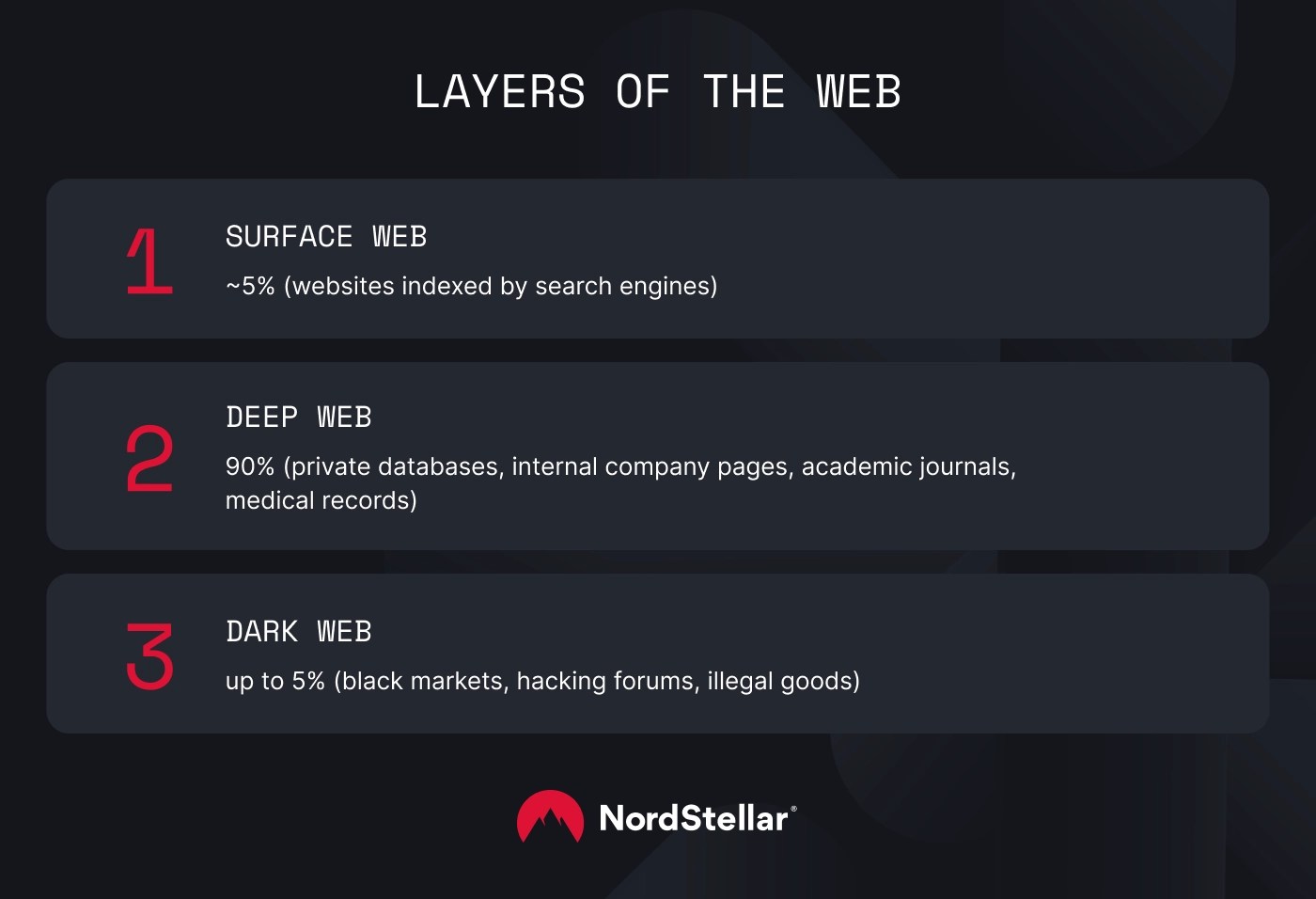
The deep web includes web content that is not indexed by search engines. This may seem trivial, but it amounts to vast amounts of data.

For instance, Google appears comprehensive. However, its web crawler index is less than five percent of the World Wide Web. The rest remains on the deep web, and you can’t reach it via traditional search engine results.

Pages on the deep web include password-protected sites like private databases, internal company pages, academic journals, and medical records. Web browsers can often access these pages with the correct credentials, but search engine crawlers cannot process them.

Most deep web content is not malicious. Universities and medical providers need to keep confidential content out of the public eye. Website owners often use the robots.txt file to manage traffic and determine what data search engines can access.

The critical takeaway when comparing deep web vs dark web content is that the deep web is publicly accessible without special browser tools. Anyone with the right credentials can gain access. That’s why criminals prefer the more private environment of the dark web.

What is the dark web?

The dark web is a section of the deep web protected by multiple layers of encryption.

Users can only access dark web servers via special browsers like Tor (the Onion Router). The Tor browser uses randomization to route traffic through virtual tunnels before granting access. This architecture anonymizes users and complicates dark web monitoring.

Ordinary browsers cannot access dark web sites due to unique registry operators. Web crawlers cannot penetrate the encryption protecting dark web servers. Without Tor or other specialist tools, access is impossible.

The dark web emerged in 2000 as a decentralized platform for anonymous communication. In theory, it remains a valuable tool – enabling secure communication for whistle-blowers and individuals in repressive states. However, it has also become a haven for illegal activities.

Dark web marketplaces allow data thieves to sell credentials and other sensitive information. Hackers plan data breaches on dark web forums, while merchants sell many types of illegal goods to customers worldwide.

What is the surface web?

Both the dark web and the deep web exist beneath the surface web. The surface web includes websites indexed by search engines like Google or Bing.

For most internet users, the surface web is all they see. However, the visible web is only a small fraction of all web traffic. 90–95% of web content is submerged and wholly or partially inaccessible via browsers like Google Chrome.

Layers of the web

Deep web vs dark web: key differences

The table below provides a quick deep web vs dark web comparison to understand the differences between the two:


Deep web

Dark web

Access method

Accessible via normal web browsers.

Only accessible via special tools (such as the Tor browser or the Invisible Internet Project)

Size

Massive, containing more than 90% of the internet, consisting of hundreds to thousands of exabytes of data, eclipsing both the surface web and dark web.

Relatively small subset of the deep web, estimated at 0,01–5% of the total internet or around 150,000 websites, with only a few thousand unique sites globally.

Visibility

Visible to web browsers, provided users have the appropriate credentials.

Invisible to ordinary web browsers due to strong encryption.

Threat level

Relatively low. Deep web content may include confidential data, requiring robust access controls and encryption. However, most content is benign and carries a low threat level.

High. Criminal collectives routinely use dark web sites for illegal activities like planning cyber attacks, sharing leaked credentials, and selling exploit or ransomware-as-a-service kits. If credentials appear on dark web forums, companies should anticipate their use in future attacks.

Legal exposure

Low. Companies often use the deep web in everyday operations. Deep web sites may host illegal content (such as torrents). However, using the deep web for legitimate reasons is uncontroversial.

Many dark web sites carry a high legal risk due to illegal activities. Using Tor to browse the dark web is legal, although participation is not advisable.

Why the difference matters for businesses

The differences above matter for one core reason: the dark web functions as a clearinghouse for illegal activities. Cyber threats hatched on the dark web steal data, disrupt business operations, and lead to severe regulatory and reputational damage.

Attackers may collaborate on dark web forums to share information and create sophisticated phishing campaigns, use off-the-shelf exploit kits to leverage backdoors, or mobilize stolen login credentials in brute-force attacks.

This situation challenges risk analysts and security teams to discover leaked credentials and gather threat intelligence. Companies need to update their threat prevention techniques to monitor dark web environments.

Dark web threats also pose a critical compliance challenge. Regulators penalize businesses that put customer data at risk. Data protection increasingly requires active dark web monitoring to manage compliance risks.

These factors make integrating dark web security into your risk management strategy critical. Security teams need to upgrade their capabilities. Analysts need security tools to track dark web activities, while engineers must implement alerting systems and controls to counter threats before they escalate.

How to monitor dark web activity for business security

The next cybersecurity threat to your critical systems and data could be incubating on the dark web as you read this. Without visibility and dark web intelligence, security teams can only wait and hope their network defenses are sufficiently robust.

Fortunately, monitoring solutions work around this problem, giving security analysts advanced warning of dark web discussions and potential threats.

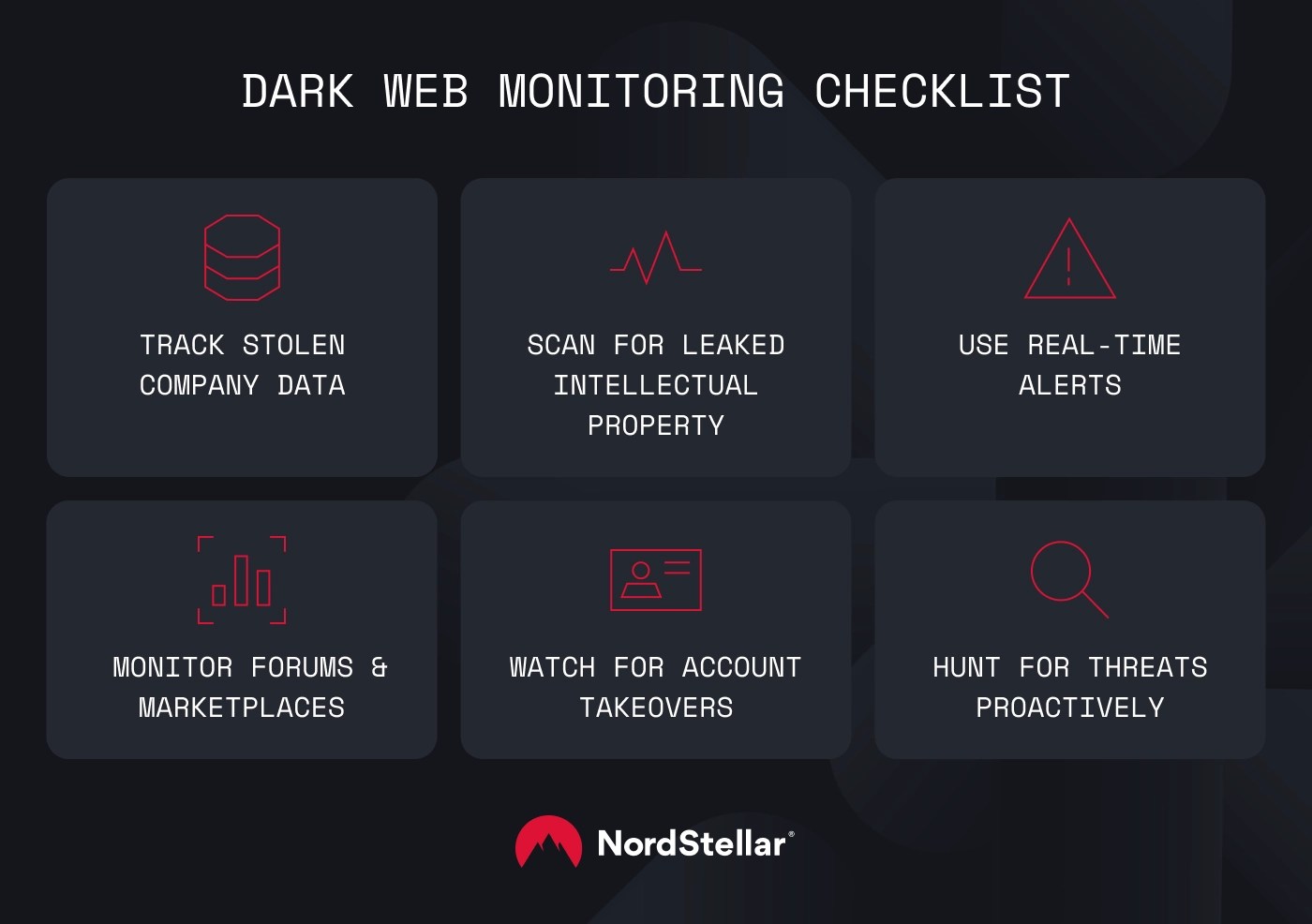
Dark web monitoring checklist

Dark web monitoring tools search for your information. They detect stolen employee logins, customer data, postal addresses, social security numbers, and other valuable personal data relating to your business operations.

Monitoring tools can also scan for intellectual property and other confidential information, helping you manage the threat posed by malicious insiders and corporate espionage.

Moreover, dark web monitoring happens in real time. Monitoring tools detect compromised data and automatically generate alerts. Security teams gain time to mitigate potential threats (for example, by requesting password changes for affected users).

NordStellar’s threat intelligence platform is a great example. Data breach monitoring continuously tracks marketplaces and forums, informing security teams when sensitive data appears on the dark web. Meanwhile, account takeover prevention monitors privileged employee and customer accounts for stolen credentials or suspicious activity. Active scanning identifies hijacks at an early stage before damage results.

Security analysts can also use monitoring tools for threat-hunting expeditions. Cyber threat intelligence helps analysts learn about active groups and attack techniques – generating research outcomes to improve the company’s security posture.

Companies should actively monitor the dark web for security threats. However, it’s important to stress that not all security actions on the dark web are legally safe or advisable from an ethical perspective.

Firstly, we should clarify what is legally permitted when investigating dark web threats. Using Tor and accessing dark web servers is legal. Companies can passively monitor activity and data sales on dark web marketplaces.

There’s nothing wrong with simply accessing dark web sites. Most countries allow free access, although the Tor browser is illegal in China, Russia, and Iran.

However, engaging with threat actors on the dark web creates risks wherever you are. Exposed investigators could receive inaccurate information or provoke cyberattacks. If discovered, automated scanning tools could mark companies as targets for reprisals by criminal groups.

Investigators could also accidentally encounter illegal content while browsing marketplaces and forums. This creates a legal risk (possession of harmful images or confidential data). Monitoring dark web forums also poses ethical questions.

For instance, should you continue to monitor forums despite knowing they host illegal transactions? Or should you inform law enforcement agencies and trust them to intervene?

These operational, legal, and ethical issues make clear policies about accessing the dark web are critically important. Security teams (and anyone else tasked with dark web access) should know how to do so safely – and how to report legal queries if they arise.

We would also advise consulting your legal team when writing dark web security policies. Legal advice ensures you stay on the right side of the law while benefiting from dark web threat monitoring.


Incident examples: When corporate data hits the dark web

The dark web is more than a distant threat hidden deep within the internet. As a couple of real-world examples show, it’s an active site for the preparation and monetization of cyber attacks.

AT&T’s unexpected dark web data breach

In March 2024, communications giant AT&T discovered that 76 million customer records were being sold via dark web marketplaces. The data included SSNs, home addresses, and login credentials of current and past clients.

Although a vast database was available for sale, the company stated that it had found no evidence of data breaches. This highlights the need for proactive monitoring that anticipates breaches, not waiting for the symptoms of cyber attacks.

LinkedIn: An entire social media ecosystem exposed on the dark web

Social media platforms have also suffered dark web data breaches. In 2021, LinkedIn disclosed the exposure of 700 million user records. The data included phone numbers, email addresses, and other personally identifiable information – a gold mine for phishers.

In this case, attackers leveraged code flaws in the platform’s API, allowing them to scrape confidential information about users and their connections.

Although the company has not disclosed details of the impact, the incident likely dented LinkedIn’s reputation as a trusted platform for networking and professional communication. It may also have influenced a gradual decline in ad revenue, harming the platform’s finances.

Colonial Pipeline: Using the dark web as a market for RaaS products

The 2021 Colonial Pipeline ransomware attack shut down a critical energy pipeline on the Eastern Seaboard, leading to a $4.4 million ransom payment. Attackers used stolen employee credentials to access an unused Virtual Private Network account that remained accessible and active.

The critical facts are that attackers used stolen credentials purchased on the dark web. Attackers also used a ransomware-as-a-service (RaaS) kit supplied by the DarkSide collective via dark web marketplaces.

Proactive threat intelligence gathering may have enabled Colonial Pipeline to detect attack planning and locate stolen credentials. However, the company relied on legacy security systems and did not account for dark web threats.

Final thoughts on managing deep and dark web exposure

The surface web is deceptive. Underneath lies a bottomless ocean of deep web content. And within that ocean, the protected dark web provides a secure refuge for illegal activities.

As we’ve learned, these illegal activities could target your company. Data from your employees or customers could be changing hands on dark web marketplaces while criminals build phishing profiles or plan data theft attacks.

Managing deep and dark web exposure is now a fundamental online safety requirement. Security teams should assume their data is available via onion sites and use monitoring platforms like NordStellar to verify the degree of exposure.

Dark web monitoring complements access controls, network segmentation, and intrusion detection and response tools. Dark web intelligence and endpoint protection protect against hidden threats, while employee training helps manage phishing risks.

Ready to strengthen your defenses against hidden online threats? Don’t wait for a breach to act – contact the NordStellar team today and proactively update your data security strategy.


About NordStellar
NordStellar is a threat exposure management platform that enables enterprises to detect and respond to network threats before they escalate. As a platform and API provider, NordStellar can provide insight into threat actors’ activities and their handling of compromised data. Designed by Nord Security, the company renowned for its globally acclaimed digital privacy tool NordVPN.

About Version 2 Limited
Version 2 Digital is one of the most dynamic IT companies in Asia. The company distributes a wide range of IT products across various areas including cyber security, cloud, data protection, end points, infrastructures, system monitoring, storage, networking, business productivity and communication products.

Through an extensive network of channels, point of sales, resellers, and partnership companies, Version 2 offers quality products and services which are highly acclaimed in the market. Its customers cover a wide spectrum which include Global 1000 enterprises, regional listed companies, different vertical industries, public utilities, Government, a vast number of successful SMEs, and consumers in various Asian cities.

Portnox Unleashes Fast, Frictionless, Cloud-Native ZTNA

Secure Access, Simplified. No Agents, No Clients, No Passwords—No Problem.


AUSTIN, TX, July 8, 2025 — Portnox, a leading provider of cloud-native access control solutions, today announced the launch of its innovative Zero Trust Network Access (ZTNA) solution. In today’s distributed work environment, employees require access to critical applications from various locations and devices, often over untrusted networks. This expanded threat landscape presents significant security challenges for IT teams. To support rapid adoption, Portnox is also introducing a free version of its ZTNA solution—offering access for unlimited users to an unlimited number of web-based applications.

Legacy ZTNA deployments are notorious for sluggish performance, bloated agents, and deployment headaches that rival traditional VPNs. Purpose-built for agility and simplicity, Portnox’s latest innovation eliminates the friction, lag, and complexity that have come to characterize conventional ZTNA and VPN architectures. Portnox ZTNA offers a unified access control approach, delivering secure remote access to any web-based application without the traditional complexities and exposures.

Leveraging modern zero trust principles, Portnox ZTNA extends robust security capabilities to the application layer, ultimately simplifying IT operations.

Key Advantages of Portnox ZTNA:

  • Instant Access with Minimal Latency: Delivers blazing-fast, high-performance connectivity to internal applications—no lag, no waiting—ensuring users remain productive without the sluggish delays common in legacy ZTNA and VPN solutions.
  • No Client or Agent Required: Users access internal web applications via standard browsers and familiar URLs, eliminating the need for legacy clients.
  • Passwordless Authentication: Provides seamless and secure access, removing the burden and risk associated with passwords.
  • Role- and Location-Based Access Controls: Ensures users can only access the resources they need, based on their role and location.
  • Endpoint Risk Posture Checks: Continuously verifies the security compliance of devices before granting access.
  • Automated Remediation: Instantly addresses non-compliant or risky endpoints.
  • Zero Network Impact: Requires no configuration changes to remote worker networks or corporate firewalls. All connections are outbound-only, simplifying secure access and minimizing the attack surface.
  • Access to Web-Based Applications: Provides secure remote access to web-based applications.

“Portnox ZTNA fundamentally changes how organizations approach remote access security,” stated Denny LeCompte, CEO of Portnox. “We’ve engineered a solution that not only significantly strengthens security but also enhances the user experience—because the best security is virtually invisible: fast, seamless, and frictionless. By eliminating the reliance on traditional VPNs and streamlining access controls, we empower businesses to embrace a true zero trust model with remarkable simplicity.”

Portnox ZTNA offers a modern, secure alternative to traditional VPNs for accessing web-based applications. It establishes a secure, outbound-only tunnel, eliminating the need for VPN clients or complex firewall modifications. This approach simplifies secure remote access without compromising security or user experience.

While today’s launch focuses on delivering high-speed, passwordless access to web-based applications, Portnox ZTNA is only just getting started. Future releases will broaden the scope of the solution to encompass secure zero trust access to a wider array of enterprise resources—including legacy applications with no web client. This continued expansion reflects Portnox’s commitment to providing holistic, cloud-native access control for every user, device, and application—no matter where they reside.

Portnox ZTNA is a core component of the Portnox Unified Access Control Platform, which also includes RADIUS authentication, Network Access Control (NAC), and TACACS+, delivered in a single, cost effective, cloud-native solution. Together, these capabilities provide organizations with a centralized, highly scalable ecosystem for managing and enforcing zero trust access across modern hybrid environments.

The free version of Portnox ZTNA—available now—enables organizations to securely connect unlimited users to unlimited web-based applications. While this free offering includes only community support , organizations can upgrade to Enterprise Support and access all to-be-released features. To use the free version, installation of Portnox’s lightweight endpoint posture assessment tool, AgentP, is required.

Who Benefits from Portnox ZTNA?

  • End users enjoy fast, seamless, secure access to applications and data without cumbersome VPNs.
  • IT decision-makers gain enhanced control and visibility over access attempts and enforce identity-based policies.
  • Organizations across industries like finance, healthcare, education, and technology benefit from robust security and streamlined access management.

To learn more about Portnox ZTNA, visit: /portnox-cloud/ztna/ 


About Portnox
Portnox provides simple-to-deploy, operate and maintain network access control, security and visibility solutions. Portnox software can be deployed on-premises, as a cloud-delivered service, or in hybrid mode. It is agentless and vendor-agnostic, allowing organizations to maximize their existing network and cybersecurity investments. Hundreds of enterprises around the world rely on Portnox for network visibility, cybersecurity policy enforcement and regulatory compliance. The company has been recognized for its innovations by Info Security Products Guide, Cyber Security Excellence Awards, IoT Innovator Awards, Computing Security Awards, Best of Interop ITX and Cyber Defense Magazine. Portnox has offices in the U.S., Europe and Asia. For information visit http://www.portnox.com, and follow us on Twitter and LinkedIn.。

About Version 2 Limited
Version 2 Digital is one of the most dynamic IT companies in Asia. The company distributes a wide range of IT products across various areas including cyber security, cloud, data protection, end points, infrastructures, system monitoring, storage, networking, business productivity and communication products.

Through an extensive network of channels, point of sales, resellers, and partnership companies, Version 2 offers quality products and services which are highly acclaimed in the market. Its customers cover a wide spectrum which include Global 1000 enterprises, regional listed companies, different vertical industries, public utilities, Government, a vast number of successful SMEs, and consumers in various Asian cities.
How to Maximize the Value of Your CMDB

A Configuration Management Database (CMDB) constitutes the backbone of IT Service Management (ITSM). It is a comprehensive map of the IT infrastructure that enables organizations to manage IT resources more efficiently, ensure compliance, and make informed decisions. 

Despite its proven importance, many organizations fail to fully exploit the potential of their CMDB, and this tool risks transforming from a strategic resource into a source of frustration and inefficiency. The truth is that having a poorly utilized CMDB solution or one unsuited to business needs can be worse than not having one at all. 

Inaccurate or obsolete data leads to wrong decisions, slows down incident resolution, and reduces user satisfaction. However, when properly used and maintained, a CMDB simplifies ITSM operations and offers countless benefits. 

Understanding the Role of the CMDB 

Fundamentally, a Configuration Management Database functions as a central hub for storing and organizing detailed information about the elements that make up an IT environment. These elements, both tangible and intangible, support service delivery and infrastructure stability. 

Key Components of a CMDB 

Configuration Items (CI): these are unique entries that represent physical or logical IT resources or services. Each CI is cataloged with distinctive attributes, such as version, owner, and lifecycle status. 

Systemic interactions: a distinctive feature of any effective CMDB is its ability to describe how different components interact with each other. 

Descriptive metadata: information associated with each element, such as deployment environment, maintenance schedule, or ownership. Metadata enhances usability and enables accurate queries. 

Difference Between CMDB and Asset Management 

Although they sometimes overlap, CMDB and Asset Management systems have different objectives. Asset Management is aimed at financial oversight and contractual aspects of IT resources, such as purchase dates and depreciation, while a CMDB is oriented toward understanding system behavior and service architecture. Together, the two offer a comprehensive view of IT resources, but it is the CMDB that provides the information necessary for efficient incident resolution and planning. 

With a properly managed CMDB, IT teams gain meaningful insights into how infrastructure components are connected to each other, enabling more informed decision-making and smoother operations. This foundational knowledge is essential for adopting practices that enable real value from the investment. 

Get the latest ITSM insights! Explore AI, automation, workflows, and more—plus expert vendor analysis to meet your business goals. Download the report now!

CMDB Implementation: The Most Common Pitfalls 

Today many CMDB initiatives fail to live up to expectations. This discrepancy between reality and expected performance is rarely due to inadequate technologies. Much more often, it is the result of underestimated operational challenges and execution not aligned with real business needs. Recognizing the most common pitfalls can help organizations fully exploit their CMDB’s potential by adopting proactive measures in a timely manner. 

The recurring reasons why many organizations fall into the trap of underutilizing their CMDB are: 

  • Lack of clear objectives: implementing a CMDB without defined purposes leads to abnormal expansion of the scope of application and data overload. 
  • Poor accuracy and data inconsistency: obsolete or incomplete data concerning CIs undermines trust in the CMDB. This is why regular audits and automated detection are essential. 
  • Overly complex mapping: trying to map every CI and every relationship from day one adds unnecessary complexity and increases the risk of errors. 
  • Manual processes more easily subject to errors: relying on manual updates slows down teams and introduces discrepancies. 
  • Integration with other IT systems: seamless connectivity with monitoring, asset, and ITSM tools often requires advanced customization, which requires significant expertise to achieve. 
  • Insufficient governance and ownership: without clear definition of responsibilities between teams, CMDB maintenance quickly ends up being neglected. 
  • Lag behind the evolution of the IT landscape: with the proliferation of cloud, containers, and microservices, the CMDB must adapt or risks becoming irrelevant. 

Recognizing these critical issues is the first step toward adopting CMDB best practices and improving its performance. By addressing these problems with a clear strategy, robust tools, and continuous stakeholder engagement, organizations can get the most out of a CMDB while improving operations. 

Best Practices for Maximizing CMDB Value 

To fully exploit the potential of a configuration management database, organizations must go beyond simply implementing the tool and adopt a strategic approach. CMDB best practices are aimed at making the database accurate, relevant, and aligned with broader IT and business objectives. They are fundamental for maximizing its value and avoiding the most frequent errors. 

Define clear objectives: start small and scale gradually. Begin with a clear articulation of why a CMDB is needed and the expected business outcomes. It’s a “start-small” philosophy: first model only the most critical services, applications, or servers, demonstrate their value, and then expand to include network devices, databases, and the rest of the assets as the process matures. 

Establish solid governance, ownership, and stakeholder engagement. Governance remains the keystone of a reliable CMDB, but it must extend beyond IT operations. If the database is to reflect the organization’s real priorities, it is essential to designate those responsible for data management, service owners, and CMDB managers and actively involve stakeholders from security, finance, and business departments. 

Automate data collection and updating. Replace error-prone manual entry with automatic detection and integration tools that identify CIs and update attributes and lifecycle status in real time. It’s good practice to connect the CMDB to monitoring platforms, IT asset management, cloud service providers, and DevOps pipelines so that changes are captured the moment they occur. 

Focus attention on data quality: verify, refine, repeat. Evaluating data quality is not a one-time activity. It’s necessary to define standards for naming, classification, and mandatory attributes; validate data at every acquisition point; perform scheduled audits to detect obsolete or conflicting entries. It’s better to use dashboards to monitor completeness, accuracy, and timeliness, so you can act before quality deteriorates. 

Define clear CI relationships and categories. The true power of a CMDB lies in understanding how components interact with each other. Categories and naming conventions must be consistent to make the data model intuitive, easy to query, and ready for impact analysis. 

Seamless integration with ITSM processes. Incorporating the CMDB into incident, change, problem, and release workflows ensures that every ticket is enriched with current configuration data and technicians can immediately assess upstream or downstream impact. 

Monitor, measure, and communicate performance. Monitoring metrics such as CI accuracy, update frequency, change success rate, and mean time to incident resolution serves to have a precise measure of the value produced and identify optimization opportunities. 

Foster a culture of continuous improvement. Encouraging feedback, keeping documentation updated, investing in continuous training, and reviewing governance policies as technology and the business evolve means, essentially, treating the CMDB as a living system in constant evolution. 

Real Benefits of CMDB Optimization 

A CMDB is at the foundation of the entire service management lifecycle. When governed by the practices we have described, the CMDB can evolve to strengthen every aspect of ITSM. The benefits are evident. 

Holistic oversight and greater efficiency: by collecting detailed information about infrastructure and services in one place, teams gain a reliable end-to-end perspective, useful for planning upgrades or tracking problems. Identifying underutilized or duplicate resources helps reduce waste for greater efficiency. 

Faster incident response: the resource map stored in the CMDB reveals at a glance which business applications or services are impacted when a component malfunctions. This broad and detailed view accelerates classification, reduces downtime, and improves customer satisfaction. 

Greater risk awareness in case of changes: before implementing a patch or update, teams can perform real-time assessments of change impact, drastically reducing the likelihood of unexpected interruptions, enabling smoother workflows and a higher degree of preparation for audits. Accurate change impact analysis reduces downtime. 

Faster root cause identification: for persistent or recurring problems, historical configuration snapshots reveal which patterns repeat and allow identification of underlying causes. This makes it possible to intervene to implement lasting solutions instead of ineffective ones. 

To achieve these results requires continuous management, cross-functional collaboration, and constant commitment to improvement. In this context, technology can prove to be an extraordinary enabling element supporting change. 


About EasyVista  
EasyVista is a leading IT software provider delivering comprehensive IT solutions, including service management, remote support, IT monitoring, and self-healing technologies. We empower companies to embrace a customer-focused, proactive, and predictive approach to IT service, support, and operations. EasyVista is dedicated to understanding and exceeding customer expectations, ensuring seamless and superior IT experiences. Today, EasyVista supports over 3,000 companies worldwide in accelerating digital transformation, enhancing employee productivity, reducing operating costs, and boosting satisfaction for both employees and customers across various industries, including financial services, healthcare, education, and manufacturing.

About Version 2 Limited
Version 2 Digital is one of the most dynamic IT companies in Asia. The company distributes a wide range of IT products across various areas including cyber security, cloud, data protection, end points, infrastructures, system monitoring, storage, networking, business productivity and communication products.

Through an extensive network of channels, point of sales, resellers, and partnership companies, Version 2 offers quality products and services which are highly acclaimed in the market. Its customers cover a wide spectrum which include Global 1000 enterprises, regional listed companies, different vertical industries, public utilities, Government, a vast number of successful SMEs, and consumers in various Asian cities.
Protecting ePHI in the Cloud

Protecting ePHI in the Cloud: HIPAA-Compliant Cloud Backup Strategies for US Healthcare

Managing electronic protected health information (ePHI) in the cloud has become necessary as healthcare organizations progressively choose cloud technologies. This method raises data remote access, cost-effectiveness, and accessibility.

However, it also comes with compliance and security issues. Failing to protect ePHI, even in backups, for covered entities under the Health Insurance Portability and Accountability Act (HIPAA) runs a risk of significant fines, legal action, mistrust development, and damage to patient relationships.

Thus, providers must ensure that their backup plans are safe, tested, and monitored closely against government rules. This post explores the most practical approaches and insights relevant to U.S. healthcare institutions.

HIPAA Requirements for Backing Up ePHI

ePHI protection is governed by the Health Insurance Portability and Accountability Act (HIPAA). This act also specifies how ePHI must be backed up and recovered should a disaster or failure strike. HIPAA outlines critical backup-related criteria but does not specify certain technologies:

  • Procedures must be in place for data backup to generate and preserve exact, retrievable copies of ePHI.
  • In data recovery plans, organizations must specify how ePHI would be rebuilt following a cybercrime, system outage, or natural disaster.
  • Critical systems must be able to operate in emergency conditions to protect data integrity in emergency mode plans.
  • Backup and recovery strategies must be routinely tested and changed depending on changing risk.
  • Only authorized staff members should access ePHI; audit trails are in place to track interactions.

Meeting these criteria in a traditional on-premise solution is tough enough. In a cloud-based setting, the stakes are even higher, and the strategies more complex.

On-Prem vs. Cloud Backup for HIPAA

Feature On-Prem Backup Cloud Backup 
Initial Cost High (hardware, staffing) Lower (subscription model) 
Scalability Limited by physical resources Virtually unlimited 
Maintenance Manual, resource-intensive Managed by CSP 
Redundancy May require a separate off-site site Built-in multi-region redundancy 
Disaster Recovery Requires dedicated DR planning Often included with DRaaS 
Physical Security Controlled by the IT team Dependent on CSP’s data center practices 
BAA Requirement Not applicable Mandatory with CSP 
Compliance Flexibility Complete control, slower changes Fast updates, shared responsibility 


Cloud backup offers greater flexibility and cost efficiency. However, it shifts part of the security responsibility to your provider. Vetting and partnering with the right cloud service provider (CSP) is critical.

Why Cloud Backup Requires Special Attention

Cloud backup offers agility and cost savings, but it also brings new levels of complexity, especially around shared accountability. Many healthcare businesses wrongly assume their cloud provider manages HIPAA compliance by default. In truth, compliance is a joint effort.

Cloud-specific risks include:

  • Multi-tenancy: Data hosted on shared infrastructure increases exposure.
  • Remote Access: Greater accessibility can lead to increased attack surfaces.
  • Data Sovereignty: The physical location of your data may affect compliance with US regulations.

Understanding your and the provider’s roles is crucial for protecting ePHI.

How to Build a HIPAA-Compliant Cloud Backup Strategy

An effective cloud backup plan has to be proactive, tested several times, and compliant with HIPAA. Here’s how you approach it:

Choose the Right Cloud Provider

Not every cloud vendor is prepared to meet HIPAA’s requirements. You’ll need a provider that:

  • Offers a signed Business Associate Agreement (BAA)
  • Demonstrates a proven track record with healthcare clients
  • Provides transparent security practices and compliance certifications

Seek vendors with industry-standard certifications, including HIPAA, HITECH, and SOC 2 Type II.

Encrypt Data at All Times

HIPAA necessitates the safeguarding of ePHI both at rest and in transit. This means

  • Enabling AES-256 encryption for stored backups
  • Using TLS or SSL protocols for data transfer
  • Implementing secure key management systems

This ensures that the data remains unreadable even if unauthorized actors access backups.

Ensure Data Redundancy and Availability

Cloud backups must be:

  • Geo-redundant in order to withstand regional outages.
  • Supported by Recovery Point Objectives (RPOs) and Acceptable Recovery Time Objectives (SLAs) specifications.
  • Capability of automatic and frequent backups with choices for long-term storage.

Redundancy isn’t just a performance booster; it’s a compliance measure.

Implement Strong Access Controls

Unauthorized access is one of the most common causes of HIPAA breaches. Limit exposure by:

  • Using Role-Based Access Controls (RBAC) to grant access based on job roles
  • Enforcing the principle of least privilege
  • Deploying Multi-Factor Authentication (MFA) for cloud portal access
  • Logging and auditing all interactions with backup systems

This creates a controlled, traceable environment around your sensitive cloud data.

Conduct Regular Testing and Validation

A backup that doesn’t work is a liability. HIPAA requires regular testing and revision of all backup and disaster recovery procedures. Best practices include:

  • Simulating disaster scenarios to test recovery speed and integrity
  • Documenting results and updating policies accordingly
  • Involving IT and compliance teams in every phase of the testing process

Testing ensures that your cloud-based recovery plan isn’t just theoretical—it’s reliable when needed.

Common Pitfalls to Avoid

Even well-intentioned organizations can fall into traps that undermine their HIPAA backup strategy. Watch out for these frequent mistakes:

  • Assuming all cloud storage is HIPAA-compliant. A vendor’s offering of encryption or redundancy does not automatically satisfy all compliance criteria.
  • Failing to sign a business associate agreement (BAA) means your cloud provider is not legally obligated to follow HIPAA.
  • Using consumer-grade backup tools. For instance, the Standard edition of Dropbox or Google Drive lacks the restrictions required for healthcare data and isn’t built for HIPAA compliance.
  • Ignoring backup monitoring calls for regular validation of completion, integrity, and accessibility.

Steering clear of these traps calls for diligence, teamwork, and vendor responsibility.

The Role of Immutable Backups and Air-Gapping

Healthcare organizations should consider including immutable backups (copies of data that cannot be changed or deleted for a designated period) for extra security. These backups can stop ransomware attackers from either encrypting or destroying recovery information.

In tandem, air-gapping techniques (storing backups in physically or logically separated environments) offer another layer of protection. Appropriately utilized techniques enable you to keep HIPAA compliance even in worst-case situations.

To Sum Up: Compliance is a Continuous Process

Adoption of cloud backup systems only modifies your HIPAA responsibilities rather than absolving them. Protecting ePHI in the cloud calls for a well-crafted backup plan that strikes a compromise between security, performance, and compliance.

To recap, a HIPAA-compliant cloud backup strategy should:

  • Built with a vetted provider that offers a BAA
  • Include encryption, access controls, and redundancy.
  • Be tested and monitored regularly.
  • Align with HIPAA’s administrative, physical, and technical safeguards

Cloud backup compliance reflects your company’s dedication to data protection, patient safety, and regulatory responsibility, more than just a checkbox. Your patients and operations will be less vulnerable in the face of growing risks, the more solid your plan is.

About Storware
Storware is a backup software producer with over 10 years of experience in the backup world. Storware Backup and Recovery is an enterprise-grade, agent-less solution that caters to various data environments. It supports virtual machines, containers, storage providers, Microsoft 365, and applications running on-premises or in the cloud. Thanks to its small footprint, seamless integration into your existing IT infrastructure, storage, or enterprise backup providers is effortless.

About Version 2 Limited
Version 2 Digital is one of the most dynamic IT companies in Asia. The company distributes a wide range of IT products across various areas including cyber security, cloud, data protection, end points, infrastructures, system monitoring, storage, networking, business productivity and communication products.

Through an extensive network of channels, point of sales, resellers, and partnership companies, Version 2 offers quality products and services which are highly acclaimed in the market. Its customers cover a wide spectrum which include Global 1000 enterprises, regional listed companies, different vertical industries, public utilities, Government, a vast number of successful SMEs, and consumers in various Asian cities.

Cybersecurity as a Business Enabler – CISO’s Driving Business Value, Productivity, and Cost Efficiency

For many organizations, cybersecurity has historically been seen as a necessary expense, like an insurance policy, rather than a strategic investment. But that outdated mindset is shifting rapidly. In today’s hyper-connected world, effective security is a business enabler. It accelerates digital transformation, safeguards productivity, protects revenue, and, when approached strategically, drives measurable cost savings in cybersecurity.

Forward-thinking organizations are now optimizing their cybersecurity budget through smarter investments, tool consolidation, and security automation, transforming security from a cost center into a value driver.

As one security leader put it:

“The conversation changes when you translate security risks into business terms such as business downtime, revenue impact, regulatory exposure. That’s when security becomes not just about protection, but a core part of how the business stays productive and competitive.”

Beyond Protection: Enabling Business Continuity and Resilience

Security teams are often asked to report on patch rates, incident detection times, or technical vulnerabilities. These metrics, while important for the security team, rarely resonate at the executive or board level unless translated into business outcomes.

The real question executives care about is simple: “If something goes wrong, how quickly can we detect it, contain it, and recover, and what does that mean for the business?”

Containing an incident quickly can be the difference between a minor disruption and a multi-million-dollar crisis. One security leader drew a parallel from their experience in emergency services:

“When somebody calls the emergency number, how quickly can you get help to that person, which can be the difference between life and death? That’s a massive service-level commitment. It’s the same with cyber incidents. Faster detection and response mean reduced impact and faster recovery.”

This is why modern security strategies emphasize not just prevention, but detection, containment, and recovery, all directly tied to business resilience.

Aligning Security with Business Priorities

The fundamental question executives care about isn’t technical; it’s risk, legal, operational, and financial:

  • How does security help keep services running?
  • How does it reduce risk without slowing the business down?
  • How can we achieve cybersecurity cost savings without increasing exposure?
  • How do we make the most of our cybersecurity budget in a resource-constrained environment?

To answer these, security leaders are embracing risk-based budgeting but prioritizing investments that directly reduce business risk and support critical operations, rather than spreading resources thin across low-impact areas.

“Risk-based budgeting helps us avoid spending on security for security’s sake. It focuses us on what actually protects the business and drives value, leading to a return on investment.”

Tool Consolidation and Security Automation: Doing More with Less

The average enterprise security stack has grown bloated and complex, with overlapping tools, redundant functionality, and spiraling costs. Not only is this expensive, but it also slows response times and creates operational blind spots.  Managing a multitude of tools presents a significant resource challenge, hindering the team’s ability to develop the necessary skills and knowledge for effective oversight and visibility.

Tool consolidation addresses this challenge head-on, streamlining security operations, reducing vendor complexity, and unlocking efficiency gains.

By consolidating platforms and introducing security automation, organizations can:

✔ Reduce tool sprawl and associated costs
✔ Improve visibility and control
✔ Accelerate incident detection and response
✔ Free up security teams to focus on higher-value tasks
✔ Drive measurable cybersecurity cost savings

“Tool consolidation and automation aren’t just about saving money, though they do that. They improve resilience and keep the business moving by making security more efficient and less reactive.”

Legacy Technology Divestment: Reducing Risk and Cost

Outdated, unsupported, or redundant technologies introduce both security vulnerabilities and hidden operational costs. Yet many organizations hesitate to part ways with legacy systems due to perceived complexity or sunk costs.

However, strategic legacy technology divestment delivers significant benefits:

  • Reduced attack surface and security risk
  • Lower maintenance and licensing costs
  • Simplified technology architecture
  • Greater agility and scalability
  • Alignment with modern security and compliance standards

As security leaders increasingly tie technology decisions to business outcomes, shedding outdated systems becomes a key component of both risk reduction and cybersecurity cost savings.

“Clinging to legacy technology isn’t just a technical debt issue; it’s a business risk. And divesting from it is often one of the fastest ways to cut costs and improve security.”

The Domino Effect of Poor Access Management

Many of the most damaging breaches share a common root cause: weak or unmanaged access controls typically related to identities and credentials.

Whether it’s stolen credentials sold for a few dollars on the dark web or privileged access abuse, attackers exploit identity gaps as their easiest entry point. From there, poor internal controls, such as a lack of network segmentation or weak separation of duties, allow them to escalate privileges, move laterally, and access critical systems.

“It’s literally a domino effect. That initial access is the first domino falling. But the last domino could be your ERP system, your customer data, or your intellectual property, and when that last domino falls, the business impact is massive.”

By managing access more effectively, including privileged accounts, third-party access, and machine identities, organizations not only reduce their risk but also improve operational efficiency and simplify regulatory compliance.

Predicting the Shift: Cyber Accountability in the Boardroom

Regulatory changes, such as new disclosure requirements, are forcing security into sharper boardroom focus. Leaders predict that organizations will face tougher scrutiny, not just on whether incidents occur, but on how well access controls, credential management, and privileged user rights are governed.

This creates both a challenge and an opportunity. Security leaders who can proactively frame these controls as business enablers protecting critical services, enabling faster recovery, and safeguarding productivity will be seen not as blockers, but as strategic contributors.

The key is to avoid overwhelming executives with technical details. Instead:

✅ Keep the conversation business-centric
✅ Explain how controls directly support operational continuity
✅ Connect risks and security investments to measurable business outcomes
✅ Demonstrate readiness through realistic scenarios and response plans

As one leader advised:

“There’s going to be a tug of war. In calm times, you keep it macro, business-focused. But in a crisis, boards will dive into the weeds asking detailed questions like, ‘How did we let this happen?’ Be prepared for both.”

The Future of Security as a Competitive Advantage

Modern security isn’t about saying no, it’s about enabling the business to move faster, innovate confidently, and stay productive, all while managing risk.

Organizations that embrace risk-based budgeting, pursue tool consolidation, leverage security automation, and commit to legacy technology divestment are finding they can both improve security and achieve real, measurable cybersecurity cost savings.

Security, when aligned to business goals, does more than reduce risk. It:

✔ Supports faster, safer digital transformation
✔ Enables employees to work productively and securely
✔ Reduces downtime and the financial impact of incidents
✔ Builds customer confidence and market credibility
✔ Enhances the organization’s ability to adapt, recover, and grow

“We’ll never eliminate all risk, but we can align security to the business, reduce costs, improve resilience, and make security a true competitive advantage.”


Bottom Line:
Security isn’t just about protecting the business. It’s about enabling it to operate, innovate, and grow safely, confidently, and with resilience built in.

About Segura®
Segura® strive to ensure the sovereignty of companies over actions and privileged information. To this end, we work against data theft through traceability of administrator actions on networks, servers, databases and a multitude of devices. In addition, we pursue compliance with auditing requirements and the most demanding standards, including PCI DSS, Sarbanes-Oxley, ISO 27001 and HIPAA.

About Version 2 Limited
Version 2 Digital is one of the most dynamic IT companies in Asia. The company distributes a wide range of IT products across various areas including cyber security, cloud, data protection, end points, infrastructures, system monitoring, storage, networking, business productivity and communication products.

Through an extensive network of channels, point of sales, resellers, and partnership companies, Version 2 offers quality products and services which are highly acclaimed in the market. Its customers cover a wide spectrum which include Global 1000 enterprises, regional listed companies, different vertical industries, public utilities, Government, a vast number of successful SMEs, and consumers in various Asian cities.