
Skip to content

Leveraging cloud-based protection to alleviate heightened cyber-risks

The ground invasion of Ukraine has put IT security teams across the region and farther afield on high alert for potential cyber-invasions. ESET Dynamic Threat Defense is a fast way to boost a company’s security.

At first glance, cloud-based protection may seem like an unlikely leap in thought in response to a land-based military invasion. That’s probably because talking about “the cloud” can conjure surreal notions of flying saucers. Yet the cloud is just as rooted as the computer planted on your desk.

The cloud is nothing more than the assorted clusters of machines around the world offered for rent or as a service. Typically, these machines are located in data centers that offer connections via fiber-optic cables buried deep underground. In Ukraine, the ongoing destruction may eventually target underground cables, which would leave satellites in orbit around the earth – our flying saucers – to broker any connections.

Powerful machines for detection
The cloud can be leveraged to improve the security of your organization by providing an extra layer of protection that’s as readily available as the link to it. Connecting to powerful computers in the cloud – that is, at a data center – that are fully dedicated to analyzing files for malware dramatically enhances the protection of machines, especially those with less processing power or those dedicated to other uses.

Few corporate computers have the raw power to run heavyweight machine learning models, at least not without paying a high price for usability and performance. Furthermore, no one wants employees’ machines to be bogged down by security software that runs at full tilt, noisily spinning up to run expensive machine learning detection algorithms whenever there is an unknown sample to analyze. Yet, in some cases, that is the computing power it would take to rapidly detect some types of threats.

Learn about EDTD’s detection layers

For architects designing security software, the limitations of corporate machine processing power speak directly to the need to balance high performance with robust detection capability. A design that focuses on faster detection of generic never-before-seen threats will likely incur performance penalties. A design that focuses on detecting sophisticated or custom threats, especially never-before-seen and new threats, will also take a toll on performance.

An advanced endpoint security product should be able to balance performance and detection so as to stand on its own without the need to link to machines in the cloud to offer protection. But most computers will unavoidably be exposed to the internet, even if via a proxy server. Threats loom large on the internet, and additional protection is available too.

ESET Dynamic Threat Defense (EDTD) steps in precisely here because it offloads the demand for enhanced detection of never-before-seen threats to machines in the cloud, keeping the performance of corporate machines high. The benefit for organizations using EDTD is enhanced, automated protection against both targeted attacks and common malware variants, shortening the time to detection. Although speed is always an appreciated benefit, ultimately, the question an organization needs to ask itself is: Do I want to be protected even against never-before-seen sophisticated threats?

Automated protection
For IT admins, once EDTD is enabled and its parameters are tuned to comply with company policy and regulations on sharing files to third parties, the added protection for endpoints, servers, and Microsoft 365 apps largely becomes a set-and-forget convenience. IT admins can view reports on the files submitted for scanning, along with detailed analysis results:
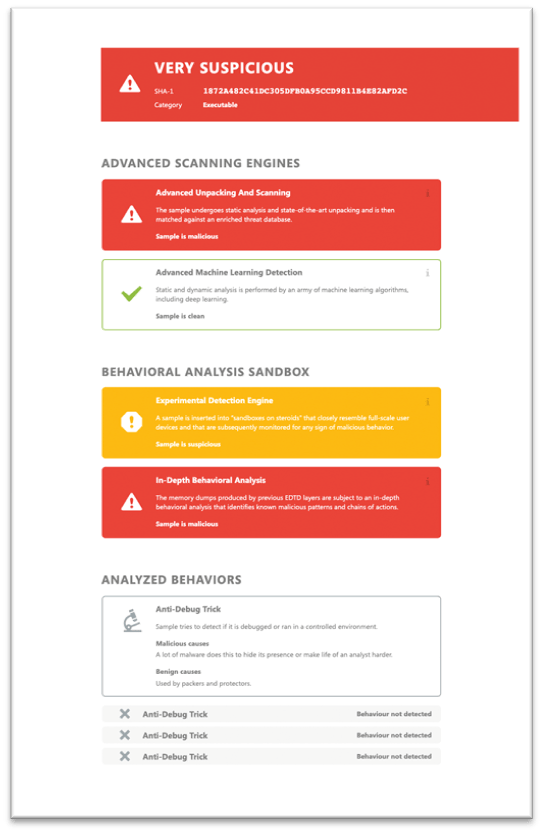
ESET Dynamic Threat Defense analysis results report
If a file turns out to be malicious, it is blocked for all machines in that company, as well as for ESET customers that participate in ESET LiveGrid®. If a file is evaluated as suspicious, it is blocked on all machines within the user’s organization, depending on the threshold set by the IT admins.

Typically, EDTD is used to scan suspicious files downloaded by browsers and email clients, as well as those stored in cloud services like OneDrive, Teams groups, and SharePoint sites via ESET Cloud Office Security.

Learn about EDTD’s privacy policy for submitting files

Employees who are on the move and not connected to the corporate network via a virtual private network (VPN) can also be protected with EDTD because it is available as a service over the internet. In the case of any detections, other employees’ machines can still be informed of the detections and receive protection against the same threats. Once traveling employees return to the corporate network or connect to it via a VPN, any EDTD metadata is synchronized, and the list of submitted files is updated for IT admins to view.

Although endpoint products such as ESET Endpoint Security minimize the probability of a successful attack, especially ransomware, this may not be enough for organizations that are looking for the best protection available. This is especially a concern now with destructive threats like data wipers continuing to emerge in Ukraine. The addition of EDTD reduces the risk factor to as close to zero as state-of-the-art technology can achieve.

In response to the heightened cyberthreat environment, ESET is now offering increased protection to all existing and new customers of ESET PROTECT Cloud. A 90-day trial of EDTD can be enabled with just one click in the ESET PROTECT Cloud management console, in the “ESET Solutions” section of the main menu.

About Version 2 Limited
Version 2 Digital is one of the most dynamic IT companies in Asia. The company distributes a wide range of IT products across various areas including cyber security, cloud, data protection, end points, infrastructures, system monitoring, storage, networking, business productivity and communication products.

Through an extensive network of channels, point of sales, resellers, and partnership companies, Version 2 offers quality products and services which are highly acclaimed in the market. Its customers cover a wide spectrum which include Global 1000 enterprises, regional listed companies, different vertical industries, public utilities, Government, a vast number of successful SMEs, and consumers in various Asian cities.

About ESET
For 30 years, ESET® has been developing industry-leading IT security software and services for businesses and consumers worldwide. With solutions ranging from endpoint security to encryption and two-factor authentication, ESET’s high-performing, easy-to-use products give individuals and businesses the peace of mind to enjoy the full potential of their technology. ESET unobtrusively protects and monitors 24/7, updating defenses in real time to keep users safe and businesses running without interruption. Evolving threats require an evolving IT security company. Backed by R&D facilities worldwide, ESET became the first IT security company to earn 100 Virus Bulletin VB100 awards, identifying every single “in-the-wild” malware without interruption since 2003.

CyberLink’s FaceMe® Achieves Perfect Score in iBeta’s Advanced Level 2 Anti-Spoofing Test and Complies with ISO 30107-3

A 100% spoofing-prevention rate for both 3D printed and resin facial masks, confirms FaceMe® as a leading facial recognition solution for preventing biometric fraud in remote applications, such as online banking, requiring identity verification before granting access to sensitive data or valuable assets.

TAIPEI, TAIWAN — March 22, 2022—CyberLink Corp. (5203.TW), a pioneer in AI and facial recognition, announced today its FaceMe® facial recognition solution achieved a perfect score in iBeta’s Presentation Attack Detection (PAD) Level 2 test, indicating its compliance with the ISO 30107-3 testing and reporting requirements. This distinction requires protection from higher-level fraud attacks with 3D masks, and FaceMe® achieved a perfect score at 100% spoofing prevention, solidifying its position as a leading facial recognition tool for combatting biometric fraud.

iBeta is one of the world’s few agencies accredited by US National Institute of Standards and Technology National Voluntary Laboratory Accreditation Program (NIST NVLAP) for biometric testing. iBeta’s PAD test is an international benchmark for spoofing tests as it confirms to ISO-IEC 30107-3, an industrial standard for facial recognition technology’s anti-spoofing capability.

FaceMe® achieved iBeta’s PAD test level 1 compliance in late 2021, which focuses on presentations from 2D photos and videos. The level 2 test uses more sophisticated presentation attacks from 3D masks, such as 3D printed masks, resin masks, or latex masks. FaceMe® has achieved an Attack Presentation Classification Error Rate (APCER) of 0%, meaning the technology is extremely reliable in preventing attacks from any form of 3D masks. In addition, the Bona Fide Presentation Classification Error Rate (BPCER) is as low as 1.5% on iOS devices and 2.5% on Android device. In other words, FaceMe® achieved respective success rates of 98.5% and 97.5% when the test subject was a real person, placing it among the top facial recognition solutions for preventing biometric fraud attempts from a variety of techniques. Robust anti-spoofing is necessary to validate users’ identity for remote applications such as online banking, shopping for age-restricted products or even logging to the intranet at work.

“Biometric fraud prevention is one of the most critical imperatives for sectors of the economy such as fintech, where a security breach can take catastrophic proportions, but also wherever users are demanding remote access to sensitive data, fueling an explosive demand for remote authentication,” said Dr. Jau Huang, CEO of CyberLink. “The iBeta PAD test is widely recognized as the global standard for testing the spoofing prevention performance of facial recognition technology offerings. Our perfect score at iBeta’s Level 2 test, which attests of its compliance with the ISO 30107-3 testing and reporting requirements, anchors FaceMe® as one of the very best facial recognition solutions to protect access from biometric fraud, even when presented with the most sophisticated attacks from 3D masks.”

FaceMe® is optimized to run across hardware configurations, from high-end workstations to low-power chipsets frequently used in IoT and AIoT devices. It is the most versatile and adaptable facial recognition offering on the market today. FaceMe® provides solution builders and system integrators a fast, reliable, precise, and flexible facial recognition technology that can be deployed across multiple scenarios including security, access control, public safety, fintech, smart retail and home protection.

CyberLink FaceMe® iBeta Presentation Attack Detection Report:

Click to access 220304-CyberLink-PAD-Level-2-Confirmation-Letter.pdf

About Version 2 Limited
Version 2 Digital is one of the most dynamic IT companies in Asia. The company distributes a wide range of IT products across various areas including cyber security, cloud, data protection, end points, infrastructures, system monitoring, storage, networking, business productivity and communication products.

Through an extensive network of channels, point of sales, resellers, and partnership companies, Version 2 offers quality products and services which are highly acclaimed in the market. Its customers cover a wide spectrum which include Global 1000 enterprises, regional listed companies, different vertical industries, public utilities, Government, a vast number of successful SMEs, and consumers in various Asian cities.

About CyberLink
Founded in 1996, CyberLink Corp. (5203.TW) is the world leader in multimedia software and AI facial recognition technology. CyberLink addresses the demands of consumer, commercial and education markets through a wide range of solutions, covering digital content creation, multimedia playback, video conferencing, live casting, mobile applications and AI facial recognition.  CyberLink has shipped several hundred million copies of its multimedia software and apps, including the award-winning PowerDirector, PhotoDirector, and PowerDVD.  With years of research in the fields of artificial intelligence and facial recognition, CyberLink has developed the FaceMe® Facial Recognition Engine. Powered by deep learning algorithms, FaceMe® delivers the reliable, high-precision, and real-time facial recognition that is critical to AIoT applications such as smart retail, smart security, and surveillance, smart city and smart home. For more information about CyberLink, please visit the official website at www.cyberlink.com

Password Reuse: Understand the Risks of this Practice

Password reuse is one of the main reasons why passwords have been questioned as an effective measure to guarantee protection against intrusion into accounts and systems. 

This practice is extremely risky as it allows a malicious agent to have access to numerous accounts with a single string of characters, being able to steal confidential and valuable data, in addition to extorting a common user.

This type of problem can be especially devastating for organizations, which deal with a variety of information every day and can respond to legal proceedings if they do not comply with legislation such as the LGPD, which determines how the personal data of their customers, employees, and suppliers should be handled.


Check out some alarming statistics on password reuse:

  • According to a survey carried out by Google, at least 65% of people have the habit of using the same password for different services;
  • According to information provided by Microsoft, 44 million is the number of accounts vulnerable to hacking due to theft and compromise of passwords;
  • 76% of millennials put their accounts at risk through password reuse, according to Security.org;
  • The Verizon Data Breach Investigations Report points out that password reuse is the reason behind 81% of hacking attacks.

In this article, we show you what you need to know about password reuse. Our content covers the following topics:

  • Why is the Habit of Reusing Passwords so Common?
  • Password Reuse: What is the Problem with this Practice?
  • What Are the Most Common Types of Password-Related Attacks?
  • Three Tips for Having Strong Passwords and Managing Them Securely
  • Multifactor Authentication and Two-Step Verification: How Important Are They?

Read it until the end!

Why is the Habit of Reusing Passwords so Common?

People daily connect to different websites, services, and social media that require passwords to access them. The main problem is that it is difficult to memorize dozens of passwords, especially complex ones, which are the most suitable for guaranteeing the cybersecurity of people and organizations.

Thus, it is common for people to use the same password on all their accounts, or to make small changes to differentiate the codes to be used.

But don’t worry: in the next topics, we will bring solutions to this problem, such as password managers and multifactor authentication. 

Password Reuse: What is the Problem with this Practice?

Password reuse is a risky practice for many reasons. Here are some problems caused by this habit: 

  • Multiple Accounts Can Be Compromised

Reusing passwords makes it possible for a malicious agent to hack into an account to have access to others belonging to the same user. And the more a password is reused, the greater the risk of having the credentials breached.

In 2021, Facebook suffered a hack, which affected about 20% of its accounts, leaking data from 533 million people. This means that if your bank password is the same used on this social network, for example, it will also become vulnerable.

  • It Puts Corporate Accounts at Risk

When an employee has no real sense of how much a cyber-invasion can harm the company they work for and how password reuse is associated with it, the organization is at serious risk.

This is because in addition to stealing personal data from this professional, malicious agents are able to gain access to the company’s accounts, causing great inconvenience, losses, and compromising business continuity.

For this reason, we always recommend that organizations promote cyber awareness among their employees and train them to deal with threats. One of the mandatory subjects in these pieces of training is precisely the risks involved in password reuse

Accounts become more vulnerable to brute force attacks and password cracking, and the more credentials a malicious actor has access to, the greater their power when it comes to brute force techniques.

And with more and more people trying to protect their accounts with weak and repeated passwords, it has become easier for hackers to gain access through brute force.

Also, with each intrusion, they expand their database, as they increasingly identify complex passwords they can use in future attacks.

The Consequences of Phishing Attacks Are More Severe

Phishing attacks are a means used by hackers to gain access to people’s data. Generally, it works like this: attackers send an alert pretending to be a trusted institution, and asking for important information, such as credit card details, full name, date of birth, and passwords. 

This message can come in several ways, including an email in which the user is instructed to access a fake website and enter the requested information. 

The victim can be instructed to update their data with the explanation that the account would have been accessed through a suspicious login, and follow the guidelines because trusts the institution associated with the message received. 

Therefore, it is possible to say that password reuse can aggravate the consequences of phishing attacks, since the user will have more accounts exposed. 

About Version 2 Limited
Version 2 Digital is one of the most dynamic IT companies in Asia. The company distributes a wide range of IT products across various areas including cyber security, cloud, data protection, end points, infrastructures, system monitoring, storage, networking, business productivity and communication products.

Through an extensive network of channels, point of sales, resellers, and partnership companies, Version 2 offers quality products and services which are highly acclaimed in the market. Its customers cover a wide spectrum which include Global 1000 enterprises, regional listed companies, different vertical industries, public utilities, Government, a vast number of successful SMEs, and consumers in various Asian cities.

About Segura®
Segura® strive to ensure the sovereignty of companies over actions and privileged information. To this end, we work against data theft through traceability of administrator actions on networks, servers, databases and a multitude of devices. In addition, we pursue compliance with auditing requirements and the most demanding standards, including PCI DSS, Sarbanes-Oxley, ISO 27001 and HIPAA.

CyberLink’s FaceMe® Achieves Perfect Score in iBeta’s Advanced Level 2 Anti-Spoofing Test and Complies with ISO 30107-3

TAIPEI, TAIWAN — March 16, 2022 — CyberLink Corp. (5203.TW), a pioneer in multimedia and AI technologies, announced today Dr. Jau Haung, its founder and CEO, has been invited to speak at NVIDIA’s GPU Technology Conference 2022 (GTC). Dr. Huang will address the role of AI in helping content creators enhance productivity and improve quality when making engaging, professional videos. The presentation will take place virtually on Thursday, March 24 at 11 a.m. CST (Wednesday, March 23 at 11 p.m. ET/8 p.m. PT).

GTC is a global AI conference held every half year, bringing together hundreds of developers who share the latest trends and applications for AI, computer graphics, data science, and machine learning.

At GTC 2022, Dr. Huang will share how CyberLink utilizes AI-powered tools in PowerDirector, its flagship video editing software, for features such as AI style transfer, sky replacement, motion tracking, and a series of enhancer tools. CyberLink first introduced its video editing software in 2001 and closely followed rising trends for more than two decades – from SD and HD to VR and 4K, from optical discs and files to online and streaming media – before deploying AI for editing in 2020.

“Artificial intelligence changes every aspect of life, from industrial-level image recognition to video analytics, security, autonomous vehicles and digital content creation,” said Dr. Jau Huang, CEO of CyberLink. “As the world-leading AI and multimedia software developer, we use AI extensively in our FaceMe® facial recognition solution as well as our creative software and apps, such as PowerDirector. It is CyberLink’s mission to help video creators at all levels achieve image and audio superiority, allowing them to create something extraordinary no matter their skill level.”

In the past, the use of motion tracking or motion masks was a labor-intensive and time-consuming undertaking reserved to professional creators. With the help of AI technology, PowerDirector delivers fast, accurate motion tracking – with just a few clicks, making this powerful tool accessible to every creator and for all creations, ultimately raising standards across all video productions.

In the same vein, AI brings some of the most sophisticated special effects to novice creators while cutting down dramatically the time spent by industry professionals. For example, PowerDirector’s sky replacement feature uses AI to precisely segment the sky in a video sequence and replace it with footage of sky conditions that better match the desired effect or visual aesthetics. This feature has the power to transform the atmosphere of a scene in a few clicks. From a practical aspect, it enables outdoor filming in a much wider range of sky conditions, eliminating costly interruption from changing weather or simply waiting for the right time between sunrise and sunset.

To learn more about PowerDirector, visit CyberLink online at http://www.cyberlink.com, or sign-up for CyberLink’s track at GTC 2022.

CyberLink @ GTC 2022 Information

  • Topic: AI-powered Video Editing for Creators at All Levels [S41616]
  • Speaker: Dr. Jau Huang, Founder and CEO of CyberLink
  • Time:
    • Thursday, March 24 11:00AM – 11:25AM (CST, Taiwan)
    • Wednesday, March 23 11:00PM – 11:25PM (EDT, New York)
    • Wednesday, March 23 8:00PM – 8:25PM (PDT, Los Angeles)
  • GTC 2022 Official Website: https://www.nvidia.com/gtc
  • Sing up for CyberLink Track

About Version 2 Limited
Version 2 Digital is one of the most dynamic IT companies in Asia. The company distributes a wide range of IT products across various areas including cyber security, cloud, data protection, end points, infrastructures, system monitoring, storage, networking, business productivity and communication products.

Through an extensive network of channels, point of sales, resellers, and partnership companies, Version 2 offers quality products and services which are highly acclaimed in the market. Its customers cover a wide spectrum which include Global 1000 enterprises, regional listed companies, different vertical industries, public utilities, Government, a vast number of successful SMEs, and consumers in various Asian cities.

About CyberLink
Founded in 1996, CyberLink Corp. (5203.TW) is the world leader in multimedia software and AI facial recognition technology. CyberLink addresses the demands of consumer, commercial and education markets through a wide range of solutions, covering digital content creation, multimedia playback, video conferencing, live casting, mobile applications and AI facial recognition.  CyberLink has shipped several hundred million copies of its multimedia software and apps, including the award-winning PowerDirector, PhotoDirector, and PowerDVD.  With years of research in the fields of artificial intelligence and facial recognition, CyberLink has developed the FaceMe® Facial Recognition Engine. Powered by deep learning algorithms, FaceMe® delivers the reliable, high-precision, and real-time facial recognition that is critical to AIoT applications such as smart retail, smart security, and surveillance, smart city and smart home. For more information about CyberLink, please visit the official website at www.cyberlink.com